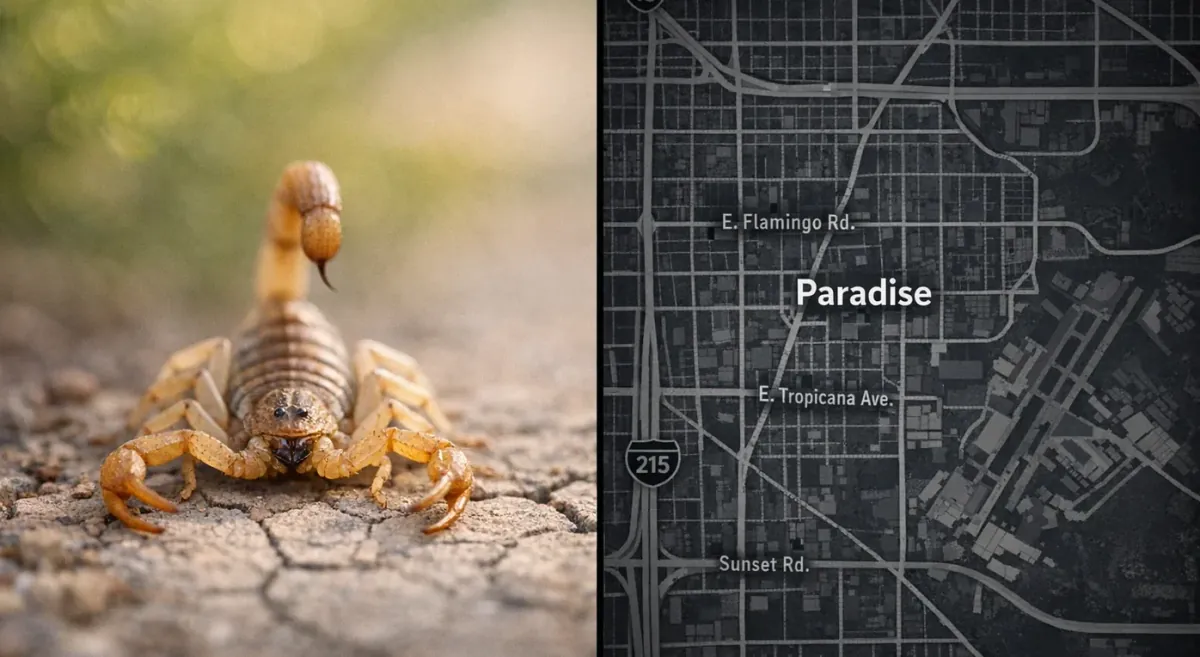
Are scorpions common in Paradise—and in Nevada overall?
Yes—scorpions live throughout Nevada, and the Las Vegas Valley (including Paradise) sits squarely in bark scorpion territory. Finding one indoors is unsettling, but it isn't rare or a sign your home is uniquely infested. It usually means a scorpion followed the desert edge right up to your foundation and slipped through a gap.
Nevada doesn't have Arizona's fearsome reputation, but southern Nevada shares the same warm, dry desert conditions bark scorpions thrive in. This is manageable, and understanding what's going on is the first step.
What does "scorpions in Nevada" actually mean for Las Vegas-area homeowners?
Scorpions are spread widely across the state, but household encounters cluster where new development meets open desert—and that describes much of Clark County. As neighborhoods push into former desert, scorpions don't leave. They shelter in block walls, landscaping, and foundations, then explore homes at night.
US poison-center data logged roughly 707 scorpion exposures a year in Nevada between 2005 and 2015, and follow-up analysis shows growing counts specifically in Clark County (Kang & Brooks 2017). Nevada isn't as famous as Arizona—but a scorpion indoors here is completely plausible.
Is Paradise a hotspot or just a few random sightings?
Paradise has an established bark scorpion presence, not a stray one-off. Community naturalists have logged dozens of verified scorpion observations within about 30 km of Paradise, spanning 2002 through 2026, with sightings recorded recently. That kind of sustained record over more than two decades signals a resident population—these scorpions live here year after year, not just passing through.
Where do people in Paradise usually see scorpions first?
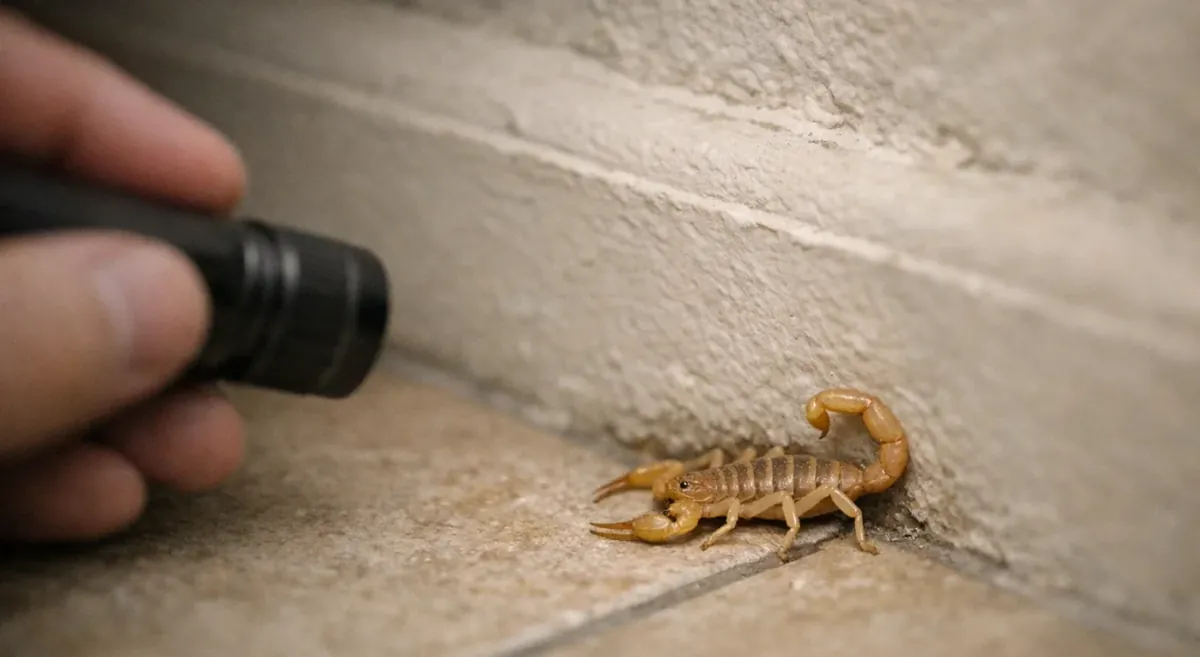
Most first sightings happen along edges and in cool, humid rooms. Scorpions are thigmotactic—they navigate by hugging surfaces, so they travel baseboards, wall bases, and furniture edges rather than crossing open floor. That's why corners and walls are your key sightlines. The top four spots to check:
- Garage—a common entry point from the exterior perimeter.
- Bathroom—cool tile and moisture near pipes.
- Laundry room—warmth, dark corners, and water.
- Patio thresholds and door sweeps—the last gap before indoors.
Which scorpions live in Nevada—and is the bark scorpion in Paradise?
Nevada is home to several scorpion species, including the large desert hairy scorpion and the Arizona bark scorpion. For southern Nevada homeowners, the bark scorpion (Centruroides sculpturatus) is the one that matters most medically.
Is the Arizona bark scorpion found in Nevada?
Yes. The Arizona bark scorpion has an established presence in southern Nevada, including the Las Vegas Valley and Paradise. Its range has expanded into parts of Nevada, California, and other Southwest states in recent decades (Skolnik & Ewald 2013). It matters because it's the only scorpion in the region whose sting can cause serious systemic symptoms, especially in children.
How can I tell a bark scorpion from other Nevada scorpions?
Use a quick build-based checklist. A bark scorpion is:
- Slender—a lean, narrow body.
- Thin-pincered—delicate, elongated claws.
- Thin-tailed—a slim tail, not thick.
- Pale tan or yellow—a light, uniform color.
Contrast that with the desert hairy scorpion, which is much bulkier, darker, and noticeably hairy-looking. Phone photos can mislead—lighting and angle can distort size and color—so focus on overall build rather than one blurry close-up.
Do Nevada scorpions glow under blacklight?
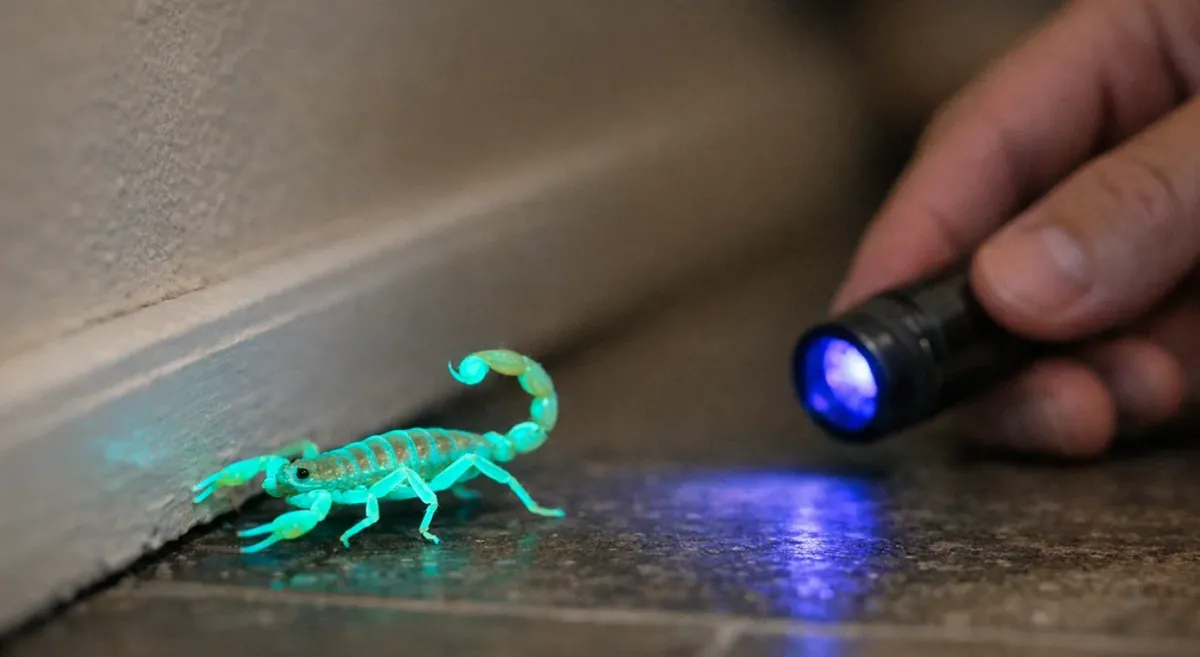
Yes—all scorpions fluoresce a bright greenish-blue under ultraviolet light, thanks to compounds in their exoskeleton. A targeted nighttime UV sweep is an effective confirmation step: switch off the lights, run a UV flashlight along baseboards and corners, and a hidden scorpion lights up. Scorpion Alert's Detectors use 365nm UV—the wavelength that produces the strongest glow—to spot scorpions the same way, automatically, while you sleep.
Can bark scorpions in Nevada climb walls and get into bedrooms?
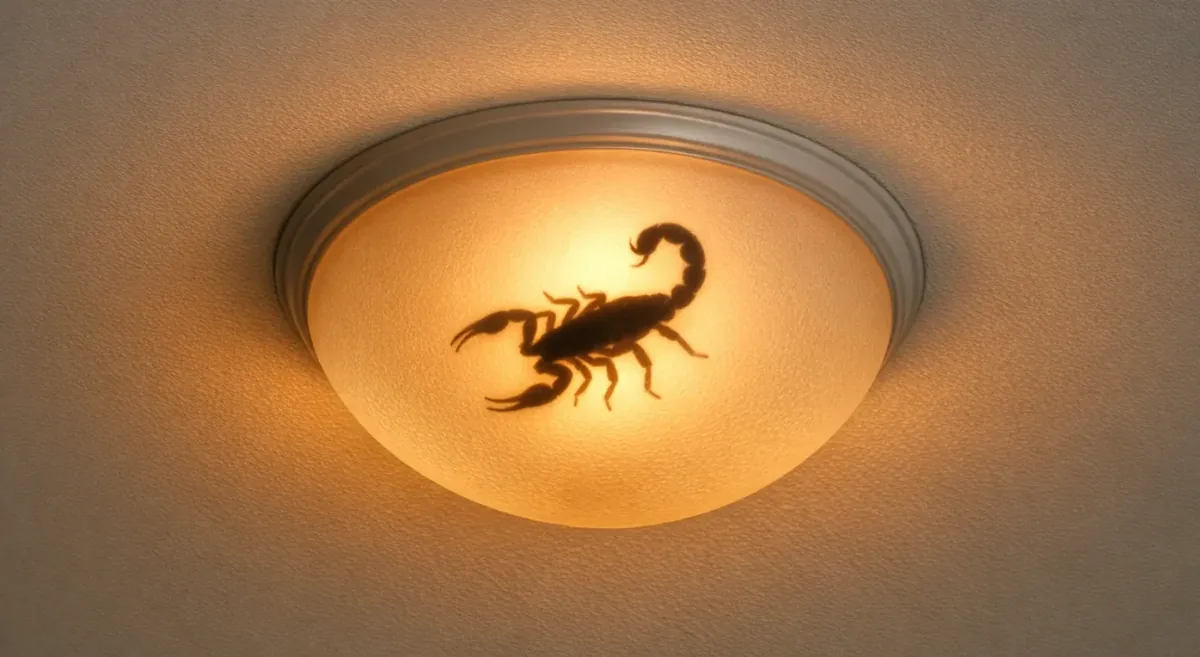
Yes, bark scorpions are strong climbers and can scale walls and vertical surfaces, which is how they reach beds and end up in bedrooms and bathrooms. In Arizona sting data, most in-bed stings happened while the person was asleep—often from a scorpion that climbed the bed skirt. A few simple habits reduce that risk:
- Pull the bed away from the wall and skip a floor-length bed skirt.
- Keep floor clutter and shoes off the bedroom floor.
- Do a quick bed and bedding check before climbing in.
When is scorpion season in Paradise, Nevada (and what triggers activity spikes)?
Scorpion season in Paradise runs roughly May through September, peaking in the hottest months. Activity is highest after dark in summer, so that's when both encounters and stings climb.
What months are scorpions most active in Paradise?
Expect the most activity from about May to September, with the peak in the hottest stretch of summer. Scorpions are nocturnal—they emerge after sunset to hunt and explore. Think of the year in three phases:
- Spring (pre-season): seal gaps and clear yard shelter before activity ramps up.
- Summer (peak): keep monitoring in place—this is the highest-risk encounter season.
- Fall (reset): re-check seals and gaps as activity winds down.
Summer heat drives scorpions to seek cooler shelter indoors, which is why warm months bring the most household traffic.
Why do I see scorpions at night (and after storms or humidity changes)?
Scorpions hunt after dark and shelter from daytime heat, so nighttime is when they move along your walls and floors. Humidity shifts and warm summer evenings can nudge more of them into the open. Picture flipping on the bathroom light at 2 a.m. and spotting one on the tile—that's peak-season timing in action. Few families can run nightly blacklight patrols, which is why a low-effort monitoring plan matters most in summer.
If I saw one scorpion this week, does it mean there are more?
Often, yes. One scorpion indoors usually means suitable prey and shelter are nearby, and that a travel path from outside exists. A sighting on the property is actually the strongest predictor of a future sting—81.8% of households where someone was stung had previously seen scorpions there (Skolnik & Ewald 2018). A calm 7–10 day plan: confirm with a UV sweep, reduce clutter, add monitoring in key rooms, then reassess.
How dangerous are scorpion stings in Nevada—and when should I worry?
Most bark scorpion stings cause intense local pain but resolve without serious complications. The real concern is systemic symptoms, which are more likely in small children. Knowing the difference lets you respond calmly instead of panicking.
What does a bark scorpion sting feel like?
A bark scorpion sting typically causes immediate burning pain, then tingling and numbness spreading from the site. In one Arizona cohort, pain occurred in 88.9% of stings and local numbness in 62.2% (Klotz et al. 2021). Those are common and scary but usually not dangerous. True red flags are different: trouble breathing, severe muscle twitching or jerking, difficulty swallowing, and roving or blurred vision. For a step-by-step response, see our bark scorpion sting first-aid guide.
Who's most at risk in Paradise homes (kids, older adults, pets)?
Young children face the highest risk of severe reactions, followed by older adults and small pets. A household plan helps: nighttime footwear rules, a quick bed check before sleep, and keeping floors clear so a scorpion can't hide near feet. Our post on why children are more at risk from scorpion stings goes deeper.
What number should I call for help after a sting?
Call Poison Control at 1-800-222-1222—it's free, staffed 24/7, and can guide you through what to do. The simple rule: call Poison Control anytime you're unsure, and seek emergency care for severe or systemic symptoms, especially in a young child.
How do I keep scorpions out of my Paradise home—and detect them before someone gets stung?
Effective control is layered: reduce outdoor shelter and moisture, seal entry gaps, cut indoor harborage, and monitor the perimeter travel lanes where scorpions actually move. No single step does it all, but together they shrink both the population and your odds of a surprise encounter.
What's the fastest way to confirm you have scorpions indoors?
Run one targeted nighttime UV sweep along baseboards and corners, and photograph anything that glows. That confirms presence quickly. Repeated manual patrols get old fast, though—most families won't keep them up night after night. Passive overnight monitoring is more sustainable, watching the same travel lanes automatically while you sleep.
What should I change outside first in Paradise (so scorpions stop showing up)?
Start in the yard, where the population lives. Top priorities:
- Remove shelter near the foundation—rock piles, wood, debris, and clutter.
- Fix moisture from irrigation leaks and drips that draw prey insects.
- Trim vegetation and branches touching exterior walls.
- Reduce bright insect-attracting lights near doors.
For a deeper look at what pulls them in, see the top things that attract scorpions.
What should I seal first to reduce indoor sightings?
Close the gaps scorpions squeeze through. A quick exclusion checklist:
- Install tight door sweeps on exterior and garage doors.
- Seal the garage threshold and refresh weatherstripping.
- Fill pipe and wire penetrations through walls.
- Close window gaps and weep areas.
Re-check these during peak summer, since seals settle and shift. For more, see the top ways scorpions get into your home and our full guide to keeping scorpions out of your house. And if you do spot one, know what not to do after spotting a scorpion.
Where should I place scorpion monitors in a Paradise house for the quickest answers?
Place monitors along perimeter travel lanes and in high-risk rooms. That means the garage entry, near exterior doors, bathrooms and laundry rooms close to water, and bedrooms or playrooms. Scorpion Alert Detectors plug into standard wall outlets on the room perimeter—right where scorpions travel—and activate automatically when the room darkens.
Can Scorpion Alert help with overnight monitoring in Nevada homes?
Yes. For homeowners dealing with scorpions in Paradise, Nevada, Scorpion Alert Detectors offer a practical overnight solution. Each unit plugs into a standard outlet and shines 365nm UV onto the floor, making any scorpion glow bright enough for the camera to catch. In a dark room, each Detector captures frames twice per second and sends a photo-verified alert with an AI confidence score straight to your phone—via push notification, plus optional SMS. The app shows a live feed and a history of past detections with date, time, and location. Detectors come as part of a monthly rental subscription with no long-term contract. Check current rental rates on our pricing page.
In Paradise, Nevada, scorpion season means checking baseboards, entry points, and dark corners—especially at night when they’re most active—and using UV light to spot their natural glow before a sting becomes a problem for kids or pets. If you want help staying ahead of that routine, Scorpion Alert adds 24/7 AI + UV monitoring so you can catch activity early and focus on targeted control.