How fast can a scorpion run, really?
Most scorpions you'll see indoors move in quick bursts of a few feet per second, then stop dead. They don't sprint long distances. What looks like blazing speed is really a low, flat body skittering across smooth tile, paired with sudden starts and freezes that catch your eye. True measured speed varies widely by species, temperature, and surface.
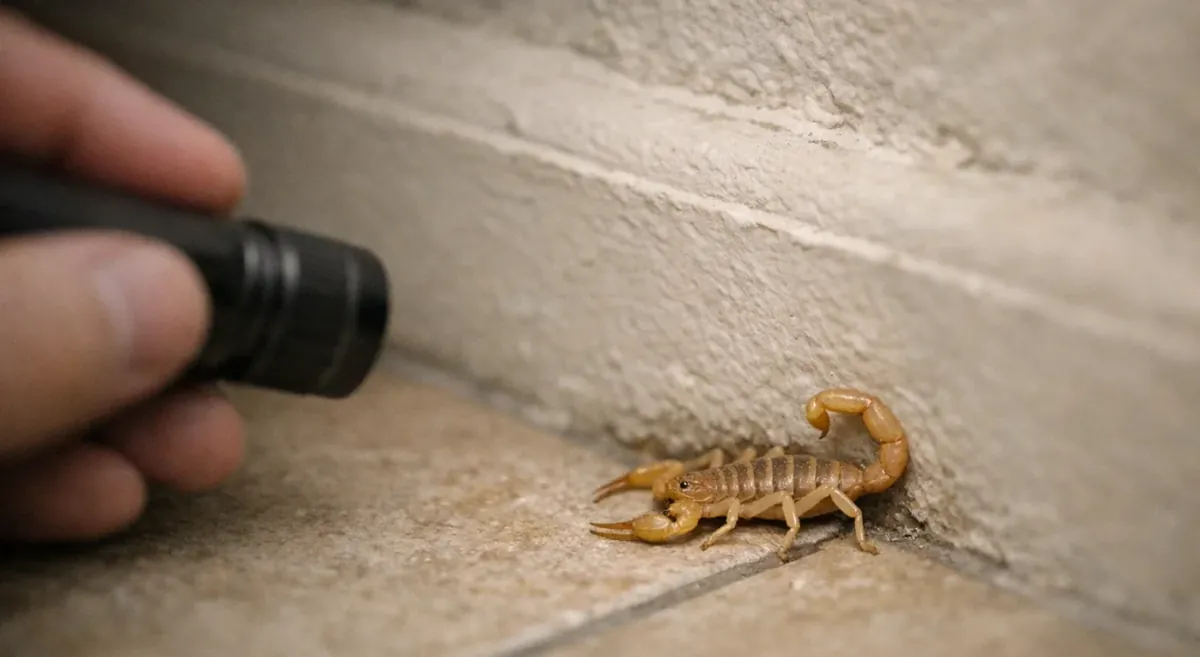
Picture this: you flip on the kitchen light and a dark shape darts under the stove before you can react. Your brain registers "fast," but the scorpion only covered a couple of feet. Those short legs and that close-to-the-ground crouch make even a slow crawl look like a dash—especially on slick flooring, where there's little to slow it down.
Is the "12 mph scorpion" claim true?
The viral "12 mph" scorpion speed figure is almost certainly exaggerated, and it gets repeated online without a clear, credible source. No widely cited study pins a reliable top speed of 12 mph on common Southwest scorpions. It's a number that spreads on social media and park posts, not a measured lab result.
Why does it stick around? It's catchy, and it matches how fast a scorpion feels when one bolts across your floor. A more realistic picture separates burst speed from sustained movement. A scorpion may lunge quickly for a second or two when fleeing or grabbing prey, but it can't hold that pace. Sustained roaming is a slow, deliberate crawl along edges.
Why bark scorpion running looks different than bigger desert species
The Arizona bark scorpion (Centruroides sculpturatus) is small, light, and remarkably agile. Its movement tends to be bursty and jerky, hugging walls and baseboards rather than crossing open ground. Bigger, heavier desert species like the giant hairy scorpion move with a steadier, more lumbering gait.
That's why a bark scorpion can look "sprinter-fast" even when its actual speed isn't extreme. A tiny body covering a foot in a flash reads as lightning-quick. The same distance crossed by a chunky desert scorpion looks slow and clumsy by comparison, even if their top speeds aren't far apart.
What makes scorpions run faster or slower?
Temperature is the biggest factor. Scorpions are cold-blooded, so warm nights speed them up and cool nights slow them way down. Surface matters too. Smooth indoor tile offers almost no resistance, so a scorpion can glide; rough desert ground or a block wall slows and steadies them.
Intent plays a role, too. A hunting scorpion moves in slow, exploratory steps. A fleeing one that feels threatened fires off those quick bursts. Knowing the difference helps you read what you're seeing—which brings up the bigger question: why do scorpions run at all instead of stinging?
Why do scorpions run instead of sting (and when will they sting)?
Scorpions run because fleeing is usually safer than fighting. A sting is a last resort they save for when escape isn't possible. They're far more likely to sting when cornered, handled, pinned under an object, or stepped on. Given an open path, most scorpions choose to flee toward the nearest dark cover.
This is why barefoot pursuit and bare-handed grabbing are the riskiest things you can do. For the full list of mistakes to avoid, see our guide on what not to do after spotting a scorpion in your home.
What does a raised tail mean when a scorpion is running?
A tail arched up and over the body signals a scorpion that's ready to defend itself. When you see the tail held high, pincers spread open, and an abrupt stop-and-turn toward whatever spooked it, those cues mean strike readiness. A scorpion in that posture isn't trying to flee anymore; it's standing its ground.
A scorpion moving with its tail low and flat, on the other hand, is usually just trying to get somewhere. The shift from a low tail to a raised, curled one is your warning to back off and switch to a safe capture method.
Do scorpions chase people?
No, scorpions don't chase people. What looks like chasing is almost always the scorpion bolting toward cover, and sometimes that cover happens to be in your direction. They're aiming for the shadow under your foot or the dark gap behind you, not for you.
It feels personal in the moment. It isn't. Give the scorpion a clear escape route away from bedrooms and appliances, and it'll take it.
How nocturnal scorpion behavior affects what you see at night
Running sightings spike at night because that's when scorpions hunt and roam. 49% of stings happen between 6 PM and midnight, according to Klotz et al. 2021 and related toxicology data, simply because that's when the animals are active and people cross paths with them. Warmer post-dusk hours mean faster movement, so a hot summer night is when you're most likely to see one truly hustle.
Why does a scorpion freeze under UV light instead of fleeing?
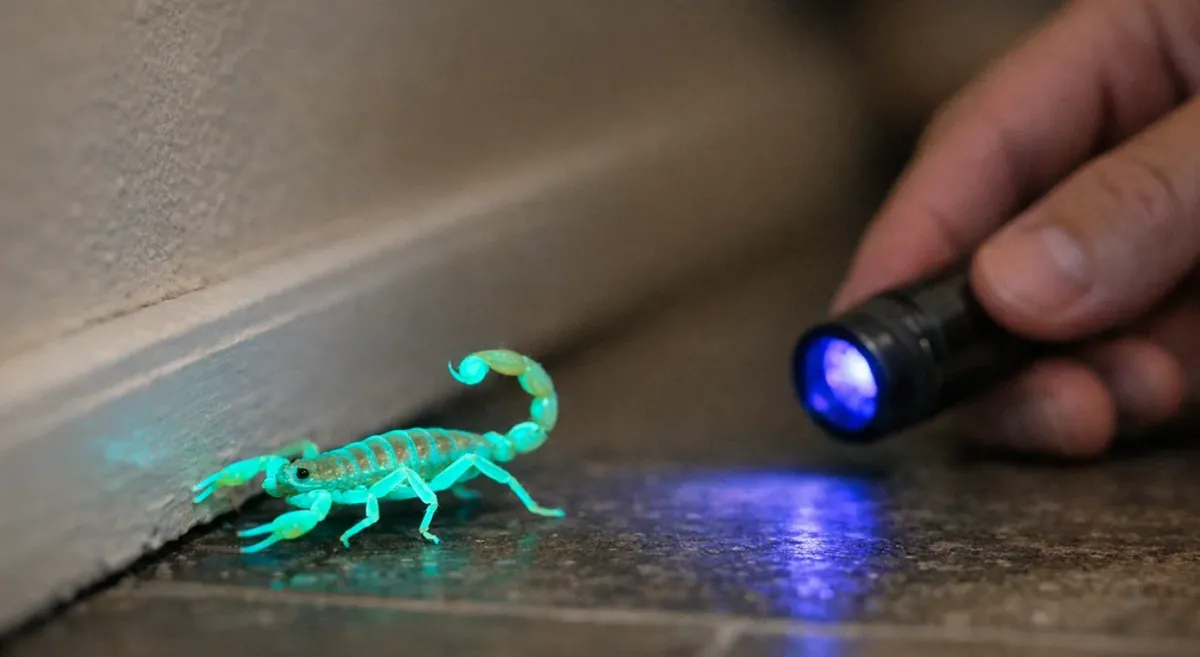
Many scorpions pause or freeze when hit with UV light rather than sprinting away. Scorpions fluoresce a bright greenish glow under UV because of compounds in their exoskeleton, and the sudden light often triggers a hold-still response instead of flight. For homeowners, that freeze is helpful: it makes a glowing scorpion much easier to spot and deal with.
It can feel eerie. You sweep a blacklight across a dark patio and a scorpion lights up like a neon sticker, sitting perfectly still. That stillness doesn't mean it's harmless or asleep. It means you've got a window to plan your next move calmly instead of chasing a moving target.
What UV light reveals (and what it doesn't)
UV fluorescence reveals scorpions on exposed surfaces, but it doesn't guarantee you've found every one. Tiny juveniles glow faintly and are easy to overlook. Scorpions tucked deep inside cracks, under kickboards, or behind furniture won't glow if the light can't reach them. A clean sweep tonight doesn't mean a clean house.
How to do a quick blacklight sweep without getting too close
Keep a safe distance and let the light do the work. A simple routine looks like this:
- Start at door thresholds and baseboards, where scorpions travel along edges.
- Scan the shadowed edges of furniture, clutter piles, and appliance gaps.
- Stay several feet back and avoid leaning in over a glowing scorpion.
- Plan your capture method before you approach, never barefoot.
An alternative to manual UV walks: automated nighttime monitoring
Sweeping the house with a flashlight every night gets old fast, and you can't be awake for the hours scorpions are most active. Plug-in detection offers a set-and-forget option. Scorpion Alert Detectors plug into wall outlets along the room perimeter, shine 365nm UV light onto the floor, and scan only when the room is dark. When one spots that telltale glow, it sends a photo-verified alert to your phone, so you're not guessing.
What does it mean if I see a scorpion running inside my house?
One scorpion running indoors can mean a lone hunter wandered in by chance, or it can hint at an entry point and harborage that make repeat visits likely. The clues that tell them apart are where it was, when you saw it, and what's nearby. A single garage sighting is different from one in your bedroom at 2 a.m.
Scorpions often follow other insects inside. If you've got a lot of prey bugs, you're more attractive to them. Our breakdown of the top things that attract scorpions in your home covers this in detail.
Why scorpions hug walls and baseboards when they run indoors
Scorpions are thigmotactic, meaning they navigate by keeping their bodies against surfaces and edges. Indoors, that translates to running along baseboards, door thresholds, and the bases of walls rather than crossing open floor. Follow those travel lines and you'll find the gaps behind furniture legs, under kickboards, and along thresholds where they transition and hide.
Does one running scorpion mean an infestation?
Not necessarily, but the FEARS survey found that 81.8% of households where someone was stung had previously seen scorpions on the property, per Skolnik & Ewald 2018. A sighting is the strongest single predictor of a future sting. Use a simple test: a one-off sighting is low concern; repeated sightings, scorpions in multiple rooms, or sightings plus heavy insect activity point toward an ongoing problem.
Where to look for the next one (the "harborage triangle")
Indoor scorpions cluster where three things overlap: cool, dark cracks; a nearby water source like a bathroom or laundry room; and prey insects to eat. Check the classic gotcha spots within that triangle: shoes left on the floor, damp towels, and clutter piles in corners. Reducing any one corner of the triangle makes a room far less inviting.
What should I do if I see a scorpion running across my floor or patio?
Stay calm, keep kids and pets back, put on closed shoes, and trap the scorpion under a glass instead of stomping it barefoot or grabbing it. Then spend the next 48 hours reducing hiding spots and setting up nighttime monitoring so you'll know if more are roaming while you sleep. Most stings happen to bare feet, so shoes are your first defense.
Immediate steps (first 60 seconds)
Containment and safety come first. Move fast, but deliberately:
- Put on closed-toe shoes before you do anything else.
- Turn on every light in the room so you can see it clearly.
- Keep children and pets out of the room.
- Block escape routes toward bedrooms and under appliances.
- Trap it under a sturdy glass, slide a stiff card underneath, and release it well outside.
If you do get stung in the process, our bark scorpion sting first aid guide walks you through the first 30 minutes.
If you can't find it again, what's the smartest next move?
Lost runners are common because scorpions vanish into cracks the moment they feel exposed. Don't tear the room apart in a panic. Reduce clutter, check the adjacent harborage spots, and shift your attention to nighttime, when the scorpion will come back out to hunt. Skip the gimmick sprays, too; see our rundown of scorpion repellent myths before wasting money.
How to monitor for night roamers without obsessing
You can't stay up all night with a flashlight, and you shouldn't have to. Place detectors in high-risk rooms and near entry-adjacent areas like garages and bathrooms. Scorpion Alert can run multiple Detectors across a whole property and share alerts with family members, so everyone knows the second a glowing scorpion shows up, even at 3 a.m. To shrink the problem at the source, also review the top ways scorpions get into your home and seal those gaps.
If you’ve noticed a scorpion running, it usually means it’s actively searching for shelter, food, or a way out—so having a fast, reliable way to spot it matters. Scorpion Alert helps by using UV-aware detection and AI-enhanced images to make scorpions easier to catch before they disappear again; learn more at Scorpion Alert.