Why am I still seeing scorpions after pest control?
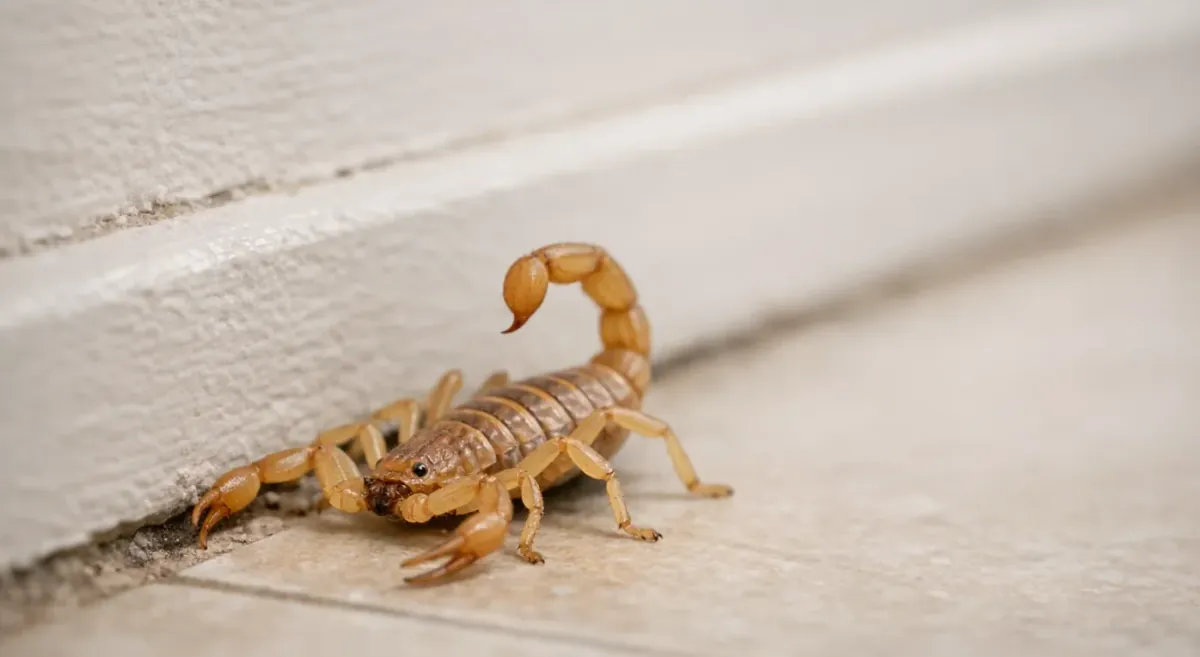
Seeing scorpions after professional treatment is common because pest control helps, but it doesn't create an impenetrable barrier — scorpions aren't like ants or roaches that die just from crossing treated surfaces. The two main failure points are: new scorpions keep entering through unsealed gaps, and scorpions already inside your home still roam at night searching for prey. Success means fewer indoor sightings, detections closer to entry points rather than bedrooms, and a downward trend over 30–60 days — not instant elimination.
Most homeowners expect pest control to work like a force field, but scorpions require a different approach. Unlike insects that readily absorb pesticides through their exoskeletons, scorpions have a waxy coating and behavior patterns that help them survive many treatments. They walk on the tips of their legs, minimizing contact with treated surfaces, and they can slow their metabolism when exposed to chemicals.
The reality is that managing scorpions takes five coordinated layers working together: reducing their food source, blocking entry points, creating exterior chemical barriers, removing any scorpions already inside, and monitoring continuously for new activity. When you rely on just one layer — even professional pest control — you're leaving gaps that scorpions will exploit.
What does "good progress" look like over 4–8 weeks?
Good progress means a measurable reduction in indoor scorpion activity, not complete elimination. Track these metrics weekly: number of indoor sightings, which rooms you're finding them in, time of night for encounters, and any "repeat offender" zones where scorpions keep appearing. A positive trend looks like fewer total sightings, encounters moving from bedrooms toward entry areas like garages, and longer gaps between incidents.
External factors can cause temporary spikes even when your plan is working. New construction disturbs scorpion habitats and sends them searching for shelter. Your neighbor's yard cleanup might push scorpions toward your property. Seasonal peaks in scorpion activity mean you'll see more movement during warm, humid months regardless of your control efforts.
Set realistic expectations: Weeks 1–2 might show little change as existing indoor scorpions keep moving. Weeks 3–4 should show declining numbers if your barriers and sealing are effective. By weeks 6–8, you should see significantly fewer indoor encounters. If you're not seeing this improvement pattern, it's time to reassess your approach or change providers.
What should I ask my pest control company (so you're not guessing)?
Get specific answers about their scorpion treatment protocol: What active ingredient are they using, and is it labeled specifically for scorpions at the concentration they're applying? Where exactly do they treat — just a quick baseboard spray inside, or a comprehensive exterior perimeter plus harborage areas like block walls, expansion joints, and landscape features? How often will they return for service in scorpion-heavy areas?
The difference between effective and ineffective scorpion control often comes down to application strategy, not chemical strength. A thorough exterior treatment that creates multiple barrier lines works better than sporadic indoor spraying. Ask if they're treating scorpion travel routes specifically: the foundation perimeter, door thresholds, weep holes, utility penetrations, and the bases of exterior walls where scorpions travel.
Consider switching companies or upgrading service if you're still seeing regular indoor scorpions after 2–3 treatment cycles. Look for providers who offer scorpion-specific services rather than generic pest control, use microencapsulated formulations that last longer in desert heat, and include exclusion recommendations as part of their service. Monthly service typically outperforms quarterly treatments in areas with heavy scorpion pressure.
Do scorpions survive spray treatments and foggers?
Yes, scorpions frequently survive common spray treatments and foggers that would kill other pests. Their unique biology — including a waxy exoskeleton, ability to slow their metabolism, and behavior patterns like walking on leg tips — allows many scorpions to endure chemical exposures long enough to reach your living spaces. This biological and behavioral mismatch with standard pest control products explains why you might find sluggish but still-moving scorpions days after treatment.
Picture this: you've just had your home professionally treated and feel confident the scorpion problem is solved. Two nights later, you spot a scorpion moving slowly across your bathroom floor. It's not your imagination — that scorpion likely contacted the pesticide but survived with enough function to keep hunting. Many products labeled for "general pests" simply aren't formulated to deliver the quick knockdown needed for scorpions.
The solution isn't stronger chemicals or more frequent applications. Instead, successful scorpion management requires understanding which application methods actually intercept scorpions (targeted perimeter barriers), which don't (whole-house fogging), and why physical exclusion plus active removal matter as much as any chemical treatment.
Why do many 'bug sprays' underperform against scorpions?
Most bug sprays use pyrethrins or synthetic pyrethroids optimized for insects, not arachnids. These chemicals attack the nervous system, but scorpions process them differently than insects do. Where a cockroach might die within minutes of crossing a treated surface, a scorpion can absorb a dose that only slows it down, leaving it impaired but mobile for hours or even days.
The practical outcome frustrates homeowners: you'll find scorpions moving sluggishly, hiding in unusual places, or acting erratically after treatment. They're poisoned but not dead, which can actually make them more dangerous. A disoriented scorpion might wander into living spaces it would normally avoid, or fail to flee when disturbed, increasing sting risk.
Safety matters more than escalation. Don't try mixing products or increasing concentrations beyond label directions — it won't solve the biological mismatch and could endanger your family. Focus instead on the other layers of protection: sealing entry routes scorpions use to enter, creating effective barriers where scorpions actually travel, and removing scorpions already inside before they can reach bedrooms.
Why do bug bombs and foggers fail so often?
Bug bombs and foggers fail against scorpions because these arachnids can dramatically slow their breathing by closing their spiracles (breathing pores) when they detect airborne toxins. While a fly or mosquito quickly absorbs lethal doses from fog, a scorpion can essentially "hold its breath" and wait out the danger, emerging hours later when the fog has settled and dissipated.
Coverage gaps compound the problem. Foggers work by filling air space, but scorpions hide in places fog doesn't reliably reach: inside wall voids, under appliances, behind stacked boxes in garages, and in cluttered storage areas. Even if some fog reaches these spots, the concentration is rarely enough to overcome a scorpion's natural defenses.
Save foggers for pests they're designed to kill — flying insects and exposed crawling bugs. For scorpions, invest in targeted approaches: exterior perimeter sprays that intercept them outside, careful sealing of entry points they use to invade, and proper removal techniques for scorpions already inside. These methods work with scorpion behavior rather than against their biology.
How can bad application make good products look useless?
Even scorpion-specific products fail when applied incorrectly. Common mistakes include wrong dilution rates (too weak won't kill, too strong doesn't last), treating too narrow an area (just interior baseboards instead of the full exterior foundation), and returning too infrequently (quarterly service in areas needing monthly attention). A product that could work becomes ineffective through poor application.
Effective scorpion treatment requires hitting their actual travel routes. This means the exterior foundation perimeter at least 3 feet up and 3 feet out, door thresholds (including garage doors), expansion joints in driveways and patios, block wall bases, and areas where utilities penetrate walls. Missing any of these zones leaves highways for scorpions to bypass your chemical barriers.
Remember that even perfect chemical application is just one layer of defense. Scorpions are remarkably persistent — some will always find ways through or around barriers. That's why sealing the entry points scorpions use, removing their prey, and monitoring for breakthrough activity are essential companions to any spray program. Chemical control buys you reduced pressure, not complete protection.
What does a 5-layer scorpion defense plan include?
A complete scorpion defense system uses five coordinated layers: reduce the insects scorpions hunt, block their entry routes into your home, create exterior chemical barriers, actively remove any scorpions already inside, and monitor continuously to catch new activity. Each layer serves a specific purpose — prey control reduces attraction, sealing blocks access, barriers intercept traveling scorpions, removal clears existing threats, and monitoring provides early warning of new invasions.
Budget constraints mean most homeowners can't implement all five layers at once. If you're prioritizing, start with sealing obvious entry points (under $50 in materials) and basic prey control through regular pest service ($30-50/month). Add exterior barriers before peak season ($200-400 for professional application), invest in tools for safe removal ($30 for UV flashlight and capture containers), then complete the system with automated monitoring ($200-300 for detector setup plus subscription).
Your order of operations matters. This week: seal door thresholds and start monthly pest control for prey reduction. Over the next 30 days: complete entry point sealing and establish exterior barriers. Within 60 days: develop a removal routine and add monitoring to protect bedrooms. This phased approach delivers quick wins while building toward comprehensive protection.
Layer 1: How do I reduce the insects that feed scorpions?
Prey control is where traditional pest control shines — not by killing scorpions directly, but by eliminating the crickets, roaches, and other insects they hunt. A scorpion enters your home following food, so reducing what attracts scorpions through consistent prey control makes your property less appealing. This indirect approach often delivers better long-term results than trying to poison scorpions themselves.
Focus exterior efforts within 10 feet of your foundation. Remove leaf litter and debris where crickets breed. Fix irrigation leaks that create moist microhabitats. Keep grass short and bushes trimmed back from walls. These habitat modifications work alongside chemical treatments to reduce insect populations near entry points.
Consistency beats intensity for prey control. Monthly service maintains constant pressure on insect populations, while quarterly treatments allow prey numbers to rebound between visits. In scorpion-heavy areas, that rebound period brings hunting scorpions back to your property. Invest in monthly service during warm months when both insects and scorpions are most active.
Layer 2: What sealing actually matters for scorpions?
Scorpions can squeeze through gaps as small as 1/16 inch — about the thickness of a credit card. Effective sealing requires meticulous attention to the specific routes scorpions use: door thresholds (including garage doors), utility penetrations where pipes and wires enter, gaps where walls meet floors or ceilings, and expansion joints in concrete. Missing even one significant gap undermines all your other efforts.
Prioritize your sealing checklist by risk and accessibility. Start with door sweeps and thresholds — these are easiest to fix and block major entry routes. Next, tackle utility penetrations using steel wool and caulk. Address garage door gaps with bottom seals and side weatherstripping. Finally, work on expansion joints and foundation cracks with appropriate sealants. Each sealed entry point is one less highway for scorpions.
Verify your sealing work weekly by checking the same hotspots. Run your hand along door bottoms, feeling for air movement. Shine a flashlight along baseboards, looking for gaps that seemed sealed but have reopened. Use tissue paper to detect drafts around utility penetrations. Small gaps you missed initially become obvious with systematic checking, and scorpions will find any gap you leave.
Layer 3: Where should an exterior chemical barrier go (and when)?
Exterior barriers work by intercepting scorpions on their predictable travel routes before they reach entry points. Apply treatments along the foundation perimeter, creating a band 3 feet up the wall and 3 feet out on the ground. Include expansion joints, the bases of block walls, door and window frames, and areas where different construction materials meet. These applications target the edges and surfaces scorpions naturally follow.
Timing matters as much as placement. In the Southwest, establish barriers by March before scorpion activity peaks. Reapply every 30–60 days during active months (April through October), and after disruptions like heavy rain or landscape work. During cooler months, you can extend to quarterly applications, but never skip entirely — scorpions remain active year-round in many areas.
Barriers reduce pressure but don't create an impenetrable shield. Some scorpions will always break through, especially during peak activity periods when no repellent or barrier is completely effective. That's why the final two layers — removal and monitoring — protect your family when barriers alone aren't enough. Think of barriers as your first line of defense, not your only one.
How do I remove scorpions already inside my house?
Scorpions already inside when you seal entry points can survive for weeks without food or water, continuing to appear in living spaces. Active removal prevents these trapped scorpions from reaching bedrooms and bathrooms where most stings occur. A systematic 15–30 minute routine focused on high-risk rooms and perimeter scanning catches scorpions before they surprise your family.
Start your search in the rooms where stings most commonly occur: bedrooms (especially children's rooms where kids are at higher risk), then bathrooms and laundry areas where moisture attracts prey, then cluttered spaces like garages and storage rooms. This prioritization protects the most vulnerable family members first.
Safety-first handling reduces sting risk dramatically. Keep children and pets in another room during removal. Never handle a scorpion with your hands, even if it appears dead — the sting reflex can persist. Have your tools ready before starting: UV flashlight, clear glass or jar, stiff cardboard, and thick gloves. Quick, confident movements are safer than hesitant attempts that give scorpions time to react.
Layer 4: How do I do a UV blacklight patrol efficiently?
Efficient UV patrol leverages scorpion behavior — they're thigmotactic, meaning they navigate by maintaining contact with surfaces. Start at room perimeters where walls meet floors, checking baseboards, corners, and edges of furniture. Scorpions glow bright green under 365-395nm UV light, making them easy to spot against most surfaces. This edge-focused approach finds 90% of scorpions in less time than random searching.
Work systematically room by room: bedrooms first, then wet areas, then living spaces, finally garages and storage. In each room, walk the perimeter slowly, holding your UV light at a low angle to cast shadows that make the glow more visible. Check inside shoes, under furniture edges, and around door frames. Don't forget closet floors and bathroom cabinets where scorpions often hide.
Consistency beats marathon sessions. A 15-minute patrol each night for two weeks after implementing other controls usually clears most interior scorpions. This is more effective than sporadic hour-long hunts. Time patrols for 9–11 PM when scorpions are most active but before you're too tired to search carefully. After the initial two-week push, you can reduce frequency unless you spot new activity.
What should I do when I find one (without getting stung)?
When you spot a scorpion, freeze first — sudden movements can trigger defensive behavior. Keep your UV light on the scorpion while you ready your capture tools. Place a clear glass or wide-mouth jar over the scorpion in one smooth motion, then slide stiff cardboard underneath. The scorpion instinctively moves up the glass walls, making it easy to flip the container upright with the cardboard as a lid.
Never assume a motionless scorpion is dead. Scorpions can remain perfectly still for hours, then sting when disturbed. Even genuinely dead scorpions can sting reflexively for hours after death — the venom delivery system works independently. Always use tools, never hands, even when a scorpion appears dead or when handling one you've already captured.
Document each capture: date, time, and specific location. Finding multiple scorpions in the same spot indicates a nearby entry point or harborage area needing attention. Release captured scorpions at least 100 feet from your home, preferably across a barrier like a wall or street. Some homeowners prefer to eliminate them, but live release away from structures is equally effective and safer than trying to kill an agitated scorpion.
How can I get 24/7 detection without nightly patrols?
Continuous monitoring solves the fundamental problem with all other scorpion control methods — scorpions move at night while you sleep, potentially traveling from entry points to bedrooms without detection. Real-time alerts let you respond immediately to remove scorpions near entry points before they penetrate deeper into living spaces. Automated detection using UV light and AI image recognition, like Scorpion Alert's system, provides round-the-clock vigilance without the exhausting routine of manual nightly patrols.
Traditional monitoring methods can't match automated systems. Sticky traps only catch scorpions that happen to walk across them, leaving most free to roam. Manual UV flashlight patrols require discipline and time every single night — miss one night and a scorpion could reach your bedroom. Automated detectors work continuously whenever rooms are dark, scanning the exact perimeter paths scorpions prefer.
This final layer complements rather than replaces the others. You still need pest control to reduce prey, sealing to block entries, barriers to intercept invaders, and removal techniques for scorpions already inside. But automated monitoring provides the early warning system that ties everything together, alerting you to breakthrough activity so you can respond before scorpions become a bedroom surprise. Scorpion Alert Detectors activate automatically when rooms darken and scan continuously throughout the night.
What does automated monitoring do differently than sticky traps?
Sticky traps suffer from fundamental limitations that automated monitoring overcomes. Dust and debris quickly coat trap surfaces, reducing effectiveness within days. Traps can paradoxically attract scorpions by catching the crickets and insects they hunt. When you do catch a scorpion, you're left handling a dangerous, angry arachnid stuck to a messy trap — risky for adults and especially dangerous if children or pets find it first.
Photo-verified alerts change the entire dynamic. Instead of finding a scorpion days later in a trap, you receive an immediate notification with a captured image and AI confidence percentage showing exactly what triggered the detection. This real-time information lets you respond while the scorpion is still near the detector, preventing it from reaching bedrooms or surprising family members.
The safety and convenience advantages multiply in homes with children or pets. No toxic substances or sticky surfaces for curious hands or paws to find. No handling of trapped, agitated scorpions. No daily trap-checking routine to maintain. Just instant alerts when action is needed, letting you sleep soundly knowing you'll be notified if a scorpion appears.
How does Scorpion Alert detect scorpions at night?
The detection system leverages two key scorpion behaviors: their strong fluorescence under UV light and their thigmotactic movement along room perimeters. Detectors plug directly into wall outlets — positioned exactly where scorpions naturally travel. Each unit shines 365nm UV light onto the floor below, creating a detection zone scorpions must cross to enter room interiors.
The specific UV wavelength matters. At 365nm, scorpions produce an intense blue-green glow easily distinguished from background surfaces. This wavelength is invisible to most people, so detectors won't disrupt sleep or create annoying purple glows in dark rooms. The system activates only in darkness when scorpions are active, conserving energy and preventing false alerts during daylight.
Technical precision ensures reliability. Each detector captures images every 500 milliseconds — about 120 photos per minute — ensuring even fast-moving scorpions get photographed multiple times. A two-stage AI process analyzes these images: first on the device itself for initial screening, then in the cloud for confirmation. This dual validation dramatically reduces false positives while maintaining sensitivity to catch every scorpion.
Where should I place detectors for the biggest payoff?
Strategic placement multiplies effectiveness. Prioritize detectors in entry-adjacent areas where scorpions first appear: near exterior doors including garage entries, along walls shared with the outside, and in rooms with plumbing that creates potential entry routes. These locations let you intercept scorpions before they spread throughout your home.
High-consequence rooms deserve protection regardless of entry proximity. Bedrooms, nurseries, and children's playrooms need coverage because that's where vulnerable family members spend time unaware. Bathrooms and laundry rooms attract scorpions seeking moisture and prey. A detector in each of these spaces provides comprehensive protection where it matters most.
Multiple detectors create overlapping coverage that scorpions can't avoid. While a single unit protects one room, scorpions entering elsewhere can still reach bedrooms undetected. Four or five Detectors cover entry points plus sleeping areas, providing early warning at entries and last-line defense at bedrooms. The system includes reliability features homeowners need: offline alerts if a detector loses connection, plus push notifications with optional SMS backup ensuring you never miss an alert.
Stop hoping your pest control service will eliminate every scorpion — it won't. Instead, build a comprehensive defense system that actually works. Start implementing the 5-layer approach today: maintain monthly pest control for prey reduction, seal entry points methodically, establish exterior barriers before peak season, develop safe removal routines, and add automated monitoring for 24/7 protection. Scorpion Alert's detection system provides the continuous vigilance that makes the whole system work, sending real-time alerts when scorpions appear so you can respond immediately. Visit ScorpionAlert.com to learn more about automated scorpion detection and stop losing sleep over scorpions in your home.
Pest control can reduce activity, but it can’t guarantee you’ll catch every scorpion—especially when they’re most active at night and can slip in between treatments. If you want a practical extra layer in your multi-layer defense, Scorpion Alert adds autonomous 24/7 monitoring with photo-verified alerts so you know when there’s actually a scorpion present. Learn how it fits alongside professional service at scorpionalert.com.