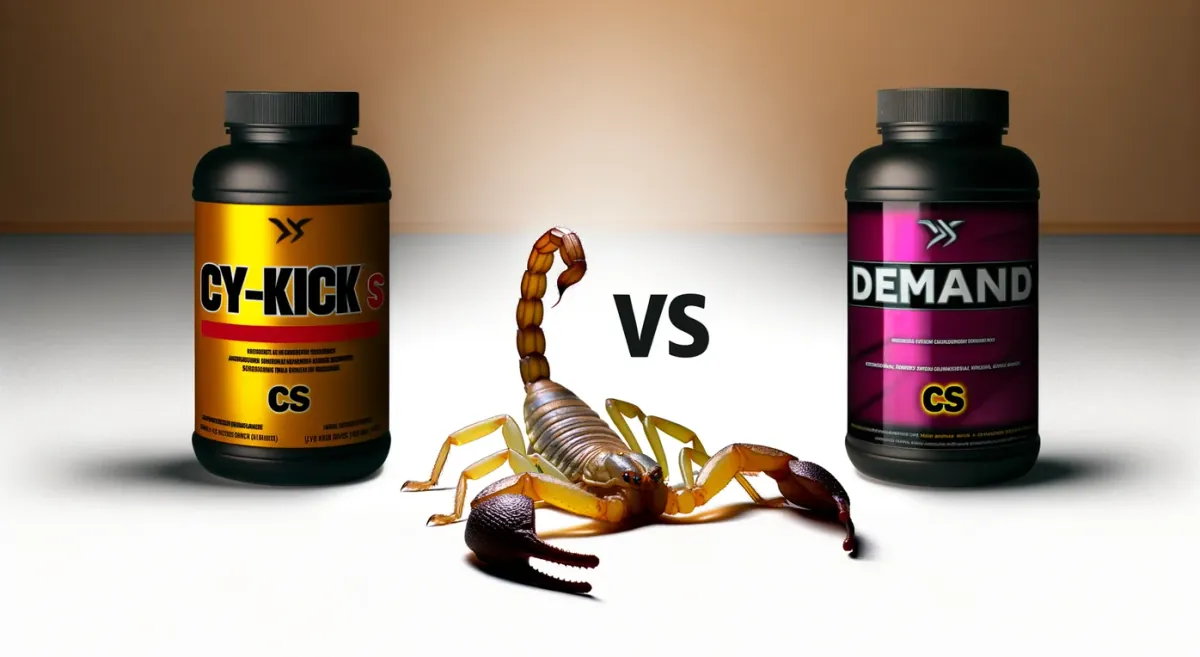
Is Cy-Kick CS or Demand CS better for scorpions?
Quick answer: Cy-Kick CS edges out Demand CS in most homeowner reviews, but both work well when applied correctly. The key is that your application technique matters more than which bottle you buy.
Both products are professional-grade microencapsulated pyrethroids — the "CS" stands for capsule suspension. They’re designed to leave tiny capsules on surfaces that transfer to scorpions as they crawl along walls and baseboards. Reddit threads and pest control forums consistently rank these two as top choices for scorpion control in Arizona's scorpion season and across the Southwest.
The key differences come down to price, longevity, and user satisfaction. Let’s break down what actually matters when you’re standing in the aisle trying to decide.
At-a-glance comparison (ingredient, residual, cost)
Here’s how they stack up side by side:
Feature Cy-Kick CS Demand CS Active Ingredient Cyfluthrin Lambda-cyhalothrin Formulation Microencapsulated Microencapsulated Typical Cost $30-60 $30-50 Claimed Residual 2-3 months ~90 days Community Rating Stronger endorsement Frequently recommended
Cy-Kick CS tends to get more enthusiastic recommendations from both homeowners and pest professionals. You’ll see comments like “Cy-Kick is the gold standard” more often than similar praise for Demand CS. That said, plenty of pest control companies successfully use Demand CS as their go-to scorpion treatment.
What "works better" actually means for scorpions
Success with scorpion control looks different than success with ants or roaches. You’re not aiming for instant knockdown — you’re playing the long game. Here’s what “working” actually means:
- Fewer scorpions inside your home over time
- Dead or dying scorpions near entry points (showing the barrier is working)
- No more 2 a.m. bathroom encounters that send your heart racing
Scorpions are tougher than most pests. Their waxy exoskeleton and slow metabolism mean they can survive doses that would kill other bugs instantly. Both Cy-Kick CS and Demand CS work by creating a toxic barrier that slowly transfers to scorpions as they cross treated areas. You might still see some scorpions in the first few weeks — but they should be sluggish, dying, or dead.
Bottom-line recommendation by situation
Choose Cy-Kick CS if you want the most commonly endorsed CS concentrate with a strong track record. It’s the safe, widely trusted pick for scorpion control.
Choose Demand CS if you find a better price or your local supplier is out of Cy-Kick. It’s a solid alternative with comparable performance — just slightly less community buzz.
But here’s the crucial point: if you’re still seeing scorpions indoors after treatment, the problem usually isn’t the product. It’s coverage gaps or weak dilution rates. Fix those issues before switching brands.
Why do "CS" microencapsulated sprays work better on scorpions?
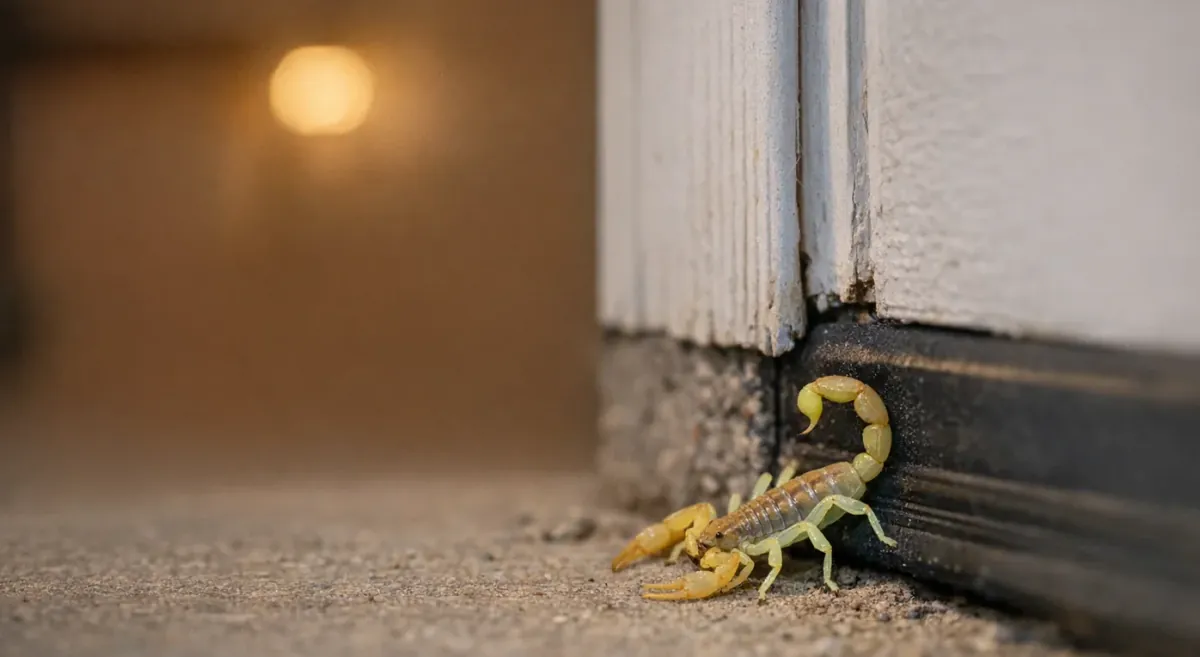
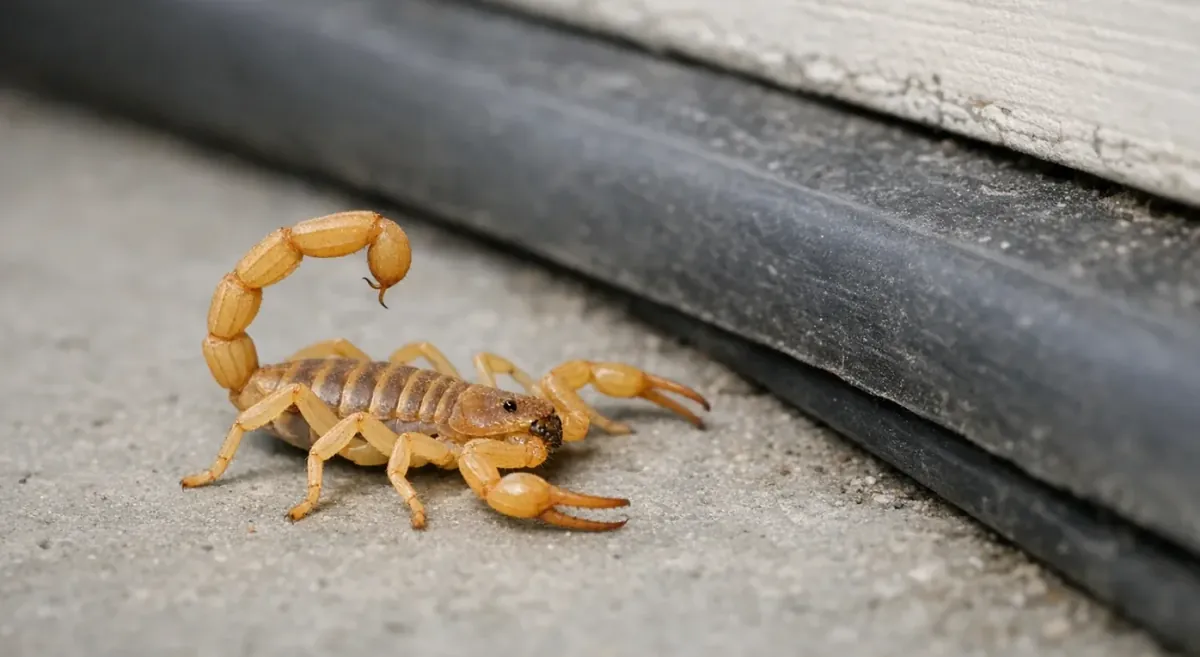
Picture this: a scorpion emerges from a crack in your block wall at midnight. It hugs the wall edge, following the baseboard toward your bedroom. With a CS spray, that scorpion picks up microscopic capsules on its legs and underside as it travels. With regular bug spray, the scorpion might walk right through with minimal effect.
The “CS” designation isn’t just marketing — it’s a fundamentally different delivery system. These microencapsulated formulas exploit scorpion behavior patterns to deliver a lethal dose over time.
What microencapsulation does on real surfaces
When you spray Cy-Kick CS or Demand CS, you’re not just leaving a film of pesticide. You’re depositing millions of tiny polymer capsules, each containing the active ingredient. These capsules stick to porous surfaces like concrete block walls, stucco, and wood. They also adhere reasonably well to smoother surfaces like door frames and tile.
As scorpions crawl through treated zones — especially those critical perimeter edges and expansion joints — the capsules transfer to their bodies. The capsules slowly release the pesticide through the scorpion’s exoskeleton. This matters because scorpions are thigmotactic, meaning they navigate by maintaining contact with surfaces. They’re literally programmed to hug the exact areas where CS sprays work best.
Why scorpions often survive 'regular bug spray'
That can of Raid under your sink? Save it for flies. Most aerosol “bug sprays” use fast-acting pyrethrins that break down within hours or days. They deliver a light surface deposit that might stun a scorpion temporarily but rarely provides a lethal dose.
Professional concentrates like Cy-Kick CS and Demand CS create a different scenario entirely. They leave a heavy, long-lasting deposit exactly where scorpions travel. The microencapsulation protects the active ingredient from UV breakdown and extends the killing power for months. If you’re only spot-spraying scorpions you see, you’re playing defense. A proper perimeter treatment with CS concentrate plays offense.
How do you mix and apply Cy-Kick CS and Demand CS for maximum results?
The difference between “this stuff doesn’t work” and “I haven’t seen a scorpion in months” often comes down to three factors: concentration, coverage, and consistency. Get these right, and either product will dramatically reduce your scorpion problem.
Most failures happen because homeowners (or their pest control company) dilute too much, spray the wrong areas, or give up too soon. Let’s fix those mistakes.
Are pest companies diluting your spray too much?
Here’s an uncomfortable truth: some pest control services dilute their sprays to stretch profits. They might mix at 0.2% concentration when the label recommends 0.8% for scorpions. That’s a 4x difference in killing power.
Ask your pest control provider directly: “What concentration are you mixing for scorpion control?” The answer should match the product label’s recommendation for scorpions, not general insects. For Cy-Kick CS, that’s typically 0.05-0.1% (1-2 oz per gallon). For Demand CS, it’s similar. If they’re using half that rate or less, you’re getting a watered-down treatment that might work fine for ants but won’t stop determined scorpions.
Where should you spray for scorpions (not for ants)
Scorpion control requires different targeting than general pest control. Here’s your precision checklist:
- Expansion joints - Those gaps between concrete sections are scorpion highways
- Block wall bases and tops - Spray a 6-inch band along both surfaces
- Door frames (all sides) - Include the threshold and weatherstripping gaps
- Garage perimeter - Focus on the door seal and corner joints
- Any crack wider than a credit card - If light shows through, scorpions fit through
Skip the middle of walls and open ground — scorpions rarely cross those areas. They’re edge-runners, gap-squeezers, and wall-huggers. Your spray pattern should match how they move.
How often should you re-apply if scorpions keep showing up?
Both Cy-Kick CS and Demand CS claim roughly 90-day residual under ideal conditions. In the real Southwest, plan for 60-75 days during active season. Monsoon rains, irrigation overspray, and dust storms all degrade the barrier faster.
If you’re still seeing live scorpions indoors after 2-3 weeks, don’t wait for the 90-day mark. Do a targeted reapplication focusing on entry points and any areas you might have missed. Remember: indoor spot treatments are band-aids. The real protection comes from maintaining that exterior perimeter barrier consistently.
Which one should you buy (and where) if you're a homeowner?
Ready to start your own scorpion control program? Let’s talk real numbers and logistics. The upfront cost might surprise you, but the long-term savings compared to monthly pest control services add up fast.
Cost-per-season math (what people underestimate)
A bottle of Cy-Kick CS ($30-60) or Demand CS ($30-50) sounds expensive until you do the math. Most concentrates come in 8-16 oz bottles. At typical mixing rates, that’s enough for 8-16 gallons of finished spray — enough to treat an average home perimeter 4-8 times.
Some Reddit users claim their Demand CS bottle lasted 18 months. That’s optimistic but possible if you have a small property and mix conservatively. A more realistic expectation is one bottle per active season (March through October in most areas). Compare that to $50-100 monthly for professional service, and you break even after just one treatment.
Where to buy pro-grade insecticides safely
In Arizona, Bug and Weed Mart is the go-to source for legitimate professional-grade chemicals. They know scorpions, stock fresh inventory, and can answer application questions. For other states, look for agricultural supply stores or professional pest control suppliers.
Buying online? Stick to established sellers with recent reviews. Check for sealed packaging, current EPA registration numbers, and avoid suspiciously cheap listings. A bottle that’s been sitting in a hot warehouse for three years won’t perform like fresh product.
What else to buy with the concentrate
Don’t sabotage your investment by skimping on application equipment. You’ll need:
- Pump sprayer - Get a dedicated 1-2 gallon model ($20-40)
- Measuring cup - Precise dilution matters ($5)
- Basic PPE - Gloves, long sleeves, closed shoes (you probably own these)
- Simple perimeter map - Sketch your treatment zones so you don’t miss spots
Critical safety note: Both products require careful handling around children and pets. Follow the label religiously, especially for re-entry intervals around doors and patios.
Are there better alternatives than Cy-Kick CS and Demand CS?
While Cy-Kick CS and Demand CS dominate the DIY scorpion control conversation, they’re not the only players. Some alternatives might work better for your specific situation — or complement your CS spray program.
Onslaught FastCap vs CS concentrates: when pros reach for it
Onslaught FastCap shows up frequently in pest tech forums as the “scorpion destroyer.” It combines two active ingredients and claims to disrupt scorpion metabolism more effectively than single-active products. Many professionals position it as their most aggressive option for severe infestations.
When to consider Onslaught FastCap: You live in a block-wall neighborhood with established scorpion populations, you’re seeing multiple scorpions weekly despite CS treatments, or you want maximum initial knockdown. The trade-off? It’s typically more expensive and may require more careful handling.
Cyzmic CS and Bifen IT: cheaper options that can still work
Cyzmic CS often gets described as “Cy-Kick’s generic cousin” — similar performance at 20-30% less cost. It uses the same active ingredient (cyfluthrin) in a microencapsulated formula. For budget-conscious homeowners, it’s a solid choice.
Bifen IT takes a different approach — it’s not microencapsulated, but it’s dirt cheap and mixes easily (typically 3/4 oz per gallon). Plenty of homeowners report success with Bifen IT for general perimeter treatments. The catch? Without microencapsulation, you’re relying more heavily on perfect application technique. Miss a gap, and scorpions will find it.
How do you know your spray program is working at night?
Here’s the challenge: scorpions are nocturnal. You could have a perfect perimeter barrier and still not know it’s working until you stumble upon a scorpion at 2 a.m. That’s where monitoring technology changes the game.
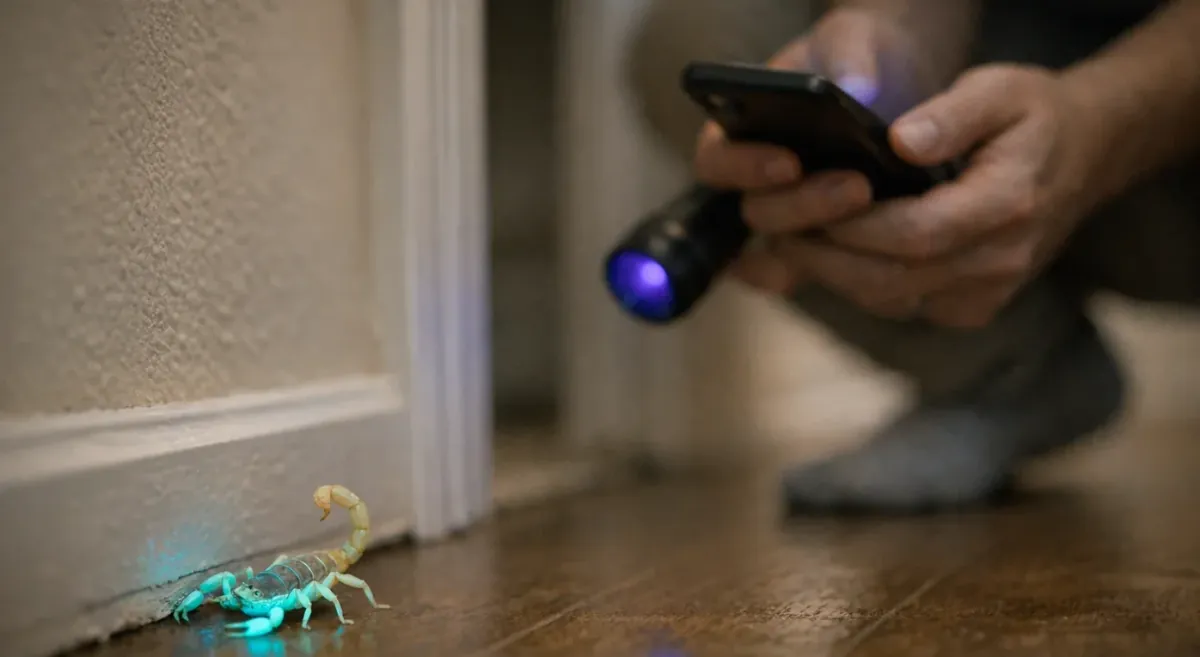
Scorpion Alert Detectors plug into outlets along your walls and shine UV light on the floor where scorpions naturally travel. When the room is dark and a scorpion passes through, its fluorescent glow triggers the detector. You get a photo-verified alert on your phone within seconds — no more wondering if your spray program is working.
Strategic placement near common entry points (garage doors, patio sliders) and high-risk rooms (bedrooms, bathrooms) creates an early warning system. You’ll know immediately if scorpions are still getting inside, which areas need better treatment, and when your barrier is truly working. It’s the verification layer that turns guesswork into data-driven protection.
The bottom line? You don’t need an arsenal of chemicals. Pick a quality CS concentrate (Cy-Kick or Demand), apply it properly to the right locations, maintain the barrier consistently, and monitor your results. That integrated approach beats any single “miracle” product every time.
Now that you’ve seen how Cy-Kick CS and Demand CS differ in knockdown and residual control, the best results usually come from pairing the right spray choice with smart placement along entry points, cracks, and exterior perimeter lines where scorpions travel. If you want a simple way to turn that plan into a repeatable routine, Scorpion Alert can help you stay on top of treatments and reduce surprises.