Does sealing a house for scorpions actually work?
Yes, sealing works — it significantly reduces how often scorpions get inside by closing the gaps they use to enter. But it’s a reduction, not a guarantee. You can miss a tiny gap, and any scorpion already living indoors won’t be affected by exterior sealing. Think of it as cutting off the highways, not erasing every risk overnight.
Here’s the part most homeowners get wrong: they seal ground-level cracks and call it done. Scorpions aren’t limited to ground-level entry — the Arizona bark scorpion can turn up well above the ground. That means gaps up high matter too: roof junctions, weep screeds, upper utility penetrations, and the seams around second-story windows.
Sealing also won’t fix what’s drawing scorpions to your property in the first place. It works best paired with smart outdoor habits, so it helps to know what attracts scorpions to your home before you start.
If I found one scorpion, does that mean I have an infestation?
Not usually. One scorpion almost always means you have an entry route plus the right conditions — not an established colony inside your walls. A single sighting is a signal to inspect, not a reason to panic.
Take a few safety-first steps right away. Trap the scorpion under a glass, then slide a stiff card underneath to relocate it outside — and read what not to do after spotting a scorpion so you don’t make a careless mistake. Note the exact room, time, and whether it was on the floor or a wall. Then start your inspection within 24 to 48 hours.
Patterns matter. If sightings cluster in the same room, that often points to one specific penetration or threshold problem — and that’s exactly where your sealing effort pays off most.
What does sealing NOT fix (and why that changes your plan)?
Sealing doesn’t kill prey insects, and it doesn’t fix moisture problems. Scorpions hunt the bugs your home attracts, and damp areas keep them active right outside your walls, constantly probing for a way in.
That’s why you should prioritize sealing near bathrooms, laundry rooms, and garage transitions. Those spots combine moisture and insect activity — the two things scorpions want most. Indoor harborage data backs this up: bathrooms, laundry rooms, garages, and bedrooms are the most common indoor hideouts.
Don’t waste an afternoon chasing every cosmetic hairline crack in your drywall. Your goal is blocking travel routes, not achieving a flawless finish.
What's the best plan for sealing a house for scorpions without tearing it apart?
The best plan for sealing a house for scorpions is a simple, repeatable system: inspect, mark, seal, verify. You don’t need to renovate. Find the real gaps, mark them, fill them with the right material, then confirm the work held. Most homes can be done over a weekend.
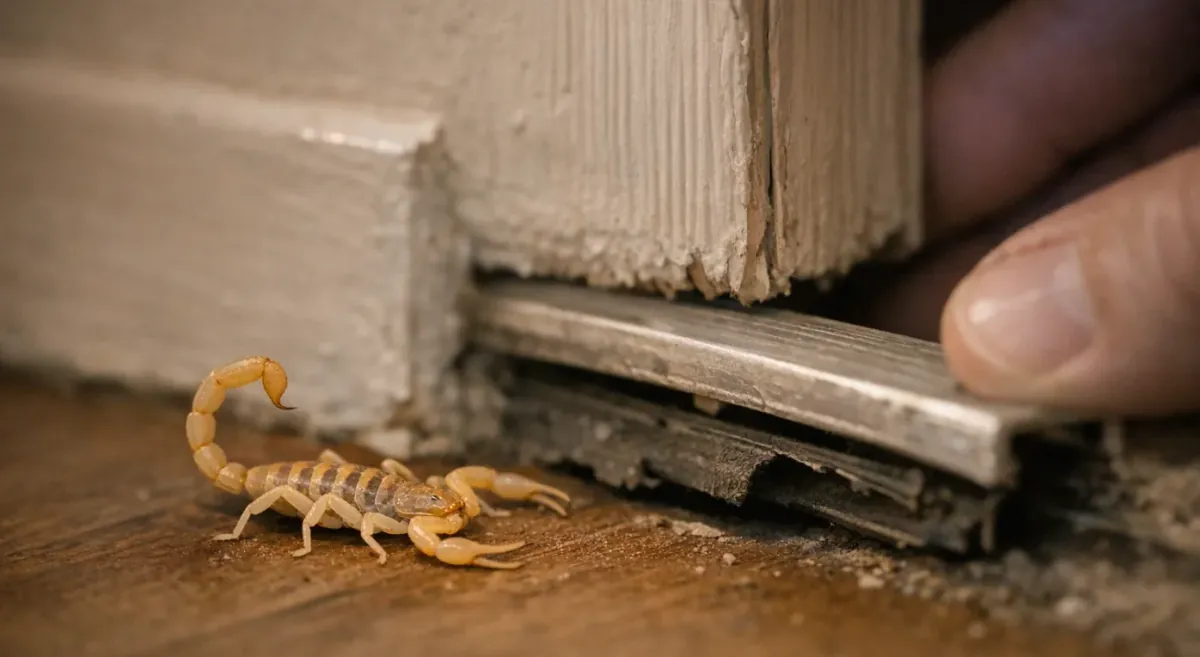
Knowing how scorpions move helps you look in the right places. They’re thigmotactic, meaning they travel hugging edges — baseboards, wall bases, and door frames. So start where edges meet openings, not in the middle of a wall.
Here’s a weekend-friendly workflow. Day 1: walk the perimeter, mark every gap, and build a shopping list. Day 2: seal everything you marked, then do a quick verification pass to catch anything you missed.
What tools help you find tiny gaps fast?
A bright flashlight, a thin probe like a zip tie, painter’s tape for marking, and a small mirror for tight angles will find almost everything.
- Shine the flashlight along edges and watch for daylight or shadow lines.
- Slide the zip tie into suspicious seams to gauge depth.
- Stick a tab of painter’s tape next to each gap so you can find it again.
- Use the mirror behind toilets, under cabinets, and around tight pipe corners.
Here’s a rule of thumb worth remembering: if the edge of a credit card fits in the gap, seal it. A young scorpion can slip through a surprisingly thin opening.
Document as you go. Snap photos labeled by room and wall so nothing slips through the cracks during the sealing phase.
Should I inspect during the day or at night?
Inspect in daylight to spot construction gaps clearly, then do a short night check to confirm where scorpions actually travel. Daytime shows you the openings; nighttime shows you which ones matter.
The night check works because scorpions fluoresce a bright greenish color under UV light — a quirk of their exoskeleton. A handheld UV flashlight at night reveals the routes they’re really using along your baseboards and exterior walls.
Use that information to rank your work. Don’t seal randomly. The gaps near where you spotted glowing activity go to the top of the list.
What should I seal first for the biggest reduction in scorpions?
Seal in this order for the biggest payoff: first, direct access points into bedrooms and living spaces; second, the wall-edge routes scorpions follow; third, gaps near moisture. This framework keeps you focused on impact instead of busywork.
For the full rundown of openings to check, see the top ways scorpions get into your home. In most Southwest homes, the two highest-risk boundaries are the garage-to-house interface and sleeping areas — and bedrooms are the single most-stung room.
42.5% of indoor Arizona scorpion stings happen in the bedroom — the most-stung room in the house.
— Skolnik & Ewald 2018, FEARS survey
Priority #1: Exterior doors, thresholds, and the garage-to-house door
Doors are the number-one entry point, and the garage-to-house door is often the weakest. Check every door sweep and weatherstrip for daylight. A quick paper test works: close a dollar bill in the door, then pull — if it slides out easily, your seal is too loose.
Common failure points include the bottom corners, uneven concrete thresholds, and diagonal gaps from house settling. Look there first.
Fix versus replace: if a sweep is just loose or misaligned, adjust it. If the rubber is cracked, flattened, or torn, replace it entirely — patching worn-out weatherstripping is a waste of time.
Priority #2: Utility penetrations (plumbing, HVAC lines, electrical)
Focus on the ring-shaped gap around pipes and wires — the annular space. Check under sinks, behind toilets, at laundry hookups, and where HVAC lines pass through exterior walls. These openings are everywhere and easy to overlook.
Seal smart so you don’t create future headaches. Keep shutoffs and access panels reachable, and never permanently bury a service area behind sealant.
Account for movement, too. Where temperature swings or vibration are in play, choose flexible sealants — rigid fills crack and reopen the very gap you closed.
Priority #3: Interior baseboards, flooring transitions, and trim gaps
Inside, seal perimeter and edge gaps along baseboards, flooring transitions, and trim. Because scorpions travel along edges, an open baseboard gap becomes a protected indoor highway they can use undetected.
Start in bedrooms, kids’ rooms, and any room where you’ve actually seen a scorpion. Children are stung more often by scorpions on the floor, which makes their rooms a priority — more on why in why children are more at risk from scorpion stings.
Don’t chase perfection. Edge gaps along the perimeter matter far more than a cosmetic hairline in the middle of a wall.
What materials should I use to seal my house for scorpions (and what should I avoid)?
Match the material to the gap using a simple decision tree: interior or exterior, wet or dry, and whether the gap moves. Get that right and your seals last for years instead of cracking by next summer.
Avoid common DIY failures — using the wrong caulk that shrinks and splits, leaving expanding foam exposed so it breaks down in sunlight, and sealing over functional drainage. Here’s a tight shopping list for one trip:
- Acrylic latex caulk (paintable interior trim)
- Silicone caulk (wet areas)
- Polyurethane sealant (durable, flexible exterior)
- Backer rod for deep gaps
- Fine stainless mesh for weep holes and vents
- Replacement door sweeps and weatherstripping
Caulk vs. foam vs. mortar: what's right for which gap?
| Material | Best use | Watch out for |
|---|
| Acrylic latex caulk | Interior trim, baseboards, paintable gaps | Not for wet or moving joints |
| Silicone caulk | Bathrooms, kitchens, sinks | Won’t take paint |
| Polyurethane sealant | Exterior gaps, flexes with movement | Slower cure time |
| Mortar / patch | Masonry and block cracks | Rigid; can re-crack if structure moves |
| Expanding foam | Deep, hidden voids only | Breaks down in UV; cover it; avoid where access is needed |
One critical caution: never seal functional weep holes or drainage paths. Those keep your walls dry. Block them with fine mesh instead — it stops scorpions while preserving drainage and airflow.
How do I seal around pipes and wires without trapping moisture or blocking access?
Seal the perimeter of the gap, not over the pipe itself, so the line can still move and be serviced.
- Clean and dry the area around the penetration completely.
- Push backer rod into deep gaps to fill space and give the sealant a base.
- Run a flexible sealant around the perimeter — not coating the pipe.
- For visible spots, use a removable escutcheon plate that covers the gap and lifts off later.
- Keep access panels serviceable; mark shutoffs so a plumber can reach them.
Quality check: once cured, there should be no visible gaps, no loose edges, and the seal should still flex slightly under finger pressure. A rock-hard seal around a moving pipe will crack.
After sealing, how do I prevent and deter scorpions long-term (and know it worked)?
Sealing is one move; prevention is the routine that keeps it working. Reduce attractants outside, declutter edges inside, and confirm your results by tracking sightings. The goal is fewer scorpions trying to get in and a clear way to tell whether your seals are holding.
To verify, log every sighting by date, time, and location for two to four weeks. That record tells you whether a stubborn sighting is a missed gap or just outside activity. Continuous night monitoring takes this further: instead of constant manual checks, plug-in Scorpion Alert Detectors activate when a room goes dark, scan the floor with 365nm UV light, and send photo-verified alerts with an AI confidence percentage within seconds.
What's a simple 'before and after' setup to prove sealing worked?
Build a 7-day baseline log before you seal. For each sighting, write down the room, the wall or edge location, the time, and whether the scorpion was on the floor or up off the ground.
After sealing, log the exact same way. Good progress looks like sightings dropping off, or shifting toward the garage and exterior boundaries instead of deep inside the house. If they vanish from bedrooms, your priority sealing worked.
For an automatic upgrade, place Detectors along room perimeters where scorpions travel. They plug into a standard outlet, connect to Wi-Fi with no hub required, and capture nighttime activity for you — so your “after” data builds itself.
Where should I focus prevention so scorpions stop trying to get inside?
Focus outdoors on reducing prey and harborage — moisture, clutter, wood piles, and dense landscaping against the foundation. The full breakdown lives in the guide on things that attract scorpions in your home.
Inside, deter them by keeping wall edges clear, pulling beds a few inches off the walls, and removing floor-level hiding spots like loose piles of laundry or boxes. Fewer edges to hug means fewer safe routes.
Timing matters. Activity spikes during warm months and monsoon rains — in Arizona, August and September are peak. Plan to tighten things up before then with the month-by-month scorpion season guide.
If I still see scorpions after sealing, what does that mean—and when should I call a pro?
Read the pattern. Repeat sightings in the same room or spot usually mean a missed gap nearby. Random, isolated sightings are more likely an occasional intruder, or one that was already living inside before you sealed.
Call a professional when you see frequent sightings in sleeping areas, when there’s a sting or a near-sting, or when monitoring keeps flagging the same wall night after night. A prior sighting at home is the strongest predictor of a future sting, so persistent activity deserves a pro’s eyes.
Reliable monitoring removes the guesswork. Photo-verified alerts confirm a real scorpion instead of a false alarm, and offline alerts let you know if a Detector disconnects for more than an hour — so you’re never left with a silent blind spot along the wall that matters most.
Once you’ve worked through sealing gaps, adding door sweeps, and tightening up screens, the next step is confirming your plan is actually reducing indoor activity. Scorpion Alert adds a practical layer of visibility by using UV light detection to help you spot scorpions on floors so you can focus your sealing efforts where they’re still getting in—learn more at Scorpion Alert.