What should I do in the first 1–5 minutes after a bark scorpion sting?
In the first 30 minutes after a bark scorpion sting: move to safety, wash the sting site with soap and water, apply ice for 10 minutes on/off cycles, remove jewelry near the sting, and call Poison Control at 800-222-1222 immediately. Call 911 if the victim is under 5 years old or shows severe symptoms like difficulty breathing, seizures, or loss of consciousness.
You've been stung. Your heart's racing, the pain is intense, and you need to know what to do right now. Take a breath — the next few minutes matter, and you can handle this. Here's your immediate action plan (and yes, this is first aid guidance to help you respond quickly, not a medical diagnosis).
Step 1: Get to safety and keep the person still
First things first: move away from where the scorpion struck. These creatures can hide in groups, and the last thing you need is another sting. Get the person who was stung to a safe spot and have them sit or lie down. Staying still helps in two ways: it can reduce panic (which can make symptoms feel worse) and it may slow the spread of venom through the body.
If the sting is on a hand or arm, remove any rings, watches, or tight jewelry immediately. Even mild swelling can turn these items into tourniquets that cut off circulation. Don't wait to see if swelling develops — by then, that wedding ring may need to be cut off.
Step 2: Clean the area and start cooling
Wash the sting site gently with soap and water. This simple step helps prevent secondary infection, especially since you might not see much of a wound — bark scorpion stings often leave minimal marks despite causing severe pain.
Next, grab an ice pack or bag of frozen peas, wrap it in a thin cloth, and apply it to the sting area. Use 10 minutes on, 10 minutes off cycles. The cold helps numb the pain and may slow venom absorption. Practical tip: note the exact time you started cooling and snap a quick photo of the area with your phone. You'll want both if symptoms change or medical professionals need to assess progression.
Step 3: Call Poison Control now (800-222-1222)
Call this number immediately: 800-222-1222. Don't wait to see if symptoms get worse. Poison control specialists handle scorpion stings every day and can give you guidance based on your specific situation.
"Don't feel that you have to call 911 right away. You can call us and if we feel you have to call 911 we can patch in with 911. We have a direct line with them."
— Dr. Frank LoVecchio, medical toxicologist, Banner Poison and Drug Information Center. ABC15 Arizona
Have this information ready when you call:
- Age and approximate weight of the person stung (especially crucial for children)
- Exact time of the sting
- Location on the body where they were stung
- Current symptoms (pain level, numbness, tingling, any unusual sensations)
- Any known allergies or medical conditions
- Medications the person takes regularly
Stay on the line with Poison Control as symptoms develop. They'll help you decide whether you need emergency care or can manage the sting at home with their guidance.
Should I call 911, go to the ER, or just call Poison Control?
This decision freezes a lot of people in the moment. You don't want to overreact, but you also can't afford to wait too long if it's serious. Here's how to decide within those critical first 30 minutes.
When 911 is the right call (don't wait)
Call 911 immediately if the person stung is a child under 5 years old. Young children face significantly higher risk from bark scorpion venom — their smaller body size means the same amount of venom has a more concentrated effect. Don't wait to see how they respond; children are more vulnerable to severe reactions from scorpion stings.
Also call 911 right away if you see any of these severe symptoms (Grade 4 envenomation):
- Difficulty breathing or shortness of breath
- Severe, uncontrollable drooling
- Repeated vomiting that won't stop
- Loss of consciousness or collapse
- Seizures or convulsions
- Symptoms that worsen rapidly within minutes
These signs indicate a medical emergency. The person needs immediate treatment, possibly including antivenom.
When an ER/urgent care visit is likely (even if you feel unsure)
Some symptoms fall into a gray area — serious enough to need medical attention, but not necessarily requiring an ambulance. If you notice any of these developing, they'll likely need medical observation and treatment:
- Pain that keeps escalating despite home treatment
- Numbness or tingling spreading beyond the sting site
- Difficulty swallowing or a thick feeling in the throat
- Abnormal eye movements, twitching eyelids, or blurred vision
- Muscle spasms or jerky movements
- Excessive sweating or salivation
The key is to follow Poison Control's recommendation. They'll assess your specific situation and tell you whether to head to the ER, urgent care, or continue monitoring at home. Trust their expertise rather than second-guessing yourself.
What to do while you're waiting for help
Whether you're waiting for an ambulance or preparing to drive to the hospital, keep the person as calm as possible. Anxiety can intensify symptoms and raise heart rate, potentially speeding venom circulation.
Continue applying cool compresses in 10-minute intervals. If the sting is on an arm or leg, elevate it slightly above heart level — this may help slow venom spread and reduce swelling. However, if the person has trouble swallowing or excessive drooling, avoid giving them food or water.
Pack smart for the trip:
- Photo ID and insurance cards
- List of current medications
- The person's weight (especially for children — medication doses depend on this)
- Phone charger (you'll want to stay in contact)
- The time you documented when the sting occurred
What symptoms are normal in the first 30 minutes—and what symptoms are dangerous?
Bark scorpion stings pack a neurological punch that catches people off guard. The pain can be shockingly intense, and symptoms can change quickly. Understanding what's "normal" versus what's dangerous helps you respond without panicking.
How bad can the pain get—and how fast does it spread?
Brace yourself: bark scorpion sting pain often ranks 8–10 out of 10 on the pain scale. Victims describe it as burning, electrical, or like being jabbed with a hot needle repeatedly. This level of pain can be "normal" for a bark scorpion sting and doesn't automatically mean it's life-threatening.
Within 10–20 minutes, you might feel tingling or numbness spreading from the sting site. Picture this: you're stung on your index finger, and within 15 minutes, your whole hand feels like it's asleep, with pins-and-needles sensations creeping up your forearm. This radiating effect happens because the neurotoxic venom affects nerve function.
The key is tracking how fast and how far these sensations spread. Faster progression beyond the affected limb or into other body systems can signal a more serious envenomation.
A quick severity scale (Grades 1–4) you can use at home
Medical professionals use a grading system to classify scorpion sting severity. Knowing these grades can help you communicate clearly with Poison Control or emergency responders:
Grade 1 (Local): Pain and mild swelling only at the sting site. No spreading symptoms. Most adults with bark scorpion stings fall into this category.
Grade 2 (Mild systemic): Pain plus tingling or numbness spreading along the affected limb. You might tap around the sting site and feel nothing, or experience "electric" sensations shooting up your arm or leg.
Grade 3 (Moderate systemic): Cranial nerve dysfunction appears. Watch for roving or jerky eye movements, difficulty swallowing, slurred speech, excessive drooling, or tongue fasciculations (twitching). These symptoms mean the venom is affecting your nervous system more broadly.
Grade 4 (Severe): Life-threatening symptoms including seizures, loss of consciousness, respiratory distress, or uncontrolled muscle movements. This is an immediate emergency requiring antivenom and intensive care.
Grades 3 and 4 require emergency medical attention. Don't try to "wait it out" if you see cranial nerve symptoms developing.
Why reactions can be worse after repeat stings
This surprises a lot of Arizona residents: your second or third bark scorpion sting might hit harder than your first. It's not your imagination — it's called cumulative sensitization.
Your immune system remembers previous encounters with scorpion venom. With each sting, it may mount a stronger response, leading to more dramatic symptoms even from the same species. Think of it like how bee sting allergies can worsen with repeated exposure.
If you've been stung before, call Poison Control promptly even if this sting feels "the same" at first. Your reaction could escalate faster than last time, and you'll want professional guidance from the start.
What medications and home treatments help—and what should I NOT do?
When you're dealing with searing pain and spreading numbness, you want relief fast. But some common "remedies" can make things worse. Here's what tends to help — and what can cause trouble.
DO: Pain control, cooling, elevation, and itch/histamine support
Keep using that ice pack — 10 minutes on, 10 minutes off. The cold can provide real pain relief and may help limit venom spread. Always wrap ice in cloth to prevent frostbite on already-traumatized tissue.
Elevate the affected limb if possible. Gravity can help here; keeping the sting site above heart level may slow systemic venom circulation.
For pain relief, ibuprofen (Advil, Motrin) is generally safe for most adults if you're not allergic and don't have contraindications. Follow package directions for dosing. Some people find diphenhydramine (Benadryl) helpful for the histamine response and itching that can accompany stings.
However — and this is crucial — confirm any medication use with Poison Control first, especially for:
- Children (dosing varies by weight and age)
- Adults over 65
- Pregnant or breastfeeding women
- Anyone taking other sedating medications
- People with kidney problems, as this affects drug clearance
DON'T: Cut the area, use a tourniquet, or try to 'suck out' venom
Forget what you've seen in old Western movies. Cutting the sting site doesn't help, and it adds tissue damage plus infection risk. This is especially misguided with bark scorpion stings, which often leave little to no visible mark — you'd literally be cutting blind.
Tourniquets are equally dangerous. Cutting off circulation traps venom in one area, which can increase local tissue damage, while doing nothing to neutralize the venom itself. Once you release the tourniquet, you risk a sudden systemic dose of concentrated venom.
As for "sucking out" venom — it simply doesn't work. Scorpion venom binds to nerve cells within seconds. You can't suck it back out any more than you could un-mix cream from coffee.
DON'T: Use opioids (morphine) or sedatives to 'knock them out'
This warning might seem obvious, but historically, scorpion sting treatment sometimes included heavy sedation to help victims "sleep through" the worst symptoms. That approach has killed people.
Here's why it's so dangerous: opioids and sedatives suppress breathing and can mask neurological symptoms. If someone is developing Grade 3 or 4 envenomation, sedatives make it harder to assess their condition and can compound respiratory problems. A sedated person can't tell you their tongue feels thick or their throat is closing.
Any prescription-level pain management belongs in a clinical setting where professionals can monitor vital signs and intervene if needed. Stick to OTC options as directed by Poison Control.
Was it a bark scorpion sting or a spider bite—and how do I prevent another sting tonight?
After the immediate crisis, two questions come up fast: "Am I sure it was actually a scorpion?" and "How do I make sure this doesn't happen again tonight?" Here are practical steps you can take right now.
Clues it was a scorpion sting (often no obvious mark)
Here's a key differentiator many people don't know: bark scorpion stings can cause intense pain and neurological symptoms with almost no visible skin change. You might see a tiny red dot or nothing at all, yet feel like you've been electrocuted. Pain at sting site reported in 88.9% of stings; local numbness in 62.2% (Klotz et al. 2021).
Spider bites, on the other hand, typically leave more visible evidence:
- Two small puncture marks (though not always visible)
- A raised welt or blister forming within hours
- Progressive skin changes — redness spreading outward, tissue breakdown, or necrosis in severe cases
- More localized pain without the electrical/radiating sensation
Of course, exceptions exist. Some spider bites cause minimal marks, and some scorpion stings leave welts. But if you're experiencing severe pain with tingling or numbness spreading up a limb, yet see almost no wound, think scorpion — not spider.
Should I try to find or capture the scorpion?
Only if you can do it safely. Identifying the species can help medical professionals, but it's not worth risking another sting. If you decide to look for it, gear up first: closed-toe shoes, thick gloves, and a flashlight (UV flashlights make scorpions glow green, making them easier to spot).
The safest capture method: place a clear glass or jar over the scorpion, slide stiff cardboard underneath, flip the container, and secure the lid. Never use your hands, even with gloves — scorpions can sting through fabric.
Don't waste precious time hunting for the scorpion if someone needs medical attention. Focus on the victim first, scorpion-hunting second.
How to prevent a repeat sting tonight (fast, realistic steps)
You need sleep, but you're worried about another encounter. Here's your 30-minute prevention plan:
- First, shake out all bedding, pillows, and any clothes on the floor. Scorpions love hiding in fabric folds.
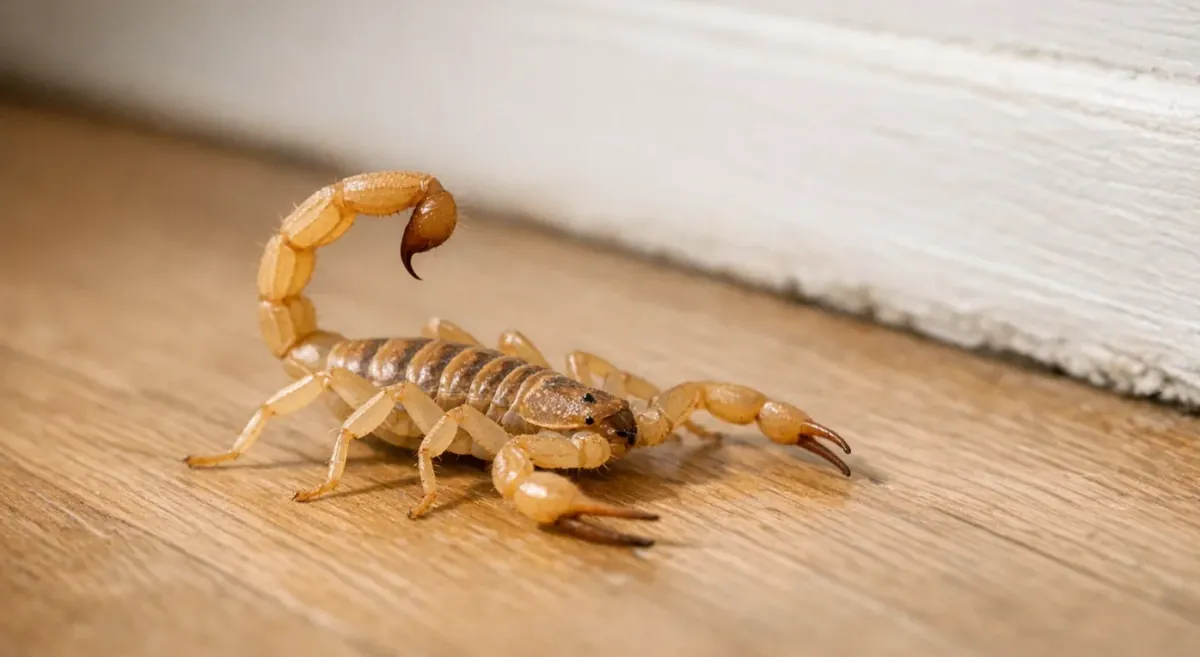
- Pull your bed a few inches away from the wall — scorpions are thigmotactic, meaning they navigate by following walls and edges. Creating a gap breaks their natural travel path to your bed.
- Check inside all shoes and slippers. Tomorrow you'll want to make this a permanent habit, but tonight, also place shoes in sealed plastic bags or boxes.
- Do a quick perimeter check of the room where the sting occurred. Look along baseboards, under furniture edges, and in corners. Scorpions rarely venture into open spaces; they stick to edges where they feel secure.
For ongoing protection, consider how scorpions actually move through homes. They follow walls at night, hunting in the dark when we're most vulnerable. While scorpions can enter through plumbing and AC vents, they still travel along room perimeters once inside. This predictable behavior is why automated detection systems like Scorpion Alert work — the plug-in detectors use 365nm UV light to spot the telltale fluorescent glow of scorpions as they travel along walls at night, sending photo alerts to your phone within seconds. It's the same principle as doing manual UV flashlight patrols, but automated so you don't have to stay up all night checking.
81.8% of households where someone was stung had previously seen scorpions on the property; 29.4% had a prior envenomation at the same address. (Skolnik & Ewald 2018)
Remember, most bark scorpion stings happen because we accidentally contact them — stepping on one barefoot or reaching into a space where one is hiding. Stay vigilant for the next few days while you implement longer-term prevention strategies. With the right approach, you can dramatically reduce your risk of another painful encounter.
In those first 30 minutes after a bark scorpion sting, staying calm, washing the area, and using a cool compress can make a real difference—then keep a close eye on symptoms and seek medical help fast if they escalate. To make the next incident less likely, Scorpion Alert can help you spot and reduce scorpion activity around your home so first aid stays a backup plan, not a routine.
Medical disclaimer: This article is informational and not medical advice. We are not doctors, and portions of this content have been edited with AI assistance. For questions about symptoms, treatment, or medications, consult your doctor. For a scorpion sting with severe symptoms, call 911 or your local emergency service.