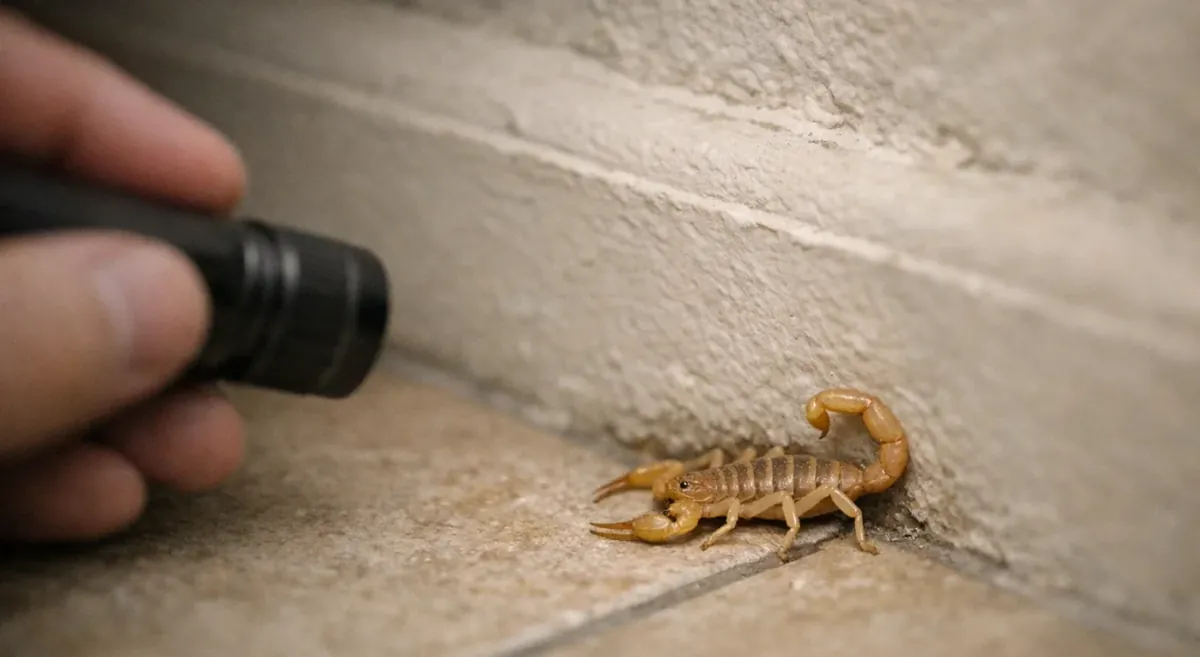
Is there a 100% effective scorpion repellent?
No single product guarantees zero scorpions in scorpion-prone areas. The practical approach combines exclusion, prey control, and monitoring for a layered defense.
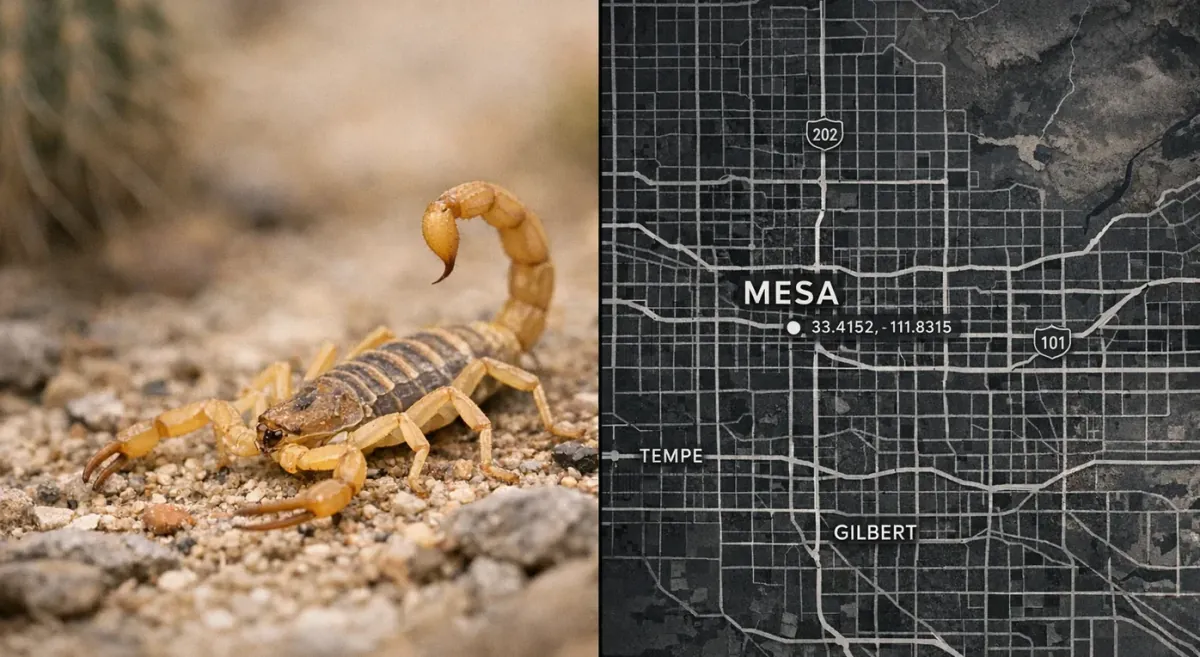
Yes, scorpions are a real problem in Mesa. As part of Maricopa County, Mesa sits in the heart of Arizona's scorpion territory. Across the county, the Banner Poison Center logged 518 scorpion exposures and 794 envenomations in just the first three months of 2026 — and those numbers only reflect incidents serious enough to generate a call.
Mesa homeowners often discover their scorpion problem suddenly. You might live in your home for years without seeing one, then find three in a week. That's because scorpions are nocturnal hunters that spend daylight hours hidden in cracks, under rocks, or tucked behind furniture. They emerge after dark to hunt insects along your baseboards and walls. By the time you spot one, there's a good chance others have been moving through your home undetected.
The difference between an occasional yard scorpion and a real problem comes down to frequency and location. Finding one scorpion outside every few months? That's desert living. But when you start seeing them inside — especially in bedrooms, bathrooms, or near where kids play — you're dealing with something that needs attention. Mesa's mix of older stucco homes and newer developments with block walls creates plenty of entry points and hiding spots that scorpions can exploit.
A single scorpion in your garage doesn't necessarily mean you have an infestation. But certain patterns signal it's time to take action. Multiple sightings within a month, scorpions in living areas (not just the garage), or any nighttime encounters in bedrooms or bathrooms all point to an established problem. Here's a quick self-assessment: Have you seen more than two scorpions indoors in the past 30 days? Found one in a bedroom or bathroom? Spotted them at night when turning on lights? Had anyone in your household stung? If you answered yes to any of these, you're past the "occasional visitor" stage.
For Mesa households with young children, elderly residents, or pets, even a single indoor sighting can warrant immediate action. Arizona leads the nation in scorpion-related hospitalizations, with 68.2% of all U.S. scorpion exposures occurring in our state. Children under 10 face the highest risk of severe reactions, which makes any indoor scorpion presence a serious concern for families.
Scorpion activity in Mesa follows predictable patterns tied to weather and environment. The worst waves typically hit during the late summer monsoon season, when humidity spikes and prey insects become more active. A sudden increase after the first 100-degree days of spring is also common — the heat pushes scorpions to seek cooler shelter, often inside homes.
Construction and landscaping changes can trigger waves, too. New development disturbs established scorpion habitat and sends them searching for new territory. Even something as simple as changing your irrigation schedule or removing a woodpile can shift scorpion movement patterns around your property. Mesa's desert landscaping with decorative boulders and gravel provides ideal scorpion habitat right up against home foundations.
Maricopa County hosts the same scorpion species found throughout southern Arizona, but the sheer population density here means more human-scorpion encounters. The county's massive irrigation canal system creates moisture corridors that scorpions follow deep into urban areas. Mesa's position in the East Valley means you're dealing with scorpions that have adapted to suburban life — they're just as comfortable hunting crickets along your foundation as they are in the open desert.
What makes Maricopa County particularly challenging is the prevalence of the Arizona bark scorpion, the most medically significant species in North America. While other Arizona counties might see mostly less dangerous species, bark scorpions dominate the urban and suburban areas where most Valley residents live. That means Mesa homeowners should treat every scorpion sighting as potentially serious until proven otherwise.
Mesa hosts multiple scorpion species, but identifying exactly which ones requires careful observation since comprehensive local species data isn't always available. The most concerning species for Mesa homeowners is the Arizona bark scorpion (Centruroides sculpturatus), which is common throughout Maricopa County and responsible for the vast majority of medically significant stings. However, you might also encounter striped bark scorpions, giant hairy scorpions, or yellow ground scorpions depending on your neighborhood and surrounding habitat.
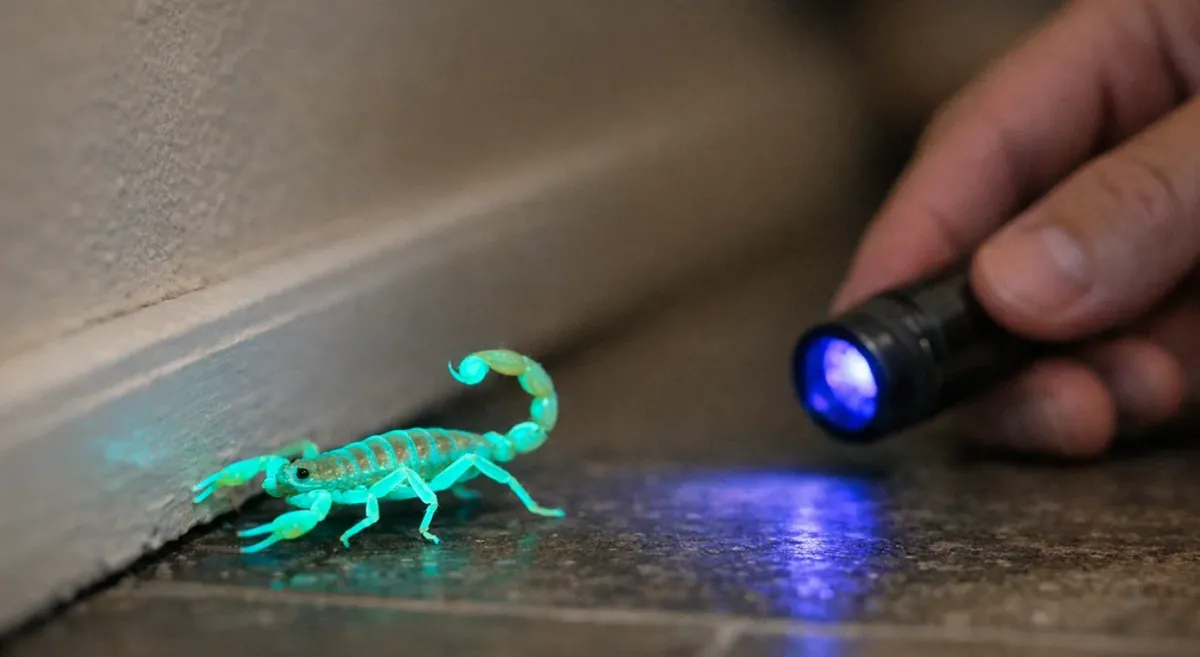
Without clear identification, it's safest to treat any scorpion in your Mesa home as potentially dangerous. The good news is that all scorpions share similar behaviors — they're nocturnal, they hunt along walls and baseboards, and they glow bright green under UV light. That means the same prevention and detection strategies work regardless of species.
The Arizona bark scorpion earns its reputation as the species of greatest concern. It's the only scorpion in the United States whose venom can cause life-threatening symptoms, particularly in children. These pale, slender scorpions measure 2–3 inches long and have a distinctive habit of reaching higher areas — walls and ceilings — something most other scorpion species can't do. If you find a scorpion high on a wall or tucked under the lip of your kitchen counter, there's a good chance it's a bark scorpion.
What makes bark scorpions particularly problematic in Mesa is their preference for human structures. While other species might wander inside occasionally, bark scorpions actively seek out the cool, dark spaces our homes provide. They're well adapted to suburban life, thriving in the microhabitats created by block walls, stucco exteriors, and irrigated landscaping.
Location often tells you as much as appearance when identifying scorpions. Bark scorpions show up in unexpected places — clinging to bathroom walls, hiding under kitchen sinks, or tucked into the folds of towels and clothing. They readily reach above ground level, so finding one up high is a strong indicator. Color-wise, they're typically tan to light brown, sometimes with subtle darker stripes.
Striped bark scorpions, in contrast, are usually darker with more pronounced stripes and prefer ground-level hiding spots. Giant hairy scorpions — the largest in North America at 4–6 inches — are unmistakable due to their size and darker coloration. They rarely enter homes, preferring to hunt in open desert areas. Many people ask if smaller scorpions are more dangerous, and with bark scorpions, there's some truth to this — younger individuals can have difficulty controlling venom injection, though adult stings remain medically significant.
The absence of comprehensive species observation data for Mesa doesn't mean scorpions aren't present — it often reflects how hard it is to safely photograph and identify scorpions in residential settings. Most homeowners encountering a scorpion at 11 PM aren't thinking about contributing to citizen science databases. They want it gone.
Practical steps matter more than perfect identification. Photograph any scorpion you find (safely, from a distance) and note where and when you found it. Track whether you're seeing them inside or outside, at ground level or up high. This pattern data helps pest control professionals and can reveal whether you're dealing with the more concerning bark scorpions or less dangerous species. Remember, effective prevention strategies work across all species — sealing entry points and reducing habitat helps no matter which scorpion is visiting.
Mesa's scorpion activity follows Arizona's broader patterns, with peak encounters happening from late July through September. The combination of monsoon humidity and sustained heat creates ideal conditions for scorpion movement. But don't let your guard down in the "off season" — Mesa's mild winters mean scorpions remain somewhat active year-round, just at reduced levels.
Nightly activity peaks between 6 PM and midnight, accounting for roughly 49% of all envenomations statewide. This timing isn't random. As the concrete and asphalt release the day's stored heat, scorpions emerge from their hiding spots to hunt. They navigate by keeping one side of their body in constant contact with a surface — a behavior called thigmotaxis — which is why you'll find them traveling along your baseboards, walls, and the edges of furniture rather than crossing open floor space.
March and April bring the first uptick as temperatures climb above 80°F consistently. You might spot occasional scorpions emerging from winter hiding spots. May and June see steady activity as prey insects become abundant. But the real surge hits in late July when monsoon moisture arrives. August and September are peak months — if you're going to have scorpion problems in Mesa, this is when they'll be most obvious.
October brings a gradual decline as nights cool, though warm spells can trigger surprising activity. By November, encounters drop significantly, and December through February are the quietest months. Still, Mesa's position in the low desert means even winter nights above 50°F can see some scorpion movement. For a detailed month-by-month breakdown of what to expect across Arizona, check out the comprehensive scorpion season guide.
Scorpions are strictly nocturnal hunters. During daylight, they metabolize slowly and remain hidden. But as darkness falls, they become active predators. Their peak hunting window runs from sunset through midnight, with a secondary activity period in the pre-dawn hours between 6 AM and noon accounting for about 30% of sting incidents — often when people encounter scorpions that haven't yet returned to hiding.
This nocturnal pattern explains why so many Mesa homeowners discover scorpions during late-night bathroom trips or early morning routines. The scorpion that stings someone reaching for a towel at 6 AM likely spent all night hunting along bathroom baseboards. Understanding this timing also helps explain why automated detection systems that activate in darkness can be more effective than random daytime searches.
Mesa's monsoon season fundamentally changes scorpion behavior. The humidity spike triggers increased activity in prey insects like crickets and roaches, which in turn draws scorpions out of hiding. More prey means more hunting, and more hunting means more scorpion encounters in and around homes. Research confirms that August and September — peak monsoon months — see the highest envenomation rates across Arizona.
Your irrigation schedule plays a similar role on a micro level. Regular watering creates moisture zones that attract insects, establishing hunting grounds for scorpions. Mesa homes with lush grass, drip irrigation systems, or pools often see more scorpion activity than those with pure desert landscaping. Even something as simple as overwatering a potted plant can create a cricket breeding ground that draws scorpions to your patio. Time your watering for early morning rather than evening to avoid creating nighttime moisture zones during peak scorpion hours.
Most scorpion stings in Mesa cause intense but manageable symptoms. You'll likely experience immediate burning pain at the sting site — 88.9% of people stung report this — followed by numbness or tingling that can spread up the affected limb. About 62.2% experience localized numbness. For healthy adults, these symptoms typically peak within an hour and gradually improve over 24–48 hours without medical treatment.
However, Mesa's position in Maricopa County means you're in the epicenter of medically significant scorpion encounters. Arizona accounts for 68.2% of all scorpion exposures reported to U.S. poison centers, and our state shows the highest rates of severe neurological symptoms and hospitalizations. This isn't meant to frighten you — it's to emphasize why every sting deserves careful monitoring, especially for vulnerable individuals.
Normal sting reactions include pain, tingling, and numbness around the sting site. You might also experience mild swelling, though scorpion stings typically swell less than bee stings. Some people report a strange sensation like electrical shocks radiating from the sting site. These symptoms, while uncomfortable, don't require emergency care in healthy adults.
Red flags that demand immediate medical attention include difficulty breathing or swallowing, blurred vision, uncontrolled muscle twitching or jerking, excessive drooling, or severe agitation. In children, watch for unusual eye movements (roving or jerking eyes), excessive restlessness, or inability to stay still. These neurological symptoms indicate systemic envenomation that may require antivenom treatment. Never hesitate to call the poison helpline at 1-800-222-1222 for guidance.
Children face significantly higher risk from scorpion stings. Their smaller body mass means venom concentration reaches dangerous levels more quickly. Children under 10 have the highest rates of systemic effects, hospitalization, and ICU admission from scorpion stings. In fact, of patients receiving Anascorp antivenom in Arizona, 54.4% were under 5 years old and 18.6% were ages 5–9.
For Mesa parents, this means taking any child's scorpion sting seriously. Even if initial symptoms seem mild, children can deteriorate quickly. The same sting that causes temporary discomfort in an adult can trigger life-threatening symptoms in a toddler. For detailed information about protecting children from scorpion encounters, see our guide on why children face higher risk from scorpion stings.
Dogs and cats react differently to scorpion stings than humans do. Dogs often yelp, paw at their face, or show sudden lameness if stung on a paw. Excessive drooling, trembling, or difficulty breathing can signal a serious reaction. Cats may yowl, hide, or show dilated pupils. Small pets face higher risk due to their size, similar to children.
Mesa pet owners should contact their veterinarian immediately after a suspected sting, especially if the pet shows signs beyond localized pain. While most pets recover without treatment, some require supportive care or pain management. Keep your vet's emergency number handy during scorpion season, and consider pet insurance that covers envenomation treatment — emergency vet visits for scorpion stings can be costly.
First, don't panic. While scorpion stings are painful and potentially serious, 90.1% of stings are managed at home without requiring an emergency room visit. What you do in the first few minutes can make a real difference in comfort and recovery.
The key is distinguishing between normal sting symptoms you can manage at home and serious reactions that need medical help. Mesa residents have access to excellent medical facilities familiar with scorpion envenomation, but you don't want to rush to the ER unnecessarily. Follow these steps to respond appropriately.
Move away from the area where you were stung — there might be more scorpions nearby. Wash the sting site with soap and water to reduce infection risk. Apply a cool compress (not ice directly on skin) to help with pain and slow venom spread. Remove any rings, watches, or tight clothing near the sting site before swelling begins.
Keep the stung person calm and still. An increased heart rate can speed venom circulation. Note the time of the sting and begin monitoring symptoms. Take a photo of the scorpion if you can safely do so — this helps medical professionals assess risk. Call the poison helpline at 1-800-222-1222 for personalized guidance. They'll ask about the victim's age, health conditions, and symptoms to determine if medical care is needed.
Call poison control immediately for any child under 10 who's been stung, regardless of symptoms. Also call for adults experiencing anything beyond localized pain and numbness. Poison control specialists can advise whether you need emergency care or can safely monitor at home.
Head to the ER immediately if you observe: difficulty breathing or swallowing, uncontrolled muscle movements or twitching, roving or jerking eye movements, excessive drooling or frothing, severe agitation or inability to stay still, or blurred vision. Children showing any neurological symptoms need immediate evaluation. Mesa's emergency rooms stock Anascorp antivenom and have extensive experience treating scorpion envenomation.
If the scorpion is still visible, don't try to kill it with your hands or feet. Instead, use the container-and-card method: place a clear glass or jar over the scorpion, slide a piece of cardboard underneath, and flip the container upright. Wear closed shoes and gloves if available. This safely contains the scorpion for identification or disposal.
For homes using automated detection systems like Scorpion Alert, check your app to see if the scorpion triggered any detectors before the sting. The photo verification feature can help confirm what type of scorpion you're dealing with and where it entered your living space. This information helps both medical providers and pest control professionals respond more effectively.
Protecting your Mesa home from scorpions starts with understanding how they enter and where they travel. Scorpions don't randomly wander into houses — they follow edges and walls, exploiting specific entry points while hunting for prey. This edge-following behavior, called thigmotaxis, means your prevention efforts should focus on sealing perimeter vulnerabilities and monitoring the paths scorpions naturally use.
The most effective approach combines three strategies: sealing entry points to block access, reducing yard habitat to minimize the population near your home, and monitoring key areas to catch any scorpions that do get inside. Mesa's mix of older homes and desert landscaping creates unique challenges, but targeted efforts can dramatically reduce indoor encounters.
Start with the gaps scorpions exploit most often. Install door sweeps on all exterior doors — that quarter-inch gap under your door can be a highway for scorpions. Pay special attention to the garage door, where worn weather stripping creates easy access. Seal weep holes in brick or stucco with steel wool and caulk, maintaining drainage while blocking entry.
Check where utilities enter your home. Gaps around plumbing, electrical conduits, and AC lines are common entry points. Use expanding foam or caulk to seal these penetrations. In Mesa's older neighborhoods, settling foundations can create cracks that need attention. Focus on accessible fixes first — you don't need perfect sealing to see a significant improvement. For more comprehensive strategies, explore what to avoid after finding a scorpion.
Mesa's desert landscaping can harbor scorpions if it isn't maintained. Remove woodpiles, leaf litter, and construction debris from against your home. Decorative boulders and river rock should sit at least 2 feet from the foundation — scorpions hide in the cool spaces underneath during hot days. Trim palm trees regularly, since dead fronds create perfect scorpion habitat.
Control the prey insects that attract scorpions. Fix irrigation leaks that create moisture zones where crickets breed. Switch exterior lights to yellow bulbs or sodium vapor to attract fewer insects. Keep grass short and remove dense ground cover near the home. Many homeowners don't realize that common household features attract scorpions — understanding these attractants helps you eliminate them systematically.
Since scorpions follow walls and edges due to thigmotaxis, monitoring these travel routes gives you early warning of activity. Traditional sticky traps placed along baseboards can work, but they require constant checking and replacement. UV flashlight patrols let you spot scorpions' green glow, but you'd need to patrol every night during active season — exhausting and impractical for most homeowners.
This is where automated detection makes sense. Scorpion Alert detectors plug into wall outlets — right on the perimeter where scorpions naturally travel. They use 365nm UV light to make scorpions glow and send photo-verified alerts to your phone when one passes by. The system activates only in darkness when scorpions are active, providing round-the-clock monitoring without the nightly flashlight patrols. For Mesa homes with a history of sightings, placing detectors in bedrooms, bathrooms, and high-traffic areas adds a layer of protection that complements your sealing and habitat reduction efforts. Don't fall for common myths about scorpion repellents — focus on proven strategies that actually work.
In Mesa, where bark scorpions are most active after dark, the safest routine is spotting them before they make it indoors—especially around block walls, patios, and entry points. If you want a practical way to check your property at night using the same UV fluorescence method pros rely on, Scorpion Alert can help you turn awareness into a quick, consistent scan.
We got 2 alerts our first week! These things really work, what a good idea, so easy to use. Much better than sticky traps, thank you so much!

We can finally go on offense against these things instead of waiting to find them in our couch and shoes. It really helps us figure out where they're getting in. Love it.

Thank you for giving us the peace of mind in knowing these things aren't crawling around in our newborn's room at night and hiding in her toys or clothes.
No single product guarantees zero scorpions in scorpion-prone areas. The practical approach combines exclusion, prey control, and monitoring for a layered defense.
Peak season runs from March to October, with the highest activity in July and August, when they mate and search for water and shelter.
Yes. There are no limits to the number of people you can add to your account. They'll receive push notifications by simply by installing the app and joining your account.
Scorpions are nocturnal and most active from late spring through early fall. In hot climates like Arizona and Texas, activity spikes at night after temperatures drop slightly.
Clean the area with soap and water, apply a cold compress, and elevate the limb. Seek medical help if symptoms worsen (e.g., difficulty breathing, muscle spasms), especially for children or the elderly. Antivenom may be needed for severe cases.
They squeeze through tiny cracks—often as small as 1/16 inch. Common entry points include door sweeps, dryer vents, foundation gaps, and poorly sealed windows. Learn more with our article titled How To Keep Scorpions Out Of Your House
Scorpion Alert notifies you the moment a scorpion is detected in your home.
Learn about Scorpion AlertNot you?
No hardware purchase necessary. Just a small monthly monitoring fee. The more Detectors you add, the more you save. Cancel any time and return them — no long-term contract.
Sign up with Google or Apple — no password required.
By continuing, you agree to our Terms & Conditions and Privacy Policy.