Why do I still find scorpions after a UV sweep?
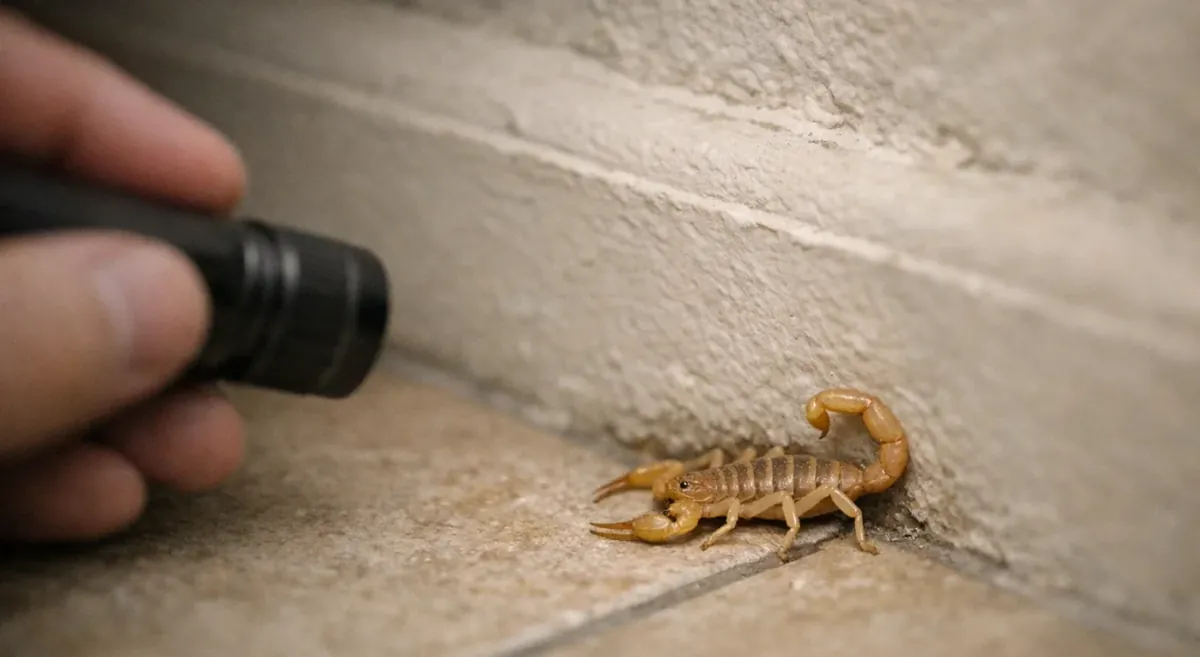
You still find scorpions after a UV sweep because a sweep is a single snapshot in time, and scorpions stay active for hours after you go to bed. You checked the floor at 10 p.m., saw nothing, and relaxed — but the scorpion that stung a bare foot may not have entered the room until 1 a.m. The sweep was accurate. It just ended too early.
That gap can create a stressful cycle. You check, you feel safe, you sleep — and then one shows up anyway. For families, that false sense of safety can feel worse than no check at all, because it lowers your guard right before the highest-risk hours. Scorpions are nocturnal, and peak sting hours fall in the evening and overnight.
~49% of scorpion envenomations happen between 6 PM and midnight, with a second peak from 6 AM to noon.
— Isbister & Bawaskar, N Engl J Med 2014
What does "most of the night unmonitored" actually mean?
It means your five-to-thirty-minute sweep covers a tiny slice of an eight-hour night. Picture the timeline: you sweep at 10 p.m., a scorpion slips under the patio slider at 1 a.m., and someone gets up for water at 2 a.m. and steps on it. Nothing about your check was wrong — it simply happened three hours too soon.
The people who feel this gap most are parents of young kids, shift workers coming home in the dark, frequent travelers who can't check every night, and light sleepers who lie awake wondering. Children are more at risk from scorpion stings, which raises the stakes during those unmonitored hours.
Is UV sweeping still worth doing if you have alerts?
Yes — as a spot-check, not as your only line of defense. A quick sweep is genuinely useful right after an alert, or on high-activity nights during monsoon season and warm evenings. Focus on entry points: doorways, garage thresholds, and patio sliders.
The hard part is consistency. Nobody realistically sweeps every doorway every single night for months, and that's exactly the gap automated monitoring is built to close.
Why do scorpions glow under UV—and what wavelength works best?
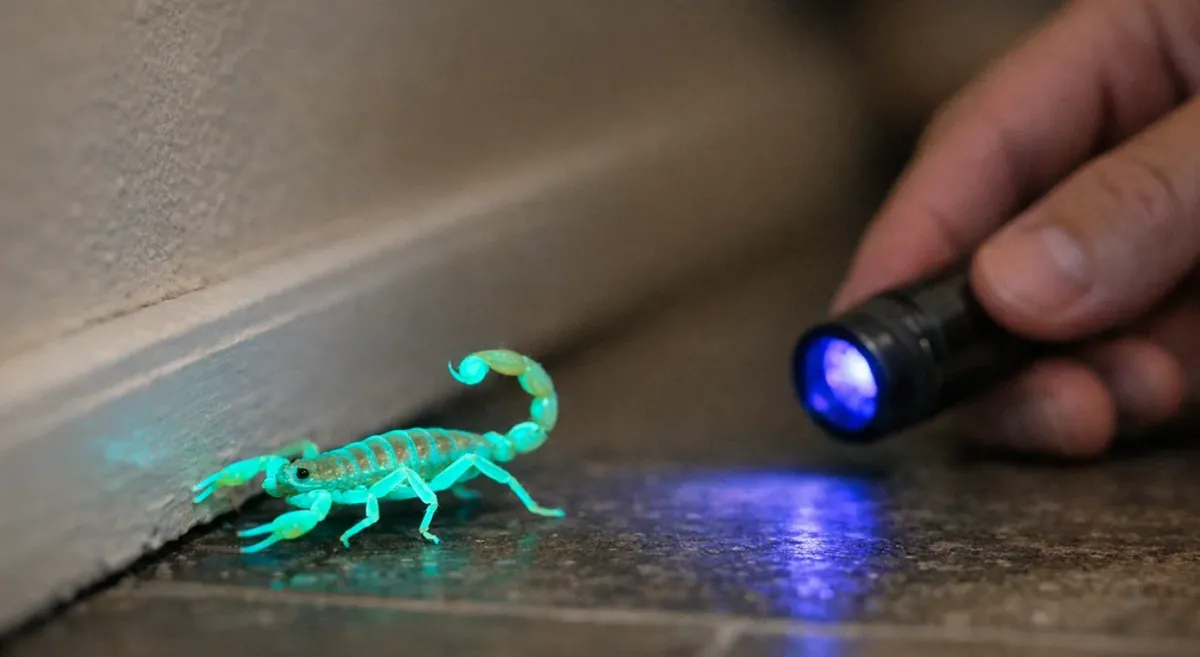
Scorpions glow because compounds in their exoskeleton fluoresce, giving off a bright greenish-cyan light under ultraviolet. A 365nm UV wavelength produces an especially strong, easy-to-see glow, which is why it's the standard for both handheld sweeps and automated detection. A scorpion that's nearly invisible on dark tile lights up like a tiny neon sign.
That fluorescence is the one fact everything else here is built on. Shine a 365nm light on a dark floor and a scorpion stands out instantly, while the surrounding room stays dark.
Does UV light make scorpions run away—or avoid the area?
No — scorpions don't reliably flee from the low UV levels used for monitoring, so the goal is detection, not deterrence. Some observations even suggest scorpions pause near UV rather than avoiding it, which can help a detector capture a clean, confirmable image before the scorpion moves on.
Will UV bother my family, pets, or sleep?
The 365nm UV used in Scorpion Alert monitoring isn't noticeable to most people and isn't sleep-disrupting — there's no bright purple glow filling the bedroom. Detectors only scan when the room is dark, so the light works quietly while everyone sleeps.
One practical tip: keep bedrooms dark enough for monitoring mode to run. A bright nightlight can keep the room lit from the detector's point of view, so choose a dim one or position it away from the detector.
What should a smart scorpion detector do that cameras and traps can't?
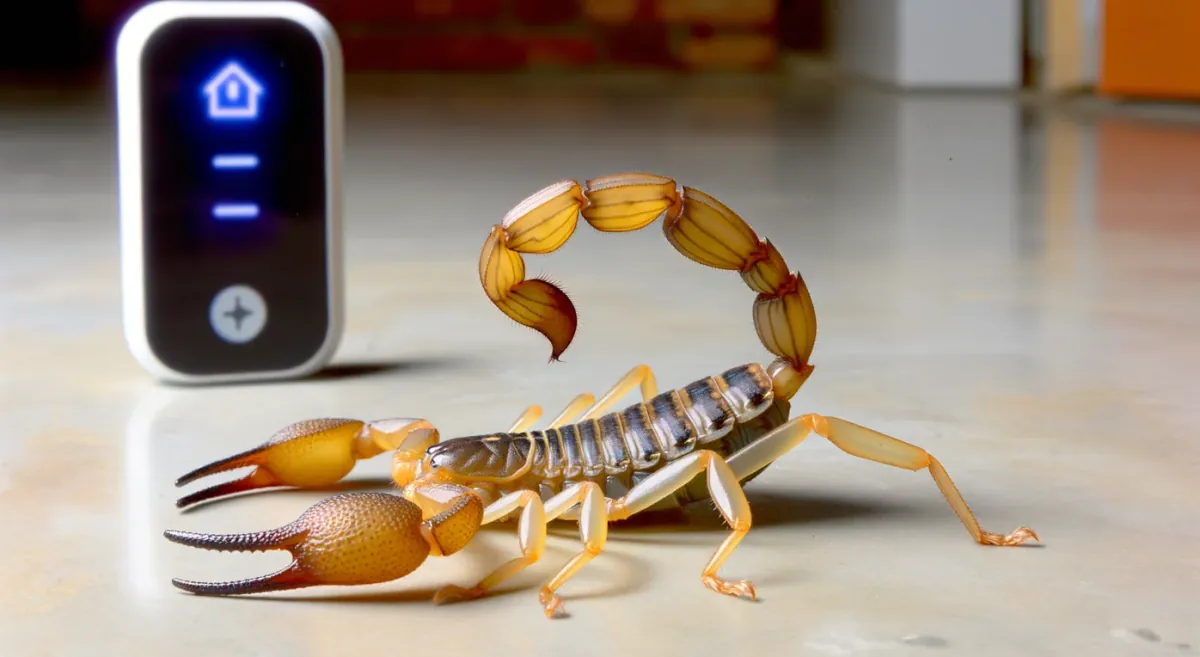
A smart scorpion detector should watch continuously, recognize the scorpion's UV glow specifically, and send an actionable alert the moment it sees one. Ordinary cameras struggle here: the target is tiny, contrast is low, nighttime lighting is poor, and generic motion detection isn't tuned for scorpions. Smart scorpion detection with real-time UV phone alerts changes that equation — at 2 a.m., an actionable alert means a photo, a location, a timestamp, and a confidence score delivered within seconds.
Compare that to the alternatives homeowners usually reach for.
| Method | Coverage | Alerts you? | Downside |
|---|
| Nightly UV flashlight sweep | Minutes per night | No | Misses the hours you're asleep |
| Sticky / glue traps | Passive | No | Messy, unsafe near kids/pets, can attract prey insects |
| Generic security camera | All night | Rarely useful | Not scorpion-specific; tiny, low-contrast target |
| Automated UV detector | All night | Yes — photo + location | Requires outlets on the perimeter |
What makes an alert actionable (instead of annoying)?
Three things: the detector's name or location, a photo, and a confidence percentage — so you can decide in seconds instead of guessing. Scorpion Alert delivers alerts by push and SMS as redundancy, so a phone charging in another room doesn't mean a missed warning.
How do you prevent false alarms and alert fatigue?
Adjustable confidence thresholds — Low, Medium, or High — let you tune out noise. Raising the threshold reduces false positives. Real homes are full of small UV noise: dust, reflections off glossy tile, and the occasional other insect. Verification is what separates a helpful system from one you eventually mute and ignore.
How does automated UV detection monitor for scorpions all night?
It works by watching the room perimeter, scanning the floor with UV, and using AI to confirm the scorpion's glow before alerting you. Scorpions are thigmotactic — they navigate by hugging walls, baseboards, and furniture edges — so watching the perimeter is far more efficient than trying to watch open floor. The loop is simple: dark room → UV on → images captured twice per second → AI checks for the glow → cloud confirms → photo alert sent.
500ms — how fast each Scorpion Alert Detector scans, capturing images twice per second whenever the room is dark.
Why does perimeter monitoring work better than watching the whole room?
Because scorpions travel along edges far more than they cross open floor. A detector on the perimeter is watching the highway, not an empty field, which sharply raises the odds of catching an overnight wanderer as it slips along the baseboard.
What does "two-stage AI verification" mean in real life?
Stage one is on-device screening: the Detector checks each frame for the telltale green-cyan fluorescence. Stage two is cloud confirmation before you're notified, which filters out false positives. The server also enhances the image to boost the glow, so the photo that lands on your phone is easy to read at a half-asleep glance.
How do you know it's still monitoring if you forget about it?
Offline alerts tell you if a Detector hasn't checked in for an hour or more, and they're timed to arrive during daytime hours so they don't wake you at night. A good trust-building habit: run a test alert after you move a Detector or change your Wi-Fi settings, just to confirm everything's still talking.
Where should you place detectors—and what should you do after you get an alert?
Place detectors by priority: entry points first, then bedrooms and kids' rooms, then bathrooms and laundry rooms where moisture draws scorpions in. Most homes do best with several detectors — often three to five — to cover key perimeters and reduce the chance of a surprise encounter deeper inside. Then follow a calm, rehearsed plan when an alert fires.
Which rooms should be first priority for coverage?
- Entry points: exterior doors, the garage, patio sliders, and pet doors — the most common routes in. See the top 5 ways scorpions get into your home.
- Sleeping areas: bedrooms, nurseries, and playrooms, where a nighttime surprise carries the highest risk.
- Water-adjacent rooms: bathrooms and laundry rooms, which offer the cool, humid corners scorpions favor.
How many detectors does a typical home need for whole-home coverage?
A small single-story home with one or two entrances might do well with two or three Detectors covering the main doors and the bedrooms. A larger or multi-entry home usually needs four or five to cover every perimeter that matters. Name each Detector by its exact spot — "Back Door Left," "Nursery Outlet" — so an alert tells you precisely where to go.
What do I need for setup to go smoothly (and to keep alerts reliable)?
- Confirm your Detectors will connect to 2.4GHz Wi-Fi — they don't use 5GHz, and this is the most common setup snag.
- Run the guided setup wizard, which takes about two minutes per Detector.
- Secure the Detector to the outlet if you have young children in the home.
- Send a test alert once it's placed to confirm it's monitoring.
What should I do the moment I get a scorpion alert?
- Keep kids and pets out of that room, and don't walk in barefoot.
- Open the alert and check the photo and location so you know exactly what you're dealing with.
- Grab your capture kit — a UV flashlight, a wide-mouth glass, and a piece of stiff paper — and go straight to the Detector that triggered.
- Find the glowing scorpion, trap it under the glass, slide the paper underneath, and release it well outside.
Avoid the common mistakes people make in the moment — here's what not to do after spotting a scorpion in your home. If anyone does get stung, know the bark scorpion sting first aid steps for the first 30 minutes. Repeated alerts in the same zone are a map — treat that spot as the place to focus sealing and professional treatment, and review the top 5 things that attract scorpions in your home.
How can I make sure I actually hear alerts at night?
Instead of full silent mode, use Sleep, Focus, or Do Not Disturb with Scorpion Alert allowed through — that way the important notification breaks through while everything else stays quiet. Enable both push and SMS for redundancy. If alerts start to feel noisy, nudge the confidence threshold up; if you suspect the system is missing things, return it to Medium and reassess. Getting that balance right is what turns detection into real, restful peace of mind.
Real-time UV phone alerts can turn scorpion control from a nightly flashlight routine into a faster, more confident response—especially when 365nm UV makes scorpions stand out and smart detection helps reduce false alarms. If you want that same “see it and know it” advantage built into your home setup, explore Scorpion Alert here.