Are scorpions a problem in Killeen?
Yes — Killeen sits in scorpion country, and encounters here are high. Killeen is in Bell County, on the warm, dry Hill Country edge of Central Texas where the striped bark scorpion thrives. Sightings inside homes are common, most happen after dark, and the anxiety of finding one in a kid's room is very real.
What does "a problem" actually mean? It's less about a plague of scorpions and more about the odds of an indoor run-in — plus the worry that follows. Texas ranks second in the nation for reported scorpion exposures, behind only Arizona — with roughly 1,743 exposures a year statewide, per Kang & Brooks 2017. Most of those encounters share a pattern: they happen at night, along the edges of rooms.
What "high scorpion relevance" means for homeowners
High relevance means two things for a Killeen household: prevent proactively, and be ready to respond fast. Scorpions are nocturnal hunters, so the worst moments tend to arrive in the dark. You flip on the bathroom light at 2 a.m. and one's sitting on the cool tile. Or your kid says something moved by the baseboard in their bedroom.
Night matters because that's when scorpions leave hiding spots to hunt insects. During the day, they tuck into cracks and clutter. By the time you'd normally notice them, they're already on the move across your floors.
Where Killeen residents most often run into scorpions
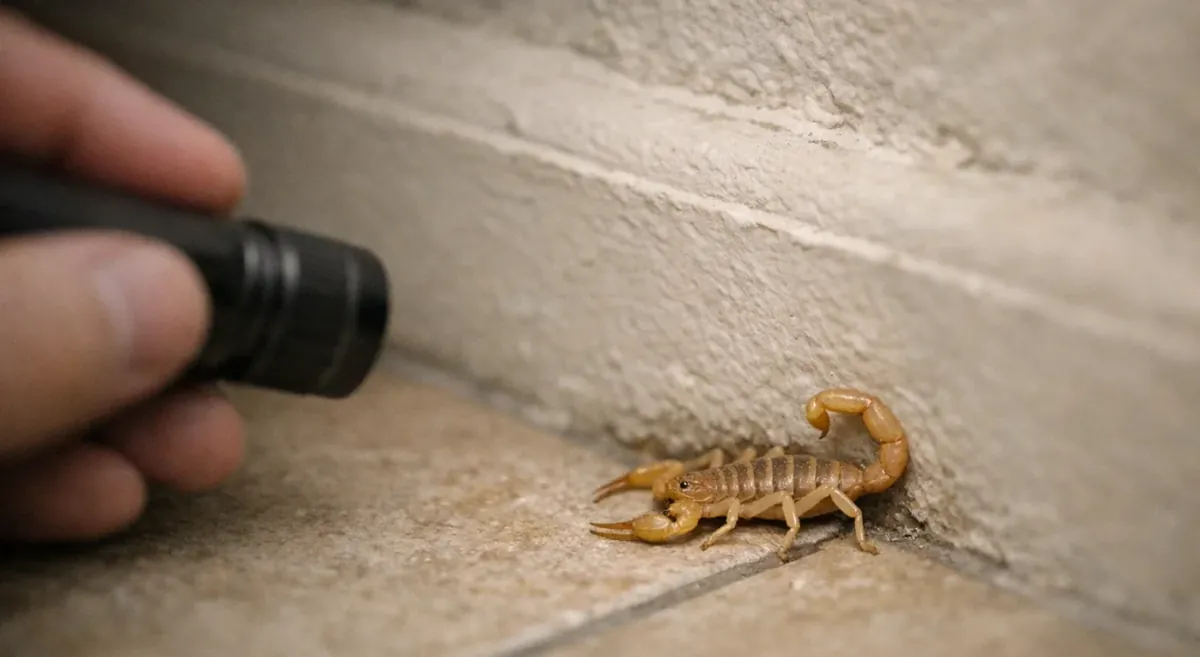
Scorpions travel from yard to house along foundations, then follow interior edges once inside. This behavior is called thigmotaxis — they navigate by keeping their bodies against a surface. That's why you find them along baseboards, at door thresholds, and in dark corners rather than out in the middle of a room.
Indoors, check the same places they'd naturally patrol: where the wall meets the floor, behind furniture, around plumbing, and in bathrooms and laundry rooms. It also helps to understand how they get in — here are the top ways scorpions get into your home.
Is it one scorpion… or a sign of more?
One sighting isn't proof of an infestation, but it isn't nothing either. A scorpion indoors usually means two things exist: a way in, and a food source (other insects). If you have gaps and you have prey, you've got a reason for scorpions to keep coming.
The smart mindset is "monitor and act." Don't panic that your house is overrun, but don't shrug it off as a fluke. Seal what you can, reduce clutter, and stay aware of where activity shows up.
Which scorpion species lives in Killeen?
The scorpion you'll encounter in Killeen is almost certainly the striped bark scorpion (Centruroides vittatus). Every one of the 175 research-grade scorpion observations logged within 30km of Killeen on iNaturalist is this single species. Correct ID matters because it changes both how worried you should be and how you control them.
Don't rely on size to judge danger. A small scorpion isn't automatically harmless, and a big one isn't automatically deadly. Species and behavior tell you far more than length does.
Striped Bark Scorpion (primary iNat species in Killeen)
The striped bark scorpion is the most widely distributed scorpion in North America, dominant across Texas and neighboring states, according to Yamashita & Rhoads 2017. It hides in cool, dark spots — under bark, rocks, and wood outside, and indoors behind clutter, in shoes, and along baseboards.
Quick ID checklist: tan to yellowish-brown body, two darker lengthwise stripes down the back, and slender pincers rather than thick, crab-like ones. That slender-pincer/stripe combination is the giveaway for a striped bark scorpion in Killeen.
How to tell a scorpion from look-alikes (at night)
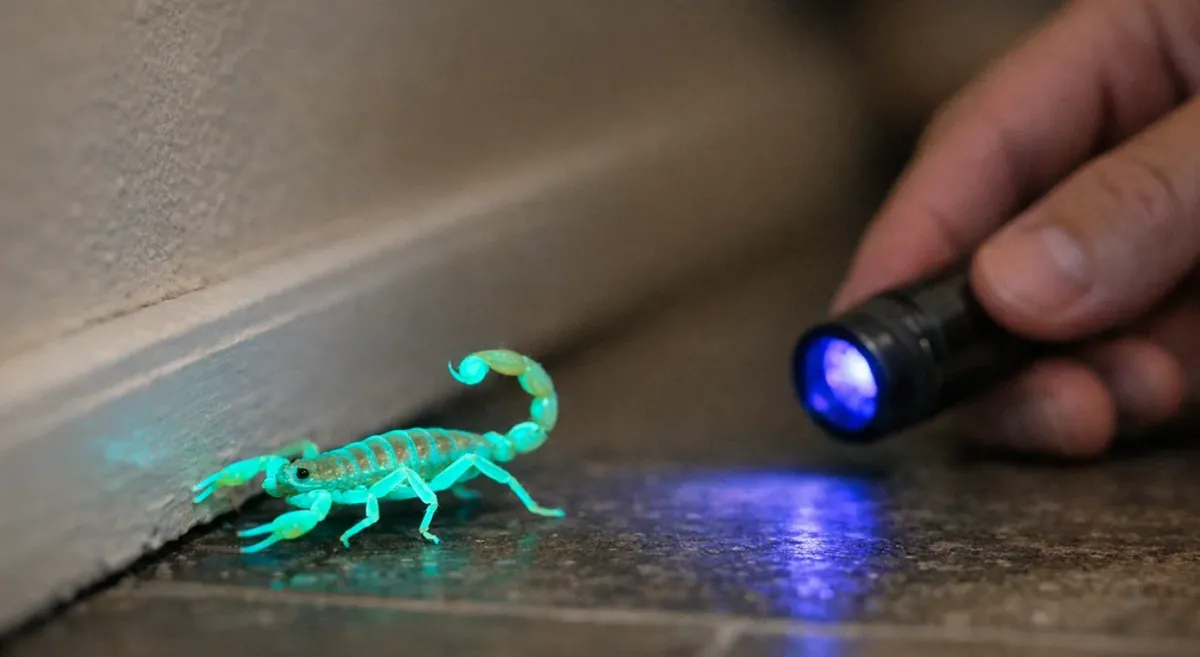
The most reliable way to confirm a scorpion is ultraviolet light. Scorpions fluoresce a bright greenish-blue under UV, glowing against a dark floor when almost nothing else does. That glow removes the guesswork from a dim nighttime sighting.
Verify from a safe distance. Keep your hands well back, shine a UV flashlight along the baseboards, and let the light do the work. Never bring your fingers close just to confirm what you're looking at.
Why species ID matters for Killeen scorpion control
Because striped bark scorpions travel edges and hide in clutter, your control strategy should target exactly those things: seal the perimeter and cut down harborage. There's no point fogging the middle of a room a scorpion never crosses. Watching the perimeter makes sense because that's the highway scorpions actually use.
When are scorpions most active in Killeen?
Scorpions in Killeen are most active during the warm months — late spring through early fall — and most active at night within those months. Summer accounts for the overwhelming majority of scorpion cases nationwide, with warm evenings driving activity, per Kang & Brooks 2017. Central Texas heat keeps the season long.
The catch is that they're hardest to spot precisely when they're busiest — in the dark. That's why planning your exclusion and monitoring for the warm season pays off.
Killeen scorpion season: what "peak months" looks like
Expect the heaviest activity from roughly May through September, when Killeen's warm nights are in full swing. Shoulder-season surprises happen too: the first hot nights of spring pull scorpions out, and humidity after rain can push them toward drier indoor spaces. Sudden heat and post-rain moisture are classic triggers.
Are scorpions nocturnal—and why that changes your routine
Yes, scorpions are nocturnal. Peak sting hours run from 6 PM to midnight — nearly half of envenomations — with a second bump in the early morning, according to the clinical literature. That should shape a few habits: shake out shoes before putting them on, glance at the bedside floor at night, and watch your step on late bathroom trips.
Can scorpions climb walls in Killeen homes?
Yes — striped bark scorpions can climb, and they're good at it on rough, textured surfaces. Treat vertical transitions the same way you treat baseboards: as possible travel routes. Brick, block, stucco, and unfinished garage walls all give them the grip they need, so gaps up higher can matter too — not just gaps at the floor.
How dangerous is a scorpion sting in Killeen?
For most healthy adults, a scorpion sting in Killeen is painful but not dangerous. Striped bark scorpion stings produce sharp local pain that averages 15–20 minutes, and life-threatening envenomation has not been documented for this species, per Yamashita & Rhoads 2017. That said, children, older adults, and pets deserve extra caution.
The reason the pain is intense without the scary full-body syndrome comes down to venom chemistry. The striped bark scorpion's venom targets pain-signaling sodium channels, which explains the burning sting without the neuromotor effects of Arizona's bark scorpion, as the same research describes.
Typical sting symptoms vs. red flags
Expect immediate sharp pain at the site, then tingling, numbness, redness, and mild swelling that fades within an hour or so. Pain at the site is reported in the vast majority of stings, per Klotz et al. 2021.
Call for help now if you see any of these: trouble breathing, severe or spreading swelling, numbness spreading well beyond the site, uncontrolled muscle twitching, roving eye movements, difficulty swallowing, or any altered mental status. These are rare with striped bark scorpions, but they always warrant immediate care.
Who is most at risk in Bell County homes
Young children, older adults, and anyone with a known sting or insect allergy face the highest risk of a stronger reaction. Kids are especially worth watching — here's why children are more at risk from scorpion stings.
Pets can get stung too, usually on a paw or the face while investigating. If your dog or cat suddenly yelps, paws at its mouth, drools heavily, or swells, call your vet.
Why stings happen: common Killeen scenarios
Most stings come from accidental contact. Slipping on a shoe with a scorpion inside, pulling laundry from a pile on the floor, grabbing a towel, or reaching into garage storage — those are the classic setups. Reducing floor clutter and doing a quick check before bed can cut the odds dramatically.
What to do if you're stung in Killeen
Stay calm — a striped bark scorpion sting is almost always manageable at home. Wash the area, apply a cold compress, take an over-the-counter pain reliever if needed, and monitor for anything unusual. When in doubt, call the Poison Help line at 1-800-222-1222, which is free and staffed around the clock.
First 10 minutes: what to do right away
Move through these steps in order:
- Move away from where you were stung so it can't happen again.
- Wash the sting site with soap and water.
- Apply a cold compress or ice pack (wrapped in cloth) to reduce pain and swelling.
- Remove rings, watches, or tight items near the sting in case of swelling.
- Note the time of the sting and keep the person calm and still.
- Call Poison Control at 1-800-222-1222 if you have any questions or the person is a child.
For a fuller walkthrough, see this scorpion sting first-aid guide for the first 30 minutes.
When to go to urgent care or the ER in Killeen
Head in for care if red-flag symptoms appear — trouble breathing, severe swelling, spreading numbness, uncontrolled muscle twitching, or altered mental status — or if the person stung is a young child, an older adult, or someone with a known allergy. Killeen has close options: Carl R. Darnall Army Medical Center (36065 Santa Fe Ave, Fort Hood) is about 3 miles away, and Seton Medical Center Harker Heights (850 W Central Texas Expy) is about 4 miles out. When symptoms are severe, don't wait — go.
If you got stung at night: how to avoid a second sting
After a nighttime sting, do a quick perimeter check before settling back in. Grab a UV flashlight and scan the baseboards, corners, and edges of the room — scorpions travel those lines. If you're constantly wondering whether there's still one in there, photo-verified detection can settle it by showing you exactly what set off an alert and where.
How to keep scorpions out of your Killeen home
Effective scorpion control for a Killeen home layers three things: seal the gaps scorpions use, remove outdoor hiding spots that stage them near your walls, and monitor the perimeter where they actually travel. No single spray fixes it — and don't fall for miracle-repellent hype; here's the truth about scorpion repellent myths.
Start with exclusion: seal the gaps that matter most
Prioritize the entry points scorpions actually use. Because they follow edges, a small gap along a threshold is all it takes.
- Install tight door sweeps on exterior and garage doors.
- Seal utility penetrations where pipes, cables, and A/C lines enter.
- Screen or seal weep holes in brick and block walls.
- Repair torn window screens and worn window tracks.
- Caulk cracks where the foundation meets the wall.
Yard + garage fixes that reduce scorpion hiding spots
Everything a scorpion hides under near your foundation is a launch pad into the house. Move firewood, rock piles, and stacked landscaping materials away from exterior walls. Thin out dense ground cover and clear leaf litter and clutter pressed against the foundation, especially near entry doors and the garage.
Think upstream, too: scorpions come for prey. Cutting down the insects around your home — by managing lights, moisture, and debris — makes your yard less of a buffet, which quietly reduces scorpion traffic without a single repellent claim.
Nighttime detection and peace of mind (a modern approach)
Since scorpions are nocturnal and hug walls and edges, the smartest monitoring runs at night, right on the room perimeter. That's the exact idea behind Scorpion Alert. The plug-in Detectors sit in standard wall outlets along your baseboards, shine 365nm UV light onto the floor to make any scorpion glow, and send a push notification or SMS to your phone within seconds — with a photo in the app so you can see what triggered it.
It solves the real problem: you often won't know a scorpion is inside until you step on it, and nobody wants to patrol with a flashlight every single night. For a Killeen home, place Detectors near exterior and garage doors, in bedrooms (especially kids' rooms), and in water-adjacent rooms like bathrooms and laundry areas. And before you react to any sighting, avoid these common mistakes in what not to do after spotting a scorpion.
Scorpion Alert is rental-based, with the hardware included in a monthly monitoring subscription and a one-time shipping fee at checkout. See /pricing for current rates. There's no long-term contract — cancel any time by emailing support@scorpionalert.com and returning the Detectors. If you've already seen scorpions in Killeen, Texas inside your home, that's the strongest reason to start watching the rooms where activity showed up.
In Killeen, scorpions can show up quickly—especially around garages, baseboards, and patios—so the key is catching activity early and responding before it becomes a routine surprise. Scorpion Alert makes that easier by using 365nm UV illumination and a two-stage AI check to spot scorpions and send a photo-based notification within seconds. If you want a practical way to monitor problem areas at night, visit Scorpion Alert.