Are there scorpions in New Mexico—and are they common in Carlsbad?
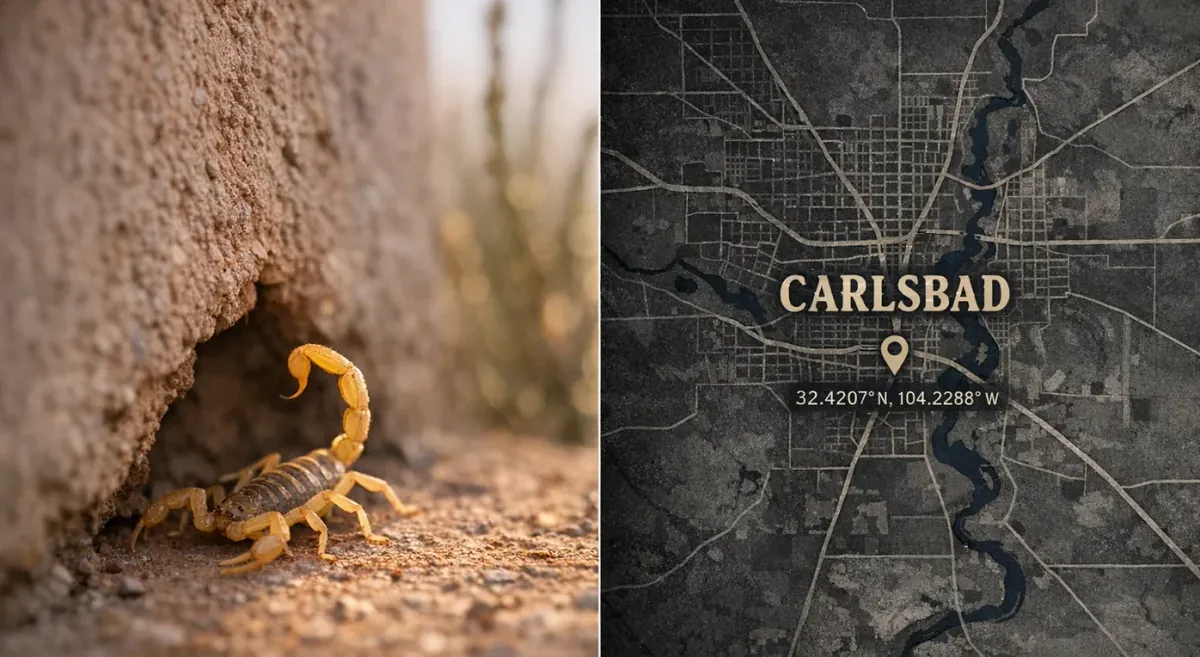
Yes—scorpions live throughout New Mexico, and in Carlsbad they're common enough that most longtime residents have seen at least one. The state's dry, rocky, insect-rich desert is ideal scorpion habitat, and Eddy County sits right in the middle of that landscape. Finding one indoors isn't unusual, but it usually means there's a gap somewhere in your home's defenses.
Carlsbad shows up regularly in citizen-science records. Public sighting databases like iNaturalist log scorpion observations across southeastern New Mexico, and residents report them along foundations, in garages, and inside bathrooms during warm months. If you just found one, pause—this is a manageable problem. Knowing which species you're dealing with, when they're active, and how they get in helps you get back in control.
Why New Mexico has scorpions (and why Eddy County feels it)
Scorpions thrive where the climate is hot and dry, the ground is rocky, and insects are plentiful—which describes much of the American Southwest. They need warmth to stay active, cover to hide during the day, and prey like crickets and roaches to hunt at night. Carlsbad checks every box.
Eddy County's caliche soil, block walls, rock landscaping, and long warm season give scorpions everything they need right outside your door. Seeing them around your yard is completely normal here. Seeing them inside is the signal worth acting on—it usually points to a prevention gap, not an invasion.
Where do scorpions show up around Carlsbad homes first?
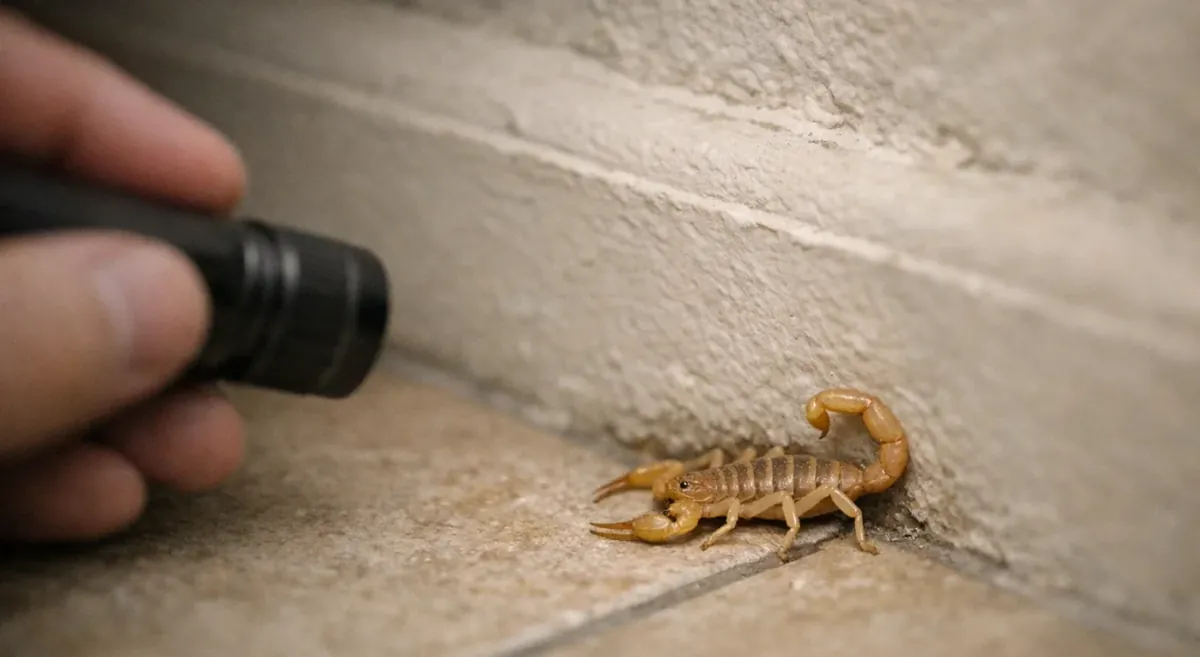
Scorpions hug edges and squeeze into tight, dark spots. The first areas to check: decorative rock borders and block walls along the foundation; cluttered garage corners and stored boxes; patio and slab edges; and bathrooms and laundry rooms where moisture collects. Those spots are where scorpions tend to appear before they ever make it into a living space.
Why you might suddenly see scorpions after years with none
Weather is usually the trigger. A stretch of intense heat drives them toward cooler indoor spaces, summer rain spikes the insect population they feed on, and windy nights push them to seek shelter. Any of these can turn a quiet year into a busy one. One scorpion doesn't mean you have an infestation—strays wander in. But repeated sightings mean it's time for a plan.
What kind of scorpions are in New Mexico (and which ones are in Carlsbad)?
New Mexico is home to several desert-adapted scorpion species, and around Carlsbad the ones you're most likely to meet are small, striped, ground-dwelling types—not the highly toxic species people fear most. Knowing which is which helps you gauge sting risk and understand where they turn up indoors.
Which scorpion species is most common around Carlsbad?
Two you'll likely encounter are the lesser stripetail scorpion and the striped bark scorpion (Centruroides vittatus). The striped bark scorpion is the most widely distributed scorpion in North America, dominant across Texas and eastern New Mexico, according to Yamashita & Rhoads 2017. Species ID matters because it hints at behavior, sting severity, and where indoors they hide. When you spot one, snap a photo from a safe distance instead of leaning in close—no picture is worth a defensive sting.
Is there a bark scorpion in New Mexico?
Yes—bark-type scorpions occur in New Mexico, most commonly the striped bark scorpion. The bark scorpion people worry about most, the Arizona bark scorpion (Centruroides sculpturatus), is largely an Arizona-centered concern, though its range has expanded into parts of New Mexico and neighboring states in recent decades, per Kang & Brooks 2017. Regardless of species, treat every scorpion as capable of stinging.
Are there scorpions in Albuquerque?
Yes, scorpions can be present in the Albuquerque area, though risk varies by neighborhood, nearby habitat, and how well a home is sealed. Homes backing up to open desert or with heavy rock landscaping tend to see more activity. The same layered approach that works for scorpions in Carlsbad, New Mexico applies there too: seal gaps, reduce harborage, control prey insects, and monitor room perimeters at night.
What are "clear scorpions" in New Mexico?
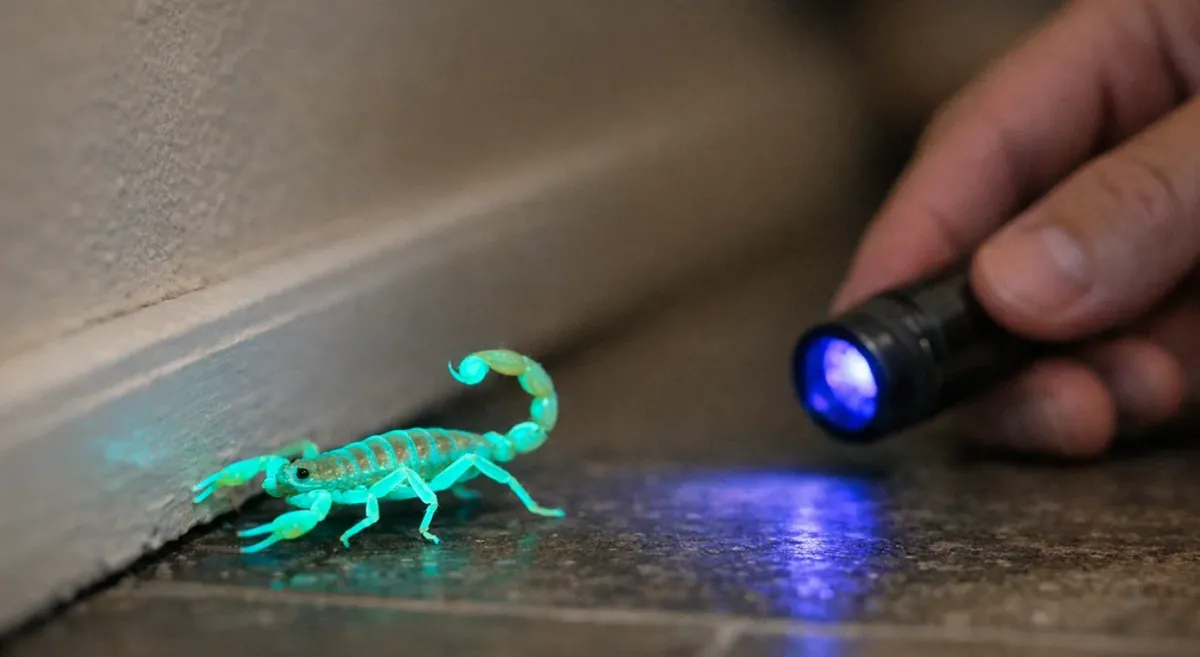
A "clear" or pale-looking scorpion usually isn't a separate species—it's a lightly colored one, a juvenile, or simply an adult that looks washed out in dim light. Some species are naturally sandy or translucent-tan. The key detail: pale scorpions still glow greenish under 365nm UV light, just like their darker cousins. Don't handle it. Trap it under a glass, slide a card underneath, and release it outside—then look for the entry point it used.
Why is Google showing "scorpion Maine" on this page?
Maine generally isn't a scorpion state—it's too cold and wet for them to establish. Most "scorpion Maine" searches come from people comparing regions, planning a move, or worrying about stowaways hitching a ride in boxes or luggage from the Southwest. The practical takeaway is the same everywhere: focus on home entry prevention and nighttime monitoring in scorpion-prone states like New Mexico.
When are scorpions most active in Carlsbad, New Mexico?
Scorpions in Carlsbad are most active on warm nights from spring through fall, with the hottest summer months as the clear peak. They're nocturnal hunters, so sightings cluster after dark—especially in bathrooms and bedrooms. Weather swings can trigger sudden spikes.
What months are peak scorpion season in Carlsbad?
Activity ramps up in spring, peaks through the hottest stretch of summer, and tapers in fall. Nationwide poison-center data shows summer accounts for the overwhelming majority of sting cases, per Kang & Brooks 2017. Fall can still surprise you—as nights cool, scorpions push indoors looking for warmth and shelter.
What time of day are scorpions most likely to show up indoors?
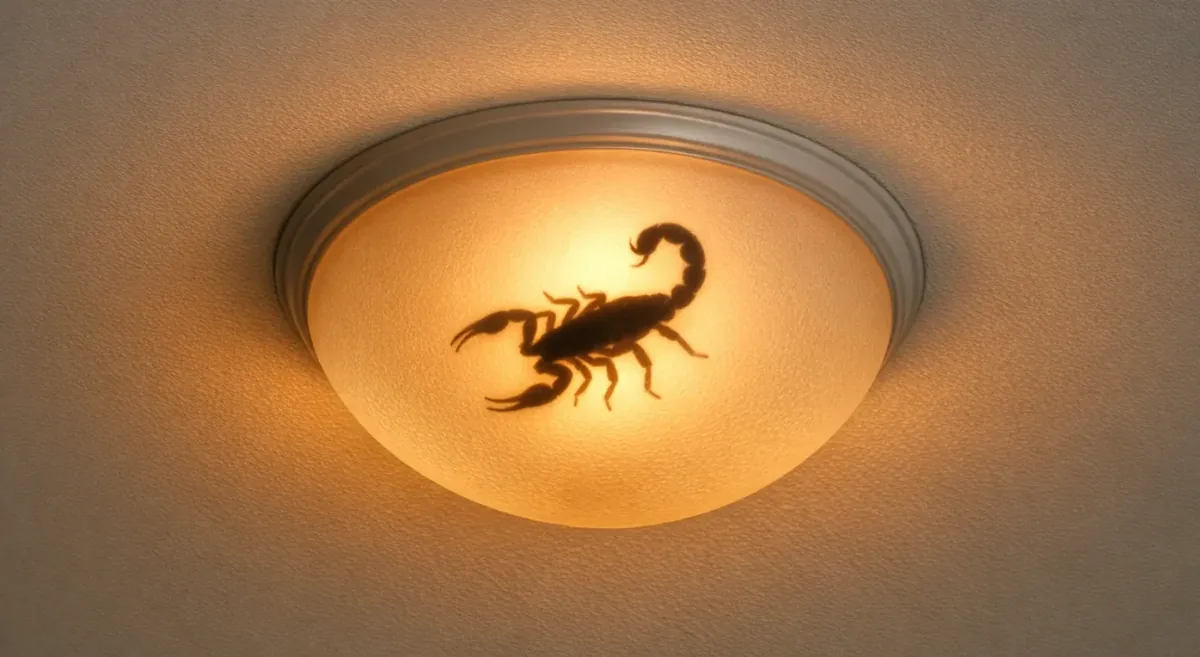
At night. Scorpions rest in cover during the day and hunt after dark. You flip on the bathroom light at 2 a.m. and there it is—a scorpion on the tile next to the toilet. Three habits help: keep shoes off the floor, shake out shoes and towels before use, and take a quick glance around the room before walking barefoot.
What weather changes can cause a sudden spike in sightings?
Heat waves, rain, and wind can all drive them indoors. Here's a simple 48-hour plan after a storm: dim or reduce exterior lighting that draws the insects scorpions eat, tidy up garage edges and clutter, and confirm your door sweeps still seal tight. Small moves in the right window can make a real difference.
How dangerous are scorpion stings in Carlsbad, and what should you do right away?
Most scorpion stings in Carlsbad are painful but not life-threatening for healthy adults—closer to a bad bee sting than an emergency. Children, older adults, and anyone with severe or spreading symptoms deserve urgent attention. Knowing the red flags and the first-response steps keeps a scary moment from becoming a dangerous one.
What does a typical scorpion sting feel like?
Expect immediate sharp or burning pain at the site, often followed by tingling, numbness, and mild swelling. For the striped bark scorpion common in this region, that local pain typically eases within 15 to 20 minutes, and severe systemic reactions are rare, per Yamashita & Rhoads 2017. Reactions vary from person to person, so watch closely for the first hour.
When should you call Poison Control or go to urgent care?
Call Poison Control at 1-800-222-1222 if you see any of these, especially in a child:
- Trouble breathing
- Difficulty swallowing or excessive drooling
- Severe muscle twitching or jerking of the arms and legs
- Roving or uncontrolled eye movements
- Symptoms spreading beyond the sting site
Children face the highest risk of serious reactions, so err on the side of caution—when in doubt, call. You can read more about why children are more at risk from scorpion stings here.
What should you do in the first 10 minutes after a sting?
Move through these steps calmly:
- Wash the area with soap and water.
- Remove tight rings, watches, or jewelry near the sting before swelling starts.
- Apply a cool compress or ice pack wrapped in cloth for 10 minutes at a time.
- Keep the person calm and the limb still—anxiety and movement can make symptoms feel worse.
- Take an over-the-counter pain reliever if appropriate.
Don't cut the wound, try to suck out venom, or apply heat—those old remedies do more harm than good. For a deeper walkthrough, see our bark scorpion sting first aid guide for the first 30 minutes.
How do you prevent a second sting that same night?
Get the stung person to a safe, well-lit spot first. Then, without putting yourself at risk, try to locate the scorpion—turn on the lights and check floor edges and baseboards where they travel. Close door gaps, avoid walking barefoot, and keep an eye on the room's perimeter until you're sure it's gone. Where one scorpion appears, another may be nearby.
How can you keep scorpions out of your Carlsbad home—and catch them before they sting?
The best results come from layering four things: sealing gaps, removing outdoor harborage, cutting off the insect prey that draws scorpions, and monitoring room perimeters at night. No single step fixes it by itself, but stacked together they dramatically lower the odds a scorpion ever reaches your bare feet.
What are the highest-impact seal-up fixes for Carlsbad homes?
Start where gaps are widest:
- Install or replace exterior door sweeps
- Add fresh weatherstripping around door frames
- Seal garage door side and bottom gaps
- Caulk utility penetrations where pipes and wires enter walls
- Close window and slider track gaps
The guiding principle: if light or air passes through, a scorpion can too. For the full breakdown, see the top 5 ways scorpions get into your home.
What yard and garage changes reduce scorpion pressure fast?
Move rock and wood piles away from the foundation, thin out clutter, and store items in sealed bins off the floor. Manage moisture pockets around hoses and irrigation lines, and dial back bright outdoor lighting that attracts the insects scorpions hunt. These changes shrink the habitat right against your walls. Learn more about the top 5 things that attract scorpions, and skip the products that don't work by reading the top myths about scorpion repellents.
How do you monitor for scorpions at night without constant flashlight patrols?
Scorpions are thigmotactic—they navigate by hugging walls, baseboards, and furniture edges. That predictable behavior makes the room perimeter the smartest place to watch, and it's why nightly flashlight patrols are so tedious: you'd have to sweep every edge, every night, just to catch a nocturnal animal in the act.
An automated system like Scorpion Alert handles that for you. The Detectors plug into standard wall outlets along the perimeter and shine 365nm UV light onto the floor, making any scorpion glow that distinctive greenish color. When one crosses the light, the system sends a photo-verified alert to your phone within seconds. For families who want real-time awareness—and the peace of mind that comes with it—it's one tool among several worth considering. And if you spot one yourself, know what not to do after spotting a scorpion.
Where should you place monitors or detectors in a Carlsbad home?
Prioritize the spots where scorpions enter and where people are most vulnerable: near front, back, garage, and patio doors; in bedrooms and kids' rooms; and in water-adjacent rooms like bathrooms and the laundry. Adding more units widens your coverage and helps you learn each room's pattern—so instead of stepping on a surprise at 2 a.m., you get a heads-up the moment one shows up.
Scorpion Alert rents plug-in Scorpion Detectors as part of a simple monthly monitoring subscription—the hardware is included. The hardware is included; pricing is per Detector per month and drops as you add Detectors — see the live calculator at scorpionalert.com/pricing for current rates. There's no long-term contract; cancel any time by emailing support@scorpionalert.com and returning the Detectors. Get started with Scorpion Alert and sleep easier tonight.
Living in Carlsbad, New Mexico means staying mindful of where scorpions like to hide—especially around patios, garages, and yard clutter after dark—so you can reduce surprise encounters. If you want an extra layer of confidence at night, Scorpion Alert uses 365nm UV plus two-stage AI detection to help spot scorpions and cut down on false alarms; learn more at Scorpion Alert.