Do roadrunners really help with scorpion control around my house?
Roadrunners can eat scorpions, but they won't reliably clear a scorpion problem on their own. They're mostly daytime hunters, while scorpions are mostly active after dark, so the two rarely cross paths during peak hours. A resident bird may trim outdoor numbers, but it can't patrol your walls, garage, or bedroom at 2 a.m.
Results vary a lot from yard to yard. A greater roadrunner defends a large territory, and its menu shifts to whatever's easiest to catch. If your neighborhood has plenty of lizards and insects, the bird may barely bother with scorpions. That's why roadrunners and scorpion control are a useful pairing outdoors—but never a real fix for an active indoor problem.
What homeowners can realistically expect
Expect fewer scorpions crossing your patio or driveway during the day—not a scorpion-free home. One bird simply can't cover every corner of a property every single night, and roadrunners don't hunt indoors, inside wall voids, or up in the attic.
Scorpions that already live in the cracks of your foundation or slip inside through a door gap stay well out of a bird's reach. Picture a roadrunner strutting across your gravel at noon while a bark scorpion sleeps in the cool dark under your baseboard. They're in the same yard on completely different schedules.
Why the timing mismatch matters (day bird vs. night scorpions)
Scorpions roam most when it's dark, which is exactly when a roadrunner is roosting. Peak sting hours are 6 p.m. to midnight, according to clinical toxicology data—long after your daytime hunter has clocked out.
That's the core limitation. The most dangerous encounters happen while people sleep, so any real plan has to account for nighttime activity the bird will never see. It's why monitoring and after-dark tactics carry so much weight in a complete approach.
Is a roadrunner a sign there are scorpions nearby?
Not by itself. Roadrunners eat dozens of prey types, so spotting one just tells you your yard supports the insects and lizards it likes. It doesn't confirm a scorpion problem.
Here's a quick self-check: if you're finding scorpions inside the house or garage, you almost certainly have more than the one you saw. In fact, 81.8% of Arizona households where someone was stung had already spotted scorpions on the property, per the Skolnik & Ewald 2018 FEARS survey. A sighting is the strongest warning sign you'll get.
How do roadrunners hunt scorpions and other venomous prey?
Roadrunners hunt with speed, sharp eyesight, and practiced handling. They stalk close, dash in fast, grab prey with the beak, and repeatedly slam it against a rock or the ground to stun and kill it before swallowing headfirst. The viral clips of a bird "smashing prey" show exactly that—a safe way to eat something that bites or stings back.
Their success isn't magic. It comes from immobilizing dangerous prey before it can retaliate, then swallowing it in a direction that folds legs, pincers, and stingers flat.
What a greater roadrunner actually eats in the desert Southwest
The greater roadrunner is an opportunist. Its diet leans heavily on insects, spiders, and other arachnids, small lizards, and the occasional small snake. Scorpions are on the list, but they're a small slice of it.
That matters for backyard ecology. A yard buzzing with insects and lizards is what draws hunting roadrunners in the first place—and, unfortunately, that same insect buffet is one of the top things that attract scorpions to your home. Fix the prey base, and you help both problems.
The 'smash against rocks' tactic (and why it works)
The bashing serves a clear purpose: it stuns or kills the prey so it can't sting or bite, and it softens the body for an easier swallow. For a scorpion, that means the stinger is neutralized before it ever connects.
Yards with natural flagstone or rock give a roadrunner handy "handling spots." Don't take that as permission to build rock piles, though. Stacked rock and stone near the foundation is prime scorpion harborage—you'd be feeding the problem to help the predator.
Can roadrunners neutralize scorpion venom?
Many desert predators carry some tolerance to venom, and roadrunners handle stinging and biting prey well. But tolerance isn't invincibility, and eating a scorpion here and there doesn't make a bird a pest-control machine.
Back to the main point: even a bird that can safely swallow a bark scorpion isn't going to give you a scorpion-free house. What it eats outdoors doesn't touch the ones already living in your walls.
How can I attract roadrunners to my yard without creating more scorpion habitat?
Encourage roadrunners with a clean water source, native shrubs, and a few open hunting lanes—while keeping the yard tidy and free of the clutter that shelters scorpions. The biggest mistake is adding brush piles, stacked rock, or dense debris that invites the very pest you're fighting. Skip rodenticides and broad-spectrum insecticides entirely; both can harm birds through the food chain.
Water, shade, and native cover (the 'stay awhile' basics)
A simple, shallow water dish and some native, drought-tolerant shrubs give a roadrunner reasons to linger. Brushy edges along a property line create cover and hunting lanes without hugging your house.
Keep it selective. Native cover placed away from the foundation is good. Messy leaf piles, wood stacks, and deep crevices right against the wall are not—they're scorpion motels.
What NOT to do: poisons and practices that backfire
Rodenticides poison more than rodents. A predator that eats a poisoned animal can be poisoned too, and heavy insecticide spraying wipes out the insect prey base roadrunners depend on. You can end up with poorer bird habitat and a contaminated food chain.
If you're treating for scorpions, choose a targeted, professional-grade plan over blanketing the yard with broad chemicals. And don't fall for spray-and-forget products—many are covered in our roundup of the top myths about scorpion repellents.
Is it legal to feed or keep a roadrunner?
Roadrunners are wild birds protected under the Migratory Bird Treaty Act. You can't keep one as a pet, and you shouldn't try to hand-feed or handle one. Support the habitat instead—that's the ethical and effective path.
If you find an injured roadrunner, don't intervene directly. Contact a licensed local wildlife rehabilitator and let a professional take it from there.
Are natural predators enough for real scorpion population reduction?
Predators can contribute to scorpion population reduction, but they're unreliable as a homeowner's only strategy when sightings are frequent. Territory size, seasonal shifts, and the fact that scorpions thrive in manmade cracks and voids all limit what any predator can do. A yard full of hunters still won't reach the scorpion tucked behind your water heater.
Which natural predators of scorpions matter most near homes?
Beyond roadrunners, several animals prey on scorpions around Southwest homes:
- Some lizards and geckos
- Owls and other nocturnal birds
- Various insectivorous and omnivorous wildlife, plus larger predatory insects
The practical takeaway is simple: these predators help outdoors, but none of them will patrol your bedroom or bathroom at night.
Why you can still find scorpions even with predators nearby
Think pressure versus elimination. Predators knock down some of the population, but scorpions hide brilliantly, reproduce steadily, and exploit the cracks and gaps we hand them. Reducing pressure isn't the same as clearing an infestation.
So if you're finding scorpions indoors, more wildlife isn't the answer—you need an indoor plan. Most stings happen on extremities at home, and that risk lives inside your walls, not out on the gravel.
Myth check: "If I have roadrunners, I don't need pest control"
Roadrunners are genuinely helpful, but they're inconsistent, and leaning on them alone delays the steps that actually work. Waiting for a bird to solve an indoor problem just gives scorpions more time to settle in.
The better move is integration: pair the natural-predator benefit with monitoring, exclusion, and targeted treatment. That's exactly what the next section lays out.
What should I do if I still find scorpions in my home—even with roadrunners nearby?
Build an integrated plan: confirm activity, reduce harborage and prey, seal entry points, and add nighttime detection. Roadrunners are one small outdoor layer; the rest of the work happens at and inside your home. If you just found one and you're wondering "are there more?"—the honest answer is usually yes, and a steady plan is how you get ahead of it.
Start with fast, reliable confirmation (night checks and monitoring)
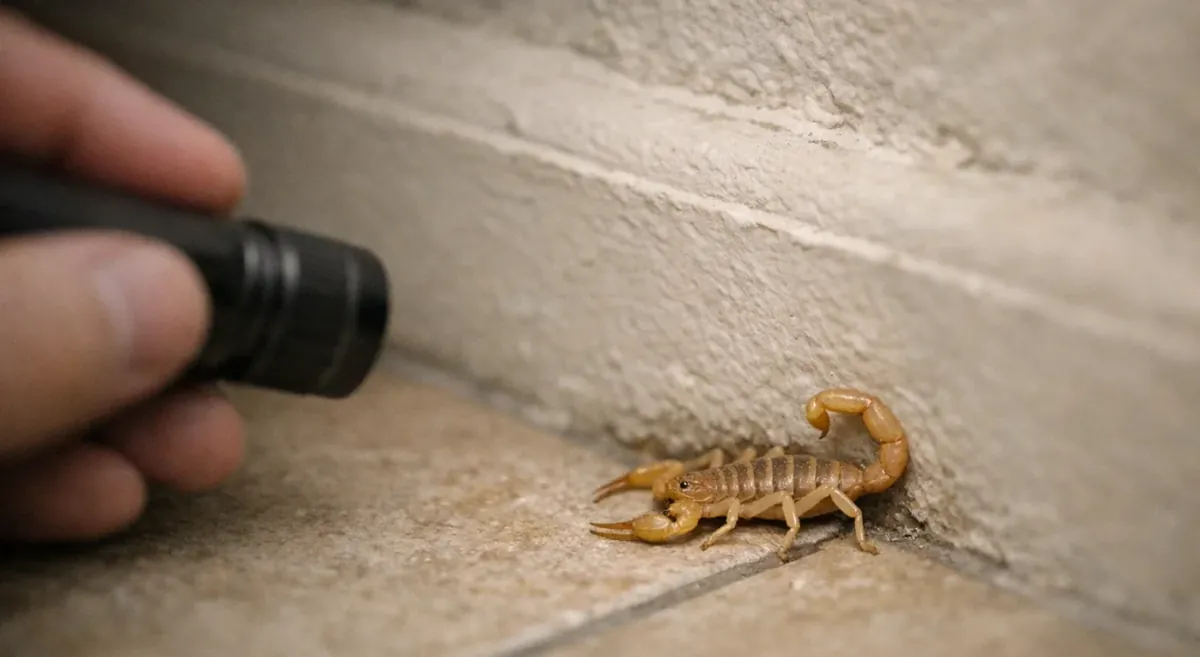
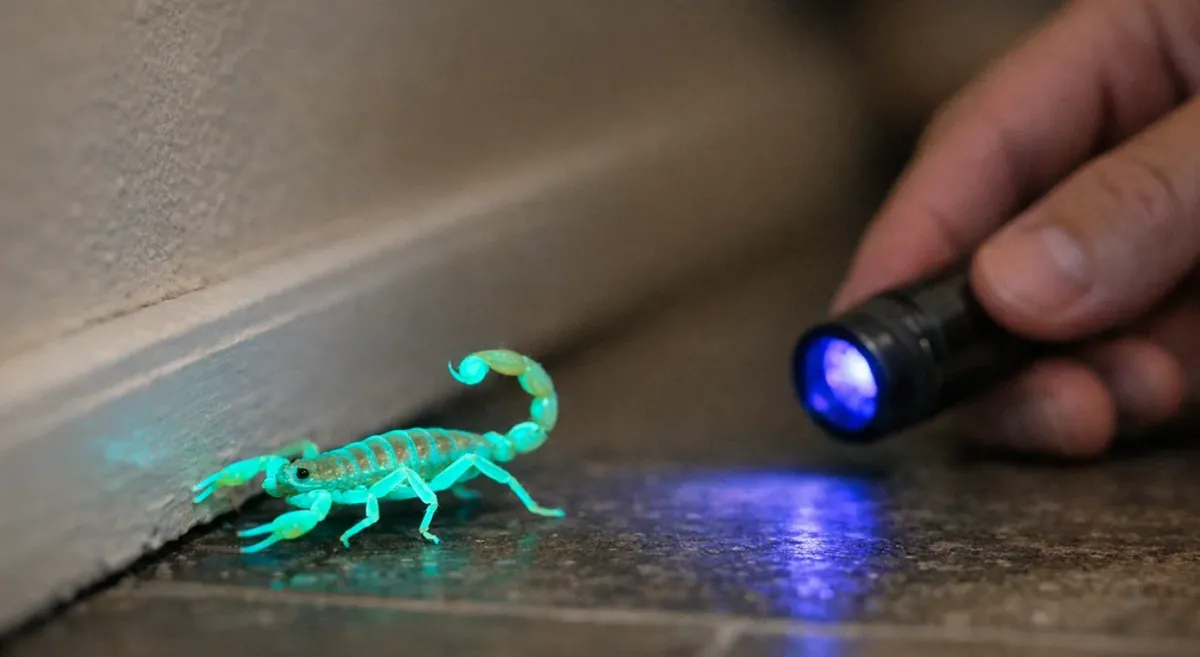
Scorpions glow a bright greenish color under 365nm UV light, which makes a UV flashlight useful for confirming exactly where activity is concentrated when you already suspect a problem. Because scorpions are thigmotactic—they navigate by hugging walls and edges—the highest-leverage places to check are room perimeters and baseboards. That's where they travel, so that's where monitoring pays off.
Manual sweeps can confirm a hot spot, but doing them every single night isn't practical. Automated detection handles the nightly watch so you don't have to.
Seal and simplify: reduce the places scorpions hide and enter
High-impact home steps make the biggest difference, and most of them are cheap:
- Seal cracks and gaps in the foundation, around pipes, and along the slab.
- Install or tighten door sweeps and weatherstripping on exterior doors and the garage.
- Clear clutter and harborage—boxes, wood, and debris—away from the structure.
For the full breakdown, see our guide to the top ways scorpions get into your home. Remember the balance from earlier: brush and rock can support roadrunners, but placed against the foundation they shelter scorpions instead.
Pair nature with proven tools (monthly pest control + smart detection)
When sightings are frequent, many homeowners add monthly pest control for steady, ongoing pressure that a bird can't provide. It keeps treatment fresh around the perimeter where scorpions travel.
Layer detection on top of that. Scorpion Alert Detectors plug into standard outlets along the room perimeter and shine 365nm UV onto the floor below, making scorpions fluoresce. They scan automatically only when the room is dark, capture frames roughly every 500ms, and send a photo-verified alert to your phone after two-stage AI confirmation—so you find out within seconds, not when you step on one.
Where to place detection and what to do when you get an alert
Put Detectors where scorpions enter and where a sting would be worst: near exterior doors and the garage, plus bedrooms, nurseries, bathrooms, and the laundry room. Children face higher stakes from stings, which is one more reason to prioritize rooms where kids sleep and play.
Here's the safe response workflow when an alert comes in:
- Open the app and confirm the scorpion in the photo the Detector sent.
- Grab a UV flashlight and a glass, then go to the room that triggered.
- Find the glowing scorpion, trap it under the glass, and slide a card underneath.
- Release it well outside—and avoid the common mistakes in what not to do after spotting a scorpion.
Real-time alerts beat sticky traps, which collect dust and debris, miss most scorpions, and can even draw them in by trapping insects at the edges. A roadrunner outside is a nice bonus. Inside, you want to know the moment something moves—not weeks later.
Roadrunners can be a helpful, natural check on scorpion activity, but they won’t stop scorpions from finding shelter in block walls, yards, and clutter close to your home. If you want a clearer picture of what’s happening around your property—alongside the practical habitat steps you’ve learned here—Scorpion Alert can help you track risk and stay ahead of unwanted sightings.