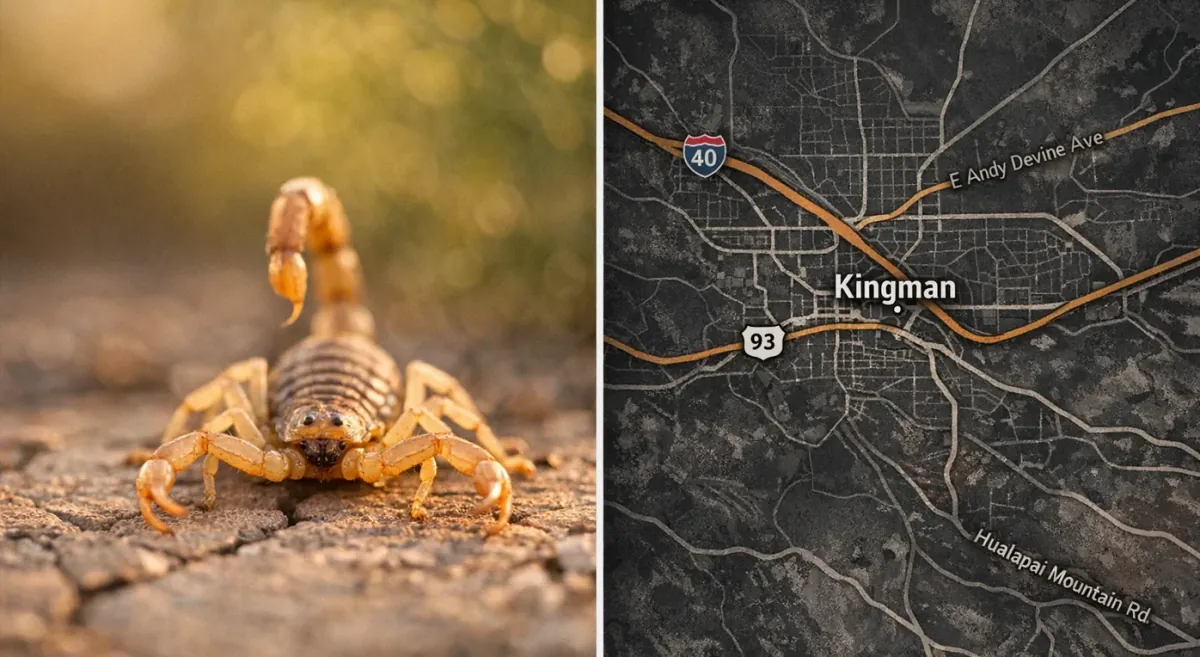
Are scorpions a problem in Kingman?
Yes — Kingman sits in high scorpion country. This part of Mohave County, Arizona has the warm nights, rocky ground, and desert insects scorpions thrive on, so occasional sightings in the yard and the occasional indoor encounter are normal here. Most stings are painful, not life-threatening, and a single sighting rarely means an infestation.
Arizona carries the lion's share of the country's scorpion activity. Statewide, 68.2% of all US scorpion exposures reported to poison control from 2005 to 2015 happened in Arizona, according to Kang & Brooks 2017. Scorpions in Kingman, Arizona share that same desert profile, which is why the area earns a "high" relevance rating.
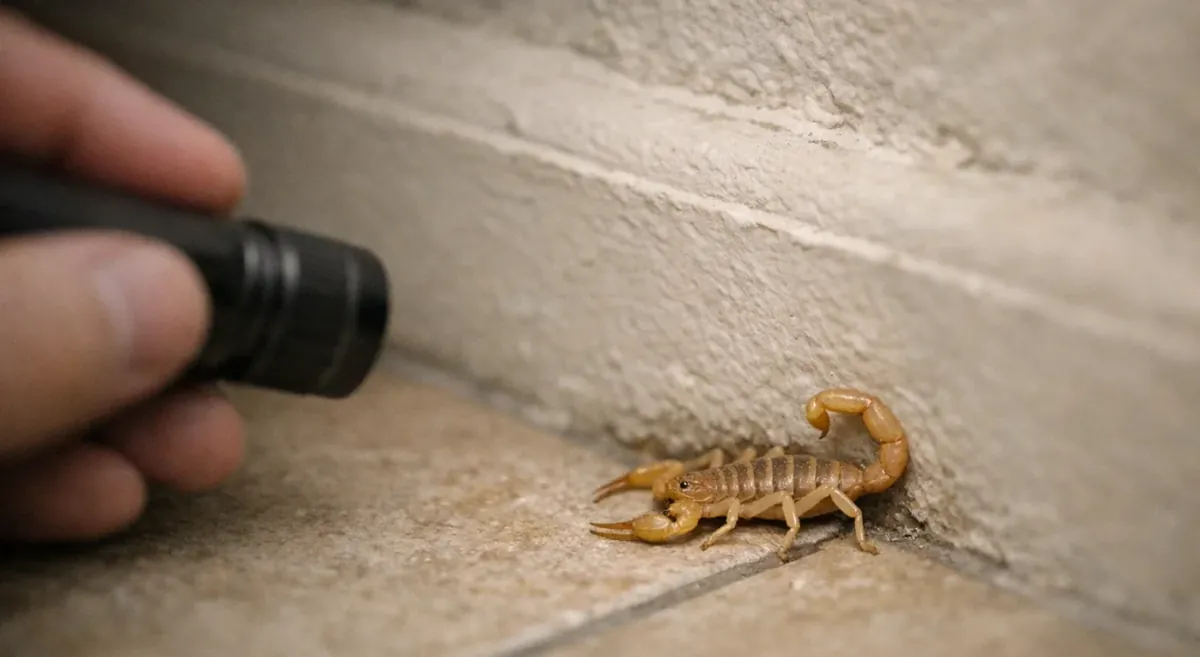
Sightings feel sudden because scorpions are nocturnal and secretive. They spend daylight hours tucked into cracks and shaded spots, then move after dark. You don't see the buildup — you just flip on the garage light one night and there one is, frozen against the baseboard.
What "high scorpion relevance" should mean for a Kingman homeowner
High relevance means you should expect occasional yard sightings and a real chance of one wandering indoors — not that your home is overrun. One scorpion on the patio in August is ordinary. A pattern is different.
Watch for these signals that you may have a recurring issue:
- Repeat sightings in the same week or same spot
- Scorpions found in more than one room
- Heavy cricket or other insect activity (scorpion food) near the house
- Any sighting in a bedroom or bathroom, where contact risk is higher
Two or more of those together is your cue to think seriously about scorpion control rather than shrugging off a one-off.
Where scorpions are most likely to show up around Kingman homes
Scorpions gravitate toward cool, dark, sheltered spots close to the structure. Around Kingman properties, that usually means rock borders, decorative gravel, block walls, woodpiles, and cluttered storage against the foundation. Bathrooms, laundry rooms, and garages are the common indoor harborage sites, per Kang & Brooks 2017.
Here's the behavior that ties it all together: scorpions are thigmotactic, meaning they navigate by hugging surfaces and edges. At night, they trace baseboards, wall bases, and the borders of furniture rather than crossing open floor. That single fact shapes almost everything in the prevention section below.
Is it normal to see scorpions inside, or is that a red flag?
One indoor scorpion, once, is usually a stray that wandered in through a gap — not a red flag. The same scorpion showing up in the same room week after week is a pattern worth acting on. The difference is repetition and location.
Start tracking sightings by date, time, and room. That simple log tells you whether you're dealing with random visitors or a defined entry zone, and it gives a pest professional something concrete to work from. If you've just found one, read what not to do after spotting a scorpion in your home before you react.
Which scorpion species lives in Kingman?
There's no single confirmed "main" species for Kingman in the community sighting data, so it's fair to say the wider Mohave County area likely hosts more than one. The medically important one to know is the Arizona bark scorpion (Centruroides sculpturatus), alongside larger, less dangerous ground and desert hairy scorpions common across northwestern Arizona.
Because Kingman didn't surface one dominant iNaturalist species, treat identification as a guide to risk, not a lab result. Knowing whether you're looking at a slender bark scorpion versus a bulky desert hairy scorpion changes how cautious you should be.
Why this page doesn't list one 'main' iNat species for Kingman
Community sighting platforms rely on people photographing and uploading what they find, and coverage is thin in many desert towns. When no single species dominates the record, it usually reflects gaps in reporting — not that only one kind of scorpion is present. Species can genuinely vary block to block depending on soil, rock, and vegetation.
If you're unsure what you have, don't fixate on a perfect ID. Focus your energy on risk awareness and prevention steps, which are largely the same regardless of species.
How to identify a scorpion in Kingman without getting close
You can tell a lot from a safe distance. Use these cues, and never handle the animal:
- Tail and pincers: a thin tail with slender pincers points toward a bark scorpion (the venomous one); thick pincers and a bulky body suggest a less dangerous species.
- Size and color: bark scorpions are small (about 2–3 inches) and light tan; desert hairy scorpions are much larger and darker.
- Where you found it: one clinging to a wall or baseboard indoors is more likely a bark scorpion than one out in the rocks.
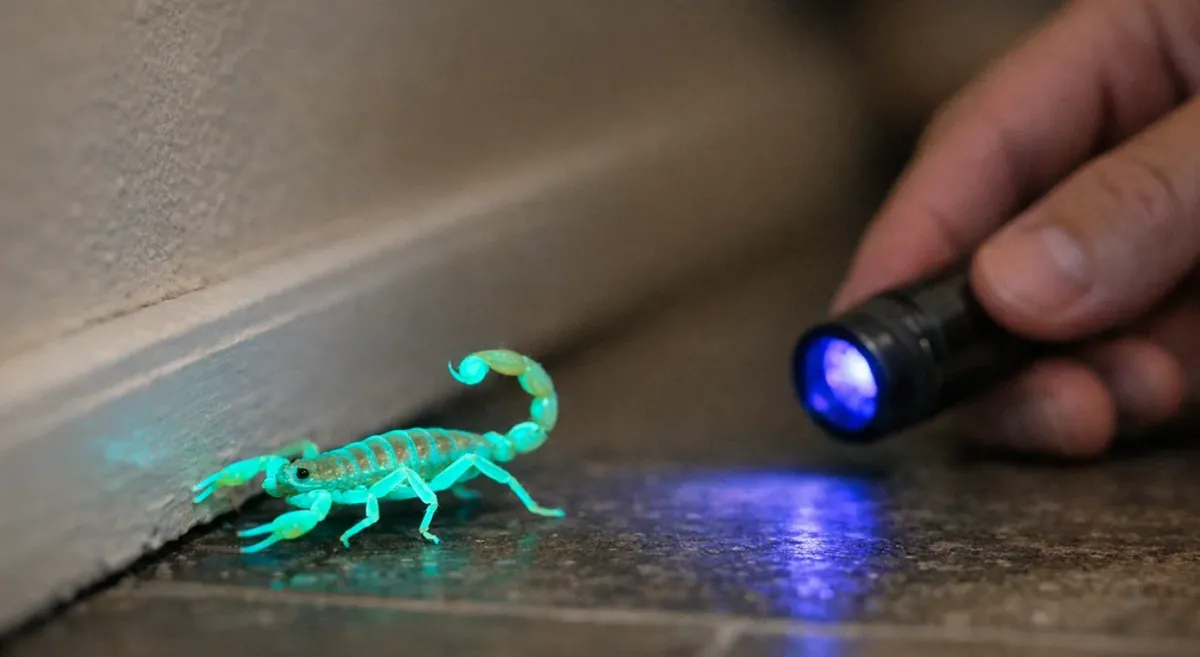
At night, a UV flashlight makes them glow bright greenish — the easiest way to spot one. Snap a photo from a safe distance so a local pro can confirm the species later.
Do different species change how you handle Kingman scorpion control?
Not much. Whatever species you have, effective control comes down to the same three levers: exclusion (sealing them out), reducing harborage (cutting hiding spots), and monitoring (knowing when and where they show up). Species only really matters at the moment of a sting, when it informs medical response.
Because control is so consistent across species, the smart move is a system that works overnight along room edges — exactly where scorpions travel. More on that in the prevention section.
When are scorpions most active in Kingman?
Scorpions are active in Kingman from spring through fall, peaking in the hottest, most humid stretch of summer — roughly August and September — and moving mostly after dark. Warm nights, monsoon moisture, and a surge of prey insects all combine to push activity to its yearly high in late summer.
Nationwide, summer accounts for the overwhelming majority of scorpion cases, and in Arizona August and September are the peak envenomation months, coinciding with monsoon warmth and humidity.
Scorpion season Kingman: the months to be extra alert
Think of April through October as the active window, with the sharpest spike during the monsoon weeks of mid-to-late summer. Moisture brings out the insects scorpions hunt, and warm overnight temperatures keep them moving longer.
During peak weeks, tighten a few routines: shake out shoes and slippers before putting them on, check bedding before you climb in, and give the patio a quick scan with a UV light before letting kids or pets out at night. For a full month-by-month breakdown, see our scorpion season 2026 guide for Arizona.
What time of night are scorpions most likely to move?
The danger window is early evening into the small hours. Roughly 49% of envenomations happen between 6 PM and midnight, with a secondary morning peak, according to Isbister & Bawaskar 2014. Scorpions are simply nocturnal hunters.
That timing is the whole problem. You're asleep when they're most active, which is why you often don't see one until you step on it. Prevention and monitoring have to work overnight to matter at all.
Do scorpions climb walls in Kingman homes?
Yes. Arizona bark scorpions are strong climbers and readily scale rough vertical surfaces like stucco, block, and wood. That ability is a documented driver of where they end up indoors, per Kang & Brooks 2017.
The practical takeaways are simple. Pull beds a few inches off the wall and skip the bed skirt, since a scorpion can use draped fabric as a ramp onto the mattress. Keep curtains and blankets from pooling on the floor, and seal vertical routes where plumbing and utility lines pass through walls.
How dangerous is a scorpion sting in Kingman?
For a healthy adult, most scorpion stings in Kingman are painful but not medically dangerous — think a bad bee sting with burning and numbness that fades over hours. The serious risk is concentrated in bark scorpion stings to young children, infants, and older or medically fragile adults, where venom can trigger systemic effects that need care.
Arizona reports the highest rates of sensory, neuromuscular, and respiratory effects and the highest hospitalization rates of any state, according to Kang & Brooks 2017. Locally, the Arizona Poison & Drug Information Center logged 17 scorpion exposures and 37 envenomations in Mohave County in 2025 — a reminder that stings here are real, but manageable.
Scorpion sting Kingman: common symptoms vs. red flags
Most people feel immediate, intense pain at the site, often with tingling and numbness. Pain occurs in 88.9% of stings and local numbness in 62.2%, per Klotz et al. 2021. Those localized symptoms alone usually don't require the ER.
According to Dr. Meghan Spyres, medical toxicologist at Banner Poison and Drug Information Center, scorpion venom "can also cause involuntary muscle movement — so jerking of the arms and legs — and even more severe, in some cases, it can cause difficulty swallowing. People's eyes can move around in weird directions."
Don't wait if you see any of these red flags: trouble breathing or swallowing, severe muscle twitching or jerking, roving or uncontrolled eye movements, drooling, or intense whole-body symptoms — especially in a child. Those signs mean get medical help now.
Who is most at risk in Mohave County households?
Children under 10 have the highest rates of systemic effects, hospitalization, and ICU admission, per Kang & Brooks 2017. Small bodies process the same dose of venom far harder than an adult does, and infants have narrow airways that secretions can overwhelm.
Older adults, people with heart or breathing conditions, and pets also warrant extra caution. Plan ahead: keep the Poison Help line saved in your phone and know your after-hours options. Our guide on why children are more at risk from scorpion stings is worth a read if you have little ones at home.
Does species matter for sting severity in Kingman?
It matters in theory, but rarely in the moment. Because no single dominant species is confirmed for Kingman and you often won't get a clear look at what stung you, don't burn time trying to identify the animal. Let symptoms drive your decisions.
Serious systemic signs deserve urgent care no matter what stung you. Localized pain that stays localized can usually be managed at home while you watch for change.
What to do if you're stung in Kingman
Stay calm, wash the area, apply a cold compress, and monitor closely — most Kingman stings can be handled at home this way. Call the free Poison Help line at 1-800-222-1222 for guidance, and escalate to urgent care or 911 if red-flag symptoms appear, especially in a child.
First 10 minutes: what to do right away
Move through these steps in order:
- Wash the sting site gently with soap and water.
- Apply a cold compress or ice pack (wrapped in cloth) to ease pain and swelling.
- Remove rings, watches, or anything tight near the sting in case of swelling.
- Keep the person calm and still, and take over-the-counter pain relief if appropriate.
- Watch closely for the next few hours, noting any spreading or worsening symptoms.
Skip the folk remedies — cutting, suction, and household concoctions don't help and only delay real care. Our bark scorpion sting first-aid guide for the first 30 minutes walks through this in more detail.
When to call Poison Control, urgent care, or 911
Call Poison Control at 1-800-222-1222 for any sting where you're unsure — it's free, staffed around the clock, and they'll tell you whether you need to go anywhere. As Dr. Frank LoVecchio of Banner Poison and Drug Information Center puts it, "Don't feel that you have to call 911 right away. You can call us and if we feel you have to call 911 we can patch in with 911."
Go straight to emergency care — or call 911 — for trouble breathing or swallowing, severe muscle jerking, or abnormal eye movements. Have this ready: the person's age and weight, the time of the sting, symptoms so far, and where on the body it happened. If you can photograph the scorpion safely, do it — but never chase one barefoot across a dark floor.
That same night: how to prevent a second sting
Where there's one scorpion, there may be another, so make the house safer before bed. Turn on lights, shake out any shoes and clothing on the floor, and check bedding before anyone climbs in. Clear a lit path to the bathroom for overnight trips.
Then do a quick perimeter sweep with a UV flashlight, focusing on floors and baseboards — the edges scorpions travel. Keep kids and pets off the floor in the affected room until you've swept it.
How to keep scorpions out of your Kingman home
Effective scorpion control in Kingman layers four things in order: fast, easy wins tonight; sealing entry points; cutting outdoor harborage; and ongoing monitoring so you know it's working. Since 97.8% of scorpion envenomations happen inside the home (Kang & Brooks 2017), keeping them out of your living space is where prevention pays off.
Fast wins you can do tonight (no special tools)
Start by attacking edge clutter, because scorpions follow perimeters:
- Clear items stacked along walls and baseboards, especially in bedrooms and closets.
- Pull beds a few inches off the wall and ditch floor-length bed skirts.
- Store shoes in sealed bins instead of loose on the floor, and shake them out before wearing.
- Keep pet food and water off the floor overnight and wipe up spills.
- Wear closed-toe slippers around the house at night.
These cost nothing and directly cut the contact scenarios that lead to stings.
Exclusion: the Kingman-specific entry points to seal first
Scorpions squeeze through gaps as thin as a credit card, so sealing is your highest-value work. Prioritize these openings:
- Install tight door sweeps on exterior and garage doors — the garage threshold is a classic gap.
- Seal around plumbing penetrations under sinks and behind appliances.
- Caulk cracks where the slab meets the wall and around AC line sets.
- Screen or address weep holes appropriately.
- Fill cracks around window frames and utility entries.
Sealing works even when scorpions are active outdoors — it just keeps encounters where they belong. Our guide to the top 5 ways scorpions get into your home covers the priority list in depth.
Yard and block-wall habits that reduce Mohave County scorpions near the foundation
Your yard sets the pressure on your walls. Move woodpiles, rock stacks, and stored materials away from the foundation, since these are prime harborage. Trim shrubs and tree limbs so nothing touches the house and forms a bridge.
Reduce moisture from leaky irrigation and hose bibs, which draws both scorpions and the insects they eat. Controlling that prey base matters — a cricket problem often precedes a scorpion problem. See the top 5 things that attract scorpions to spot what's inviting them in.
Ongoing monitoring: how to know if your plan is working
Keep a simple log — dates, rooms, and weather for every sighting. Over two to six weeks, success looks like fewer sightings, none indoors, and none repeating in the same room. Rising or clustered sightings mean it's time to escalate.
The catch is that scorpions move while you sleep, and past sightings are the single strongest predictor of a future sting — so the hardest gap to close is overnight visibility. That's where Scorpion Alert fits. Its detectors plug into standard wall outlets right on the room perimeter where scorpions travel, shine 365nm UV light onto the floor, and send a photo-verified alert to your phone within seconds of a detection — automatically, only when the room is dark, with no nightly blacklight walks required. Install one in any room where a scorpion has shown up before, and the app's history log doubles as the monitoring record that tells you whether your plan is working.
Scorpion Alert rents its Detectors through a monthly monitoring subscription, with a one-time shipping fee at checkout. See
/pricing for current rates. There's no long-term contract — cancel any time by emailing
support@scorpionalert.com and returning the Detectors. For a Kingman family that keeps finding scorpions after dark, it's the hands-off way to finally see what's moving while you sleep. Learn more at
scorpionalert.com.
In Kingman, scorpions can show up when you least expect them—especially during warm nights—so the goal is turning “I hope there aren’t any” into “I know what’s out there.” If you want an extra layer of confidence, Scorpion Alert uses UV-based detection with photo-verified, real-time notifications to help you spot activity fast; learn more at Scorpion Alert.