Are scorpions a problem in Summerlin South?
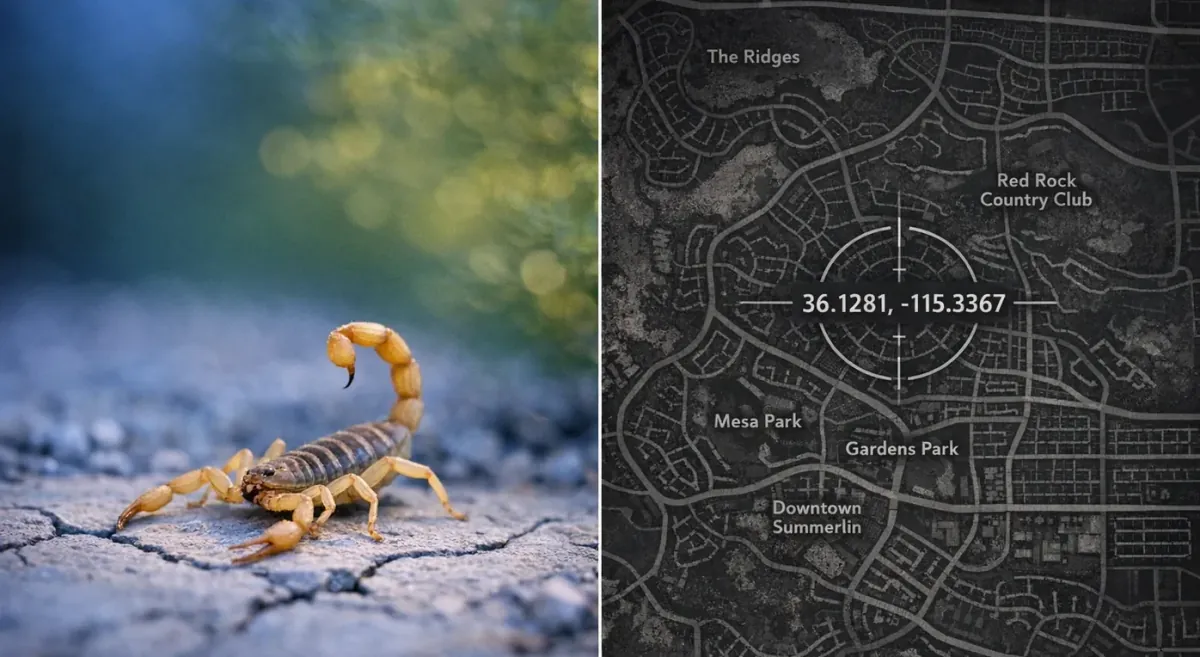
Yes — scorpions are a real, active presence in Summerlin South. This part of Clark County sits squarely in scorpion country, and citizen-science records show hundreds of local observations, including the medically significant Arizona bark scorpion. Sightings here are seasonal, but common enough that most homeowners will eventually cross paths with one.
Within 30km of Summerlin South, naturalists have logged 356 research-grade scorpion observations on iNaturalist between 2002 and 2026. That's not a desert myth — it's your neighborhood. And while Arizona dominates the national picture, southern Nevada is climbing. A follow-up analysis of poison-control data in Kang & Brooks 2017 found growing exposure counts in Clark County specifically.
What "high scorpion relevance" means for your neighborhood
"High relevance" means you should plan around scorpions the way you'd plan around summer heat — as a predictable seasonal reality, not a freak event. In practical terms, expect occasional sightings during the warm months, a stronger case for sealing your home's exterior, and real value in monitoring bedrooms where kids sleep. Being proactive here isn't paranoia — it's how families in this area sleep easier.
Are Clark County scorpions likely to wander indoors?
They can, and they do. Scorpions come inside chasing three things: shelter, water, and the insects they eat. When the daytime heat spikes or the ground dries out, your cool, plumbed, air-conditioned home starts looking like prime real estate.
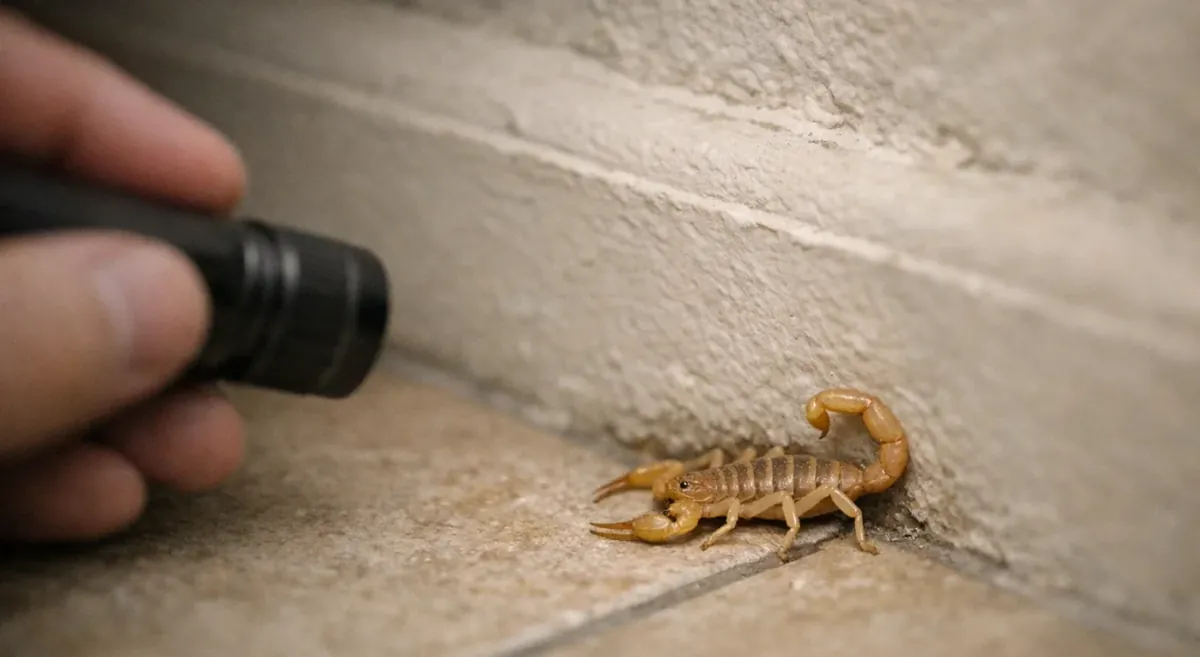
Here's the part most people miss — a spotless home isn't scorpion-proof. Scorpions are thigmotactic, meaning they navigate by hugging surfaces and edges. They can slip under a door sweep, then trace the baseboards along your walls. That's why you find them in corners, along thresholds, and next to furniture rather than out in the open middle of a room.
If I saw one scorpion, does that mean there are more?
Not necessarily — but don't assume it was a one-off, either. A single scorpion might be a lone traveler that wandered in. It can also signal nearby harborage or a healthy insect population feeding them just outside your walls.
The smart move is to document it. Note the date, time, and exact spot where you saw it. That log becomes useful later when you compare it against the local activity season and decide where to focus your defenses.
Which scorpion species lives in Summerlin South?
The primary scorpion species around Summerlin South is the Arizona bark scorpion (Centruroides sculpturatus), which accounts for 148 of the local iNaturalist records — the most of any species logged nearby. This matters because the bark scorpion is the one species in the region capable of a medically serious sting, so correct identification shapes your whole control plan.
Primary local species: Arizona Bark Scorpion
iNaturalist data points to the Arizona bark scorpion as the dominant species in and around Summerlin South. It's the most-studied scorpion in the Southwest for a reason: it's the one linked to significant envenomations. The species' range has expanded into parts of Nevada, California, and beyond in recent decades, according to Kang & Brooks 2017. Knowing you likely have bark scorpions — not a harmless desert species — is why sightings deserve to be taken seriously.
Can bark scorpions climb walls and reach beds?
Yes. Bark scorpions are strong climbers, which is exactly why second-floor and bedroom sightings happen. They can scale rough vertical surfaces, work their way up stacked garage storage, and climb a bed skirt to end up in your sheets. The practical takeaway: keep bedding and blankets from draping onto the floor, pull beds and cribs a few inches off the wall, and cut down on climbable clutter that gives them a vertical highway indoors.
Quick ID cues homeowners can use (without handling)
You can spot a likely bark scorpion without touching it. Look for a slender, straw-to-tan body with thin, delicate pincers, rather than a bulky, crab-like build. They tend to be nocturnal and are often found up off the floor or clinging to walls. If you want a pro to confirm it, snap a photo from a safe distance. Never pick one up — even to move it.
When are scorpions most active in Summerlin South?
Scorpions in Summerlin South are most active through the warm months — roughly late spring into early fall — with movement peaking in summer. Encounters climb as temperatures rise, and the vast majority of sting activity happens after dark. Summer accounts for the overwhelming majority of cases across all reporting states, per Kang & Brooks 2017.
Scorpion season in Summerlin South: what months to expect the most encounters
Think of the window as May through September, peaking in the hottest stretch of summer. Warm nights are the key driver. When evening temperatures stay high, scorpions stay out hunting longer, which can stretch the encounter season past what many newcomers expect. A single warm autumn night can still put one on your patio.
Why scorpions are mostly a nighttime problem
"I never see them — until bedtime." That's the classic complaint, and it's simple biology. Scorpions are nocturnal. Peak sting hours run 6 PM to midnight, when roughly 49% of envenomations occur, according to Kang & Brooks 2017. At night they roam along walls and baseboards hunting insects. Any real defense has to work during the dark hours, when they're actually moving.
Do scorpions mate in Summerlin South—and does that change sightings?
Scorpions do mate locally, typically during the warm season, and that can shift how much they move around. Don't overthink it, though. Finding one doesn't mean a mate is nearby, and scorpions don't reliably travel in pairs. Base your plan on entry points and hiding spots, not on the assumption that a second one is always tagging along.
How dangerous is a scorpion sting in Summerlin South?
Most bark scorpion stings in Summerlin South cause intense local pain and aren't life-threatening for healthy adults — but the Arizona bark scorpion is the one regional species that can produce serious symptoms, especially in small children. Because that's the primary local species, stings here deserve real attention rather than a shrug.
What a bark scorpion sting can feel like
The most common symptom is immediate, burning pain at the site — reported in 88.9% of stings in a large Arizona cohort — often followed by tingling or numbness, seen in 62.2% of cases, per Klotz et al. 2021. More serious neurological effects — muscle jerking, roving eye movements, trouble swallowing — are far less common but signal a real emergency. This isn't a diagnosis; when in doubt, get professional medical guidance.
Who is at higher risk in Summerlin South homes?
Children face the highest risk. Kids under 10 have the highest rates of systemic effects, hospitalization, and ICU admission in both Arizona and Nevada data, according to Kang & Brooks 2017. Pets and elderly household members are also more vulnerable. That's why it pays to build your defenses around nurseries and kids' bedrooms first — and why the greater risk to children from scorpion stings is worth reading before summer hits.
When to treat a sting as urgent
Call for help immediately if you notice trouble breathing or swallowing, severe muscle twitching, jerking limbs, unusual eye movements, or any intense full-body reaction — and always treat a sting on a small child as urgent. The Poison Help line, 1-800-222-1222, is staffed 24/7 and can tell you whether you need the ER or can safely monitor at home.
What to do if you're stung in Summerlin South
Stay calm, wash the area, apply ice, and monitor for the red-flag symptoms above. Most stings can be managed at home, but call Poison Help at 1-800-222-1222 for guidance, and go to the ER for any severe or worsening reaction — especially in a child.
Immediate first steps (the first 5 minutes)
- Move away from where you were stung so you don't get hit again.
- Wash the sting site with soap and water.
- Remove rings, watches, or anything tight near the sting in case of swelling.
- Apply a cool pack or ice to ease pain and swelling.
- Stay calm and note the time the sting happened.
- If it's safe, photograph the scorpion — never chase it barefoot.
For the full response window, see our guide to bark scorpion sting first aid in the first 30 minutes.
Who to call and what details to have ready
Call the Poison Help line first — they can patch you through to 911 if needed. Have this ready: the person's age and weight, symptoms and how they're changing, where and when the sting happened, and whether the scorpion looked like a slender bark scorpion. Since that's the primary local species, mention it. Two nearby hospitals are Swanlake Medical Center at 3330 S Hualapai Wy #120, Las Vegas, and Dignity Health – St. Rose Dominican Hospital, West Flamingo, at 9880 W Flamingo Rd, both roughly a mile or two away.
How to avoid a second sting while you handle the situation
Scorpions travel the perimeter — baseboards, thresholds, and edges. Turn on the lights, put on closed-toe shoes, and keep everyone else out of the room while you look. Don't reach blindly under furniture or into piles. A little caution here helps keep one sting from becoming two.
How to keep scorpions out of your Summerlin South home
Effective scorpion control works from the outside in: reduce habitat and prey in the yard, seal the gaps that let them inside, then add targeted night monitoring where it counts. No single step is a silver bullet, but layered together, they make your home a much harder place for a bark scorpion to survive. Scorpions in Summerlin South, Nevada follow the same playbook as elsewhere in the Mojave Desert fringe — and so does the defense.
Start outside: reduce hiding spots and the bugs scorpions eat
Scorpions follow their food. Clear debris, keep firewood and stone piles away from the house, and trim vegetation back from the foundation. Cut down on the insects near your doors — porch lights that draw bugs are basically a dinner bell — and fix leaky spigots or standing water, since scorpions and their prey both need moisture in this dry climate.
Seal and screen: the fastest wins for keeping scorpions out
Sealing your home's shell is the highest-return hour you'll spend. A quick checklist:
- Install tight door sweeps on all exterior doors, including the door to the garage.
- Replace worn weatherstripping around doors and windows.
- Close the gaps along the bottom and sides of the garage door.
- Screen or seal weep holes, vents, and pipe penetrations.
- Caulk cracks where utilities enter and where the wall meets the foundation.
For more on the routes they exploit, read our breakdown of the top ways scorpions get into your home.
Can scorpions climb walls? How to make interiors harder to navigate
Since bark scorpions climb well, deny them the routes. Keep the floor along walls clear of clutter, pull beds and cribs a few inches off the wall, and don't let comforters or bed skirts drape to the floor — that fabric is a ladder straight into the sheets. Break up stacked storage in closets and the garage so there's no easy vertical path up.
Night monitoring: catching scorpions while you sleep
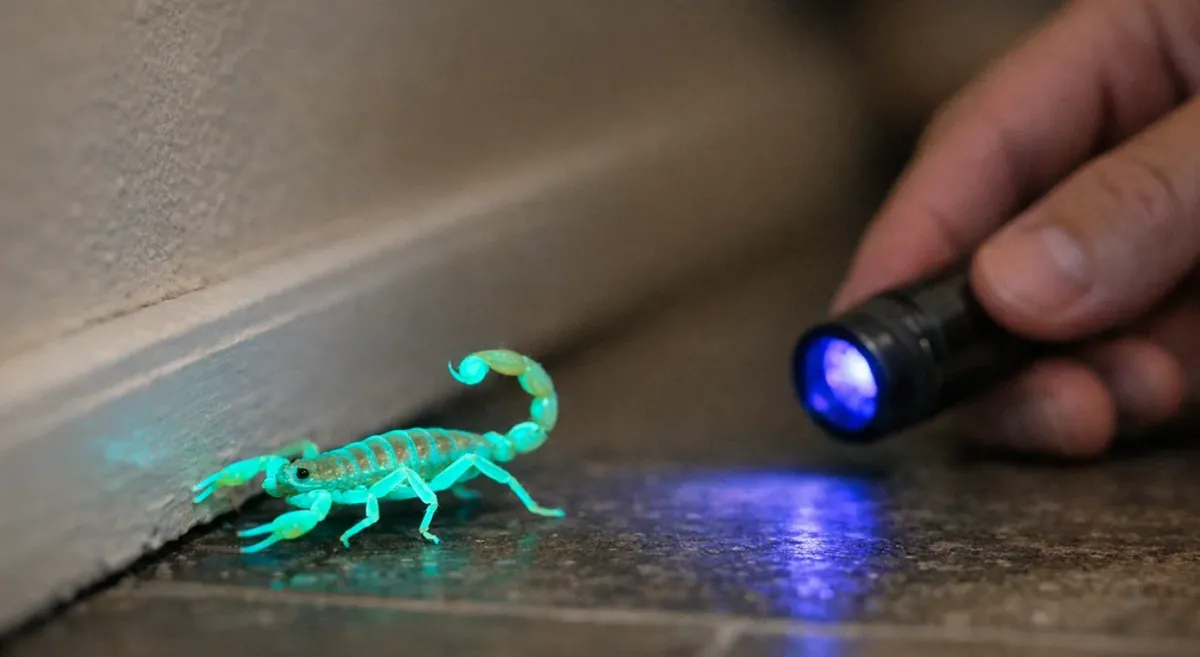
Because scorpions move at night along your walls, monitoring should focus on the dark hours and the room perimeter. This is where a Scorpion Alert Detector earns its keep. It plugs into a standard wall outlet on the room's edge, shines 365nm UV light onto the floor — the wavelength that makes a scorpion glow an eerie green — and sends a photo-verified alert to your phone within seconds of spotting one, scanning only when the room is dark. Instead of stepping on one at 2 a.m., you get a heads-up, grab a UV flashlight and a glass, and remove it on your terms. It beats messy glue traps and tedious flashlight patrols. Also worth knowing: if you've spotted a scorpion before, that spot is your best predictor of the next one — so read what not to do after spotting a scorpion in your home before you react.
Where to place detection/monitoring tools in a Summerlin South layout
Cover your home's weak points. A simple placement map for a typical Summerlin South floor plan: near the front and back doors, at the garage entry, in bathrooms and the laundry room where water draws them, and — most important — in kids' bedrooms. Because scorpions hug the perimeter, more Detectors mean better coverage across the edges of your home. Scorpion Alert rents its Detectors on a monthly monitoring plan starting at $3.50 per Detector per month for a single unit and sliding down to $2.00 at ten or more, with a one-time shipping fee at checkout. There's no long-term contract — cancel any time by emailing support@scorpionalert.com and returning the Detectors. For a scorpion-country neighborhood like this one, that's peace of mind while your family sleeps.
In Summerlin South, Nevada, scorpion activity can spike on warm nights, so it helps to focus on prevention outside and smart checks where they’re most likely to travel. If you want an easier way to confirm what’s really showing up after dark, Scorpion Alert uses 365nm UV detection and night-activated monitoring to help you spot scorpions when they’re active.