Are scorpions a problem in Douglas?
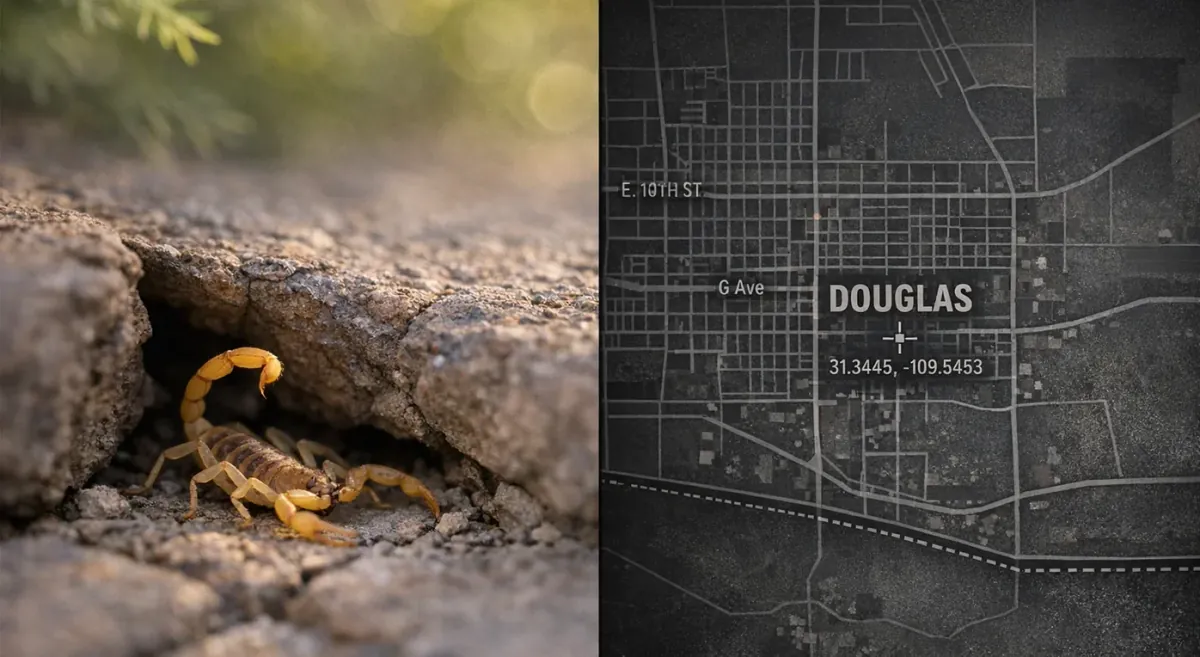
Yes — scorpions are a real and regular part of life in Douglas, Arizona. Sitting on the edge of the Sonoran and Chihuahuan Desert transition in southeastern Cochise County, Douglas has the warm, dry habitat scorpions thrive in. Across Cochise County, the Arizona Poison & Drug Information Center logged 56 scorpion exposures and 10 envenomations in 2025.
Arizona carries the country's heaviest scorpion load by far. 68.2% of all US scorpion exposures reported to poison control between 2005 and 2015 came from Arizona alone, according to Kang & Brooks 2017. So if you found one on your kitchen tile, you're not unlucky — you're living in scorpion country.
Scorpions come indoors chasing three things: water, prey insects, and shelter from heat. That's why the first sighting can feel random — a scorpion by the shower, another near the laundry, then nothing for weeks. Stay calm, don't touch it with bare hands, trap it under a glass if you can, note the room and time, and start thinking about your home's perimeter rather than just the one bug.
Why am I seeing scorpions in my Douglas house?
Scorpions enter Douglas homes through the same small gaps that let insects in — worn door sweeps, gaps under garage thresholds, plumbing penetrations under sinks, and weep gaps along the stucco base of the wall. Older Douglas housing stock and block-wall construction can leave more of these openings than newer builds.
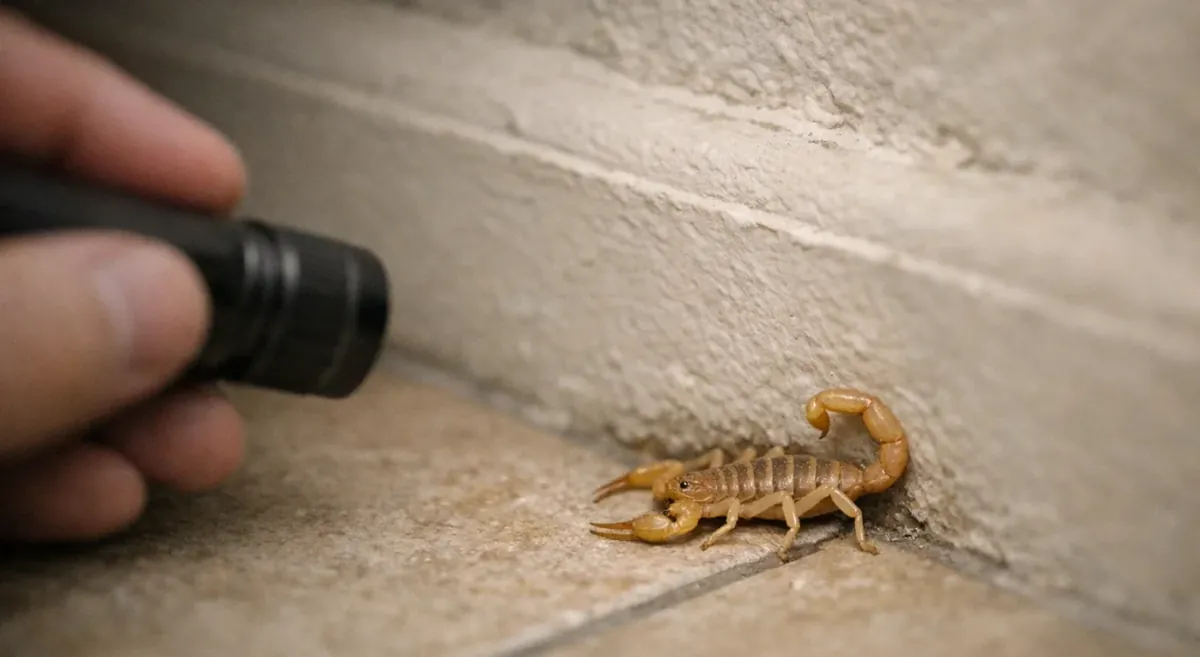
Once inside, scorpions don't wander the middle of the room. They're thigmotactic, meaning they navigate by keeping their bodies pressed against a surface. That's why sightings cluster along baseboards, wall edges, and furniture corners. A single scorpion might be one that slipped in overnight. Repeated sightings in the same area usually point to harborage — a cool, dark pocket nearby where they're sheltering.
Activity often spikes after weather shifts. A hot spell that drives them toward cooler indoor micro-habitats, or monsoon moisture that pushes prey insects indoors, can turn a quiet week into three sightings in a row.
Are Cochise County scorpions different from Phoenix-area problems?
Cochise County scorpions face the same species pressure as much of southern Arizona, but the intensity varies neighborhood to neighborhood. Homes on the desert edge, lots with heavy landscaping or wood piles, and older construction with more wall-base gaps tend to see more scorpions than newer homes in the middle of town.
Because of that variation, tracking sightings by room and date pays off. A pattern near the front door points to an entry-point problem. A pattern that jumps between interior rooms suggests scorpions already living inside. Photo-verified monitoring helps here too — plenty of people aren't even sure they "really saw one," and a time-stamped record removes the guesswork.
Which scorpion species lives in Douglas?
iNaturalist shows no confirmed primary species for Douglas specifically — the city-level dataset is sparse. That doesn't mean scorpions are rare here; it means casual observers simply haven't logged enough verified photos to name one dominant species. For southeastern Arizona and Cochise County, the likely residents include the Arizona bark scorpion (Centruroides sculpturatus), the striped bark scorpion (Centruroides vittatus), and stout desert hairy or giant ground scorpions.
The bark scorpion is the one that matters medically. It's slender, straw-colored to light brown, with thin pincers and a thin tail. Ground and hairy scorpions tend to be stouter, with thicker pincers, and they're generally found in soil clutter rather than up on walls. Never rely on color alone — lighting and juvenile stages fool people constantly.
The safety rule is simple: don't handle any scorpion with bare hands. Use a wide glass and a stiff piece of card to trap and slide it, or a long pair of tongs. Treat every unknown scorpion as if it could be a bark scorpion until you've confirmed otherwise.
If iNaturalist doesn't show a primary species, what should Douglas homeowners assume?
Assume a medically significant species could be present. City-level citizen-science datasets are thin because they depend on people uploading clear, verified photos — and most folks squash a scorpion or flush it long before they think to document it. A blank primary-species field is a data gap, not an all-clear.
The conservative approach is to treat unknown scorpions cautiously and get a real ID. Snap a clear photo from a safe distance and send it to a professional or to the University of Arizona Cooperative Extension office serving Cochise County. A confirmed ID takes the anxiety out of a sighting and tells you exactly how careful to be.
Quick ID cues that matter for homeowners (not entomologists)
You don't need a taxonomy degree — just two practical buckets. Bark-type scorpions are slender with thin, delicate pincers, and you'll often find them up on walls, in showers, or on ceilings. Ground and dune-type scorpions are stout with beefy pincers and usually stay low, in soil, under rocks, and in clutter.
That wall-versus-ground distinction ties into a common question about scorpions in Douglas, Arizona: can they climb? Bark scorpions can, and they're very good at it — they'll scale stucco, block, and drywall and hang upside down. That ability is exactly why bark-scorpion sightings show up in high, unexpected places while ground scorpions stay near the floor. Don't judge by color, though; juveniles and different lighting mislead even experienced eyes.
When are scorpions most active in Douglas?
Scorpions in Douglas are active from spring through fall, with the sharpest peak in the warm, humid stretch of August and September. Activity coincides with monsoon moisture and heat, and it runs heavily at night — these are nocturnal hunters that move along room edges after dark.
Heat drives them toward cooler indoor spaces. Monsoon moisture boosts the insect populations they hunt. Add both together and you get the late-summer surge Arizona is known for. As Kang & Brooks 2017 documented, August and September are the peak envenomation months statewide.
49% of scorpion envenomations happen between 6 PM and midnight — the scorpion is a nighttime hunter.
— Isbister & Bawaskar, N Engl J Med 2014
What months are "scorpion season" in Douglas?
Vigilance should be highest from roughly July through September, with shoulder activity in late spring and early fall as temperatures climb and fall. The practical takeaway: start your exclusion and yard cleanup before the peak, not during it. Sealing gaps in June beats chasing scorpions in August.
It also helps to align any pest control service with the peak window. If you use a pro for Douglas scorpion control, schedule the heaviest treatment cycles ahead of the monsoon. Our month-by-month Arizona scorpion season guide breaks down what to expect and when.
What time of night are scorpions most active?
Expect the most movement from late evening through the pre-dawn hours — roughly 6 PM to midnight is the busiest stretch, with a secondary bump around dawn. That's the window when scorpions leave harborage and travel your walls and baseboards hunting.
This nighttime pattern is exactly why continuous, automatic monitoring beats a one-off flashlight sweep — detectors that activate when a room goes dark scan the perimeter while you sleep. If you want to do a quick check yourself, hit the high-risk rooms first: kids' rooms, bathrooms, and the laundry. Water draws scorpions, so plumbing rooms are the most likely places to find them.
How dangerous is a scorpion sting in Douglas?
Most scorpion stings in Douglas are painful but not life-threatening. A bark scorpion sting is genuinely venomous, and a small subset of cases — especially in young children — can turn serious. "Venomous" means the venom causes real effects; "life-threatening" describes the rare severe reaction. Which one you get depends on the species, the dose, and the person stung.
Pain at the sting site shows up in 88.9% of stings, with local numbness in 62.2%, per an Arizona cohort studied by Klotz et al. 2021. Arizona also reports the highest rates of neuromuscular and respiratory effects of any state. Children under 10 carry the highest risk of systemic effects, hospitalization, and ICU admission — a good reason to read up on why children are more at risk from scorpion stings. Older adults and pets deserve extra caution too.
What does a scorpion sting feel like—and when is it an emergency?
Expect immediate burning pain, then tingling and numbness spreading around the site. That's normal and usually stays local. The sting becomes an emergency when you see red-flag symptoms: trouble breathing or swallowing, severe muscle twitching or jerking of the arms and legs, roving or jerking eye movements, excessive drooling or secretions, or intense full-body agitation — especially in a child.
Because kids can be more vulnerable, watch them closely and act fast if symptoms escalate. Write down the time of the sting and the symptoms you notice. That timeline is genuinely useful to clinicians, particularly when you never got a clear look at the scorpion.
Does scorpion size tell you how dangerous it is?
No — a bigger scorpion is not automatically more dangerous. Among Southwest species, some of the largest are relatively mild, while the slender, medically significant bark scorpion is fairly small. We cover this in detail in our piece on whether smaller scorpions are more dangerous.
Since ID uncertainty is so common, don't try to grade the danger by size. Base your decisions on symptoms instead. If red-flag signs appear, get help regardless of how big or small the scorpion looked.
What to do if you're stung in Douglas
If you're stung in Douglas, wash the area with soap and water, apply ice, take an over-the-counter pain reliever if needed, and monitor symptoms. Then call the Arizona Poison Help line at 1-800-222-1222 — it's free, staffed 24/7, and they'll tell you whether you can stay home or need care.
Most stings are managed on-site: 90.1% of US scorpion envenomations never require an emergency transfer, according to Kang & Brooks 2017. For severe pediatric cases, Arizona hospitals stock Anascorp, the FDA-approved scorpion antivenom. In a randomized trial, symptoms resolved within four hours in 8 of 8 children who received the antivenom versus 1 of 7 on placebo (Boyer et al. 2009). Call Poison Control first; go straight to the ER for any red-flag symptom or a young child with intense whole-body effects.
First 10 minutes: what to do right away
Move calmly and keep the stung limb still — panic and heavy movement can worsen how you feel.
- Wash the sting site thoroughly with soap and water.
- Apply a cool pack or ice wrapped in cloth to ease pain and swelling.
- Take an over-the-counter pain reliever if you normally can.
- Note the time of the sting and start tracking symptoms.
- Call 1-800-222-1222 and follow their guidance.
Do not cut the wound, suck out venom, apply a tourniquet, or take alcohol or sedatives. For the full breakdown, see our first-30-minutes bark scorpion sting first-aid plan.
Should I try to find the scorpion after a sting?
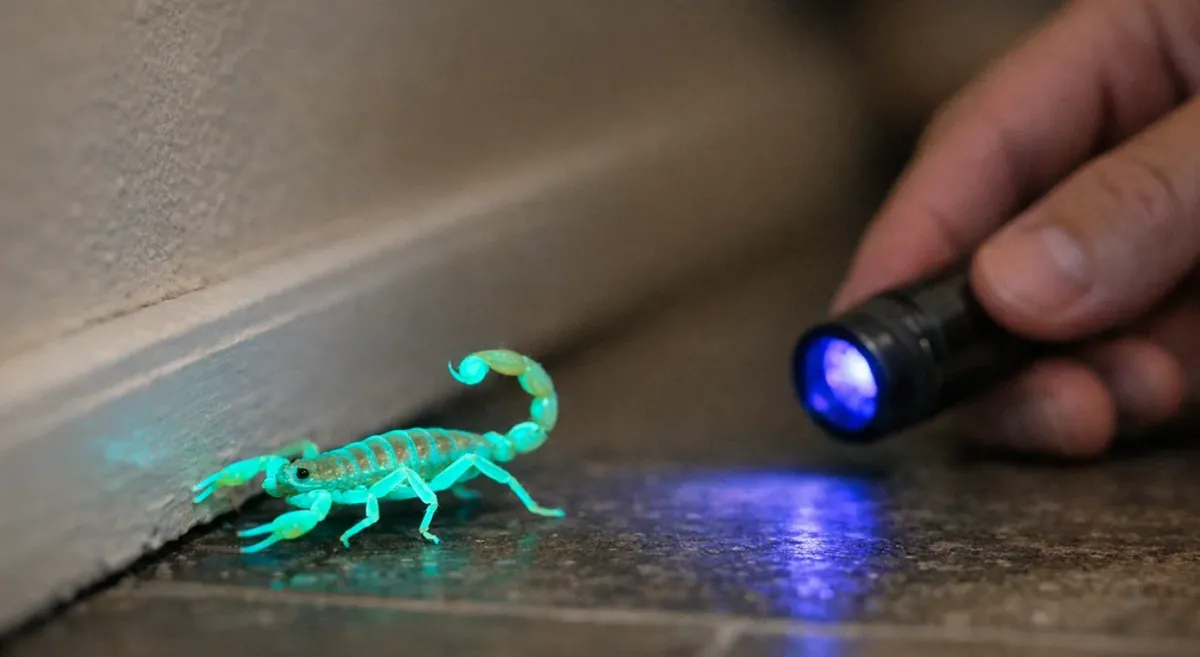
Only if you can do it safely — an ID helps clinicians, but it's not worth a second sting. Grab a UV flashlight; scorpions glow a bright greenish-blue under 365nm light, which makes them far easier to spot along baseboards and edges. Never pick one up with bare hands. Trap it under a wide glass, slide a stiff card underneath, and keep it contained.
Until the room is cleared, keep kids and pets off the floor and away from wall edges where scorpions travel. This is also where photo-verified alerts earn their keep — they tell you the exact room and time a scorpion was active, so you know where to look instead of searching the whole house blind.
How to keep scorpions out of your Douglas home
The most effective Douglas scorpion control follows a clear priority order: reduce harborage, cut off their food supply, seal entry points, then monitor. Past sightings are the strongest predictor of future trouble, so treat every scorpion you spot as a signal to act, not a one-off.
Start outside. Clear wood piles, rock stacks, and yard debris away from the foundation, and trim plants back off the wall. Reduce prey insects with good exterior lighting habits and by keeping the perimeter dry. Then work room by room indoors — bedrooms, bathrooms, laundry rooms, and garages are classic indoor harborage sites because scorpions favor cool, dark, humid pockets. Pull beds a few inches off the wall, skip the bed skirt, shake out shoes before you put them on, and wear closed-toe slippers at night.
The Douglas-focused exclusion checklist (what to seal first)
Seal the gaps scorpions actually use. In Douglas homes — many older, block-built, on desert-edge lots — the usual culprits are:
- Worn or missing door sweeps on exterior and garage doors
- Weep-screed and stucco-base gaps along the bottom of the wall
- Plumbing and cable penetrations under sinks and behind appliances
- Garage thresholds that don't seal flush to the slab
- Gaps around window frames and utility boxes
Here's a simple weekend plan: at dusk, walk the perimeter with a flashlight and mark every gap you find with tape. The next morning, seal them with weatherstripping, door sweeps, and exterior-grade caulk. Dusk reveals where they travel; daylight is when you fix it. And remember what not to do after spotting a scorpion — don't just kill the one and move on.
Monitoring without losing sleep: catching activity early
Because scorpions hug edges and walls as they travel, the perimeter of a room is exactly where you want your eyes. The problem is that they move at night, when you're asleep — and nobody wants to patrol the house with a blacklight every single evening.
That's the gap an automated system like Scorpion Alert fills. The plug-in Detectors sit in wall outlets right along the room perimeter, shine 365nm UV light onto the floor, watch for the telltale scorpion glow only when the room is dark, and send a photo-verified alert to your phone within seconds. For a Douglas home, place them near entry points — garage door, exterior doors — and in water-adjacent rooms like the bathroom and laundry, where scorpions gather. Since past sightings predict future stings, a Detector in any room where you've already seen one is the smartest place to start.
In Douglas, Arizona, scorpions can be tough to spot because they’re most active at night and often travel along baseboards and edges—so a quick visual check isn’t always enough. Since they naturally fluoresce under UV light, a dedicated 365nm UV LED can make sweeps around entry points and dark corners far more effective; if you want a simple tool to help with that, explore Scorpion Alert.