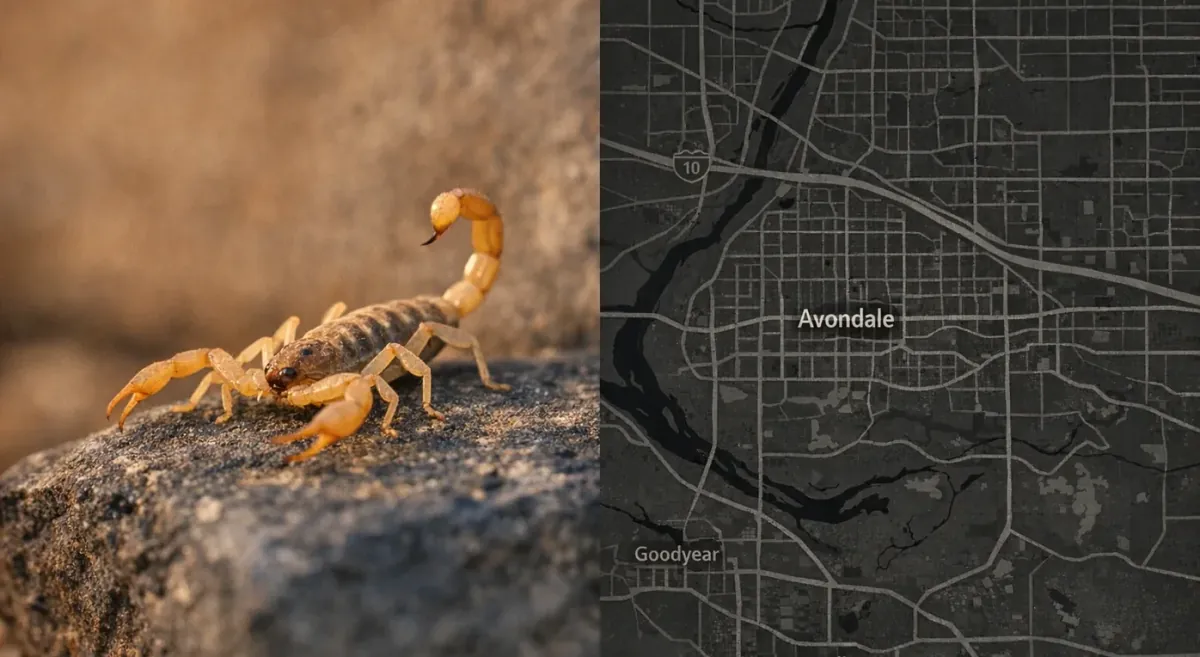
Are scorpions a problem in Avondale?
Yes, scorpions are a significant concern for Avondale homeowners. The city sits in Maricopa County, where the Banner Poison Center logged 518 scorpion exposures and 794 envenomations in just the first three months of 2026. Arizona accounts for 68.2% of all scorpion exposures reported to poison centers nationwide — more than any other state by far.
Most Avondale residents discover scorpions the hard way: flipping on a light at night and spotting one on the wall, or worse, feeling that sharp sting while walking barefoot to the bathroom. These encounters spike during summer months when scorpions are most active, driving those urgent "scorpion control" searches at 2 a.m.
Why Avondale homeowners see scorpions indoors
Scorpions move into Avondale homes at night, traveling along baseboards and room edges — a behavior called thigmotaxis. They navigate by maintaining contact with surfaces, which is why you'll often spot them where the wall meets the floor or tucked against door frames. This edge-hugging behavior makes them easy to miss until someone nearly steps on one.
Avondale's housing stock creates ideal entry conditions. Many homes feature stucco exteriors with small gaps around pipes and wiring, sliding glass doors that don't seal tightly, and attached garages that act like scorpion highways into living spaces. Block wall fences — common throughout the area — provide perfect harborage just feet from your back door.
Is this just a 'desert living' thing—or a real infestation risk?
There's a difference between the occasional scorpion wandering inside and an actual infestation. A single scorpion every few months? That's desert living. But if you're seeing scorpions weekly, finding them in multiple rooms, or discovering baby scorpions (which means adults are breeding nearby), you're dealing with something more serious.
Here's a quick self-assessment checklist:
- Frequency: More than one scorpion per month indoors
- Location spread: Scorpions in bedrooms, bathrooms, and living areas
- Size variety: Both adults and tiny juveniles spotted
- Timing: Regular sightings during peak season (July-September)
- Evidence: Shed exoskeletons found in closets or the garage
Three or more "yes" answers suggest you need professional scorpion control services rather than occasional DIY removal.
Where scorpions hide around Avondale yards
Avondale yards offer scorpions everything they need: shelter, moisture, and prey. Block walls create miles of perfect habitat — scorpions wedge into the gaps between blocks and hunt along the wall base at night. Rock landscaping provides countless hiding spots, especially when decorative boulders sit directly against the foundation.
Irrigation systems compound the issue. Drip lines attract the insects scorpions eat, while the moisture creates cool microhabitats during brutal summer heat. Palm trees drop fronds that pile up against walls, creating scorpion hideouts. Storage areas — plastic deck boxes, stacked lumber, or forgotten pool equipment — become prime harborage when left undisturbed for months.
Which scorpion species lives in Avondale?
While iNaturalist shows no primary species data for Avondale specifically, the city sits squarely in Arizona bark scorpion territory. The Arizona bark scorpion (Centruroides sculpturatus) dominates Maricopa County and remains the most medically significant species in the region. This is the scorpion that sends 54.4% of antivenom recipients to Arizona hospitals being children under 5 years old.
What 'iNat primary species: None' means (and what it doesn't)
The lack of iNaturalist observations for Avondale doesn't mean scorpions are absent — it reflects limited user submissions from the city. Citizen science platforms depend on people photographing and uploading their findings, and most folks encountering a scorpion at 11 p.m. aren't thinking about contributing to a database.
Nearby cities with robust iNaturalist data all show Arizona bark scorpions as the dominant species. Given Avondale's location and habitat, residents should assume any scorpion encountered is likely C. sculpturatus until proven otherwise. This "plan for the worst, hope for the best" approach encourages appropriate caution, especially with children in the home.
The species Avondale residents most worry about
The Arizona bark scorpion has earned its reputation. Unlike other Arizona scorpions that deliver painful but medically minor stings, bark scorpions can cause severe systemic reactions. Their venom affects the nervous system, potentially causing uncontrolled muscle movements, breathing difficulties, and vision problems — especially dangerous in young children.
Don't rely on size alone for identification. Adult bark scorpions measure 2-3 inches, but juveniles can deliver equally potent stings despite being smaller than a penny. Color varies from pale yellow to light brown, making visual ID tricky. The most reliable indicator is where you found it. Bark scorpions reach higher areas, rest upside-down under objects, and frequently enter homes — behaviors that distinguish them from ground-dwelling species that stay near the floor.
Quick ID tips that actually help pest control
These observations help pest control professionals plan treatment when you spot a scorpion:
- Body shape: Slender build with thin pincers (bark scorpion) vs. stocky with thick pincers (less dangerous species)
- Location found: Up higher on a wall? Classic bark scorpion. Down on the ground only? Could be another species
- Time spotted: Most active between 9 p.m. and 2 a.m. during summer months
- Tail position: Bark scorpions often hold their tail curved to the side when resting
- Group or solo: Multiple scorpions together suggests a harborage site nearby
Take a photo if you can do so safely — use your phone's zoom rather than getting close. Clear documentation helps technicians identify patterns and choose appropriate treatment strategies. Photo-verified monitoring systems like Scorpion Alert can capture these details automatically, building a record of activity without requiring you to get near the scorpion.
When are scorpions most active in Avondale?
Scorpions in Avondale follow predictable patterns tied to temperature and darkness. Peak activity runs from late May through October, with August and September seeing the highest sting rates. During these months, scorpions emerge after sunset — typically between 6 PM and midnight — when 49% of envenomations occur.
Scorpion season Avondale: what to expect month-to-month
Avondale's scorpion calendar starts slowly in March as temperatures climb above 70°F at night. Activity ramps up through April and May, then explodes when monsoon humidity arrives in July. August and September mark peak season — hot nights plus moisture create ideal hunting conditions. Activity tapers through October and November, though warm fall evenings can extend encounters into Thanksgiving.
Winter doesn't eliminate scorpions entirely. They'll emerge on those random 75-degree January days, catching homeowners off guard. The key difference is movement. Winter scorpions move slowly and stay closer to their harborage sites. Summer scorpions range widely, traveling 30+ feet from their daytime hiding spots to hunt along your baseboards. For month-by-month specifics, see our detailed Arizona scorpion season guide.
Weather triggers that increase sightings overnight
Three weather patterns drive scorpions into Avondale homes. First, extreme heat waves (115°F+) push scorpions to seek cooler indoor temperatures — your air-conditioned home can feel like a refuge. Second, monsoon storms create humidity that scorpions crave while flooding their outdoor burrows. Third, warm, still nights following afternoon thunderstorms can bring maximum scorpion movement as they hunt rain-activated insects.
Watch for activity spikes 24-48 hours after significant rain. Scorpions that normally stay outside may venture indoors seeking dry ground. This post-storm window is when families should be extra vigilant about checking shoes, shaking out towels, and keeping bedroom doors closed.
Do scorpions climb walls in Avondale homes?
To a point — and the useful part is what it means for your home. Arizona bark scorpions aren't limited to floor level the way other species are; they can reach higher areas of a room, which is why homeowners sometimes find them well above the ground. They can't grip perfectly smooth surfaces like clean glass, but textured stucco, drywall, and fabric are within reach.
Understanding this reach changes prevention strategies. Ground-level barriers alone won't stop a scorpion that can get above them. Focus also on sealing upper-level entry points like bathroom fan vents, gaps around air conditioning lines, and spaces where walls meet ceilings. Monitoring devices should be placed at various heights along walls — not just at floor level.
How dangerous is a scorpion sting in Avondale?
Most healthy adults experience intense pain, numbness, and tingling that resolves within hours. However, Arizona has the highest rates of severe scorpion reactions nationwide, with some victims — especially children — requiring intensive medical treatment. In Avondale and greater Maricopa County, 88.9% of sting victims report immediate burning pain, while 62.2% experience local numbness that can last hours or days.
Typical symptoms vs. red-flag symptoms
Common reactions stay localized to the sting site: sharp burning pain (like touching a hot stove), tingling that spreads up the limb, and mild swelling. These symptoms, while painful, don't require emergency care for most adults. Ice, over-the-counter pain medication, and monitoring typically suffice.
Red-flag symptoms demand immediate medical attention:
- Difficulty breathing or swallowing
- Uncontrolled muscle twitching or jerking movements
- Roving eye movements or blurred vision
- Excessive drooling or foaming at the mouth
- Severe agitation or confusion
- Any systemic symptoms in a child under 5
Why children and pets are treated differently
Children face dramatically higher risk from bark scorpion stings. Their smaller body mass means venom concentration hits dangerous levels faster — what causes localized pain in an adult can trigger life-threatening systemic reactions in a toddler. Data shows children under 10 have the highest rates of ICU admission, with those under 5 representing over half of all antivenom treatments in Arizona.
According to Dr. Frank LoVecchio, medical toxicologist at Banner Poison and Drug Information Center, "Unfortunately little kids because they have a small airway or a small breathing tube, lots of secretions are a problem for them." This explains why children may need immediate intervention while adults can often wait and monitor. For detailed information about pediatric risk, see our guide on why children are more vulnerable to scorpion stings.
Does time of day change sting risk?
Absolutely. Nearly half of all scorpion stings occur during peak activity hours between 6 p.m. and midnight, with a secondary spike between 6 a.m. and noon. These patterns reflect both scorpion behavior (nocturnal hunting) and human vulnerability (walking barefoot in the dark, reaching into spaces without looking).
Nighttime stings often happen in bedrooms and bathrooms when people are groggy and barefoot. The combination of darkness, bare feet, and a scorpion that reached the bed by way of the bed skirt creates perfect conditions for accidental contact. This timing pattern reinforces why bedroom monitoring and nighttime precautions — like wearing slippers and checking bedding — matter most during evening hours.
What to do if you're stung in Avondale
Call the Poison Help line at 1-800-222-1222 immediately for professional guidance. They'll assess your symptoms and determine whether you need emergency care or can manage at home. For severe reactions, Avondale residents have multiple nearby hospitals equipped to handle scorpion envenomations, with antivenom typically available at major Phoenix-area medical centers.
Step-by-step: first 10 minutes after a sting
- Stay calm and move away from the area where the sting occurred — there may be more scorpions nearby
- Remove any jewelry or tight clothing near the sting site before swelling begins
- Wash the area with soap and water to reduce infection risk
- Apply a cool compress (not ice directly on skin) for 10-minute intervals
- Take a photo of the scorpion if visible and safe to do so — don't attempt capture
- Call Poison Control (1-800-222-1222) while monitoring symptoms
- Note the time of the sting and any symptoms as they develop
What NOT to do: Don't cut the wound, apply electricity, use a tourniquet, or take sedatives. These outdated remedies can worsen outcomes. Also avoid driving yourself to the hospital if systemic symptoms develop — have someone else drive or call 911.
When to call Poison Control vs. go to urgent care/ER
Call Poison Control first for all scorpion stings — they're the experts who handle these calls daily. They'll guide you through symptom assessment and tell you definitively whether emergency care is needed. Most adult stings can be managed at home with their guidance.
Go directly to the ER (or call 911) if:
- The victim is under 5 years old or over 65
- Severe symptoms appear within 30 minutes
- Any difficulty breathing or swallowing develops
- Uncontrolled muscle movements begin
- The person has heart conditions or takes beta-blockers
- Previous scorpion stings caused severe reactions
If you can do it safely: capture info that helps doctors
Documentation can speed treatment decisions. If the scorpion is visible and you can photograph it without getting close, zoom in for a clear image. Note these details for medical staff: exact time of sting, location on body, what the person was doing when stung, and how symptoms progress minute by minute.
Write down any medications the victim takes — certain drugs interact with scorpion venom or treatment options. If you have a Scorpion Alert system, screenshot the detection history showing when and where scorpions have been spotted in your home. This pattern data helps doctors understand exposure risk and can influence treatment decisions, especially for households with recurring scorpion activity.
How to keep scorpions out of your Avondale home
Effective scorpion prevention in Avondale requires a three-layer approach: sealing entry points, modifying habitat, and monitoring for early detection. Focus first on exclusion — scorpions can't sting you if they can't get inside. Combined with smart yard management and automated monitoring, you'll dramatically reduce encounters during peak season.
Exclusion checklist for Avondale: seal the easiest gaps first
Start with these high-impact fixes that block the most common entry routes:
- Door sweeps: Install tight-fitting sweeps on all exterior doors, especially the garage-to-house door
- Weatherstripping: Replace worn stripping around doors and windows — even 1/16" gaps allow entry
- Weep screeds: Cover stucco weep holes with steel wool or specialized covers
- Plumbing penetrations: Seal gaps around pipes under sinks with expanding foam or caulk
- Window tracks: Ensure sliding windows close completely; add foam tape if needed
- Garage threshold: Install a threshold seal where the garage door meets concrete
Weekend exclusion plan: Dedicate one Saturday to sealing. Start with doors (1 hour), move to accessible windows (1 hour), then tackle under-sink areas (30 minutes). Save complex repairs like weep screeds for professional help if needed.
Yard & perimeter changes that reduce scorpion pressure
Avondale's combination of block walls, rock landscaping, and irrigation systems creates ideal scorpion habitat. You can't eliminate every scorpion, but you can make your property less attractive. Remove what attracts them most.
Priority changes for immediate impact:
- Clear all debris within 3 feet of your foundation — especially palm fronds and leaf litter
- Move decorative rocks away from the house perimeter or replace with decomposed granite
- Fix dripping irrigation that creates moist zones where crickets (scorpion food) breed
- Trim plants touching the house — scorpions use these as bridges to walls and roofs
- Organize storage areas to eliminate ground-level hiding spots
- Switch to yellow bug lights outdoors to reduce insect attraction
Block walls need special attention. Scorpions live in the gaps between blocks and hunt along the base at night. While you can't tear down walls, you can reduce nearby habitat by keeping the area clear of stored items, maintaining a rock-free zone along the wall base, and treating the wall perimeter during professional pest control visits.
Monitoring that works while you sleep (without nightly blacklight walks)
Scorpions are most active when you're asleep, traveling along baseboards and room edges thanks to their thigmotactic behavior. Rather than exhausting nightly UV flashlight patrols or discovering scorpions only after someone gets stung, automated monitoring provides 24/7 vigilance at key entry points and travel routes.
Strategic monitor placement for Avondale homes:
- Master bedroom: Both sides of the bed near the baseboards
- Children's rooms: Near doors and along walls where toys accumulate
- Bathrooms: Behind toilets and near shower entries where scorpions seek moisture
- Kitchen: Under sink areas and near sliding door tracks
- Garage: Along the wall leading to interior doors
Scorpion Alert's plug-in detectors use 365nm UV light to spot the characteristic scorpion glow, sending instant photo alerts to your phone when one passes underneath. Since each detector watches continuously in dark conditions and captures images for verification, you'll know quickly if a scorpion enters a protected room — no more surprise encounters at 2 a.m. The system particularly helps in homes where past sightings predict future stings, providing early warning before scorpions reach beds or high-traffic areas.
81.8% of Arizona households that experience a scorpion sting had previously seen scorpions on the property — making past sightings the strongest predictor of future stings.
— Kang & Brooks, J Med Toxicol 2017
Remember: while various scorpion repellent myths promise easy solutions, only physical exclusion, habitat modification, and vigilant monitoring provide reliable protection. Combining all three creates multiple barriers between scorpions and your family — especially critical during Avondale's intense scorpion season from July through September.
Living with scorpions in Avondale, Arizona often comes down to spotting them early—especially around entry points, block walls, and dark yard edges where they hunt at night. If you want a practical way to add another layer of confidence beyond occasional UV checks, Scorpion Alert uses UV-based detection plus custom-trained AI to help you confirm what you’re seeing and respond faster.