Does killing a scorpion attract more scorpions?
Here's the truth: killing a scorpion won't summon an army of vengeful relatives. Scorpions don't operate like ants or wasps that release alarm pheromones when threatened. But there's a catch — the aftermath of killing one can create conditions that indirectly increase scorpion activity in your home.
This fear is incredibly common, especially in Arizona and Texas where scorpion encounters happen regularly. You kill one scorpion in your bathroom on Tuesday. By Friday, you spot another near the kitchen. Your brain connects the dots: "I killed one and now they're everywhere!" But correlation isn't causation.
What's really happening? That second scorpion was likely already in your home, hunting along your baseboards in the dark while you slept. Most homes with one scorpion have others nearby — they just haven't crossed paths with you yet.
What people mean when they say "it attracted more"
When homeowners say killing a scorpion "attracted more," they're usually describing one of three scenarios:
Chemical attraction is what most people fear — that a dying scorpion releases a distress signal that draws others. This happens with some insects, but scorpions don't have that kind of alarm system. They're solitary hunters, not colony defenders.
Coincidental timing is far more common. Scorpions follow seasonal patterns. In Phoenix, bark scorpions become more active during monsoon season. Kill one in July, and you'll probably see another simply because July is prime scorpion time — not because the first one called for backup.
Disturbed hiding spots create the most dramatic "attraction" effect. Picture this: you spot a scorpion behind your couch, so you pull out the furniture to spray. Suddenly, three more scatter from underneath. They weren't attracted by the first one's death — you just revealed their shared hideout.
Are scorpions social or territorial?
Most scorpions are solitary creatures. The Arizona bark scorpion is a notable exception — they sometimes hibernate in groups during winter. But even bark scorpions don't coordinate hunting or defend territory together.
This solitary nature is why you typically find scorpions one at a time indoors. They're not traveling in packs or following each other's trails. Each scorpion in your home arrived independently, drawn by the same attractants: water, shelter, and prey insects.
Scorpions don't mourn their dead or seek revenge. They're opportunistic predators focused on survival, not social bonds. Understanding this helps explain why scorpions live solitary lives and why killing one doesn't trigger a group response.
Do dead scorpions release pheromones or chemical signals that attract others?
The short answer: there's no credible evidence that freshly killed scorpions release attraction pheromones that draw other scorpions into homes. The biology doesn't support this common worry.
Scorpions do produce pheromones, but they're primarily for mating. Male scorpions release sex pheromones to attract females during breeding season. These chemicals are species-specific and situation-dependent — not a general "come here" signal triggered by death.
Pheromones vs. stress chemicals: what's plausible (and what's not)
Pheromones are precise chemical messages. Think of them as text messages between scorpions — each one has a specific meaning and intended recipient. Mating pheromones say "single male seeking female." Trail pheromones (which scorpions don't use) would say "food this way."
A dying scorpion might release stress chemicals or bodily fluids, but these aren't pheromone signals. They're more like random keyboard mashing — no coherent message for other scorpions to interpret. Plus, indoor air circulation and cleaning products break down these chemicals within hours.
Even if scorpions could detect death-related chemicals, your home's HVAC system disperses them quickly. That's why many scorpion repellent myths fall apart — chemical signals don't persist long enough indoors to create meaningful effects.
Will other scorpions eat a dead scorpion (cannibalism)?
Scorpion cannibalism exists, but it's opportunistic, not systematic. A hungry scorpion might eat a dead one if it stumbles across the carcass, especially during food scarcity. But they won't hunt for dead scorpions or travel distances to scavenge.
Here's the real concern: that dead scorpion attracts ants within 6-12 hours. Ants attract spiders. Spiders and insects attract live scorpions. You've created a buffet line — not through pheromones, but through the food chain.
In the wild, cannibalism helps scorpions survive lean times. In your home, a scorpion is far more likely to hunt the crickets in your garage than search for scorpion carcasses.
Do scorpions behave differently in Arizona vs. Nevada vs. New Mexico?
Regional differences come down to species, climate, and housing styles. Arizona bark scorpions in Phoenix behave differently than striped bark scorpions in Albuquerque, but not because of state lines.
In Arizona's Sonoran Desert, scorpions deal with extreme heat and monsoon moisture. They're more likely to seek indoor refuge during temperature extremes. Nevada scorpions face similar heat but less dramatic moisture swings. New Mexico's higher elevation areas see scorpions that are more cold-tolerant.
Housing matters too. Adobe homes in Santa Fe have different entry points than stucco houses in Henderson. But regardless of location, all scorpions share the same indoor attractants: moisture, darkness, and prey insects. The fundamentals don't change across state lines.
Which killing method is least likely to draw more scorpions in?
Your killing method matters less for attracting scorpions and more for the secondary problems it can create. Each approach has trade-offs that could indirectly support future scorpion activity.
Does crushing a scorpion attract more?
Crushing creates the messiest aftermath. Scorpion bodily fluids can attract ants and other scavengers within hours, especially in warm weather. Those insects then become scorpion food, creating an indirect attraction cycle.
If you must crush, clean immediately. Use paper towels to remove all residue, then spray the area with a cleaning solution. Vacuum any debris, but empty the vacuum outside — you don't want ant scouts finding scorpion remains in your vacuum bag.
The crushing force needed also puts you dangerously close to the stinger. One slip and you're dealing with a sting instead of a stain.
Does scorpion spray attract more (or just reveal more)?
Scorpion spray doesn't attract scorpions, but it can create confusing results. Many general insecticides work poorly on scorpions due to their tough exoskeletons and low metabolic rates. You might see increased activity because you're flushing out hidden scorpions, not attracting new ones.
Spraying also kills the insects scorpions eat. Dead bugs pile up in corners and under furniture. Live scorpions find these easy meals and stick around longer. It's not attraction — it's an all-you-can-eat buffet of poisoned prey.
Some homeowners spray, see more scorpions over the next week, and assume the spray attracted them. In reality, they're seeing survivors that were already present, now searching for new hunting grounds because you disrupted their usual spots.
Do sticky traps attract scorpions?
Sticky traps don't directly attract scorpions, but they can create attraction zones. Insects get stuck on trap edges, struggling and releasing distress chemicals. Those trapped bugs become scorpion bait.
A scorpion might approach to investigate the trapped prey, then either get stuck itself or feed successfully and move on. Traps placed along walls (where scorpions naturally travel) catch more scorpions, but they also accumulate more bait insects.
For safer placement, put traps behind furniture and appliances where pets and children can't reach. Check them weekly — a trap full of dead insects is basically a scorpion feeding station. This is why understanding what not to do after spotting a scorpion helps prevent making the problem worse.
How should I clean up and dispose of a dead scorpion safely?
Quick, safe disposal helps prevent both sting risks and secondary pest problems. In desert climates, a scorpion carcass can attract ants within 6 hours and trigger a scavenger feeding frenzy within 24-48 hours.
Can a dead scorpion still sting or contain venom?
Yes. A dead scorpion's stinger remains sharp, and venom glands can still contain toxins for hours after death. Reflex muscle contractions can even cause a "sting" motion if you handle the tail.
Never pick up a dead scorpion with bare hands. Use long tongs, thick gloves, or a dustpan and brush. Keep curious pets and children away during cleanup — they're drawn to investigate anything unusual on the floor.
The venom doesn't become harmless just because the scorpion died. Treat every scorpion, living or dead, as potentially dangerous until it's sealed in the trash outside.
Quick disposal checklist (indoors and outdoors)
For indoor disposal: First, confirm it's actually dead (no movement for 60 seconds). Use tongs to place the scorpion in a sealed plastic bag or jar. Wipe the area with disinfectant to remove any fluids. If you crushed it, vacuum thoroughly, then empty the vacuum outside.
Take the sealed container directly to your outdoor trash bin. Don't leave it in indoor garbage where ants might investigate. Wash your hands thoroughly, even if you wore gloves.
For outdoor discoveries, you can bury the scorpion at least 6 inches deep or place it in your yard waste bin. If you've had multiple sightings or someone was stung, consider preserving one in alcohol for professional identification — knowing your exact species helps target prevention efforts.
How long could a carcass attract other pests?
In air-conditioned homes, expect ants within 6-12 hours if you don't clean up. In humid areas or during monsoon season, this timeline shrinks to 2-4 hours. The carcass remains attractive to scavengers for 1-3 days depending on temperature and humidity.
Outdoor carcasses decompose faster but attract more diverse scavengers. Birds and lizards might feed on fresh kills during daylight. At night, beetles and other scorpions might investigate.
This is why prompt disposal matters. Every hour that carcass sits is another hour of chemical signals telling scavengers "free meal here." Those scavengers then attract the next predator up the chain — often another scorpion.
If killing doesn't attract more, why do I keep seeing scorpions in my house?
Repeated scorpion sightings point to systemic issues, not revenge plots. Your home offers something scorpions need: easy entry, reliable water, or abundant prey. Killing individuals treats symptoms while the root causes persist.
Are there more scorpions if I found one?
One scorpion often signals others nearby. Not because they travel together, but because they exploit the same resources. If your bathroom provides moisture for one scorpion, it's suitable for others.
Think of it like finding one mouse — rarely is there truly just one. Scorpions cluster around shared resources without socializing. Five scorpions might hunt the same cricket population in your garage without ever interacting.
Create a 14-day observation window after your first sighting. Note times, locations, and scorpion sizes. Multiple sightings in different rooms suggest entry points throughout your home. Same room repeatedly? You've found their highway. This data helps you understand how scorpions enter homes and where to focus prevention.
What actually attracts scorpions to homes (and how to reverse it)
Moisture tops the attraction list. Scorpions need water, but they also hunt moisture-loving insects. That dripping faucet feeds crickets, which feed scorpions. Fix leaks, run dehumidifiers, and eliminate standing water.
Clutter provides harborage. Scorpions hide in rarely disturbed areas — boxes in garages, piles of shoes, stacked firewood. Reduce hiding spots and you'll reduce scorpion comfort levels. Keep storage off the floor and away from walls.
Seal entry points methodically. Start with door sweeps tonight (quick win). This weekend, caulk cracks around pipes and vents. Long-term, consider professional exclusion for weep holes and foundation gaps. Small efforts add up to major protection.
How do I find scorpions before they find me (blacklight detection and smarter monitoring)?
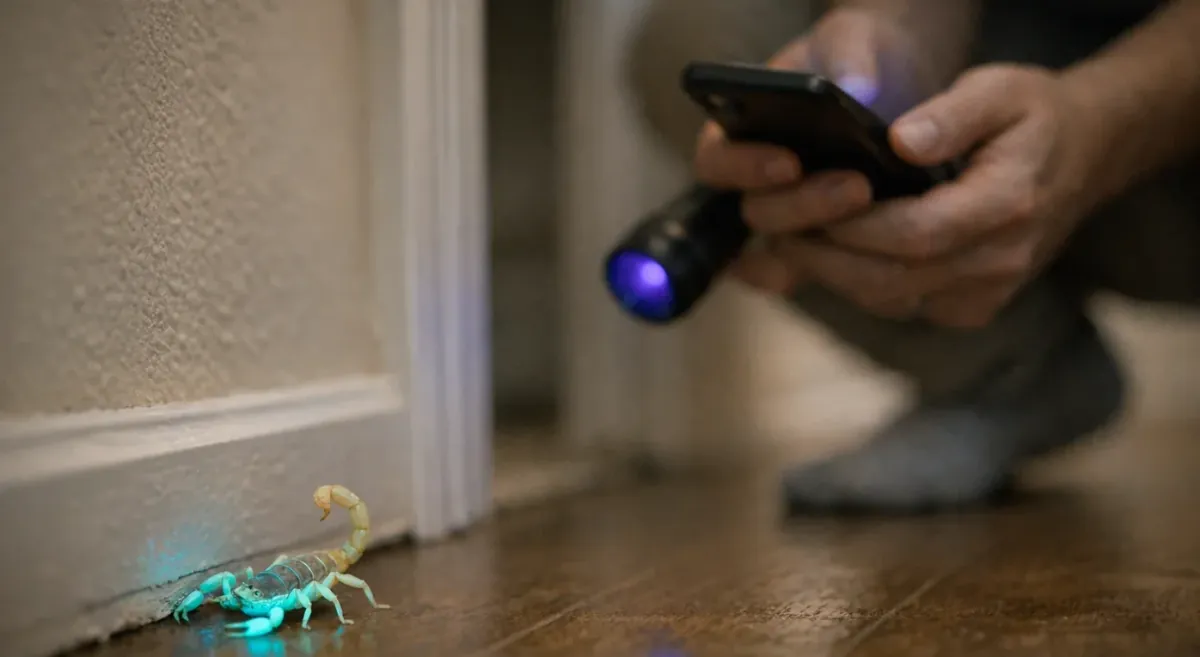
Scorpions glow green-blue under UV light — it's like they're wearing nature's highlighter. A 365nm UV flashlight turns invisible scorpions into glowing beacons. Check along baseboards, in corners, and around door frames where scorpions naturally travel.
But here's the hard part: effective detection requires nightly perimeter checks. Every single night. Skip one evening and you might miss the scorpion that makes it into your bedroom.
For those who can't commit to nightly patrols, technology offers an alternative. Automated detection systems like Scorpion Alert use the same UV principle but monitor continuously. Wall outlet-mounted sensors watch the perimeter where scorpions travel, sending phone alerts when they detect that telltale glow. It's the difference between being a night watchman and having a security system.
When should I call pest control for a possible scorpion infestation?
Call professionals when you see patterns, not isolated incidents. Multiple weekly sightings, finding juveniles (babies mean breeding nearby), or any sting incidents warrant expert intervention.
High prey insect activity also signals it's time for help. If you're battling crickets, roaches, or spiders, you're maintaining a scorpion buffet. Professional integrated pest management tackles the entire ecosystem, not just the scorpions you see.
The best pest control companies don't just spray and leave. They identify entry points, recommend exclusion work, and create ongoing monitoring plans. Ask about their scorpion-specific training — general pest control knowledge doesn't always translate to effective scorpion management in the Southwest.
Killing a scorpion doesn’t usually “call in” more scorpions, but it can be a clue that the real draw—prey insects, moisture, and hiding spots—is still present, so more may show up later. If you want a clearer picture of what’s bringing them in and what to change next, Scorpion Alert can help you track activity and focus your efforts where they matter most.