Are scorpions a problem in Somerton?
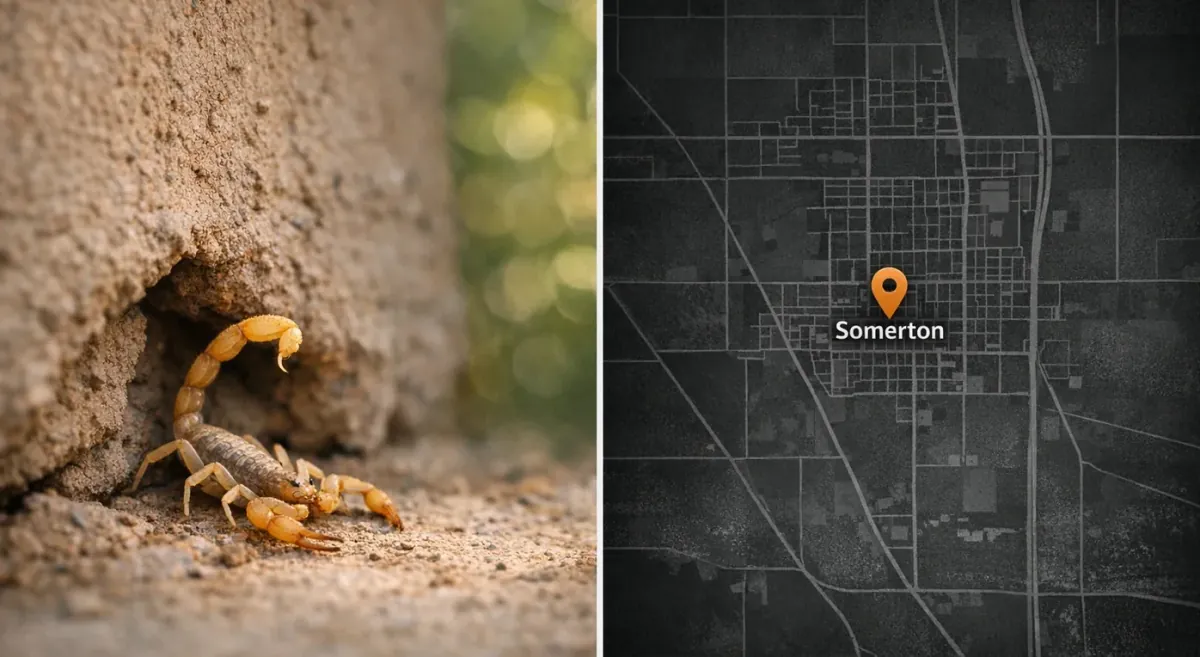
Yes — Somerton sits in Yuma County, deep in the Sonoran Desert, and scorpions are a real and ongoing part of life here. This corner of southwestern Arizona has the hot, dry conditions scorpions thrive in, and Arizona as a whole reports far more scorpion encounters than any other state. A sighting in your kitchen or garage isn't a fluke — it's the local ecosystem doing what it does.
Scorpions turn up in neighborhoods for three simple reasons: they hunt at night, they travel along edges and walls, and they follow their prey — crickets, roaches, and other insects that live around foundations and lights. Where the bugs go, scorpions follow. The rest of this guide walks you through which species matter, when they're most active, how to handle a sting, and a layered plan to keep them out.
Why Somerton homeowners see scorpions indoors
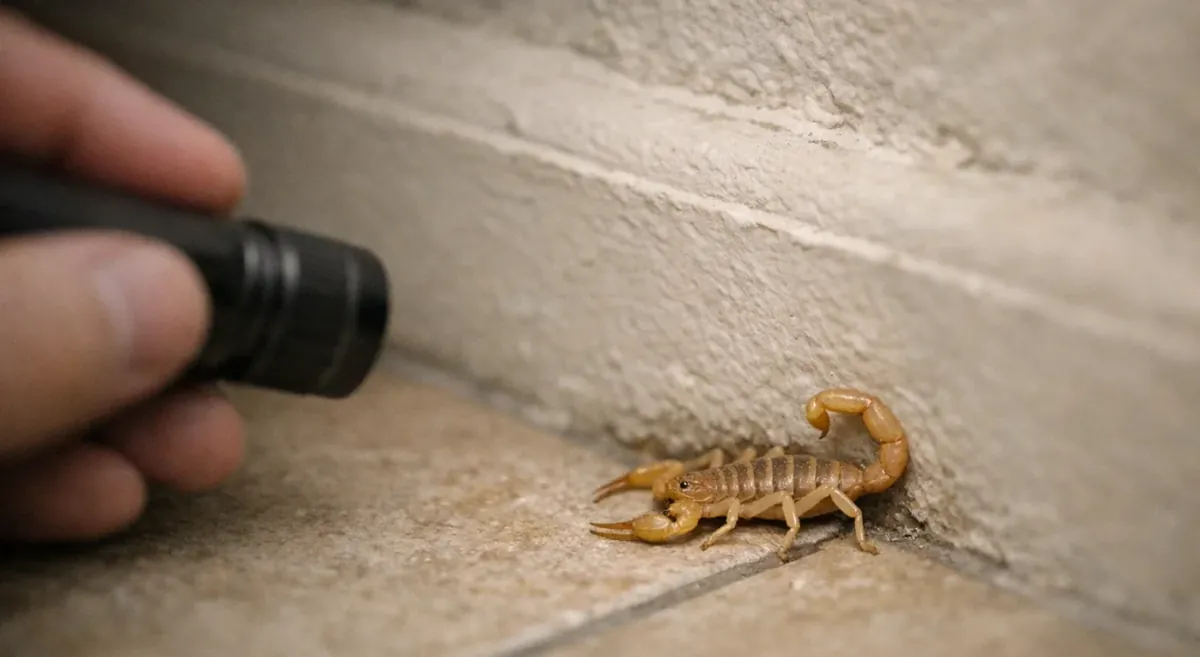
Scorpions are thigmotactic, which just means they like to keep a body part touching a surface as they move. At night, they trace baseboards, wall edges, and the sides of furniture rather than crossing open floor. That's why you'll spot them hugging a corner or moving along the base of a cabinet — and it's exactly why monitoring works best along room perimeters.
Somerton's housing mix of slab-on-grade homes, block walls, and attached garages gives scorpions plenty of ways in. Common entry points include gaps under garage and patio slider doors, unsealed pipe and utility penetrations, weep screed gaps along the stucco, and vents. If you want the full rundown, our guide on what not to do after spotting a scorpion in your home covers the response side.
Are Yuma County scorpions a 'few sightings' or an ongoing issue?
Recurring, but usually manageable. Across Yuma County, the Arizona Poison & Drug Information Center logged 33 scorpion exposures and 45 envenomations in 2025 — and those are only the cases that prompted a call. Statewide, the pressure is even clearer.
68.2% of all US scorpion exposures reported to poison control from 2005–2015 happened in Arizona.
— Kang & Brooks, J Med Toxicol 2017
Here's the reality: one scorpion doesn't mean an infestation. It usually means conditions around your home are right — food, shelter, and easy entry. Fix those, and the sightings drop.
What makes scorpions hard to catch and easy to miss
Scorpions are quiet, nocturnal, and small enough to vanish into a crack in seconds. They rarely make an appearance while you're awake and watching. That's why so many stings happen at night — you don't see the one that's already inside until you step near it. A handheld blacklight can catch a snapshot on any given night, but scorpions in Somerton are moving every night, and no one can patrol every room every evening. Automated night monitoring that activates whenever a room goes dark closes that gap, and we'll come back to it later.
Which scorpion species lives in Somerton?
Somerton doesn't have a single verified "primary" species in the citizen-science record, so the honest answer is: southwestern Arizona is home to several scorpions, and the one that matters most for your health is the Arizona bark scorpion (Centruroides sculpturatus). Treat any indoor scorpion cautiously until you know what it is.
If iNaturalist doesn't show a clear 'primary' species, what should you assume?
Public sighting databases for Somerton are thin — a mix of low observation counts, occasional misidentifications, and plain under-reporting. That's not evidence there are few scorpions; it's just a gap in the data. The safe approach is to assume any scorpion you find indoors could be medically significant until a clear photo says otherwise.
The species that matters most for sting risk in Arizona homes
The Arizona bark scorpion is the one Arizona homeowners worry about, because it's the only species in the region whose sting can cause serious systemic effects, especially in children. ID cues: it's slender and light tan to golden brown, roughly 2–3 inches including the tail, with thin pincers rather than thick crab-like claws. Appearance alone isn't foolproof, though — lighting and life stage can change how one looks, so a photo beats a gut call every time.
Common ID questions: size, color, and wall-climbing
Are small scorpions more dangerous? Not necessarily — but younger bark scorpions can deliver plenty of venom, so don't dismiss a small one. Bark scorpions can also reach upper floors of a home by traveling through wall voids and attic spaces, which is why they turn up in unexpected places. For day-to-day prevention, behavior is more useful than perfect species ID: they roam at night and cling to edges. Plan your defense around those habits, not around a lucky guess at the Latin name.
When are scorpions most active in Somerton?
Scorpions are active in Somerton nearly year-round thanks to the region's heat, but activity spikes in the warm months — roughly late spring through early fall — and peaks in the evening. Nationwide, summer accounts for the overwhelming majority of scorpion cases, and in Arizona August and September are the peak envenomation months.
Night vs. day: when Somerton scorpions actually move
Scorpions are primarily nocturnal, so they're hardest to spot precisely when they're most active. Peak sting hours run from 6 PM to midnight — roughly half of all envenomations — with a smaller morning bump. The practical takeaway: the highest-probability paths through your home are the baseboards and edges after dark, which is where any real monitoring should focus.
Scorpion season Somerton: heat, humidity, and 'surge' weeks
Warm nights and rising humidity drive the surge. When summer monsoon moisture rolls into the low desert, insect prey booms and scorpion movement climbs with it — the days after a rain are classic "surge" weeks. Before the first long hot stretch, run through a quick season-start checklist: replace worn door sweeps, seal fresh cracks, clear yard clutter, and swap bright white exterior bulbs for warmer, bug-resistant lighting. Our month-by-month Arizona scorpion season guide lays out the timeline.
Do scorpions mate or reproduce at certain times here?
Scorpions mate mostly in the warm season, and females carry and later give birth to live young that ride on the mother's back — they don't lay eggs. Many species live several years. What you actually notice at home is more wandering, especially males on the move looking for mates, which means more surprise sightings during peak weeks. The lesson isn't to hunt down every scorpion — it's to seal entry points and cut the prey supply so fewer ever come inside.
How dangerous is a scorpion sting in Somerton?
For most healthy adults, a bark scorpion sting in Somerton is painful but not life-threatening — think intense localized burning and tingling that fades over hours. The real concern is young children, older adults, and anyone with a serious allergy history, where symptoms can turn systemic. Arizona reports the highest rates of neuromuscular and respiratory effects of any state, so it's worth taking seriously.
What a scorpion sting usually feels like
Pain at the sting site shows up in about 88.9% of stings, and local numbness in roughly 62.2%, according to an Arizona cohort of 4,398 patients. Picture a sudden hot-needle sensation on your foot, then a spreading tingle and numbness moving up the limb. Experiences vary from person to person, so don't panic if yours feels different — what matters is watching how symptoms progress.
Who is most at risk in Somerton households?
Children under 10 have the highest rates of severe reactions, hospitalization, and ICU admission in Arizona data. Kids and pets spend their time at floor level — exactly where scorpions travel — so they encounter them more often, and their smaller bodies react more strongly. That floor-level exposure is a big reason night monitoring matters for families. Our post on why children are more at risk from scorpion stings goes deeper.
When to treat it as an emergency
Call 911 or head to the nearest ER right away if you see any red flags: trouble breathing or swallowing, uncontrolled muscle jerking, roving or abnormal eye movements, severe vomiting, altered mental status, or rapidly worsening symptoms — especially in a child. When in doubt, call the free Poison Help line at 1-800-222-1222; they can advise you and patch in emergency services if needed.
What to do if you're stung in Somerton
Stay calm and act in the first few minutes: wash the sting with soap and water, apply a cool compress, keep the area still, and call Poison Control at 1-800-222-1222. Most stings in the region are managed at home, but knowing your local steps ahead of time makes a nighttime sting far less scary.
First steps (the calm checklist)
- Wash the sting site with soap and water.
- Apply a cool compress or ice pack wrapped in cloth to ease pain and swelling.
- Remove rings, watches, or anything tight near the sting in case of swelling.
- Keep the person calm, still, and comfortable — anxiety can make symptoms feel worse.
- Note the exact time of the sting and start watching symptoms.
- If you can do it safely without risking another sting, trap the scorpion under a glass for later ID.
Our first 30 minutes of bark scorpion sting first aid guide walks through the timing in detail.
Who to call in Somerton and what info to have ready
Call the Arizona Poison & Drug Information Center at 1-800-222-1222 first — it's free, staffed around the clock, and they'll tell you whether you need an ER. For severe symptoms, call 911. Have this ready: the person's age and weight (critical for kids), the symptoms you're seeing, the sting location and time, any known allergies, and whether the scorpion was actually seen. If care is needed, Yuma Regional Medical Center is the main hospital serving the Somerton area.
If the sting happened at night: what to do about the scorpion still in the room
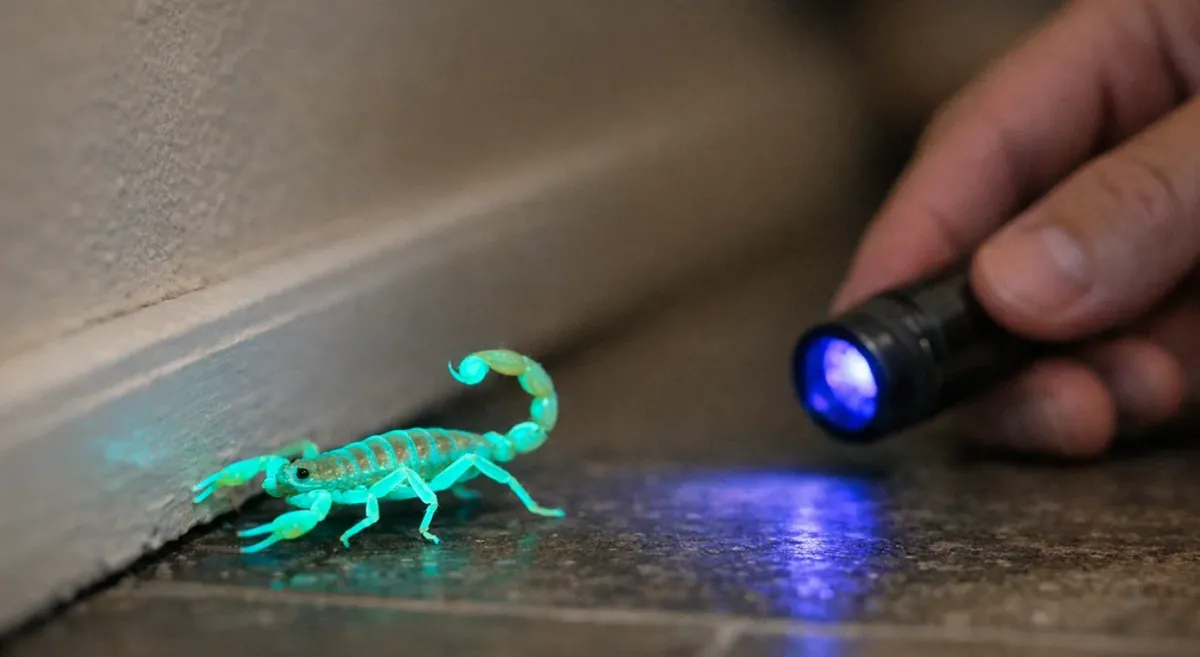
Turn on the lights and keep everyone's bare feet off the floor. Then do a slow, controlled sweep along the baseboards and edges — that's where a scorpion is most likely to be. A handheld UV flashlight helps a lot here, because scorpions fluoresce a bright greenish glow under 365nm ultraviolet light. Trap it under a glass, slide a stiff card underneath, and release it outside. This is also exactly the moment an automated detector earns its keep, alerting you with a photo within seconds instead of leaving you to search blind.
How to keep scorpions out of your Somerton home
The most effective plan for dealing with scorpions in Somerton, Arizona is layered: seal them out, make your yard less inviting, cut off their food, and monitor the rooms where they actually travel. No single step is a complete fix, but stacked together they dramatically reduce both sightings and stings. Remember that most scorpion encounters happen inside the home — 97.8% of US envenomations occur indoors — so indoor defense matters as much as the yard.
Somerton scorpion control priorities: seal first, then simplify habitat
Start with sealing, because it stops the problem at the door. The top five targets for a slab-on-grade Somerton home:
- Install tight door sweeps on exterior and garage doors — bark scorpions slip through gaps as thin as a credit card.
- Replace cracked or missing weatherstripping around patio sliders and windows.
- Close garage gaps, including the sides and bottom of the roll-up door.
- Seal pipe, cable, and utility penetrations with caulk or steel wool.
- Screen weep screed gaps and wall vents where scorpions enter behind the stucco.
Outside, clear away wood piles, rock piles, and clutter against the foundation, and manage irrigation so you're not creating cool, damp harborage right next to the house.
Reduce their food supply (without turning your yard into a desert)
Scorpions follow prey, so a home crawling with crickets and roaches is a home that attracts scorpions. You don't need a barren moonscape — just reduce insects around the foundation. Switch bright white exterior lights to warm or yellow bulbs that draw fewer bugs, keep trash sealed, and remove damp debris where roaches hide. If you want to understand the pull factors, our list of the top 5 things that attract scorpions is a good primer. Think integrated pest management, not panicked DIY spraying that rarely touches the scorpions themselves.
Monitoring that matches scorpion behavior in real homes
Because scorpions travel along room perimeters at night, that's exactly where monitoring should live. A Scorpion Alert Detector plugs into a standard wall outlet on the room's edge, activates only when the room goes dark, and shines 365nm UV light onto the floor to catch that telltale scorpion glow. When it spots one, it sends a photo-verified push notification or SMS to your phone within seconds — no nightly flashlight patrols, no messy glue traps. It's a non-chemical layer that works while you sleep.
Where to place monitoring in a typical Somerton house
Cover the routes and rooms scorpions favor: entry points first (front and back doors, the garage, the patio slider), then bedrooms and any nursery, and finally water-adjacent rooms like bathrooms and the laundry, which offer the cool, humid shelter bark scorpions seek. Scorpion Alert is built for multi-detector coverage with simple plug-in setup over 2.4GHz Wi-Fi, so you can protect several rooms at once. Because homes that have already had scorpion sightings are the ones most likely to see them again, the smartest move is putting a Detector in any room where you've spotted one before.
Renting Detectors comes as a monthly monitoring subscription — the hardware is included, the per-Detector rate drops with each one you add, and there's no long-term contract. For current rates, check the live calculator at scorpionalert.com/pricing.
If you’re in Somerton, it helps to remember that scorpions are most active after dark—and because they fluoresce under UV light, the right nighttime checks can make a big difference. For a more consistent way to spot activity when you’re not outside with a flashlight, Scorpion Alert uses UV-based, night-active detection to help you see what’s happening around your home.