Are scorpions a problem in Round Rock?
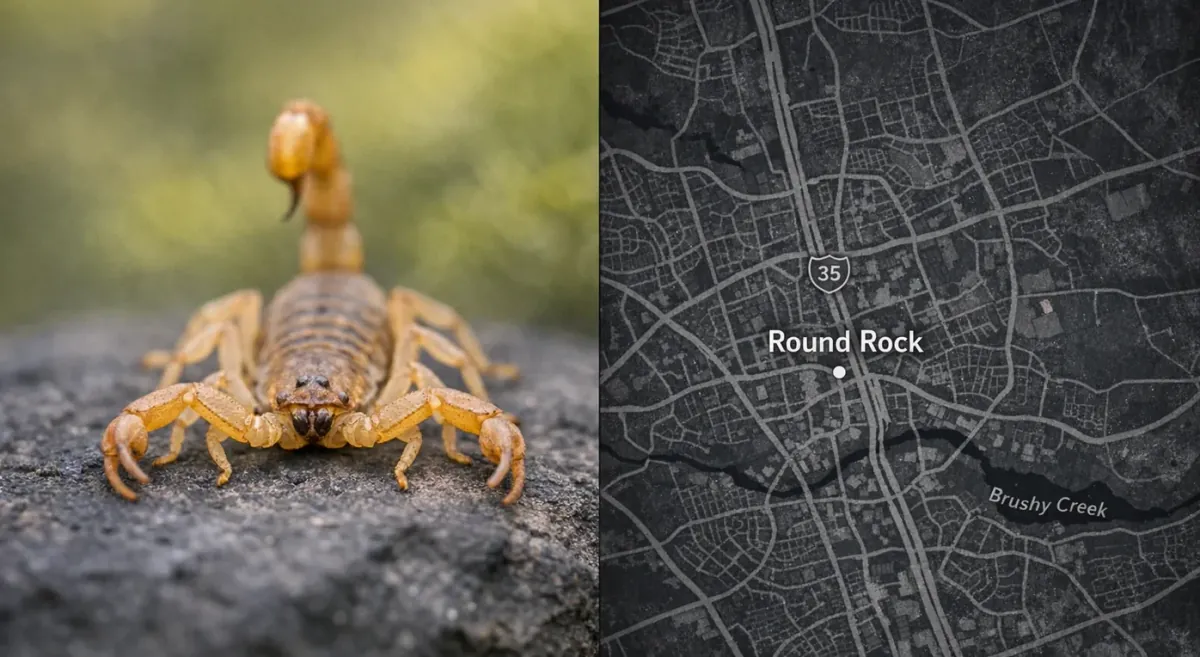
Yes — scorpions are a real and common part of life in Round Rock. The striped bark scorpion is well established across Williamson County, and researchers have logged 1,071 research-grade scorpion observations within 30 km of Round Rock, with the most recent in May 2026. Finding one indoors here is normal, not bad luck.
Statewide, Kang & Brooks 2017 counted about 1,743 scorpion exposures a year in Texas — roughly 10.3% of the US total. Central Texas, with its limestone soil and warm nights, falls well within that range. So when you spot one in the garage or bathroom, you're seeing something thousands of Texans deal with every summer.
Why do they suddenly show up inside? Scorpions are nocturnal and shy. They hide in cracks and dark gaps by day, then wander after dark hunting insects. If they slip through a gap chasing prey or moisture, they end up in your living space. Effective scorpion control in Round Rock, Texas isn't a one-time spray — it's reducing entry points, cutting off their food and water, and monitoring where they travel.
Is one scorpion a fluke—or a warning?
A single scorpion is often just one wanderer that slipped inside overnight. It becomes a pattern worth acting on when you see multiple scorpions, the same room comes up more than once, or sightings cluster in the same late-night window. Repeat sightings in one spot usually mean there's harborage or an entry route nearby.
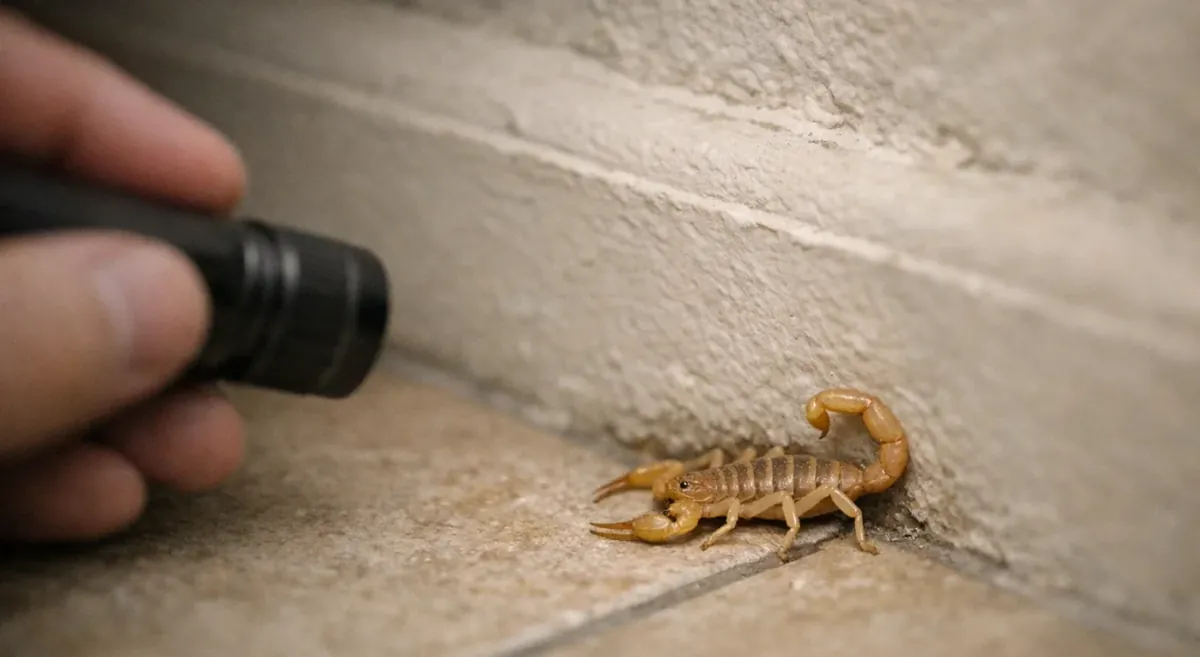
The tricky part is that scorpions are easy to miss until they're already indoors. They're silent, they only move at night, and they wedge into tight gaps you'd never think to check. By the time you find one on the tile, it may have been coming and going for days.
Where in and around your home are you most likely to see them?
The usual first rooms in Round Rock homes are the garage, laundry room, and bathrooms — plus anywhere a pet door or exterior threshold offers easy entry. These spots combine dark corners, moisture, and a way in from outside.
Scorpions are thigmotactic, meaning they navigate by hugging surfaces and edges. At night they travel along baseboards, walls, and the edges of furniture rather than crossing open floor. That's why you'll typically spot one near a wall or in a corner — and it's the behavior smart monitoring is built around.
Which scorpion species lives in Round Rock?
The main scorpion in Round Rock is the striped bark scorpion (Centruroides vittatus). It accounts for 805 of the 1,071 local iNaturalist observations — the clear majority. It's the most widely distributed scorpion in North America, dominant across Texas and neighboring states.
Correct ID really matters here. The striped bark scorpion Round Rock homeowners worry about looks intimidating, but it is not the dangerous Arizona bark scorpion. Knowing which one you have takes a lot of the fear out of stings and points you toward the right control approach.
Striped Bark Scorpion in Round Rock: what homeowners notice first
Most people notice the two dark stripes running down its back over a tan or yellowish body. Adults are roughly 2 to 3 inches, with slender pincers and a thin tail. They favor cool, dark, humid hiding spots — under bark, rocks, and boards outside, and in cracks, voids, and clutter indoors.
Bark scorpions are strong climbers and are often found on vertical surfaces and tucked into cracks and wall voids. That's why sightings sometimes happen off the floor, and why sealing gaps at every height matters more than people expect.
Are there other scorpions in Williamson County?
One other species shows up locally: the Reddell's cave scorpion (Pseudouroctonus reddelli), with 266 observations near Round Rock. It's smaller, darker, tied to rocky and cave-like habitats, and rarely a concern inside homes.
If you're not sure what you're looking at, snap a photo from a safe distance. Send it to a local pest pro or extension office when the scorpion is unusually large, oddly colored, or you're seeing several — a clear photo answers most ID questions fast.
When are scorpions most active in Round Rock?
Scorpion season in Round Rock runs through the warm months, peaking in the heat of summer — roughly June through September. Nationwide data confirms that summer accounts for the overwhelming majority of scorpion cases, and warm evenings are when activity spikes. Two rhythms matter here: the seasonal peak and the nightly one.
Round Rock scorpion season: the months that drive most sightings
Expect the most sightings from late spring into early fall, with the peak in mid to late summer and shoulder activity tapering into cooler months. During the hot stretch, prey insects boom, scorpions hunt harder outdoors at night, and dry heat pushes them toward the moisture inside your home.
Picture a July night: the yard is buzzing with insects, the house holds cool, humid corners in the bathroom and laundry room, and a scorpion following the wall finds a gap under the garage door. That's the season in a nutshell.
What time of night do they move—and why?
Scorpions are firmly nocturnal, and the highest-risk window is evening through midnight. Roughly 49% of stings occur between 6 PM and midnight, with a smaller morning bump. That's exactly when you and your family are winding down, walking barefoot, and least likely to be watching the floor.
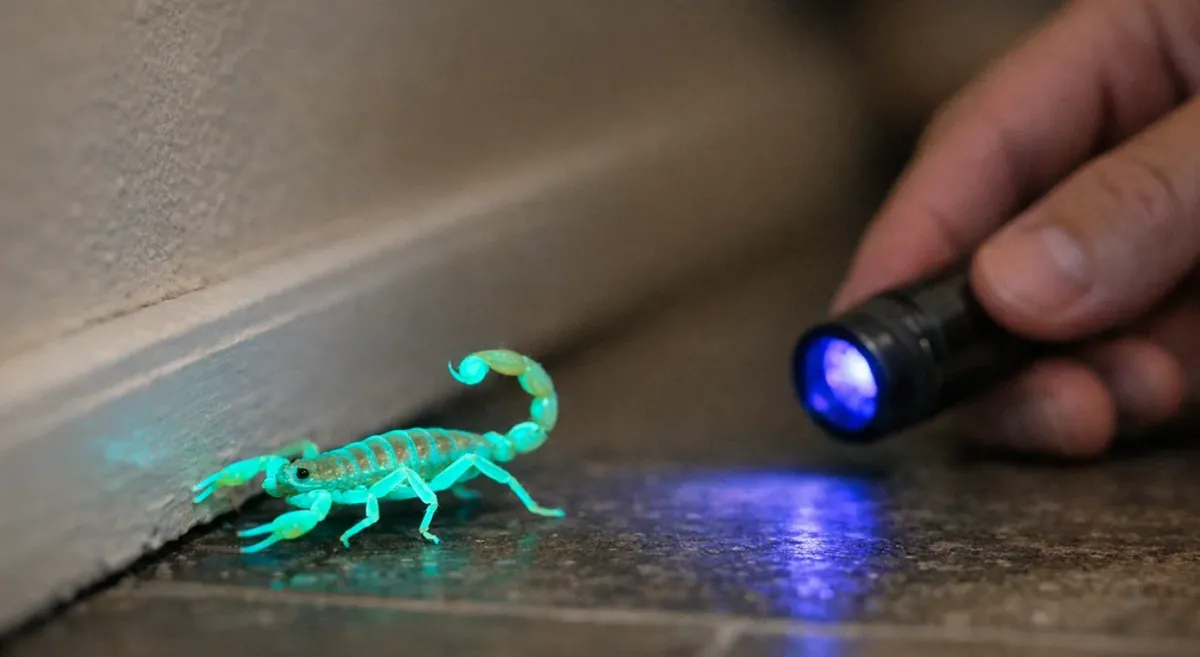
This is where automated monitoring earns its keep. A Scorpion Alert Detector only scans when the room is dark, shining 365nm UV light on the floor and watching for the greenish glow scorpions give off — then sending a photo alert to your phone within seconds. It works overnight, while you're asleep, without you patrolling anything.
How dangerous is a scorpion sting in Round Rock?
For most healthy adults, a striped bark scorpion sting in Round Rock is painful but not dangerous. Its venom produces sharp local pain lasting about 15 to 20 minutes, and life-threatening envenomation has not been documented for this species. "Dangerous" here usually means intensely painful, not an emergency.
Risk is higher for certain people: young children, older adults, and anyone with a known sting allergy. For those groups it's worth watching symptoms more closely and calling for guidance sooner rather than later.
What a typical sting feels like (and what's normal afterward)
Expect immediate sharp, burning pain at the site, followed by some tingling, mild swelling, and possibly numbness around the spot. This usually eases within an hour or so. The C. vittatus venom targets pain-sensing nerves, which is why it stings hard without the whole-body symptoms of more dangerous species.
Anxiety can make a sting feel worse than it is — a racing heart and panic are real, but they don't mean the venom is doing serious harm. Stay calm, breathe, and track the actual symptoms. That said, never brush off genuine warning signs.
When a Round Rock sting becomes urgent
Get medical help right away if you notice trouble breathing or swallowing, severe muscle twitching or jerking, roving eye movements, drooling, or intense full-body symptoms. Call 911 for any breathing difficulty or signs of a severe allergic reaction like facial swelling or hives.
Children deserve extra caution because their small size makes reactions more pronounced. If a young child is stung and seems more than mildly uncomfortable, treat it as urgent — our guide on why children are more at risk from scorpion stings goes deeper.
What to do if you're stung in Round Rock
Stay calm, clean the sting, cool it, and monitor. Most Round Rock stings can be managed at home, but keep the Poison Help line — 1-800-222-1222 — handy for free, 24/7 guidance from a real toxicology expert.
Immediate first steps (before you start Googling)
- Wash the sting site with soap and water.
- Apply a cool compress or ice pack (wrapped, not directly on skin) to ease pain and swelling.
- Remove rings, watches, or tight items near the sting in case of swelling.
- Note the time and jot down symptoms as they change.
- Call Poison Control at 1-800-222-1222 for personalized advice, and follow a clinician's guidance on any pain medication or dosing.
Two ERs are close by if symptoms escalate: St. David's Round Rock Medical Center at 2400 Round Rock Ave (about 2.1 miles) and Family Medical Center at Round Rock at 1925 S A.W. Grimes Blvd (about 1.8 miles). For the detailed hour-by-hour timeline, see our bark scorpion sting first aid guide for the first 30 minutes. And whatever you do, don't panic-treat with folk remedies — our what not to do after spotting a scorpion post covers the common mistakes.
If you can, identify and prevent a second sting
If it's safe, get a photo of the scorpion from a distance so you can confirm the species later, then trap it under a glass to keep it from stinging anyone else. Never handle it barehanded. Once contained, you can slide a card underneath and release it outside.
Rather than walking the house at night with a blacklight hoping to catch the next one, photo-verified monitoring does that job for you. A Detector scans in the dark and sends an alert with an image, so you know exactly where a scorpion is before someone steps on it.
How to keep scorpions out of your Round Rock home
Lasting Round Rock scorpion control comes from three moves working together: seal the routes scorpions use, make your yard less inviting, and monitor where they travel at night. No single spray does all three, which is why one-time treatments so often disappoint.
Seal the routes they actually use (not just the obvious gaps)
Prioritize the entry points that matter most in Round Rock homes: gaps under exterior doors and garage door edges, weep holes in brick, utility and plumbing penetrations, and pet doors. Add door sweeps and weatherstripping, seal around pipes, and screen weep holes. Tiny gaps count — a striped bark scorpion can slip through an opening about the width of a credit card. Our list of the top 5 ways scorpions get into your home shows where to focus first.
Make your yard less scorpion-friendly (without overhauling everything)
Reduce harborage close to the house: move firewood and rock piles away from the foundation, thin dense ground cover, and clear clutter that gives scorpions cool, dark daytime shelter. Trim plants back from exterior walls so there's no shaded bridge to the house.
Because scorpions come inside hunting bugs, cutting down the insect population around your foundation removes their reason to visit. Our guide to the top things that attract scorpions breaks down the prey-and-moisture triggers to fix.
Add nighttime monitoring where scorpions travel: along the perimeter
Sealing and yard work shrink the problem, but they can't tell you when one still gets inside. That's the missing piece for most homeowners. Since scorpions hug walls and edges as they move, and wall outlets sit right on that perimeter, plug-in Detectors land exactly where scorpions travel.
Place them in the rooms that matter most in Round Rock — the garage, laundry, bathrooms, and any room where a scorpion has been spotted before, since past sightings are the strongest predictor of the next one. Scorpion Alert rents its Detectors as a monthly monitoring subscription starting at $3.50 per Detector per month, sliding down toward $2.00 per Detector at ten or more, with a one-time shipping fee at checkout. Each one watches for the UV glow overnight and sends a photo alert to your phone — peace of mind while your family sleeps.
In Round Rock, scorpions can show up when nights are warm and the house goes dark, so knowing where they’re moving is half the battle. Scorpion Alert helps by using 365nm UV light with night-active mode and AI detection to make scorpions easier to spot without wandering around with a flashlight—learn more at Scorpion Alert.