Are scorpions a problem in Pahrump?
Yes — scorpions are a real part of desert life in Pahrump, Nevada. But "a problem" usually means occasional yard sightings and the odd indoor visitor, not an infestation. Homeowners here regularly spot scorpions in garages, bathrooms, and ground-floor rooms because the surrounding Mojave Desert is prime scorpion habitat, and Nye County properties sit right in it.
Within 30km of Pahrump, iNaturalist has logged 237 research-grade scorpion observations between 2016 and 2025, spanning nearly a dozen species (iNaturalist). Statewide, Nevada accounted for roughly 707 scorpion exposures a year in the 2005–2015 poison-center data, about 4.2% of the national total (Kang & Brooks 2017).
The goal here isn't panic. It's prevention plus early detection. Know when they're active, know where they hide, and you can live in a desert town with scorpions without stepping on one at 2 a.m.
Why do people see more scorpions after moving in?
Scorpions were almost certainly already living around the property before you arrived — you just start noticing them once you're paying attention. They're nocturnal, so they stay hidden by day and come out to hunt after dark, which is exactly when a homeowner walks into a dark garage or flips on the bathroom light.
Pahrump's hot, dry days and cooler evenings push scorpions toward cooler, darker micro-habitats, and warm summer nights get them moving. Because they're thigmotactic — meaning they travel hugging surfaces — they follow baseboards, wall edges, and door thresholds indoors. That's why sightings so often cluster along the bottom of a wall instead of in the middle of a room.
Are Nye County scorpions common in neighborhoods or only rural lots?
Both. Open desert edges and rural acreage have the highest natural populations, but Nye County scorpions do just fine in established neighborhoods with irrigated landscaping, block walls, rock yards, and sheds. Anything that gives them shade, moisture, and insect prey can turn a suburban lot into decent scorpion real estate.
A quick risk checklist for a typical Pahrump property: wood and rock piles near the foundation, cluttered garages and sheds, block walls with hollow cores, dense ground cover or bark mulch, dripping irrigation lines, and outdoor lighting that draws the crickets and moths scorpions eat. The more of these boxes you tick, the more likely you are to see one.
Which scorpion species lives in Pahrump?
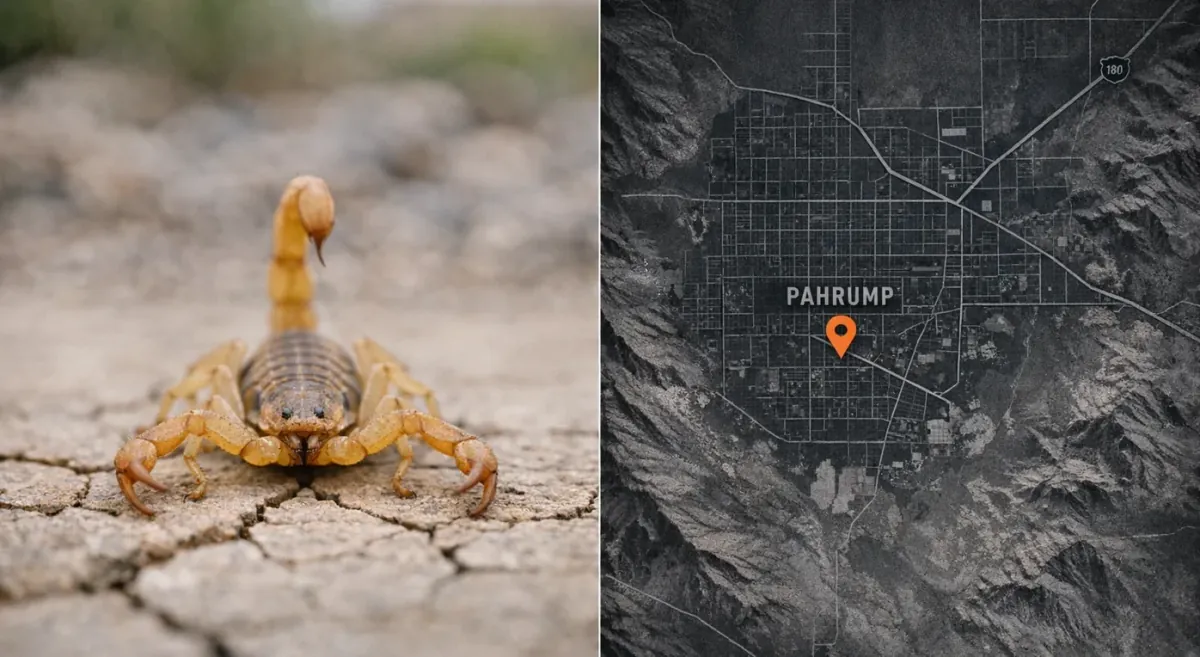
The scorpion most often reported in and around Pahrump is the Desert Hairy Scorpion (Hadrurus arizonensis), the leading species in local iNaturalist observations (iNaturalist). It's the largest scorpion in North America, and despite its intimidating size, its sting is generally comparable to a bee sting for most healthy adults.
Finding a scorpion in your home doesn't automatically mean you're dealing with the most dangerous kind. Pahrump's records include several species — Paruroctonus shulovi, Paravaejovis confusus, and Smeringurus vachoni among them — most of which deliver a painful but non-life-threatening sting.
For a homeowner-safe ID, note the size, general color, and pincer shape, and never handle one to get a better look. When in doubt, photograph it from a safe distance and let an expert confirm.
Primary iNat species: Desert Hairy Scorpion
The Desert Hairy Scorpion earns its name from the fine sensory hairs on its tail and legs. It's big — adults can reach five to six inches — with an olive-to-tan body and a darker back. Those hairs help it detect ground vibrations from prey and threats.
On Pahrump properties, you're most likely to encounter one in the yard, along block walls, under wood or rock piles, and in garages where it wanders in while chasing insects. It's a burrower by nature, so gaps under thresholds and cluttered corners suit it perfectly.
What homeowners in Pahrump confuse scorpions with
A few desert critters get mistaken for scorpions in the dark. Earwigs have rear pincers but no arched tail. Vinegaroons (whip scorpions) look fierce but have a thin, whip-like tail and no stinger. Even large crickets can startle people at a glance.
The fastest way to be sure is UV light. Scorpions fluoresce a bright greenish-blue under 365nm ultraviolet light — nothing else in your home glows quite like it. A quick UV check turns a "what was that?" moment into a confident ID.
When are scorpions most active in Pahrump?
Scorpions in Pahrump are most active from late spring through early fall. The season ramps up as temperatures climb and peaks in the hottest summer months. Nationwide data shows summer accounts for the overwhelming majority of scorpion cases (Kang & Brooks 2017), and Pahrump's hot Mojave summers fit that pattern.
They're overwhelmingly nocturnal. Warm evenings bring them out to hunt, and once indoors they roam along baseboards, under furniture edges, and near door thresholds. Any spike in humidity or moisture can nudge activity, and cooler nights late in the season can push them indoors as they look for shelter.
Seasonal peaks: what to expect month-to-month in Pahrump
Expect sightings to start rising around April and May, climb through June, and peak in the July–September stretch when nights stay warm. Activity tapers off through October as temperatures drop, and winter is quiet — though a scorpion can still turn up on a mild day.
The best move is to prep two to four weeks before peak. Late spring is the time to seal entry points, declutter the garage, and clean up the yard, so you're not scrambling once activity is in full swing.
Night behavior: why scorpions show up when you're asleep
Peak sting hours run from 6 PM to midnight, which accounts for roughly half of envenomations, with a second bump in the early morning (Klotz et al. 2021 describes the same nocturnal pattern). Scorpions move at night because that's when they hunt.
Their thigmotactic, edge-hugging travel is why they end up along baseboards and in doorways instead of the middle of the floor. It's also why automated nighttime monitoring makes sense — detectors that activate only when a room is dark are watching during exactly the window when scorpions are on the move.
How dangerous is a scorpion sting in Pahrump?
Most scorpion stings in Pahrump are painful but not life-threatening for a healthy adult — think intense burning, tingling, and numbness at the site rather than a medical emergency. Pain at the sting site shows up in about 88.9% of cases and local numbness in 62.2% (Klotz et al. 2021). Still, risk varies by person, and a few situations deserve fast attention.
Red-flag symptoms that warrant urgent care include difficulty breathing or swallowing, severe muscle twitching or jerking, roving or uncontrolled eye movements, blurred vision, drooling, and intense whole-body symptoms — especially in a child. Higher-risk groups are young children, older adults, and anyone with allergies or certain medical conditions.
Children under 10 have the highest rates of systemic effects, hospitalization, and ICU admission in both Arizona and Nevada cohorts (Kang & Brooks 2017). When in doubt, call the Poison Help line at 1-800-222-1222 — it's free, staffed around the clock, and they'll tell you whether home care is enough. You can read more about why children are more at risk from scorpion stings.
Typical sting scenarios in Pahrump homes
Most stings happen through simple contact. Sliding a bare foot into a shoe or boot that's been sitting in the garage. Pulling a towel off the rack or lifting laundry out of a basket. Reaching into stored boxes on a garage shelf. Rolling over in bed and brushing against one along the mattress edge.
Kids playing on the floor are especially exposed, since that's where scorpions travel. Bathrooms, laundry rooms, garages, and bedrooms are classic indoor harborage spots because they offer the cool, dark, humid corners scorpions prefer (Kang & Brooks 2017).
Who should treat a sting as urgent?
Use age and symptoms as your guide. A healthy adult with only local pain can usually manage at home while monitoring. Treat it as urgent, though, for a young child, an older adult, or anyone with a known allergy — and for anyone, regardless of age, showing red-flag symptoms like trouble breathing, muscle jerking, or vision changes.
This is exactly why so many families here lean into prevention and nighttime monitoring. Knowing a scorpion isn't roaming the kids' room while everyone sleeps is worth a lot of peace of mind.
What to do if you're stung in Pahrump
Stay calm — the large majority of scorpion stings are managed successfully at home. Clean the area, cool it, control the pain, and watch for warning signs. Pahrump's nearest emergency care is Desert View Hospital at 360 S Lola Ln (about 2.3 miles from the city center; 775-751-7500) if symptoms escalate.
First 15 minutes: what to do right away
Follow these steps in order:
- Wash the sting site gently with soap and water.
- Apply a cool compress or ice pack wrapped in a cloth for 10 minutes at a time to reduce pain and swelling.
- Take an over-the-counter pain reliever if appropriate for the person stung.
- Keep the affected limb still and roughly at heart level.
- Note the time of the sting and watch how symptoms progress; if it's safe, snap a photo of the scorpion for ID.
- Call Poison Control at 1-800-222-1222 if symptoms spread beyond the sting site or the person is a child, older adult, or high-risk.
Just as important is what not to do: don't cut the wound, don't try to suck out venom, don't apply a tourniquet, and skip the folk remedies. Go to the ER right away for any red-flag symptoms — trouble breathing or swallowing, severe muscle twitching, or abnormal eye movements.
If a scorpion is still inside: safe capture vs. kill
If the scorpion is still in the room, you can safely contain it without getting close. Place a wide-mouth glass or clear container over it, slide a piece of stiff paper or card underneath, then lift and carry it outside to release — or dispose of it, your call. Only attempt this if you can do it without reaching into a tight space.
A UV flashlight makes this far easier, because the scorpion will glow greenish under the light and you can spot it instantly instead of tearing the room apart. For more on handling that first sighting the right way, see what not to do after spotting a scorpion in your home.
How to keep scorpions out of your Pahrump home
The most effective approach to scorpions in Pahrump, Nevada combines three things: sealing entry points, removing the habitat and prey that draw scorpions in, and a reliable way to verify whether they're still getting inside. Do the first two well and you cut your risk sharply; add the third and you actually know whether it's working.
Exclusion first: seal the easiest entry points
Scorpions squeeze through shockingly small gaps, so exclusion delivers the fastest results. On a typical Pahrump home, target the spots that matter most:
- Install or replace door sweeps on exterior doors and the door into the garage.
- Re-seal weatherstripping around sliders and patio doors — a common Pahrump entry point.
- Fix the gap under the garage rollup door with a fresh threshold seal.
- Screen or seal weep holes and utility penetrations where pipes and wires enter.
- Caulk gaps at baseboards, around plumbing, and where the wall meets the slab.
For the full rundown on how they sneak in, see the top 5 ways scorpions get into your home.
Yard + garage fixes that matter in Pahrump
Exclusion keeps them out; habitat reduction stops them from gathering at your walls in the first place. Move wood piles, rock piles, and stacked clutter away from the foundation. Clear out cluttered garage corners and get stored items up off the floor and into sealed bins.
Watch moisture, too — fix leaky irrigation and drippy hose bibs near the foundation, since damp soil draws both scorpions and the insects they eat. Cutting down that prey base is one of the biggest levers you have; scorpions won't stick around a property with nothing to hunt. Learn more about the top things that attract scorpions in your home, and don't waste money on repellents that don't work. Consistent cleanup beats a one-time spray every time.
Monitoring: how to know you still have a scorpion problem
Here's the hard part about scorpions: they're active in the dark, when you're asleep, so you rarely see the ones actually moving through your house. Sticky traps only catch what wanders across them, and patrolling every night with a UV flashlight isn't realistic.
That's the gap automated monitoring fills. Detectors from Scorpion Alert plug into standard wall outlets on the room perimeter — right along the edges where scorpions travel — and shine 365nm UV light onto the floor. When a room is dark and a scorpion's telltale glow appears, you get a photo-verified alert on your phone within seconds. You'll know exactly which room and when, so you can confirm whether your exclusion and cleanup are actually holding, without guessing.
Scorpion Alert works on a monthly monitoring subscription with the Detectors included — pricing runs from $3.50 per Detector per month for a single unit down to a $2.00 floor at ten or more, plus a one-time shipping fee ($9.95 US). There's no long-term contract; cancel any time by emailing support@scorpionalert.com and returning the Detectors. For a Pahrump home in the middle of Mojave scorpion country, it's an easy way to trade nighttime uncertainty for real answers.
In Pahrump’s warm desert nights, scorpions are most active, so the best protection is making them visible before you (or a pet) stumble onto one. If you want an extra layer of help beyond routine checks, Scorpion Alert uses 365 nm UV light and two-stage AI detection to spot scorpions quickly and help you respond with confidence.