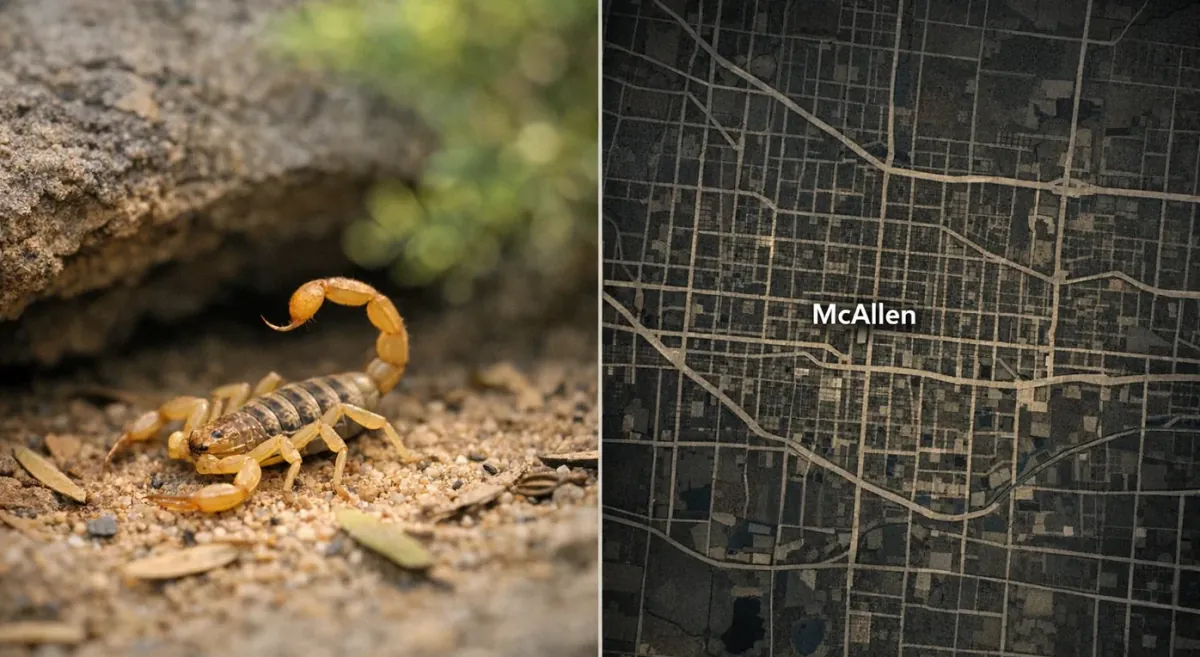
Are scorpions a problem in McAllen?
Yes — McAllen sits in scorpion country, and sightings around homes are common enough that repeated encounters should be treated as a real safety issue. Hidalgo County's heat, dry landscaping, and abundant insect prey give scorpions plenty of reasons to move close to houses, especially after dark. Within 30 km of McAllen, iNaturalist has logged 269 research-grade scorpion observations.
For most homeowners, "a problem" starts as a single wandering scorpion — one lonely visitor on the bathroom tile. That's normal in this part of Texas. It becomes something more when sightings repeat week after week, which usually means scorpions have found food, cover, and a way inside. Statewide, Texas reports roughly 1,743 scorpion exposures a year to poison control (Kang & Brooks 2017), so you're far from alone.
What homeowners in McAllen typically notice first
The first encounter is almost always at night. You flip on the kitchen light for a glass of water and spot something skittering along the baseboard. Or you open the garage and there's one tucked into a corner near the door. Patios, bathrooms, and laundry areas are all common discovery spots.
Why nighttime? Scorpions are mostly nocturnal. They hide during the day and come out after dark to hunt, which is why so many McAllen sightings happen between dusk and the small hours of the morning.
Why Hidalgo County scorpions end up near houses
Homes create perfect edge habitat. Rock borders, palm and citrus debris, stacked firewood, and cluttered garages all give scorpions the tight, dark cover they crave. Where there's cover, there's usually prey — crickets, roaches, and other insects drawn to porch lights and irrigation.
A scorpion isn't trying to confront you. It's looking for a cool hiding spot and its next meal. Your foundation line and landscaping just happen to offer both.
When a McAllen scorpion situation becomes an urgent issue
Treat it as urgent when you see multiple scorpions in a single week, when anyone is stung, or when you find one in a bedroom or nursery. Those are signs of an established indoor presence, not a one-off wanderer. Homes with small children or pets deserve extra caution, since they're closer to floor level where scorpions travel and more sensitive to stings.
Which scorpion species lives in McAllen?
The scorpion you'll almost certainly encounter in McAllen is the Striped Bark Scorpion (Centruroides vittatus). Every one of the 269 local iNaturalist records maps to this species. That's good news for safety: it's a painful sting, but not the medically dangerous kind found in Arizona.
One quick reminder — don't get stuck on perfect identification. If you can't confidently name the scorpion, focus on prevention and safe handling instead. Every scorpion in a home gets the same practical response.
Striped Bark Scorpion in McAllen: the one you'll hear about most
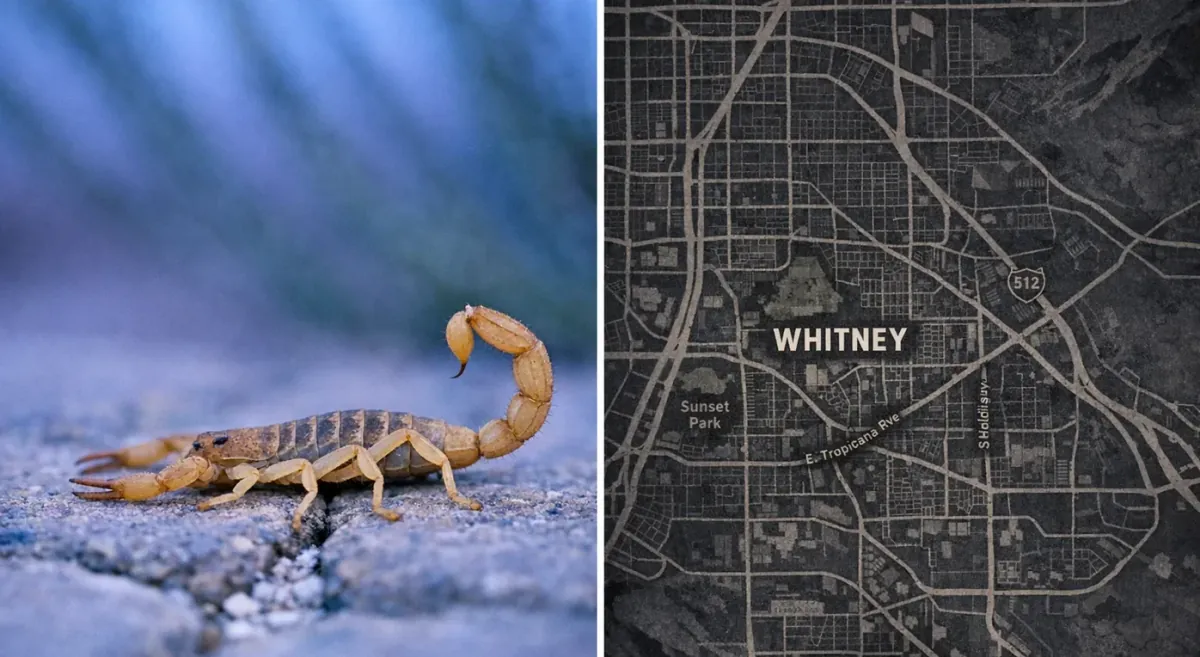
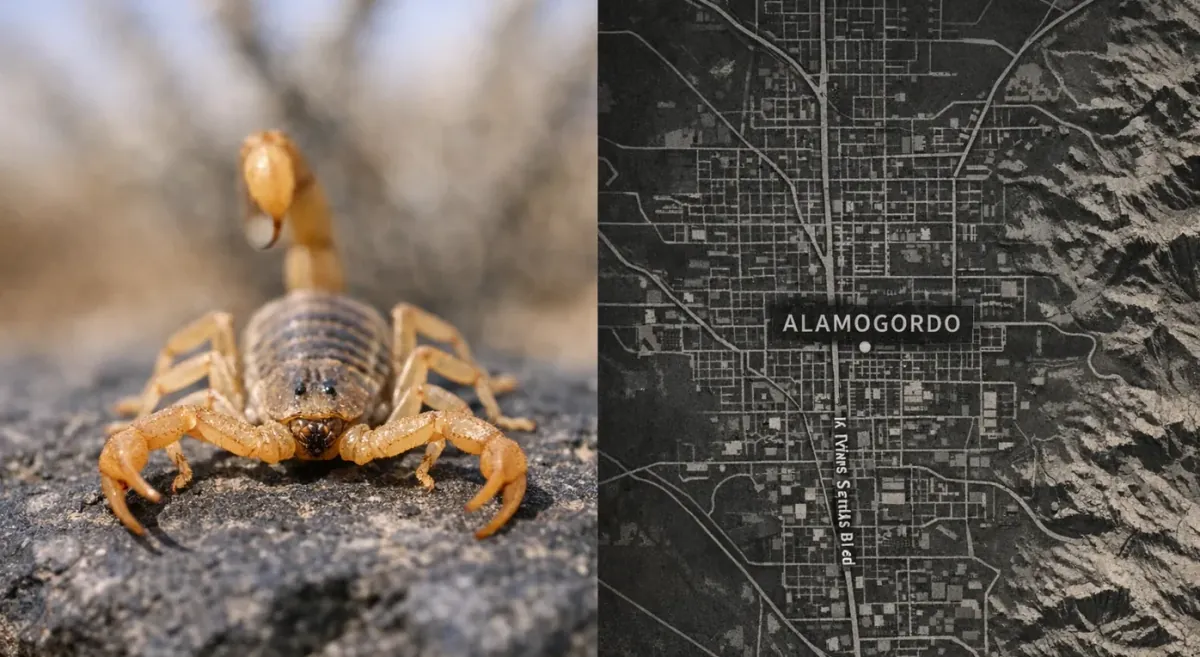
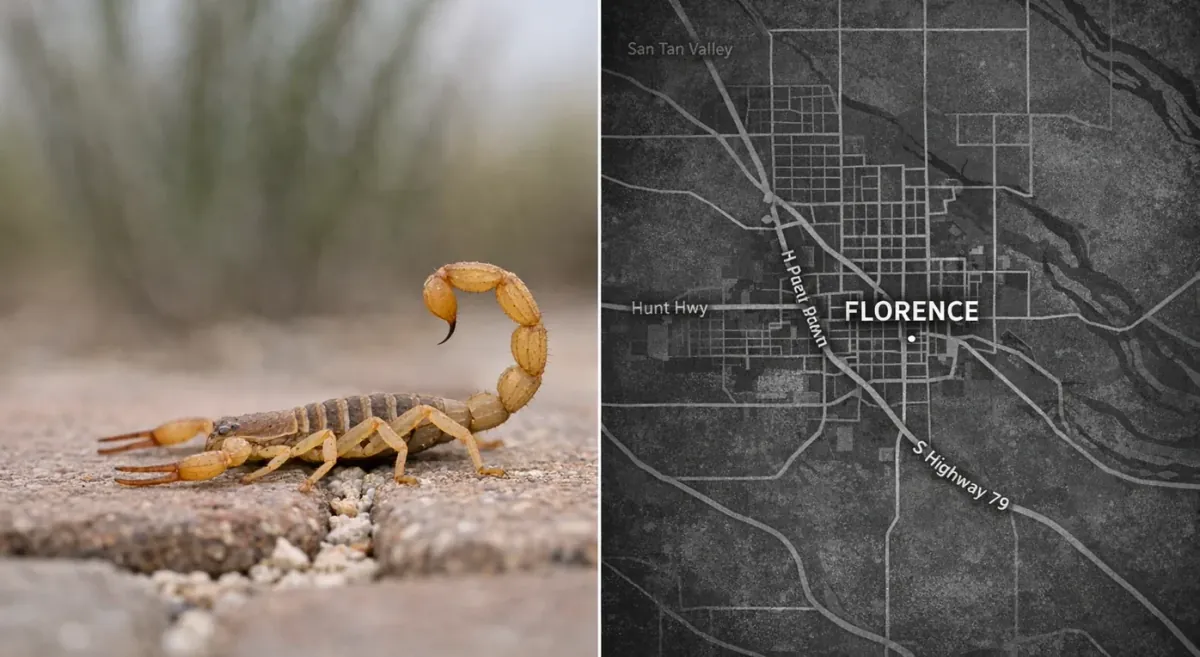
The Striped Bark Scorpion McAllen homeowners find is tan or yellowish with two dark bands running down its back and a slimmer, lighter build than the bulky desert species. It's a capable climber, so finding one off the floor isn't unusual. It's also the most widely distributed scorpion in North America (Yamashita & Rhoads 2017), dominant across Texas and neighboring states.
Where this species hides in and around McAllen homes
Indoors, look along baseboards, in cluttered closets, behind furniture, and in garage corners. Outdoors, they favor block-wall gaps, landscape stones, wood piles, and leaf litter under shrubs. Scorpions travel along room edges and tight lines rather than crossing open floors — a habit that makes perimeter monitoring far more effective than random searching.
What homeowners confuse scorpions with (and how to tell)
In dim light, people mistake roaches, earwigs, and small lizards for scorpions. The giveaway is the pair of front pincers and the curled tail — no other household pest has both. If you're unsure, snap a photo from a safe distance rather than picking it up. A clear picture beats a lot of risk every time.
When are scorpions most active in McAllen?
Scorpions are active in McAllen across much of the year thanks to the mild South Texas climate, but activity peaks through the hot months from late spring into early fall. Summer evenings bring the most sightings, and nationwide data shows warm-month evening hours dominate scorpion calls (Kang & Brooks 2017).
Scorpion season McAllen: what "peak" usually means
"Peak" doesn't mean a sudden invasion. It means more nights with sightings — a run of evenings where you spot one on the patio or inside. Indoor encounters can happen any month of the year in McAllen, but they cluster when heat drives both scorpions and their insect prey into motion.
Are scorpions nocturnal in McAllen?
Yes. Scorpions are nocturnal, hiding by day and hunting after dark. Peak sting hours run from 6 PM to midnight, accounting for roughly 49% of envenomations (Isbister & Bawaskar 2014). Practically, that means the best time to look for them is after dark, and the best move is to reduce nighttime attractants like porch lights that draw insects.
What changes after rain, irrigation, or extreme heat
Weather shifts scorpion behavior fast. Heavy rain or over-watered landscaping can push them toward doors, garages, and low-lying bathrooms and laundry rooms as they seek dry cover. A brutal heat wave sends them hunting for cooler, humid micro-spaces indoors. These spikes tend to be short windows — a few nights of heightened activity right after the weather event — so that's when to stay especially alert.
How dangerous is a scorpion sting in McAllen?
A scorpion sting in McAllen is painful but rarely dangerous. The local Striped Bark Scorpion produces sharp local pain that typically lasts 15–20 minutes, and life-threatening envenomation has never been documented for this species (Yamashita & Rhoads 2017). Children, elderly adults, anyone with a known allergy, and small pets are more vulnerable and worth watching closely.
What a McAllen scorpion sting can feel like
Expect immediate, sharp pain at the site, followed by some swelling, redness, and often tingling or numbness around the sting. In an Arizona cohort, pain was reported in 88.9% of stings and local numbness in 62.2% (Klotz et al. 2021). For scorpion stings in McAllen, Texas, symptoms usually stay local and fade within an hour or two.
When to seek urgent care in McAllen
Call 911 or head to an ER if you notice trouble breathing, facial or throat swelling, severe muscle twitching, vision problems, or intense whole-body symptoms — especially in a very young child. When in doubt, call the free Poison Help line at 1-800-222-1222 for guidance. If you can do it safely, bring a photo of the scorpion to help clinicians.
Are stings more dangerous for kids?
Yes. Small children have smaller airways and lower body weight, so venom effects can hit them harder and faster. If a child is stung and shows anything beyond mild local pain, treat it as urgent. Our guide on why children are more at risk from scorpion stings covers the details.
What to do if you're stung in McAllen
Stay calm and act methodically. Most McAllen stings are handled at home with washing, ice, and monitoring — but knowing your escalation points matters. McAllen has ER options close by, including Tavarez Medical Center at 801 S Main St (0.59 miles from the city center) and General Hospital at 301 W Expy 83 (1.15 miles). Skip the folklore remedies.
First 5 minutes: what to do right away
- Wash the sting area with soap and water.
- Remove rings, watches, or anything tight near the sting in case of swelling.
- Apply a cool compress or ice pack to reduce pain and swelling.
- Take an over-the-counter pain reliever if needed, and stay still and keep calm.
Just as important is what not to do: don't cut the wound, don't try to suck out venom, and skip the unproven home remedies. For more on avoiding common mistakes, see what not to do after spotting a scorpion.
Next 30–60 minutes: monitor and decide
Write down the time of the sting and track how symptoms change. Mild local pain that stays local is expected. But if you see spreading swelling, difficulty breathing, muscle twitching, or unusual eye movements, call Poison Control or head to urgent care right away. Our first-aid guide for the first 30 minutes walks through the timeline.
If you can safely identify or capture it
A quick photo from a safe distance is plenty — never handle a scorpion with bare hands. If you want to contain it, trap it under a glass and slide a stiff card underneath. Identification mainly helps clinicians when symptoms are concerning, so don't put yourself at risk chasing a picture.
How to keep scorpions out of your McAllen home
Effective scorpion control in McAllen follows a clear order: seal them out first, remove the habitat and prey that draw them in, then monitor along the paths they actually travel. Scorpions are thigmotactic — they hug walls and edges — so perimeter-focused effort pays off far more than random spraying.
McAllen-specific exclusion checklist (do this first)
Start where scorpions slip in, which on slab-built McAllen homes usually means ground-level gaps:
- Install door sweeps on exterior and garage doors — the gap under a garage door is a top entry point.
- Replace worn weatherstripping around doors and windows.
- Caulk cracks in the foundation, siding, and around utility and plumbing penetrations.
- Screen or seal weep holes and attic vents.
Tackle doors and the garage threshold first, since those are the busiest routes. Our roundup of the top ways scorpions get into your home is a good weekend checklist.
Yard and garage changes that reduce encounters in Hidalgo County
Clear the cover that scorpions rely on. Break down clutter piles, keep firewood and stacked items off the ground and in sealed bins, and pull mulch, rock borders, and vegetation back from the foundation. In the garage, tidy corners and lift stored boxes off the floor.
Cutting prey pressure helps too. Fewer crickets and roaches around the foundation means fewer reasons for scorpions to patrol your walls in the first place.
Monitoring at night: catching the problem before the next sting
Because scorpions travel along room edges, the smartest place to watch is the perimeter of your highest-risk rooms — bedrooms, bathrooms, laundry areas, and spaces near exterior doors and the garage. Scorpions glow bright greenish under 365nm UV light, which is exactly how automated detection works. Scorpion Alert Detectors plug into perimeter outlets, scan the floor only when the room is dark, and send a photo-verified alert to your phone within seconds of spotting that glow — no nightly flashlight patrols required.
When to call a pro (and what to ask a McAllen technician)
Call a professional after repeated indoor sightings, any sting, or when scorpions keep turning up despite your exclusion work. Set realistic expectations — scorpions are tough, and lasting results come from integrated steps, not a single spray. Ask a McAllen technician:
- What will your inspection focus on, indoors and out?
- What specific exclusion repairs do you recommend for my home?
- How do you treat garages, attics, and the exterior perimeter?
- What's the follow-up schedule?
- What should I do between visits to keep pressure down?
Pair a solid pro with good exclusion and night monitoring, and you turn a recurring scare into a managed, quiet home.
In McAllen, striped bark scorpions often follow wall edges and end up near thresholds, clutter, and water-heavy rooms like bathrooms and laundry areas—so focusing your checks there can make nightly surprises a lot less likely. If you want an extra layer of confidence between inspections, Scorpion Alert is a simple tool that helps you monitor for scorpion activity where they’re most likely to travel.