Why are scorpions getting into my house in the first place?
Scorpions enter homes for two reasons: resources and routes. Your home offers moisture and prey insects, and scorpions follow the edges of your foundation into any gap they can find. They're not targeting you — your house just sits inside their nightly hunting range.
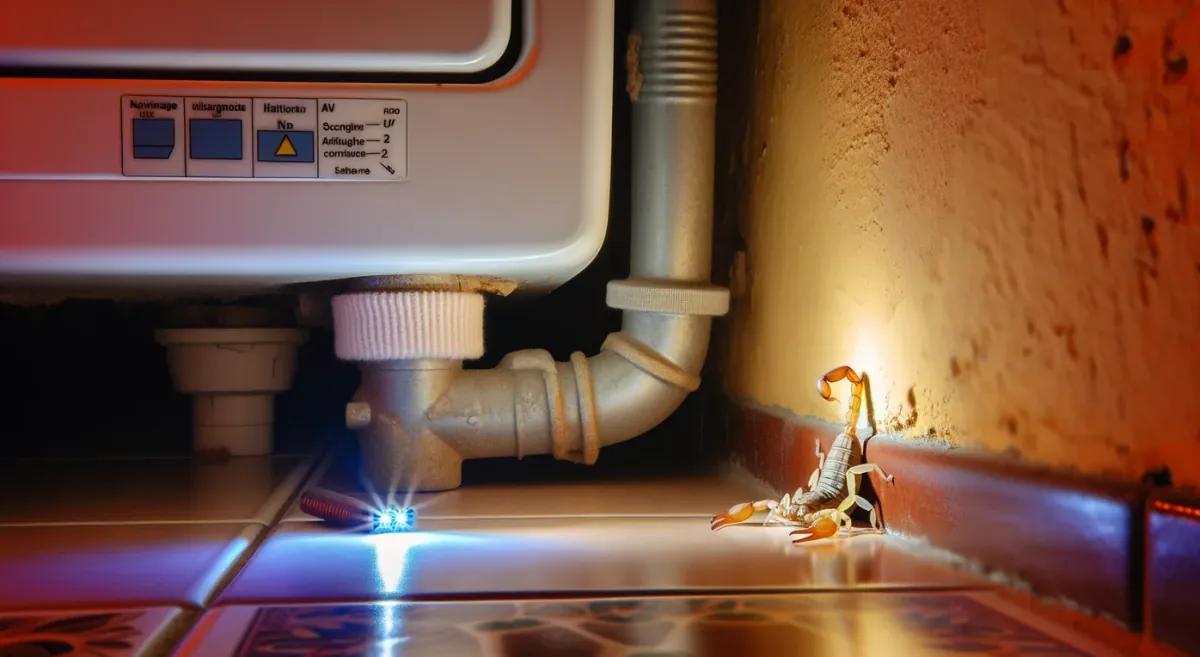
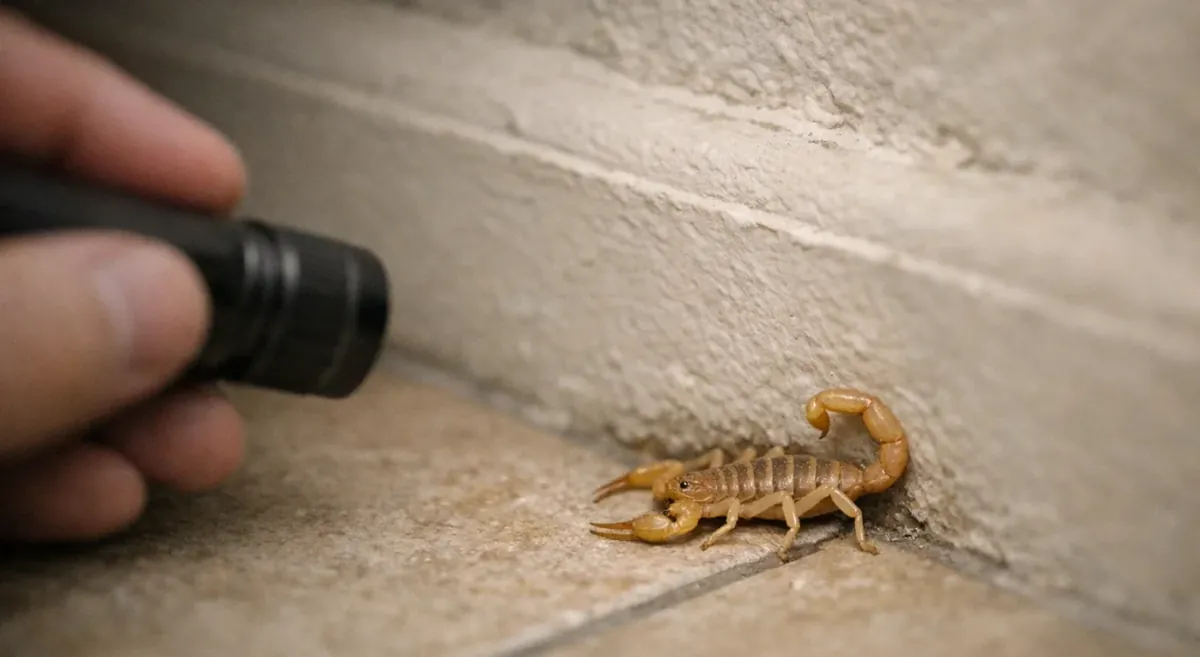
The pattern is predictable. Damp spots draw insects, insects draw scorpions, and scorpions travel along walls and baseboards because they're thigmotactic — they navigate by hugging surfaces. That's why you find them along a wall, not in the middle of the room.
Is your home attracting them? Run through this short list: standing moisture, active insects, clutter along walls, and gaps under doors. Fix those four and you've removed most of the invitation. And no — a "house scorpion" isn't a tame indoor pet. It's a wild scorpion whose range happens to include your floor plan, especially after dark.
What attracts scorpions into a house (even a clean one)?
Moisture is the anchor. An AC condensate drip, a leaky sink trap, pet bowls left out overnight, or irrigation overspray can create a small "micro-oasis" that concentrates insects — and where insects gather, scorpions hunt. That's why bathrooms, laundry rooms, and garages see the most indoor sightings.
Do a quick 60-second walkthrough tonight. Check under sinks and around the water heater for wet spots. Look for insect activity near baseboards. Note any clutter — shoes, boxes, laundry — stacked against a wall. Those three things line up almost perfectly with where scorpions travel.
Are "house scorpions" a real thing—or just scorpions adapting to my home?
"House scorpions" is just what people call scorpions they keep seeing indoors. There's no separate domesticated species. Repeat sightings usually mean your home has become a reliable hunting spot — not that a colony moved in.
Indoor sightings can spike without any "nest." A prey-insect boom, seasonal pressure during warm months, or a garage left open at night can push more scorpions across your threshold. In the Southwest, that's often the Centruroides sculpturatus (Arizona bark scorpion) in Arizona, or the striped bark scorpion across Texas and New Mexico. Species ID mostly matters when kids or pets are around, or when stings keep happening.
Why am I seeing tiny scorpions in my house?
Tiny scorpions usually mean one of three things: juveniles dispersing from a nearby outdoor brood, breeding habitat right outside your foundation, or a surge of small prey insects drawing young scorpions in. Seeing multiple small ones is a signal worth acting on.
Don't assume small means harmless. Size doesn't reliably predict sting severity — a point we cover in whether smaller scorpions are more dangerous. If you're seeing several tiny scorpions, treat it as your trigger to tighten exclusion and increase monitoring near entry points and bedrooms.
What should I do right now if there's a scorpion in my house?
Tonight, focus on two things: lower your sting risk and safely remove the scorpion you can see. Clear the floor along your walls, shake out shoes and clothing before wearing them, keep a flashlight by the bed, and capture any visible scorpion under a cup — never with bare hands.
Most of the danger is preventable with simple habits. Avoid the common missteps we list in what not to do after spotting a scorpion in your home — like swatting at it barefoot or reaching into a dark corner without light.
What are the fastest steps to reduce sting risk tonight?
The bedtime routine below cuts risk fast. It matters because feet and hands are the most-stung body parts, usually when people are barefoot.
- Clear the floor along every wall — no clothes, shoes, or bags where a scorpion would travel.
- Shake out shoes, slippers, and any clothing before you put them on.
- Turn beds and cribs into "islands": pull them off the walls, tuck bedding so it doesn't touch the floor, and remove nearby items a scorpion could use to reach the mattress.
- Keep a flashlight within reach so a 2 a.m. bathroom trip isn't a barefoot gamble.
Spend ten extra minutes on the spaces where kids and pets sleep or play. Children are more vulnerable to serious stings — see why children are more at risk from scorpion stings — so nurseries, playrooms, and pet beds deserve the same island treatment.
How do I safely get rid of a scorpion inside the house (without getting stung)?
Pick a no-contact method. Trap it under a cup, slide a stiff card underneath, and release it far outside. Or use long tongs or a grabber to lift it into a container. If you must kill it, do it with a shoe or a long tool — never your hand.
After removal, re-check the perimeter and baseboards of that room with a flashlight, since scorpions stick to the same edges. Then shift from reacting to preventing: sealing and monitoring. If someone gets stung and develops severe symptoms — trouble breathing, jerking muscles, roving eye movements — follow the bark scorpion sting first-aid plan and call Poison Control right away.
Can scorpions climb stairs or reach second-floor bedrooms?
Yes. Scorpions can climb textured surfaces and wander widely, so second-floor and upstairs bedroom sightings absolutely happen. Stairs are no barrier, and an upper-floor bedroom isn't automatically safe.
The takeaway: don't defend only exterior doors. Protect interior travel routes too — hallway bottlenecks, bedroom thresholds, and baseboards on every floor. If your sightings or stings are happening upstairs, prioritize detection in those upstairs bedrooms rather than assuming the problem stays at ground level.
What's the best way to keep scorpions out of the house long-term?
The best long-term approach is a simple 3-layer system: Exclusion (seal the gaps they use), Habitat modification (reduce the moisture and prey drawing them in), and Detection (catch the ones that slip through fast). Do all three and intrusions become rare events instead of nightly surprises.
A high-impact weekend starts with the biggest openings first: exterior doors, the garage, and utility penetrations — then works outward to the yard and finishes with monitoring.
What does "keeping scorpions out" realistically mean in scorpion country?
Realistic success is fewer intrusions, fewer hiding places, and faster detection — not a perfectly scorpion-proof home. In the Southwest, "zero forever" isn't the target. A rare sighting is a win.
Measure progress by tracking sightings per month, which rooms they show up in, and how that shifts with the seasons. Pressure rises in the warm months, so plan to intensify effort then — our month-by-month scorpion season guide shows when to expect the peaks.
Which entry points should I seal first to get the biggest results?
Seal ground-level gaps first, because scorpions follow edges and can slip through openings as thin as a credit card. Here's the priority order:
- Exterior doors — add door sweeps and fix worn thresholds.
- Garage door seals — replace the bottom gasket and corner seals.
- Utility penetrations — gaps around pipes under sinks and behind appliances.
- Weep holes and trim gaps — small structural openings near the foundation.
Use the flashlight test on doors: have someone shine a light from outside at night while you watch from inside for gaps. For pipe gaps, use the "stuff and seal" method — pack the opening with steel wool or copper mesh, then cap it with caulk. Scorpions can also exploit vents and plumbing routes, covered in whether scorpions get in through AC vents and whether scorpions come through plumbing.
How can you keep scorpions out if you rent or can't do major repairs?
Renters have plenty of no-damage options: peel-and-stick door sweeps, removable weatherstripping, and foam gaskets you can lift off when you move. Under-sink gaps can be packed with removable steel wool instead of permanent caulk.
Behavioral controls matter just as much. Keep the garage door closed at night, declutter the edges of every room, and cut indoor insects by fixing drips and moving pet bowls off the floor overnight. For the structural stuff, document and request: photograph the gap, note the location, and ask your landlord or HOA to fix the garage seal, worn thresholds, and exterior cracks. A short written request with photos gets action faster than a phone call.
How do I make my yard less scorpion-friendly without ripping out my landscaping?
You don't need a bare desert lot. The goal is a buffer zone: reduce hiding spots, moisture, and prey insects in the strip closest to your foundation. Small, targeted changes near doors and walls do most of the work. For the full picture, see the top ways scorpions get into your home.
What should I move away from the foundation first?
Start with the worst offenders: firewood, stacked pavers or bricks, and dense ground cover pressing against the wall. These are prime daytime harborage right where scorpions enter.
Aim for a 12–24 inch buffer between plantings and the wall where you can. Move woodpiles about 20 feet from the house and elevate them off the ground. Got a small yard? Skip the full perimeter and just create a bare or gravel strip near the doors and garage — the highest-traffic entry points.
How do I reduce the bugs scorpions eat near my doors and walls?
Two quick wins. First, lighting: swap bright white bulbs near entries for amber or yellow, or put them on motion sensors, so you stop drawing clouds of insects to your doorstep. Second, moisture: fix drips, angle irrigation away from the foundation, and bring pet bowls in at night or set them away from doors.
Fewer bugs at your walls means fewer reasons for scorpions to hunt there. Cut the prey, and you cut the traffic.
How can I detect scorpions fast—and know if my house is infested?
Fast detection is the third layer, and it's the one most homeowners skip. Because scorpions are nocturnal and hard to spot, you often don't know one is inside until you step on it. Monitoring closes that gap — but not all monitoring is equal.
97.8% of US scorpion stings happen inside the home — not outdoors.
— Kang & Brooks, J Med Toxicol 2017
That number is exactly why indoor detection matters so much. Across US poison-center data, Arizona alone accounted for 68.2% of all reported scorpion exposures from 2005–2015 (Kang & Brooks 2017). The stings are happening where you live, so that's where you need eyes.
Where should I place monitors or traps to catch scorpions early?
Place devices along walls, not in open floor, because scorpions travel the baseboards. Follow the perimeter and work from most to least likely: door thresholds first, then the bedroom hallway, then bathrooms and laundry, then the bedrooms and nurseries themselves.
A simple 3-device starter map works for most homes: one at the primary entry door, one in the hallway leading to bedrooms, and one near water — a bathroom or the laundry area. That covers where scorpions come in, where they travel, and where they linger.
Are real-time scorpion alerts better than checking sticky traps?
Real-time alerts beat sticky traps on the thing that matters most: time. A trap only tells you a scorpion was there whenever you happen to check it. A live alert tells you the moment one appears — before it reaches a bedroom.
| Method | Speed | Coverage | Effort |
|---|
| Sticky / glue trap | Only when you check it | One spot on the floor | Manual checking, messy |
| Nightly UV flashlight sweep | Only while you patrol | Wherever you walk | High — every single night |
| Automated UV detectors (Scorpion Alert) | Alert within seconds | Whole-home with multiple units | Low — scans for you |
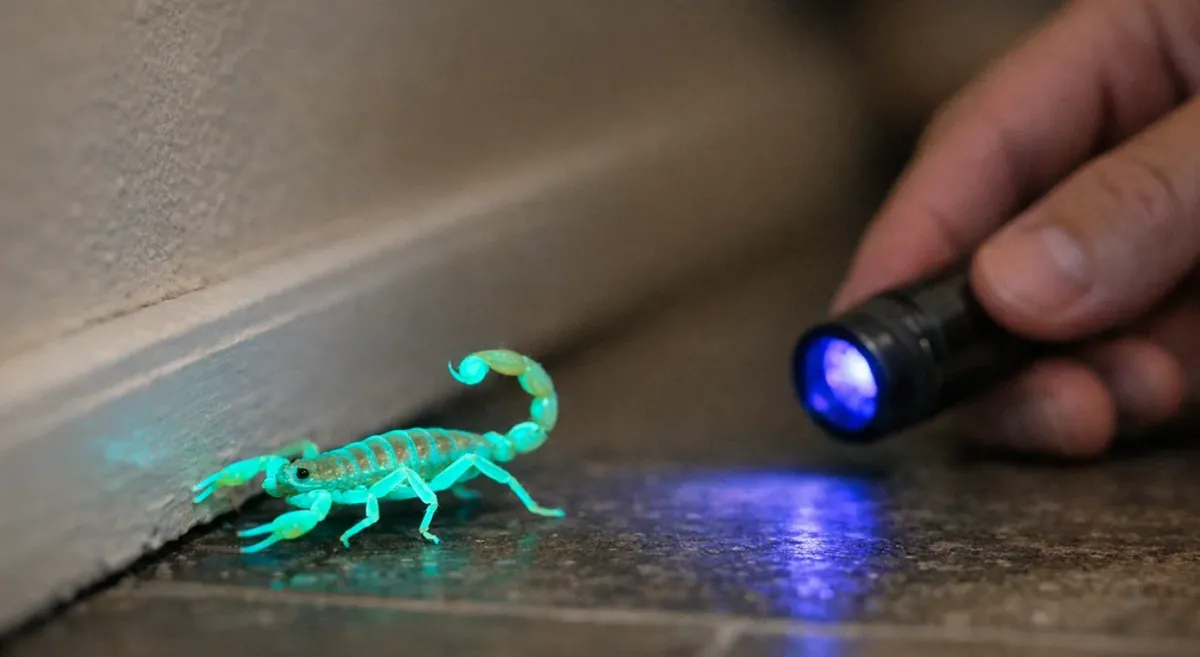
Scorpions fluoresce a bright greenish glow under ultraviolet light — a genuine quirk of their exoskeleton. Scorpion Alert Detectors put that to work: they plug into wall outlets along the room perimeter, shine 365nm UV on the floor below, and watch for that glow only when the room is dark, which is exactly when scorpions are active. When one shows up, you get a push notification or SMS within seconds, plus a photo-verified alert and a history log showing the date, time, and location. No nightly patrol required.
How do I know if I have a scorpion-infested house (and when should I call a pro)?
In homeowner terms, "infested" means frequent sightings, scorpions in multiple rooms, repeated upstairs or bedroom encounters, or several small scorpions turning up. One scorpion isn't an infestation — a pattern is. Here's a simple decision tree:
- One sighting: run tonight's sting-risk plan and seal the nearest gaps.
- Weekly sightings: add exclusion, reduce yard pressure, and set up monitoring along travel routes.
- Daily sightings or any sting: bring in a professional inspection and pursue aggressive exclusion.
Log every sighting and alert — date, time, and exact location. Those notes reveal your entry points and patterns faster than anything else, and they make a real difference when a pro walks the property. A prior sighting at home is the single strongest predictor of a future sting, so treating the pattern seriously is the whole point. Keeping scorpions out of your house is a checklist, not a one-time fix — the homeowners who stay ahead of it are the ones who track what's happening and adjust.
Scorpion Alert rents plug-in UV Detectors as part of a monthly monitoring subscription — the hardware's included, plus a one-time shipping fee at checkout. See
/pricing for current rates. There's no long-term contract — cancel any time by emailing
support@scorpionalert.com and returning the Detectors. If you're in Arizona, New Mexico, Texas, Nevada, or California and tired of finding scorpions the hard way,
see how Scorpion Alert catches breaches the moment they happen.
If you work through this checklist—sealing entry points, reducing clutter, and cutting down on the insects that attract scorpions—you’ll make your home a much harder target. For an extra layer of confidence at night, Scorpion Alert provides 24/7 UV-based detection so you’re not relying on manual flashlight checks; learn more at ScorpionAlert.com.