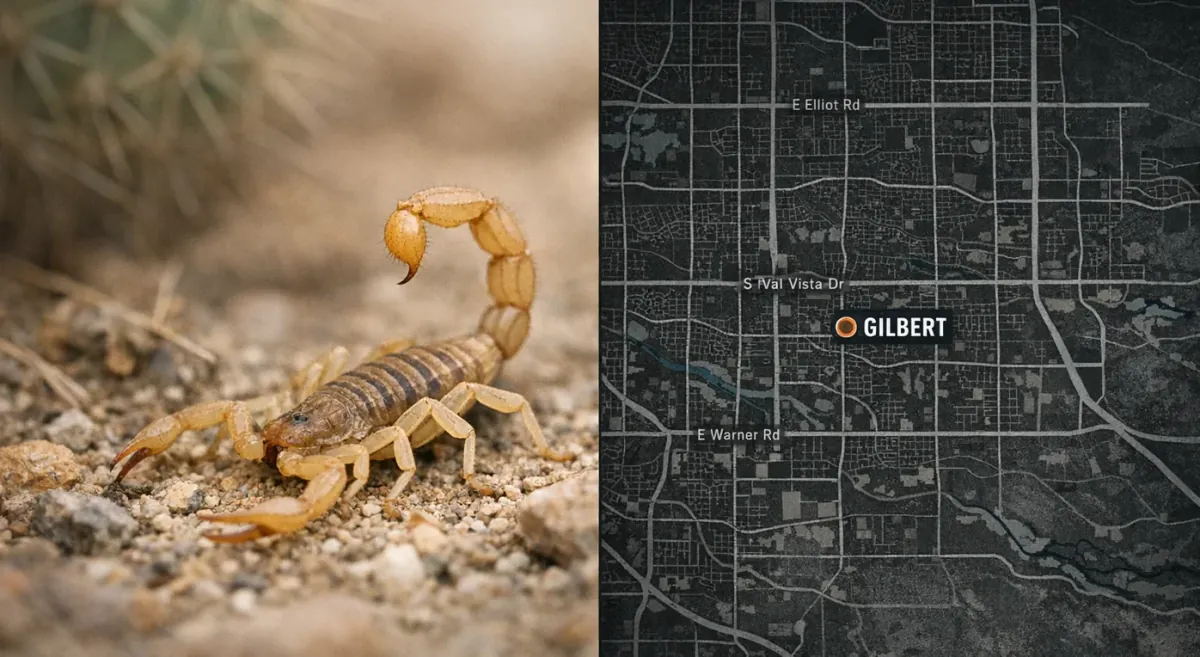
Are scorpions a problem in Gilbert, Arizona (and where are the hotspots)?
If you're living in Gilbert or thinking about moving here, you should know what to expect with scorpions. Yes, they're a real concern in this East Valley community — but here's what matters: scorpion activity is incredibly localized. Your neighbor three houses down might find 8-10 scorpions nightly during peak season while you see none.
Why such dramatic differences? It comes down to micro-habitats. Scorpions don't randomly wander the desert looking for your house. They follow moisture, prey (like crickets and roaches), and shelter opportunities. A single irrigation leak or a row of untrimmed palm trees can turn one property into scorpion central while leaving the house next door untouched.
The key is understanding your specific property's risk factors. Gilbert's rapid growth means newer developments push right up against desert areas, creating prime scorpion territory along those edges. But even established neighborhoods can have hotspots around greenbelts, canal paths, and common areas with dense landscaping.
Which parts of Gilbert tend to see more scorpions?
Instead of claiming certain neighborhoods are "bad" (which can change over time), use this hotspot checklist to evaluate any Gilbert property:
- Edge-of-development areas: New construction near open desert or agricultural land sees higher activity, especially in the first 2-3 years.
- Wash and greenbelt corridors: Properties backing to these natural pathways provide scorpion highways into neighborhoods.
- Mature palm neighborhoods: Those picturesque palm-lined streets? Dead fronds create perfect scorpion harborage.
- Block wall boundaries: Homes against common walls, retaining walls, or shared fences see more traffic along these "scorpion highways."
Want to know your real risk? Map everything within a 200-500 foot radius of your home. Look for block walls with cracks or voids, utility easements with overgrown vegetation, canal paths, and any undeveloped lots. These features create the refuge sources that feed scorpion populations into nearby homes.
Why do some Gilbert homes get 8–10 a night while others get none?
Picture this scenario: two identical homes on the same Gilbert street. One homeowner battles scorpions nightly while the other rarely sees them. The difference? Micro-habitat factors that concentrate scorpion activity.
Moisture magnets top the list. That drip irrigation system creating a muddy spot by your foundation? It's attracting crickets and roaches — prime scorpion food. Add a leaky hose bib or overwatered landscaping, and you've created a scorpion buffet.
Then there's the shelter factor. Rock landscaping looks great but provides countless hiding spots. Dense groundcover, stacked materials, and cluttered storage areas multiply available refuge. But here's what many homeowners miss: "refuge sources" like block wall voids, untrimmed palm skirts, and irrigation valve boxes can seed repeated indoor encounters. Scorpions establish territories near these features and venture inside repeatedly unless you address the source.
Finally, consider your outdoor lighting. Bright lights attract insects, which attract scorpions. Properties with excessive landscape lighting or uncovered porch lights essentially ring the dinner bell every night.
How can I quickly assess my property's scorpion pressure?
Skip the guesswork and run a simple 2-night baseline check to understand your actual scorpion situation. Here's your assessment protocol:
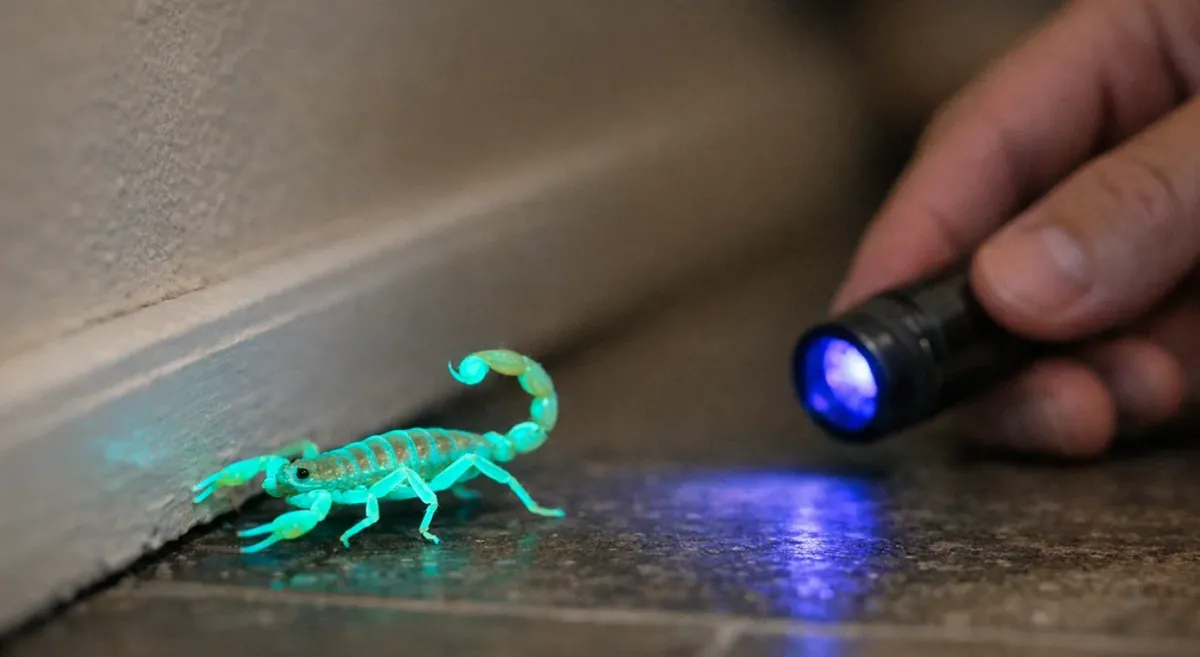
Night 1 - Perimeter sweep: Wait until full darkness (at least 2 hours after sunset). Using a quality UV flashlight, walk your property's entire perimeter. Check along foundation walls, around doorways, and near any moisture sources. Scorpions glow bright green under 365nm UV light — you can't miss them.
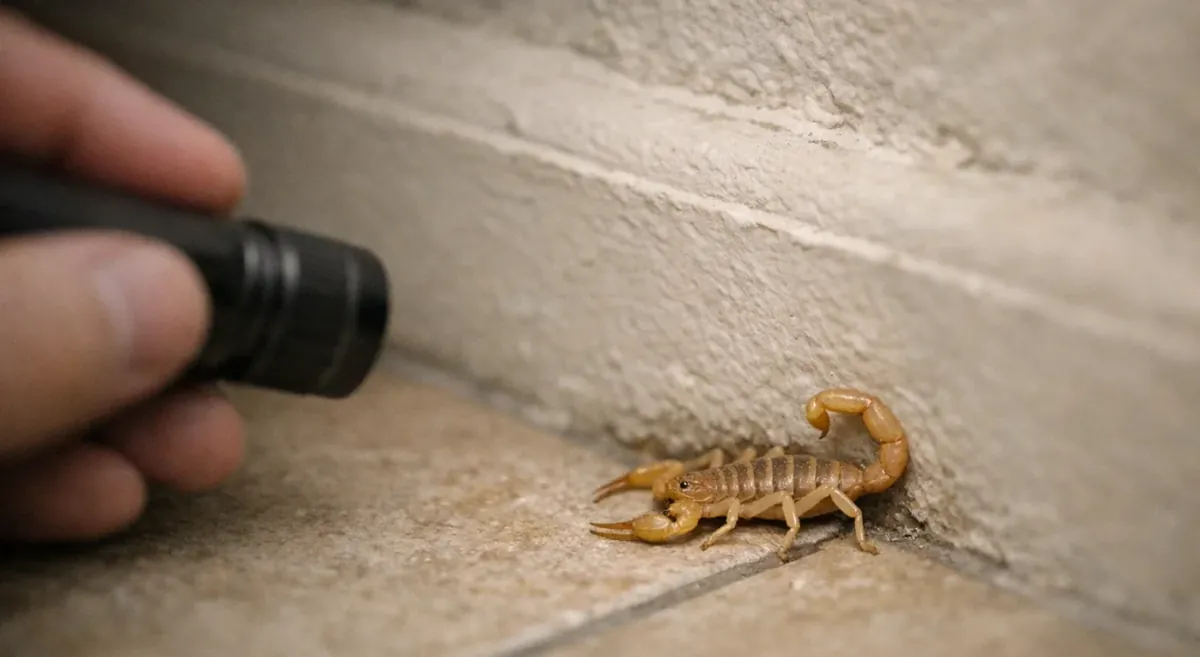
Night 2 - Interior inspection: Focus on high-risk indoor areas where scorpions travel. Thanks to their thigmotactic behavior (following edges and walls), you'll find them along baseboards, door thresholds, and room perimeters. Check bathrooms, laundry rooms, and garages thoroughly — these areas combine moisture and entry points.
Document what you find: location, time, and count. This baseline tells you whether you're dealing with occasional visitors or an established population. If you're finding multiple scorpions indoors or 5+ on your perimeter per night, you need immediate action.
Which scorpion species live in Gilbert—and how can I identify the dangerous one?
Not all scorpions pose the same threat. In Gilbert, you'll encounter several species, but only one sends people to the emergency room: the Arizona bark scorpion. Learning to identify it changes how you respond.
Most scorpions you'll see outdoors — the "big brown" ones under rocks or in garages — are desert hairy scorpions or stripe-tailed scorpions. Their stings hurt but rarely cause serious medical issues in healthy adults. The Arizona bark scorpion? That's a different story, especially if you have young children.
Is the Arizona bark scorpion common in Gilbert?
Unfortunately, yes. The Arizona bark scorpion thrives in Gilbert's environment and causes the most concern for good reason. Unlike other local species that stay ground-level, bark scorpions aren't limited to ground-level entry — they slip through tiny gaps and show up in places you'd never expect, like your second-story bathroom or an upstairs bedroom.
They're attracted to cooler, humid micro-habitats inside homes. That's why you'll often find them in bathrooms near shower stalls, laundry rooms with washing machines, or kitchen areas under sinks. During Gilbert's hot summers, these indoor refuges become even more appealing as scorpions seek relief from extreme temperatures.
What makes them particularly troublesome is their size. At just 2-3 inches fully grown, bark scorpions can squeeze through gaps other scorpions can't navigate. Weather stripping gaps, worn door sweeps, and utility penetrations become easy entry points.
What does an Arizona bark scorpion look like compared to "big brown" scorpions?
Here's your quick identification guide for the scorpions you'll encounter in Gilbert:
Arizona bark scorpion: - Light tan to yellowish color (never dark brown or black) - Slender build with thin pincers and tail - 2-3 inches maximum length - Often found on walls or hanging upside down - Tail often held curved to the side when resting
Desert hairy & stripe-tailed scorpions: - Dark brown to black coloration - Thick, robust build with hefty pincers - 4-6 inches for desert hairy species - Ground-dwelling, rarely found up high - Tail typically straight back when at rest
Safety note: Never rely on size alone to judge danger. A small bark scorpion poses more risk than a large desert hairy. If you're unsure, take a clear photo from at least 3 feet away. Local pest control companies or Gilbert community groups can often identify from photos — much safer than getting close for a detailed look.
Can scorpions in Gilbert climb walls and end up in beds?
Yes. The practical point is that bark scorpions can reach upstairs rooms and beds — no floor is automatically safe. This isn't fear-mongering; it's documented behavior that leads to many nighttime stings. Because they aren't limited to ground-level entry, they can make their way to nightstands, bedding, and even second-story rooms as they move through a home searching for prey or cooler shelter.
Common bedroom sting scenarios include reaching for items on nightstands, grabbing towels or clothing from the floor, or rolling over onto a scorpion that reached the bed by way of bed skirts or blankets touching the floor. One Gilbert resident's story involved finding a bark scorpion on their pillow at 3 a.m. — discovered only when they felt movement near their face.
Your bed safety checklist: - Pull all bedding at least 2 inches off the floor - Move beds away from walls (scorpions travel along edges) - Remove bed skirts entirely during scorpion season - Don't store shoes or clothes under the bed - Shake out any bedding that touches the floor before sleeping
When is scorpion season in Gilbert, and what should I do month by month?
Scorpions aren't just a "summer problem." In Gilbert, scorpion activity follows temperature and humidity patterns that create distinct risk periods throughout the year. Understanding these patterns helps you time your prevention efforts for maximum impact.
The basic framework: scorpions become active when overnight temperatures consistently stay above 70°F. In Gilbert, that means activity starts ramping up in April, peaks during the monsoon months of July through September, and gradually decreases through October and November. But here's what catches people off guard — warm winter days can trigger activity even in December or January.
What months are worst for scorpions in Gilbert?
August-September see the highest rates of scorpion envenomations across Arizona, aligning with peak temperatures and monsoon humidity.
— Arizona Poison and Drug Information Center data
While scorpions stay active from April through October, August and September create the most favorable combination of conditions. Temperatures remain high (overnight lows above 80°F), and monsoon humidity drives both scorpions and their prey into overdrive. This combination pushes more scorpions to seek shelter indoors.
Here's the practical insight: the worst indoor invasions often follow humidity spikes, not just heat. A dry 110°F day might see less activity than a humid 95°F evening after monsoon rains. Watch weather patterns, not just the calendar. When you see rain in the forecast followed by warm nights, expect increased scorpion movement within 24-48 hours.
What time of night are scorpions most active around my house?
Scorpions follow predictable nightly patterns. Activity typically begins 1-2 hours after sunset and peaks between 10 p.m. and 2 a.m. During these hours, they hunt along your home's perimeter, following walls and foundations while searching for prey.
This timing matters for your prevention strategy. Schedule your inspection walks during peak hours for an accurate assessment. If you're checking at 7 p.m., you're missing most activity. The same goes for setting up monitoring systems — they need to operate during these prime hours.
Weekend routine suggestion: Start with a perimeter scan around 10:30 p.m., checking foundation walls, doorways, and common entry points. Follow up with interior checks in your garage, laundry room, and bathrooms — the areas where scorpions most commonly enter homes.
A simple Gilbert scorpion calendar (what to prioritize each season)
Spring (March-May): Focus on exclusion before populations explode. Seal cracks, install door sweeps, and repair weather stripping now. Clear winter debris, trim palm trees, and reduce harborage areas. This is your window to get ahead of the problem.
Early Summer (June-July): Shift to prey control and perimeter defense. Address cricket and roach populations that attract scorpions. Apply targeted perimeter treatments if using them. Begin regular monitoring as activity increases.
Monsoon Season (July-September): Tighten moisture control immediately. Fix leaks, adjust irrigation, and eliminate standing water. This is when automated monitoring pays off — scorpion movement peaks and becomes less predictable. Maintain barriers and stay vigilant.
Fall (October-November): Don't let your guard down. Keep exclusion measures in place as scorpions make final pushes before cooling weather. Continue monitoring through Thanksgiving — warm fall nights can surprise you.
Winter (December-February): Use quiet months for deep cleaning and repair projects. Declutter garages, seal interior gaps, and plan next year's prevention strategy. Check stored items carefully — dormant scorpions hide in boxes and rarely-used spaces.
Critical reminder: Re-inspect and replace door sweeps and weather stripping every June before monsoon season. These barriers degrade faster in Gilbert's extreme heat and become less effective right when you need them most.
How dangerous is a scorpion sting in Gilbert—and what should I do right now?
Most scorpion stings in Gilbert cause localized pain similar to a wasp sting, not life-threatening reactions. For healthy adults, you'll experience pain, tingling, and numbness at the sting site that gradually improves over several hours. But — and this is crucial — young children face much higher risks.
The Arizona bark scorpion's venom affects children differently than adults. Their smaller body mass means the same amount of venom can cause more severe systemic effects. This isn't about being overly cautious; it's about knowing when a sting becomes a medical emergency.
What do scorpion stings usually feel like?
Adult sting experiences vary, but common sensations include immediate burning pain at the sting site, followed by tingling that spreads beyond the wound. Some describe it as touching a live electrical wire. The area often becomes numb, and you might feel "pins and needles" traveling up the affected limb.
Most stings happen predictably: reaching into shoes without checking, grabbing towels or clothing from the floor, or accidentally pressing against a scorpion in bed. Hand and foot stings are most common because we unknowingly reach into scorpion hiding spots. The mechanism matters — understanding how stings occur helps you prevent them through simple habit changes.
Severity depends on several factors: the amount of venom injected (scorpions can control this), sting location, and individual sensitivity. Multiple stings or stings near the torso tend to cause stronger reactions than a single extremity sting.
When should I seek emergency care (especially for kids)?
Children under 10 years old account for the highest rates of severe scorpion envenomation, with significantly higher hospitalization and ICU admission rates than adults.
— Journal of Medical Toxicology, multi-state study
For children, especially those under 10, watch for these emergency warning signs that require immediate medical attention:
- Uncontrolled muscle movements or twitching
- Roving or darting eye movements
- Excessive drooling or difficulty swallowing
- Breathing difficulties or wheezing
- Severe agitation or inconsolable crying
- Muscle rigidity or abnormal posturing
Don't wait to see if symptoms improve. Children's smaller body mass means venom effects can escalate quickly. If you notice any systemic symptoms beyond localized pain, head to the nearest emergency room immediately. Gilbert has several nearby hospitals equipped to handle scorpion envenomations.
What should I do if I'm stung in Gilbert?
Here's your step-by-step response plan for scorpion stings:
1. Move to safety — Get away from the area where the sting occurred. Other scorpions might be nearby.
2. Basic first aid — Wash the sting site with soap and water. Apply a cool compress (not ice directly on skin) for 10-minute intervals to reduce pain and swelling.
3. Avoid these mistakes — Don't cut the wound, apply suction, use tourniquets, or take aspirin (which can increase bleeding).
4. Call Poison Control — Dial 1-800-222-1222 immediately. They'll assess your symptoms and advise whether hospital treatment is needed. Have the victim's age and time of sting ready.
5. Document if safe — If possible, photograph the scorpion from a safe distance. This helps medical staff confirm species and adjust treatment. Don't risk another sting trying to capture it.
In Maricopa County, where Gilbert is located, poison control centers log hundreds of scorpion exposures annually. During peak months, Gilbert emergency rooms stay familiar with treatment protocols. Most adult stings resolve with pain management, but severe cases might receive antivenom treatment.
What's the best scorpion control plan for Gilbert homes (DIY vs pro vs monitoring)?
Effective scorpion control isn't about picking one solution — it's about layering defenses. Think of it as a system: reduce outdoor habitat, block entry points, eliminate prey, and verify your results. The question isn't whether to go DIY or hire professionals; it's understanding what combination works for your specific situation and budget.
Success takes consistency. The homeowner who seals gaps once and forgets maintenance won't see lasting results. Neither will someone who pays for monthly spraying but ignores the moisture problem attracting prey. Let's break down what actually works and what it costs.
How do I keep scorpions out of my Gilbert home?
Start with the highest-return exclusion tasks that physically block scorpion entry:
Priority 1 - Door and threshold sealing: Install door sweeps on every exterior door, including your garage. Pay special attention to garage-to-house doors — this is scorpion highway number one. Quality sweeps cost $15-25 per door but stop more scorpions than any other single measure.
Priority 2 - Weep screed and foundation gaps: That gap between your stucco and foundation (weep screed) provides hundreds of feet of potential entry. Seal it with copper mesh and caulk, focusing on areas near doors and windows first. Budget $200-400 in materials for an average Gilbert home.
Priority 3 - Utility penetrations: Check where pipes, cables, and wires enter your home. Even pencil-width gaps allow bark scorpion entry. Use expanding foam for large gaps, caulk for small ones.
Beyond sealing, conduct a moisture audit. Walk your property with a notebook and document every water source: dripping faucets, irrigation overspray, A/C condensation lines, and pool equipment leaks. Fix these issues and you'll see prey populations (and subsequently scorpions) drop significantly.
Don't forget habitat modification. Clear debris from your foundation perimeter, trim palm skirts monthly during season, and maintain at least 2 feet of clear space around your home. Remove rock piles, lumber stacks, and dense vegetation that provide scorpion refuge.
Does perimeter treatment work for scorpions in Gilbert?
Here's the honest answer about chemical perimeter treatments: they're better at killing scorpion prey than scorpions themselves. Most products labeled for scorpion control actually work by reducing cricket and roach populations. When prey disappears, scorpions eventually move elsewhere — but it's not instant.
Professional-grade treatments typically last 30-60 days in Gilbert's extreme weather. Rain, irrigation, and UV exposure break down residual barriers faster here than in milder climates. That means reapplication every 4-6 weeks during active season, whether you DIY or hire a service.
The key to perimeter treatment success? Pairing it with exclusion and monitoring. Spraying alone won't overcome poor sealing or abundant habitat. Think of treatments as one layer in your defense system, not a complete solution. Focus applications on entry points, foundation walls, and known travel paths rather than broadcast spraying everything.
DIY vs professional Gilbert scorpion control: what does each actually cost?
Let's break down real costs for Gilbert homeowners:
DIY Approach: - Initial materials (caulk, foam, mesh, sweeps): $300-500 - Quality UV flashlight: $30-50 - Perimeter treatment products: $40-60 per application - Time investment: 10-15 hours initial work, 2-3 hours monthly maintenance - Annual cost: $400-600 plus your time
Professional Service: - Monthly treatments: $45-75 per month - Initial exclusion service: $500-1,500 (if offered) - Guarantees vary widely — read carefully - Annual cost: $540-900 plus any exclusion work
Hybrid Approach: - DIY sealing + professional treatments: $800-1,200 annually - Often the most effective for severe problems
Track your results by counting weekly sightings before and after implementing changes. If you're not seeing at least a 50% reduction within 60 days, reassess your approach. Many Gilbert homeowners find that good exclusion work reduces the need for ongoing chemical treatments.
How can I monitor for scorpions at night without doing blacklight walks?
Manual blacklight patrols work, but let's be realistic — checking your entire property every night isn't sustainable. This is where automated monitoring can help a lot. Scorpion Alert detectors plug into outlets along your walls and activate when rooms darken, continuously scanning for the characteristic UV fluorescence of passing scorpions.
The science is straightforward: scorpions fluoresce under 365nm UV light due to compounds in their exoskeleton. Detectors use this same wavelength to identify scorpions as they travel along walls (remember that thigmotactic behavior?). When detected, you receive a photo-verified alert on your phone showing exactly where and when the scorpion appeared.
Strategic placement maximizes coverage: position detectors near high-risk entry points like garage doors, sliding patio doors, and doggy doors. Add units in laundry rooms and bathrooms where moisture attracts both scorpions and prey. The AI-powered detection is designed to reduce false alarms from lint or pet fur — only confirmed scorpion sightings trigger notifications.
This technology fits neatly into a comprehensive control strategy. While exclusion and treatments reduce scorpion numbers, monitoring verifies your success and catches any that slip through. Instead of wondering whether your efforts are working, you'll have timestamped photo evidence of activity levels. More importantly, you'll know right away when a scorpion enters your living space, so you can remove it quickly before anyone gets stung.
Remember, no single method eliminates scorpions completely. But combining smart exclusion, targeted treatments, and automated monitoring gives Gilbert homeowners the best chance at peaceful coexistence with these desert critters.
Living in Gilbert, Arizona means scorpion season can feel like a year-round concern, but knowing where they’re showing up—and catching them at night when they’re most active—can make a big difference. If you want an extra set of eyes after dark, Scorpion Alert uses UV light detection and photo capture to help you spot scorpions around your home so you can respond quickly and confidently.