Are scorpions a problem in Midland?
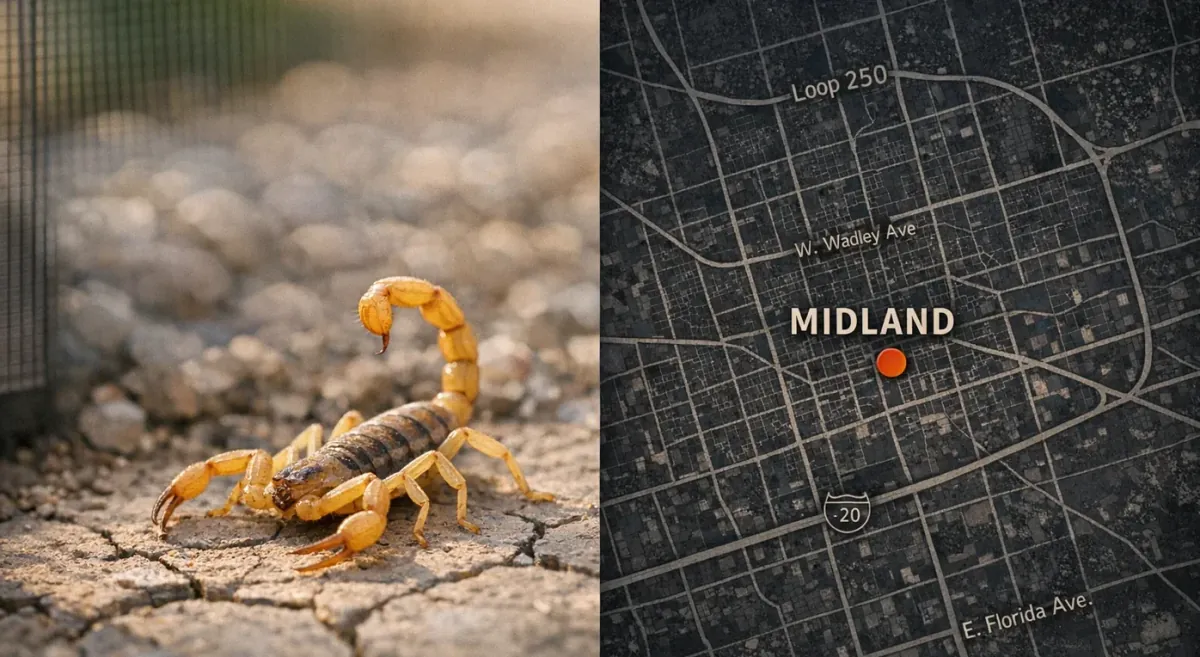
Yes — scorpions are a real and regular part of life in Midland, Texas. Midland County sits in West Texas scorpion country, where warm nights and dry ground make ideal habitat for the striped bark scorpion. Sightings can feel sudden because these animals are nocturnal and secretive, so most homeowners only notice one when it turns up on a wall or floor after dark.
Statewide, Texas reports roughly 1,743 scorpion exposures to poison centers each year, about 10.3% of the national total, according to Kang & Brooks 2017. Within 30km of Midland, community naturalists have logged 32 research-grade scorpion observations on iNaturalist — most of them the striped bark scorpion. That's a small window into a much larger population living quietly around local homes.
What "high scorpion relevance" means for Midland homeowners
High relevance means scorpions in Midland, Texas aren't a once-a-decade oddity. It means being a little more careful at night, putting more weight on sealing your home, and acting quickly when you find one. It doesn't mean panic — it means having a plan.
Spot-treating with a can of spray every time you see one is reactive and tiring. Detection and monitoring are calmer: instead of hoping you catch the next one, you'll know exactly when and where one shows up. Scorpion Alert sends photo-verified alerts with a confidence percentage, so you're responding to facts instead of dread.
Where Midland County scorpions show up around homes
Scorpions gravitate to cool, dark, sheltered spots. Around Midland homes, people most often find them at:
- Garage thresholds and door gaps
- Baseboards and the edges of rooms
- Bathrooms and laundry rooms, where there's moisture
- Bedroom floors and closets
- Shoes and boots left near an exterior door
These spots matter because they tell you where to focus monitoring. A scorpion found at a garage threshold points to an entry gap you can fix.
Do I need to panic if I only saw one?
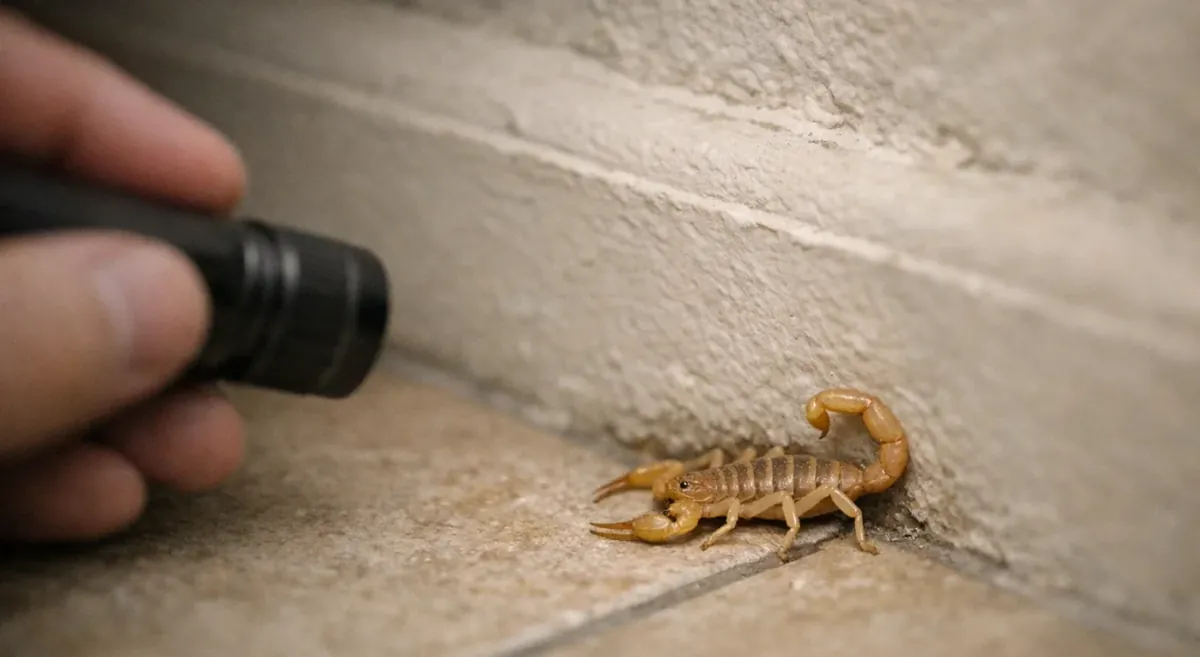
No — one scorpion isn't a crisis, but it is worth paying attention to. Scorpions are thigmotactic, meaning they navigate by hugging walls, baseboards, and furniture edges as they patrol at night. Where one traveled, others may too.
Picture flipping on the kitchen light at midnight and spotting a scorpion frozen against the baseboard. Ongoing monitoring takes the guesswork out of moments like that. A detector runs autonomously through the night and alerts your phone with a photo the moment it sees the telltale glow, so you're never left wondering what's out there in the dark.
Which scorpion species lives in Midland?
The primary scorpion in Midland is the striped bark scorpion (Centruroides vittatus). It accounts for 24 of the 32 local iNaturalist observations, making it far and away the species you're most likely to meet. A few other desert scorpions turn up in smaller numbers, but the striped bark scorpion is the one that matters for most Midland households.
Striped Bark Scorpion (primary species in Midland)
The striped bark scorpion Midland homeowners encounter is slender and tan to yellowish, usually 2 to 3 inches long, with two dark stripes running down its back and a dark triangle on its head. It has thin pincers and a slim tail — built for agility, not brute force. It's the most widely distributed scorpion in North America, dominant across Texas and neighboring states, per Yamashita & Rhoads 2017. Around properties, it shelters under rocks, wood, and clutter by day and hunts along edges by night.
Can Midland have more than one scorpion type?
Yes. Local records also include Chihuahuanus coahuilae (6 sightings) and single records of Diplocentrus lindo and Chihuahuanus crassimanus. For a homeowner, precise ID matters less than the practical rule: treat any scorpion as capable of stinging, and focus your energy on exclusion and monitoring rather than trying to name every one you see.
Why species ID changes your Midland scorpion control plan
Species tells you where to look. The striped bark scorpion is an agile species that favors vertical surfaces and tight harborage, so it shows up on walls, in stored boxes, and along baseboards — not just on the floor. Because it travels perimeters, perimeter-focused checks and outlet-height monitoring catch it where it actually moves. A safe way to confirm what you saw is to photograph it from a distance rather than handle it — and Scorpion Alert alerts already include a captured photo, so you have a record without getting close.
When are scorpions most active in Midland?
Scorpions are most active in Midland during the warm months — roughly late spring through early fall — with peak activity across the hottest stretch of summer. Nationally, summer evenings dominate scorpion calls, and stings cluster between 6 PM and midnight, according to Isbister & Bawaskar 2014 and Kang & Brooks 2017. That's the window that lines up with late-night kitchen trips, kids up past bedtime, and pets nosing around the yard.
What months are "scorpion season" in Midland?
In West Texas, scorpion season runs mainly May through September. Activity ramps up as spring warms, peaks in the July–August heat, then tapers as nights cool in October. You may still see the occasional scorpion in the off-season, but the summer months are when encounters spike.
What time of day are scorpions active—and why does it matter?
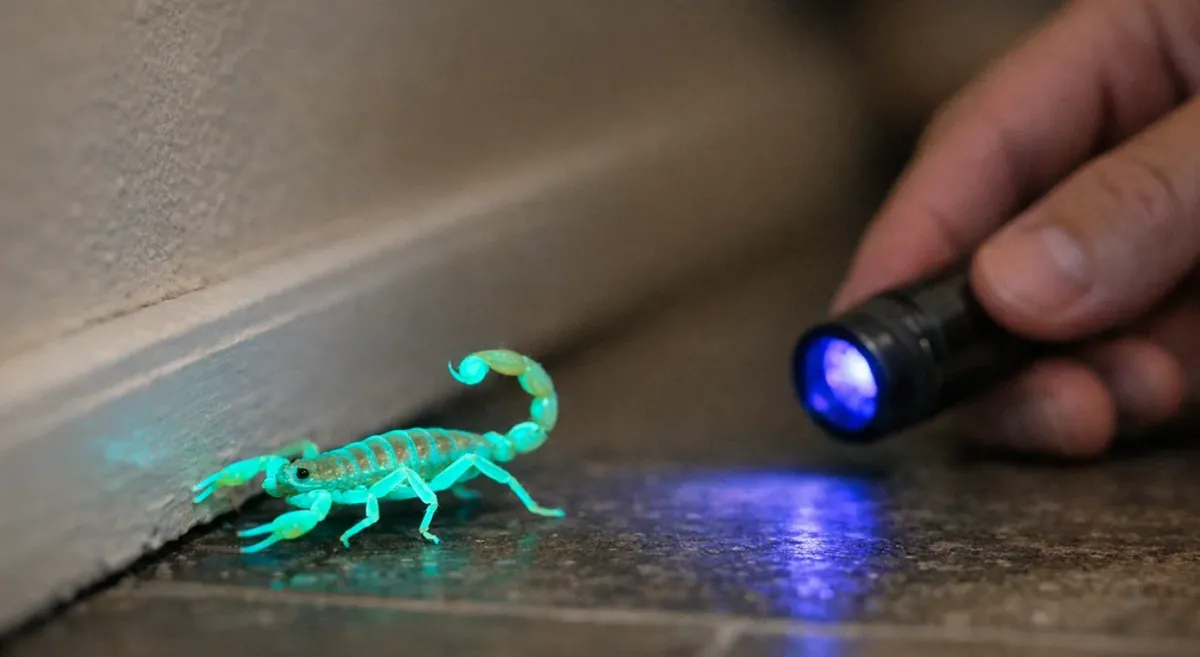
Scorpions are nocturnal. They stay hidden through the heat of the day and emerge after dark to hunt, traveling along walls and edges as they go. That's why nighttime is the key window — and why nighttime monitoring reduces surprises. Scorpions fluoresce a bright greenish-blue under 365nm UV light, a quirk of their exoskeleton. Detectors that activate when a room goes dark and scan continuously turn that glow into an instant alert, so a scorpion crossing your bedroom floor at 1 a.m. becomes a notification, not a barefoot discovery.
Do rainstorms or watering make Midland scorpions worse?
They can. Heat waves, rain events, and heavy irrigation all push scorpions and their insect prey toward the cooler, damper shelter your home provides. After a storm or a big watering, tighten door sweeps, cut back on indoor insects that scorpions hunt, and declutter the edges of rooms and the garage. Those quick moves reduce the pressure right when it spikes.
How dangerous is a scorpion sting in Midland?
For most healthy adults, a striped bark scorpion sting in Midland is painful but not dangerous. It produces sharp, localized pain that typically lasts 15 to 20 minutes, and severe systemic reactions are rare — life-threatening envenomation from C. vittatus has not been documented, per Yamashita & Rhoads 2017. Still, every sting deserves attention, especially in children.
What most Midland homeowners experience after a sting
The usual pattern is immediate burning pain at the site, often with tingling, numbness, or mild swelling nearby. Symptoms vary from person to person and by how much venom was delivered, but they generally ease within an hour or two. The species' venom targets pain-signaling channels, which explains the intense local pain without the whole-body syndrome associated with the more dangerous Arizona bark scorpion.
Who's at higher risk in Midland households?
Young children, older adults, people with allergy histories, and pets are the groups to watch most closely. Small bodies react more strongly to the same dose of venom, so a sting that a grown adult shrugs off can hit a toddler harder. If you have kids at home, it's worth reading why children are more at risk from scorpion stings and acting faster when a child is stung.
Does the Striped Bark Scorpion in Midland change sting risk?
It lowers it, relatively speaking. Because Midland's primary species is the striped bark scorpion rather than the neurotoxic Arizona bark scorpion, the odds of a truly severe reaction are low. That's reassuring — but don't rely on the scorpion's size to judge danger, and treat any sting seriously. The part you actually control is prevention and monitoring, which is where your effort pays off.
What to do if you're stung in Midland
If you're stung in Midland, wash the area with soap and water, apply ice, take an over-the-counter pain reliever if needed, and watch for worsening symptoms. Most stings can be managed at home. Call the Poison Help line at 1-800-222-1222 for free, 24/7 guidance if you have any doubt.
First 5 minutes: the calm checklist
- Move away from where you were stung so it can't happen again.
- Wash the sting site with soap and water.
- Apply an ice pack, 10 minutes on and 10 minutes off, to ease pain and swelling.
- Take an over-the-counter pain reliever if appropriate for you.
- Note the time of the sting and start tracking how symptoms change.
- If it's safe, snap a photo of the scorpion from a distance — don't try to catch it.
Seek professional medical advice right away if symptoms are severe or getting worse. For a fuller walkthrough, see this bark scorpion sting first aid guide for the first 30 minutes.
When to call Poison Control vs. go to urgent care/ER
Call Poison Control first for most stings — they'll tell you whether home care is enough or you need to be seen. Go straight to urgent care or the emergency room, or call 911, if you notice trouble breathing, difficulty swallowing, severe muscle twitching, roving eye movements, or intense full-body symptoms, especially in a child. Midland's nearest hospital is Midland Memorial Hospital, at 400 Rosalind Redfern Grover Pkwy, Midland, TX 79701, about 1.3 miles from the city center.
Aftercare: what to watch for over the next few hours
Keep an eye on the sting for the next few hours. Local pain, tingling, and mild swelling that slowly fade are normal. Spreading numbness, escalating pain, muscle jerking, restlessness, or any breathing or swallowing trouble are not — get medical help. Writing down when symptoms started and how they've changed gives clinicians a clear picture and speeds up care. Confirming exactly what stung you also matters, which is one quiet benefit of photo-verified detection: it cuts down on "mystery stings" where you never even saw the culprit.
How to keep scorpions out of your Midland home
Keeping scorpions out of your Midland home comes down to three things: seal the ways they get in, reduce the habitat and prey that draw them, and monitor at night so nothing slips past unnoticed. Because roughly 97.8% of scorpion envenomations happen inside the home per Kang & Brooks 2017, keeping them outside is the whole game.
Midland exclusion priorities: what to seal first
Scorpions squeeze through gaps as thin as a credit card, and West Texas slab homes and attached garages give them plenty of options. Tackle these first:
- Garage door gaps and worn bottom seals — the single most common entry route
- Exterior door sweeps and thresholds, including the door from garage to house
- Weep holes in brick, fitted with weep-hole screens that still allow drainage
- Utility penetrations where pipes, cables, and A/C lines enter walls
- Window screens and gaps around frames
Verify each fix at night with a flashlight held low — if you can see daylight or feel a draft, a scorpion can get through. For more on this, see the top 5 ways scorpions get into your home.
Yard-to-house pressure: landscaping and prey control in West Texas
Scorpions follow their food. Crickets, roaches, and other insects thriving in mulch beds, wood piles, and desert landscaping pull scorpions toward the house. Move firewood and stored materials away from exterior walls, keep gravel and rock beds from mounding against the foundation, and reduce outdoor lighting that draws bugs to your doors at night. Fewer insects around the perimeter means fewer reasons for scorpions to press in. For the full picture, here are the top 5 things that attract scorpions in your home.
Monitoring that reduces surprises at night
Exclusion alone isn't foolproof — the striped bark scorpion's agility means one can reach stored boxes on a shelf or turn up in a bedroom even after you've sealed the obvious gaps. That's why a layered approach works best: solid exclusion paired with continuous night monitoring, so you're not doing homework every evening. Scorpion Alert detectors plug into standard outlets right on the room perimeter, where scorpions naturally travel, activate automatically when the room goes dark, and shine 365nm UV to catch that greenish glow. When one appears, you get a photo-verified alert on your phone within seconds — a calm, hands-off way to know exactly what's in your home and where. If you do spot one, avoid the common mistakes in this guide on what not to do after spotting a scorpion in your home.
Scorpion Alert rents its Detectors as part of a monthly monitoring subscription — the hardware is included, with pricing that starts at $3.50 per Detector per month for a single unit and slides down to a $2.00 floor at ten or more, plus a one-time shipping fee at checkout. There's no long-term contract; cancel any time by emailing support@scorpionalert.com and returning the Detectors. For a Midland home where scorpions are already active, it's an easy way to trade nighttime dread for photo-verified answers.
In Midland, scorpions are most active after dark, which is why spotting them early—before a sting happens—matters. Scorpion Alert uses 365nm UV detection to automatically watch at night and send a real-time photo notification when a scorpion is found, so you can respond quickly. Learn more at Scorpion Alert.