Are scorpions a problem in Deming?
Yes — scorpions are a real, ongoing presence in Deming, and homeowners in Luna County should treat any indoor sighting seriously. Even if you only see one, that single scorpion proves there's an entry route into your home. The desert environment around Deming supports scorpion activity much of the year, especially on edge-of-town lots and in rock or gravel yards.
Deming sits in the high Chihuahuan Desert, where scorpions are simply part of the landscape. Homes near open desert, with gravel landscaping, block walls, or storage clutter, tend to see the most activity around the foundation. That doesn't mean you're doomed to constant encounters — it means a few smart changes can go a long way.
You won't eliminate every outdoor scorpion. That's not the goal. The realistic goal for managing scorpions in Deming, New Mexico is to reduce indoor encounters through exclusion, prey control, and nighttime monitoring.
Why Deming homes see scorpions indoors
Scorpions come inside for three reasons: shelter, water, and prey. Your home offers cool, dark hiding spots during the day and a buffet of insects at night. In the dry Chihuahuan Desert, indoor moisture from a leaky pipe or a bathroom drain can be a powerful draw.
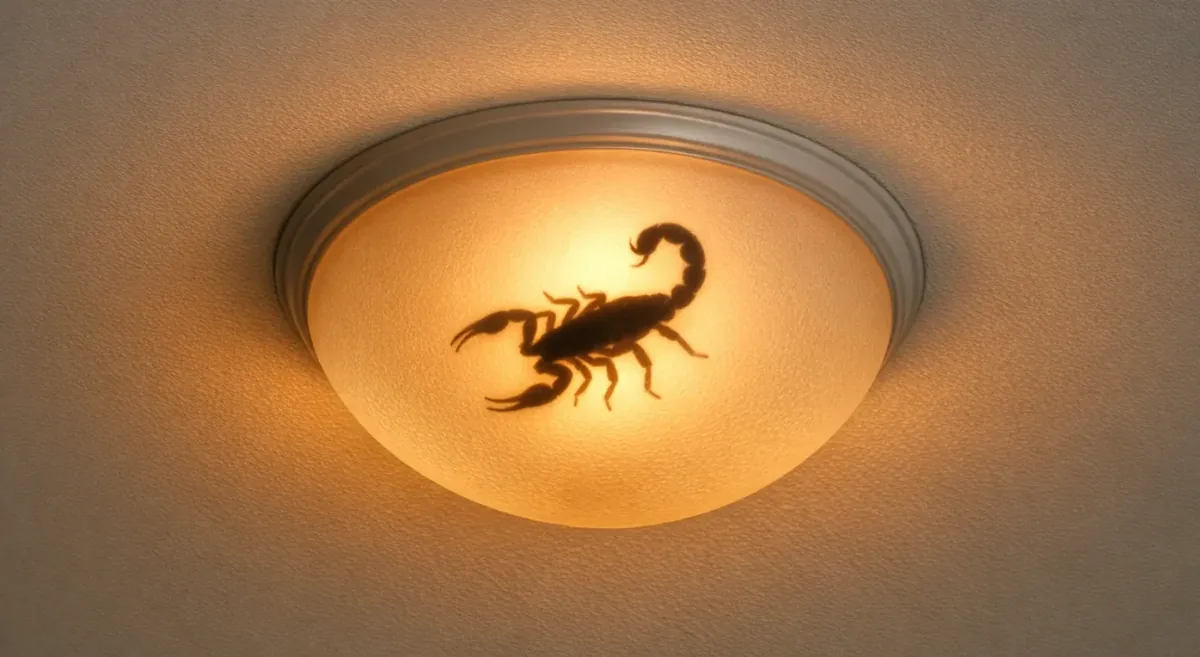
Here's the tricky part: scorpions are nocturnal and hard to spot, so sightings often feel random. You didn't see one for months, then suddenly there's one on the bathroom floor. It was likely there all along — you just weren't awake at 1 a.m. when it was out hunting along your baseboards.
Are Luna County scorpions a sign of a dirty home?
No. Scorpions enter spotless homes all the time. The real drivers are access points, nearby desert habitat, and available insects — not dust or dishes in the sink. A brand-new, immaculate house on the edge of town can see just as many scorpions as an older one.
That said, a single indoor scorpion still warrants action. It tells you there's a gap somewhere a scorpion can use — under a door, around a pipe, or through a garage threshold. Where one got in, others can follow.
What "Deming scorpion control" should mean (and what it shouldn't)
A realistic control plan has three parts: seal entry points, reduce the insect prey scorpions hunt, and add nighttime monitoring so you know when one gets inside. Together, those three actually move the needle.
What doesn't work as a complete solution? Relying on a single perimeter spray or a folk remedy and calling it done. Sprays fade, scorpions are resistant to many pesticides, and a chemical barrier alone won't tell you when one slips past it. Think layers, not silver bullets.
Which scorpion species lives in Deming?
The scorpion you're most likely to encounter in and around Deming is the Lesser Stripetail Scorpion (Chihuahuanus coahuilae). Of the small set of research-grade observations logged within 30km of Deming on iNaturalist, this species accounts for the majority — a good signal of what residents actually run into.
Community-science sightings like these reflect what people commonly encounter, not a full scientific census. Identification also gets harder at night, and scorpions can look different by life stage and lighting. Treat any single ID as a best guess unless a specialist confirms it.
Lesser Stripetail Scorpion: the Deming "most likely" scorpion
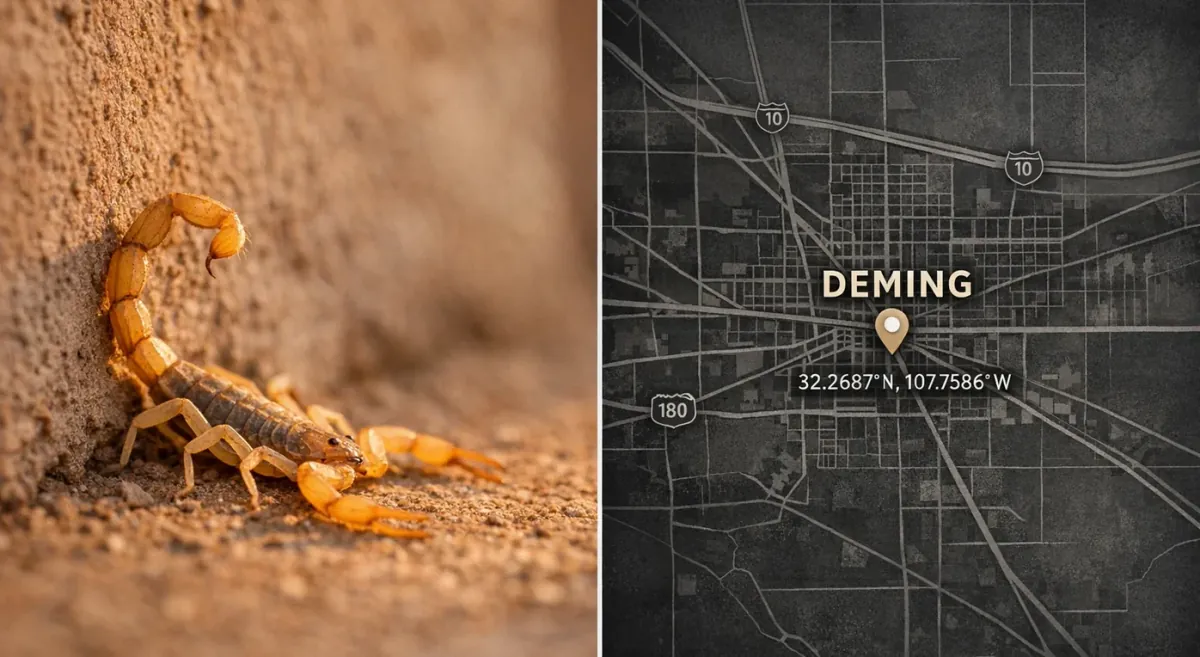
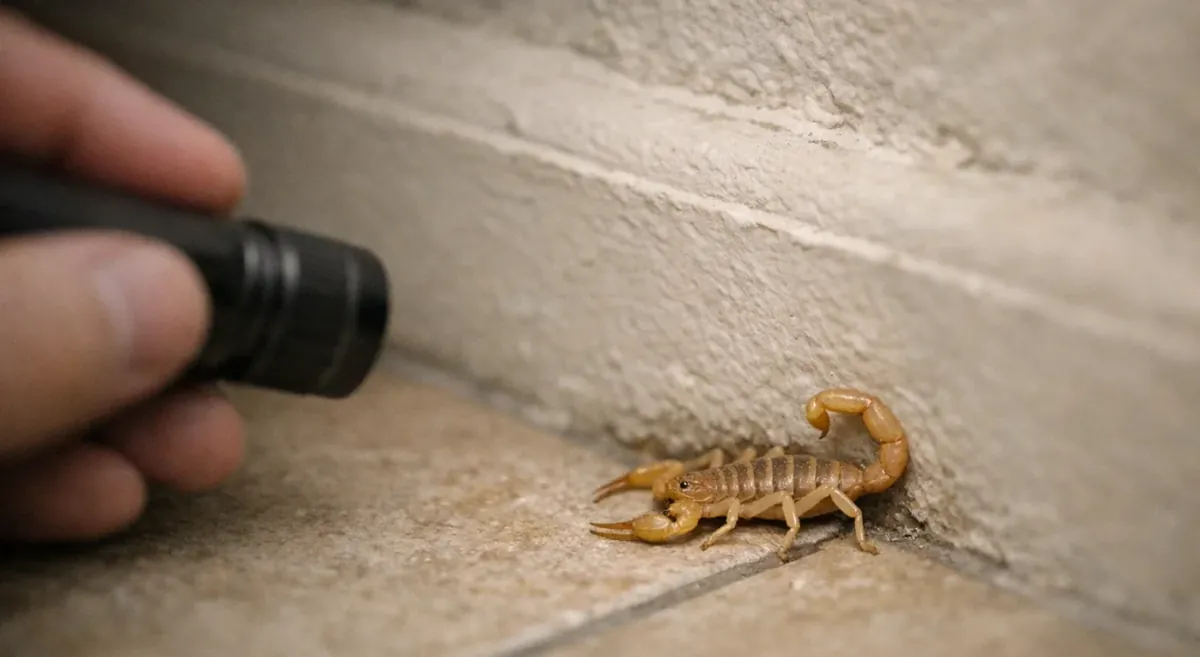
The Lesser Stripetail is a small, modest desert scorpion — generally tan to yellowish-brown, blending easily into gravel and sandy soil. Look for a slender tail and relatively slim pincers. It hides under rocks, in soil cracks, and beneath yard debris during the day, then comes out to hunt after dark.
Its sting is painful, like a bad wasp sting, but it isn't considered a life-threatening species the way the Arizona bark scorpion is. Don't overgeneralize scary bark-scorpion content to what you'll meet in Deming — but still respect any sting and watch for symptoms.
Do Deming scorpions glow under blacklight?
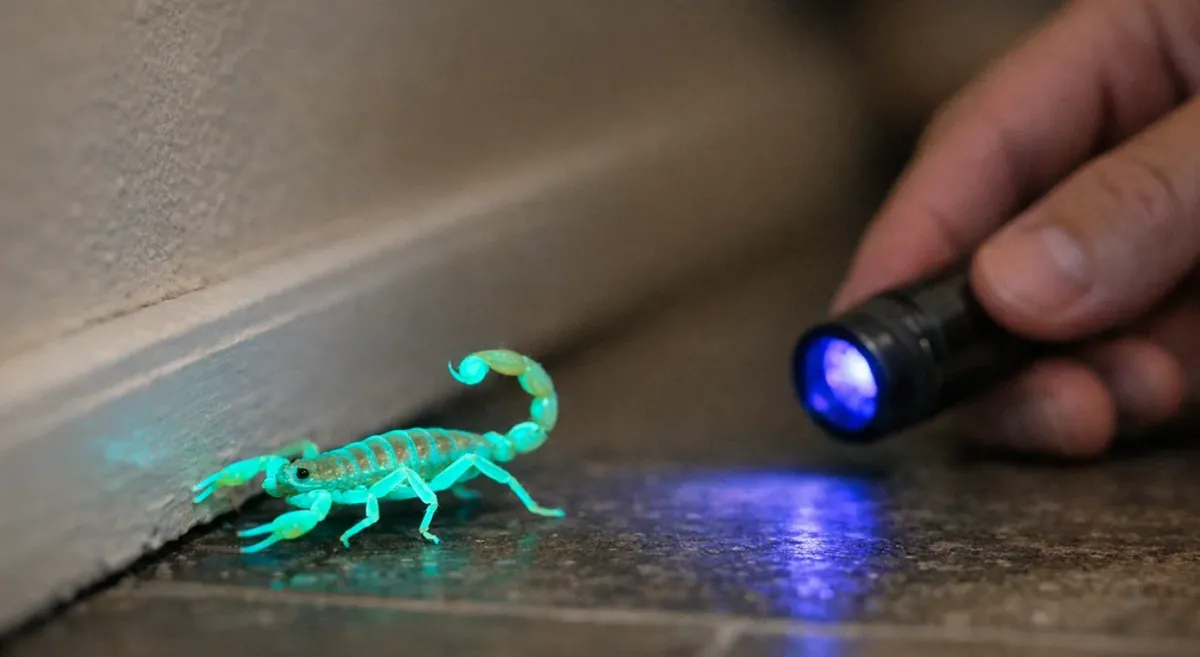
Yes. Every scorpion species glows a bright greenish-blue under ultraviolet light, thanks to fluorescent compounds in their exoskeleton. Sweep a UV flashlight across a dark room and a hidden scorpion lights up like a tiny glow stick — which makes UV the single best tool for spotting them at night.
This is exactly why monitoring tech leans on it. Scorpion Alert Detectors shine 365nm UV — a wavelength that triggers a strong glow — to spot scorpions on the floor when the room goes dark.
Can scorpions climb walls in Deming homes?
Scorpions can climb rough vertical surfaces like stucco, brick, and block walls, and they can grip furniture and drapes. In practice, though, most indoor encounters happen low and along edges. Scorpions are thigmotactic — they navigate by hugging surfaces — so they travel baseboards, corners, thresholds, and the bases of walls.
That's good news for prevention. Because scorpions favor perimeters, focusing your defenses on floor-level edges, doorways, and items leaning against walls covers most of their travel routes.
When are scorpions most active in Deming?
Scorpions in Deming are most active in the warm months — roughly late spring through early fall — with the strongest activity on warm summer evenings. Nationwide data shows summer produces the overwhelming majority of scorpion cases (Kang & Brooks 2017), and that pattern holds across the desert Southwest.
What ramps activity up? Heat, bumps in moisture after a summer rain, irrigation and yard watering, and any spike in insect activity that gives scorpions something to hunt. When the bugs come out, scorpions follow.
Scorpion season Deming: what homeowners notice first
The first sign of scorpion season in Deming is usually more sightings in the "edge" rooms at night — garages, bathrooms, laundry rooms, and pet-feeding areas. You might spot one near a water heater or crossing the tile on a late-night trip to the kitchen. More sightings usually just mean the warm-season cycle is in full swing.
Why nighttime is the high-risk window
Scorpions are nocturnal, and the higher-risk window follows their schedule. Sting data shows a clear peak from 6 p.m. to midnight, when roughly half of envenomations occur (Kang & Brooks 2017). That's exactly when most people are asleep or heading to bed — and least likely to catch a scorpion in the act.
This is the gap monitoring fills. Scorpion Alert Detectors activate when a room darkens and scan continuously through the night, sending an alert to your phone the moment one is spotted — no barefoot patrols required.
After rain or watering: does activity jump?
It can. In the dry Chihuahuan Desert around Deming, moisture from a monsoon-style downpour or heavy yard watering pushes insects out, and scorpions move to follow the food and the humidity. After a rain, it's worth checking entry points and your water-source rooms — laundry areas and bathrooms are the usual indoor draws.
How dangerous is a scorpion sting in Deming?
For most healthy adults in Deming, a scorpion sting is painful but not dangerous — think localized burning, swelling, and tingling that fades over hours. The Lesser Stripetail Scorpion common here is not a documented life-threatening species. Still, severity varies by person, and certain groups should treat every sting with higher urgency.
Those higher-risk groups are young children, older adults, anyone with a history of severe allergic reactions, and pets. Children under 10 have the highest rates of serious systemic effects in the medical literature (Kang & Brooks 2017).
What a Deming scorpion sting typically feels like
Expect immediate, sharp pain at the site, often followed by tingling, numbness, and some swelling. Local pain shows up in the large majority of stings, and local numbness in well over half (Klotz et al. 2021). Symptoms can vary from person to person, so it helps to note the time of the sting and track how things change over the next hour.
When a sting is an emergency
Most stings stay local, but certain red-flag symptoms mean you should seek urgent care right away: trouble breathing, widespread hives or swelling, severe weakness, uncontrolled muscle twitching or jerking, roving eye movements, difficulty swallowing, or any intense full-body symptoms — especially in a child. Call 911 for severe symptoms. For anything else, call Poison Control at 1-800-222-1222.
Kids and pets in Deming: why the risk feels higher
Smaller bodies absorb the same dose of venom relative to their size, so children and pets can react more strongly than adults. That's why the extremes of age deserve extra caution. Practical steps help: do a quick UV check in nurseries and kids' bedrooms at night, keep pet bowls tidy so you're not drawing insects, and reduce floor clutter where a scorpion can hide. For more on why the youngest household members are most vulnerable, see our guide on why children are more at risk from scorpion stings.
What to do if you're stung in Deming
If you're stung in Deming, stay calm, wash the area, apply a cool compress, and monitor symptoms — most stings can be managed at home. Call the Poison Help line at 1-800-222-1222 for guidance, and if severe symptoms appear, head to Mimbres Valley Medical Center at 900 Ash St or call 911.
First 5 minutes: basic first aid and what NOT to do
Move through these steps calmly:
- Wash the sting site with soap and water.
- Remove rings, watches, or anything tight near the sting in case of swelling.
- Apply a cool compress or ice pack, wrapped in cloth, to ease pain and swelling.
- Keep the person calm and still, and note the time of the sting.
- Take an over-the-counter pain reliever if needed, and watch for red-flag symptoms.
And the don'ts: don't cut or try to suck out venom, don't apply heat, don't take alcohol, and don't chase the scorpion around barefoot. For a fuller rundown, read what not to do after spotting a scorpion in your home.
If you can do it safely: contain the scorpion for ID
If — and only if — you can do it without risking a second sting, trap the scorpion for identification. Place a wide glass over it, slide a stiff piece of paper or card underneath, and lift. This is far safer than stomping and often more effective, since a missed stomp invites a defensive sting. Can't catch it? A clear photo, or a photo-verified detection alert, can still help you confirm what you saw.
What to tell a clinician (or Poison Control)
Have these details ready: the time of the sting, where on the body it happened, the person's age and weight (especially for kids), the symptoms and how they're changing, any medications or allergies, and whether you suspect a Lesser Stripetail Scorpion. A clear photo of the scorpion, if you have one, makes the clinician's job easier.
How to keep scorpions out of your Deming home
The most effective way to keep scorpions out of your Deming home combines three things: sealing entry points, reducing the insects and harborage that attract them, and monitoring at night where scorpions travel. Nearly all scorpion envenomations happen inside the home (Kang & Brooks 2017), so the payoff for indoor-focused prevention is huge.
Deming scorpion control starts with exclusion (the fast wins)
Exclusion gives you the quickest results. Work through this checklist:
- Install tight door sweeps on exterior doors — especially the garage-to-house door.
- Add or replace weatherstripping where you can see daylight around a closed door.
- Caulk gaps around windows, baseboards, and wall cracks.
- Seal around plumbing, cable, and utility penetrations, plus garage weep holes.
- Repair torn window and vent screens.
You're not trying to make the house airtight — you're removing the easy access points. For more on how they slip in, see the top 5 ways scorpions get into your home.
Yard and garage changes that reduce Luna County scorpions near your walls
The fewer places to hide and hunt near your foundation, the fewer scorpions press against your walls. Clear clutter, keep rock and gravel piles away from the foundation, store boxes off the garage floor, and stack firewood well away from the house. Managing the insect population matters too, since prey is a magnet — our list of the top 5 things that attract scorpions in your home is a good primer. In Deming's desert-landscaped yards, decorative rock beds and block walls are prime harborage, so pay special attention to the strip right against your foundation.
Monitoring at night: catching scorpions before they hide
Exclusion and yard work reduce the odds, but you still want to know when a scorpion actually gets inside. Because scorpions glow under UV and travel along perimeters, nighttime detection along your walls is the most reliable way to catch them before they tuck into a shoe or a corner.
Scorpion Alert Detectors plug into standard wall outlets right on the room perimeter where scorpions naturally travel. They scan only when the room is dark, shine 365nm UV onto the floor, and send a photo-verified alert to your phone within seconds. Place them near entry points and in water-source rooms like bathrooms and laundry areas — the exact spots Deming homeowners tend to find them. Rentals start at $3.50 per Detector per month and slide down to $2.00 at ten or more, with a one-time shipping fee at checkout; cancel any time by emailing support@scorpionalert.com and returning the Detectors. If you've already seen a scorpion on your property, that's the strongest sign you'll see another — and it's the ideal moment to start monitoring.
In Deming’s warm, desert conditions, scorpions can be active after dark, so a quick nightly check around entry points and sleeping areas can go a long way toward peace of mind. If you want an easier way to spot them when they’re most active, Scorpion Alert uses UV-based detection and night-only operation to help you find scorpions fast and deal with them before they become a surprise.