Are scorpions a problem in College Station?
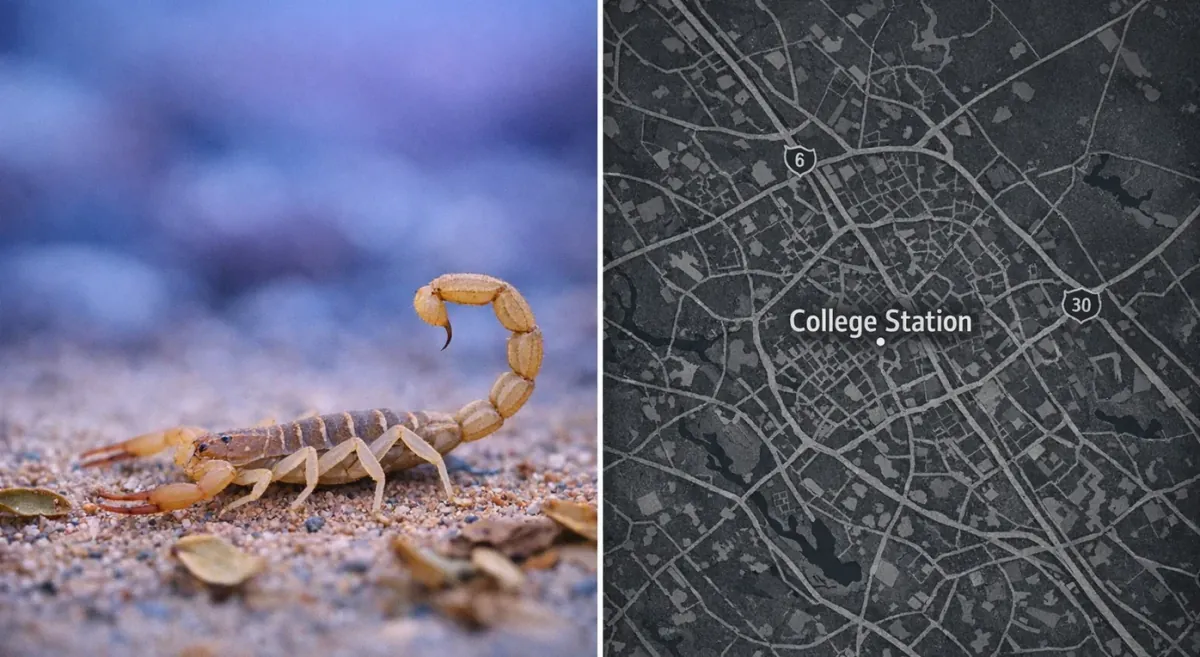
Yes, scorpions are a common part of life in College Station. The area sees frequent scorpion activity, especially in warm months, and homeowners here regularly report indoor sightings after dark. iNaturalist logs 305 research-grade scorpion observations within 30km of College Station — all of a single species — so this isn't a rare-visitor situation.
Brazos County sits squarely in scorpion country. That said, how many you see depends a lot on your specific neighborhood, yard conditions, and whether there's undeveloped habitat nearby. A home backing up to a greenbelt or with rock beds and woodpiles will notice scorpions more than a tidy lot in the middle of a subdivision. Statewide, Texas is second only to Arizona for scorpion exposures, logging roughly 1,743 per year according to Kang & Brooks 2017.
For most homeowners, the real problem isn't danger — it's the surprise. You reach into a laundry basket, or your kid points at the baseboard, and there it is. That sleep-stealing "what else is in here?" feeling is exactly what this guide addresses — covering the local species, when they're most active, how much a sting actually matters, what to do if you get stung, and how to keep scorpions in College Station, Texas from becoming a recurring headache.
Where do College Station homeowners usually notice them first?
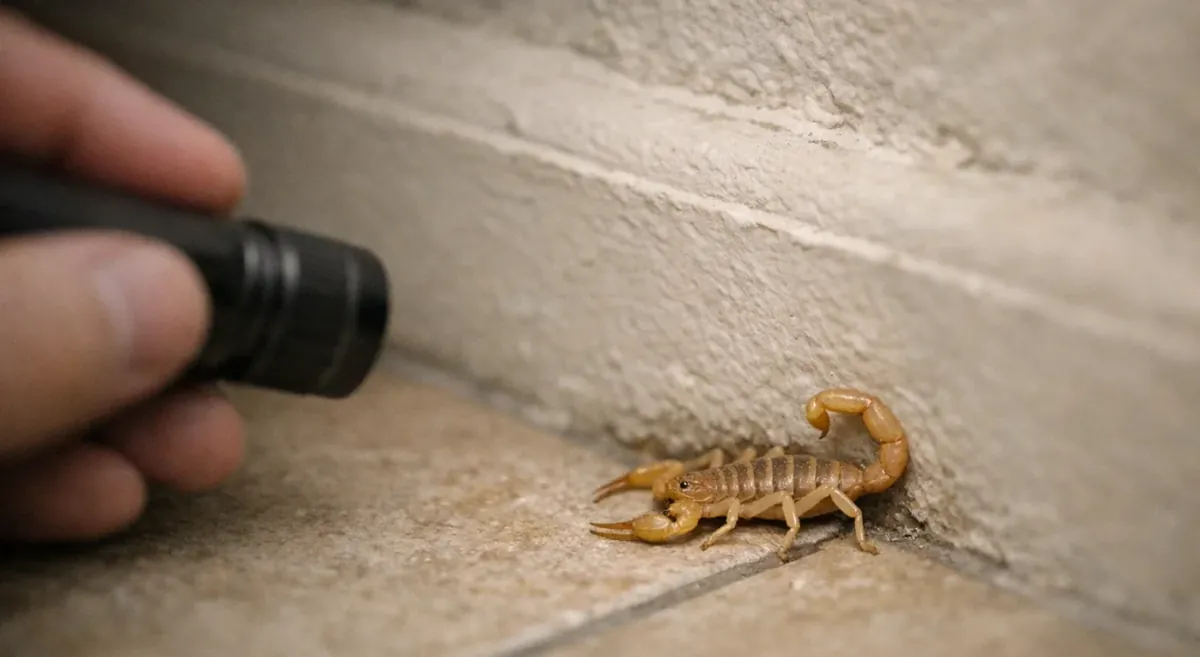
The first sighting almost always happens in a low-traffic, dark spot: the garage, the laundry room, a bathroom floor at night, or along a baseboard in a back bedroom. These are the cool, sheltered edges scorpions gravitate toward once they slip indoors.
Yard conditions around College Station feed right into this. Mulched beds, decorative rock, stacked firewood, and irrigation-damp soil all give scorpions cover and prey close to the house. From there, it's a short trip to a door threshold or a gap around a utility line.
Here's why so many people don't see one until late: scorpions are nocturnal. They hide during the day and hunt after dark, moving along walls and edges. You could share a house with one for weeks and only meet it when you flip on the bathroom light at 2 a.m.
Does one scorpion mean more are nearby?
Not necessarily. A single scorpion can be a lone wanderer that slipped in through a door gap. But repeated sightings — two or three over a few weeks — usually mean there's a reliable food source and good hiding spots in or around your home.
People often ask whether scorpions travel in pairs or live in groups. They're mostly solitary hunters, so seeing one doesn't imply there's a nest nearby. What matters more is the conditions: if bugs and shelter are plentiful, one scorpion today can mean more next month. If you've already spotted one, resist the urge to panic-stomp — read what not to do after spotting a scorpion in your home first. Monitoring and prevention, covered later, are how you tell a one-off from a pattern.
Which scorpion species lives in College Station?
The scorpion you'll almost certainly encounter in College Station is the Striped Bark Scorpion (Centruroides vittatus). Every one of the 305 research-grade iNaturalist observations near the city belongs to this single species. It's the most widely distributed scorpion in North America, according to Yamashita & Rhoads 2017.
Getting the ID right matters because it sets your expectations. This is not the Arizona bark scorpion that makes headlines for serious envenomations. Correctly identifying your local species helps you choose a proportional, sensible response instead of overreacting.
Striped Bark Scorpion (College Station's most reported species)
The striped bark scorpion is small and tan, usually about 2 to 2.5 inches long, with two dark lengthwise stripes running down its back and a slender tail. Young ones can look paler. It's by far the top species on iNaturalist locally because it thrives across Texas in yards, woodpiles, and homes.
Behaviorally, it favors tight edges and crevices and comes out to hunt at night. As a "bark" scorpion, it's a capable climber — textured surfaces like brick, stucco, wood fencing, and rough block give it plenty of grip. Smooth, slick surfaces like clean glass or glazed tile are much harder for it to scale, which is useful to keep in mind when you're deciding where to position a crib or a bed.
Lookalikes and common misidentifications in Brazos County
In Brazos County, most "is this something else?" confusion comes from size and color variation within the striped bark scorpion itself — juveniles and freshly molted adults look lighter and can seem like a different species. True alternate species are uncommon this far into Central Texas.
Whatever you find, don't handle it to check for stripes. Use a jar-and-paper method: place a glass over it, slide a stiff card underneath, and lift. Better yet, snap a clear photo from a safe distance. A good photo lets a pest professional or the Texas A&M AgriLife Extension office confirm the ID without any guesswork or risk.
When are scorpions most active in College Station?
Scorpions are most active in College Station during the warm months — roughly late spring through early fall — with peak sightings in the heat of summer. Nationwide, summer evenings dominate scorpion reports, per Kang & Brooks 2017. The iNaturalist observations near College Station cluster the same way, spanning warm-season months across many years.
The nightly pattern is just as important as the seasonal one. Peak sting hours are 6 PM to midnight, accounting for about 49% of envenomations in one clinical analysis, with a smaller morning bump. Scorpions travel along room edges and baseboards after dark, which is exactly why daytime inspections tend to come up empty.
A quick note on reproduction: scorpions mate in warmer months, and females don't lay eggs — they give live birth. The young ride on the mother's back for a while before dispersing. That's part of why a good habitat can support a rising local population over a season.
What triggers a spike in sightings (heat, rain, and prey)?
Heat drives the biggest jumps. As summer temperatures climb, scorpion activity increases and they push closer to homes hunting for prey and cooler shelter. Rain plays a supporting role — moisture brings out insects, and where the bugs go, scorpions follow.
That "prey follows moisture" chain is worth remembering. An irrigation leak, an overwatered bed, or a damp garage corner feeds an insect population, and that buffet draws scorpions in to hunt. Because most of this hunting happens after dark, a daytime walk-through of your yard or garage will miss the very activity that matters.
Seasonal checklist: what to do before, during, and after peak season
- Before peak (spring): seal exterior gaps, clear woodpiles and debris away from the foundation, and fix moisture leaks. Schedule a pest inspection if you had sightings last year.
- During peak (summer): tighten nightly habits — shake out shoes, towels, and bedding, and keep monitoring in the rooms where scorpions travel.
- After peak (fall): keep up your exclusion work. If prey and hiding spots are still around, don't assume the scorpions are gone for good.
How dangerous is a scorpion sting in College Station?
For most healthy adults in College Station, a striped bark scorpion sting is painful but not medically dangerous. The venom produces sharp, localized pain that typically lasts 15 to 20 minutes, and severe systemic reactions are rare — life-threatening envenomation from C. vittatus has not been documented, per Yamashita & Rhoads 2017.
The key distinction is painful versus medically serious. This species' venom targets pain-sensing nerves, which explains the intense sting without the whole-body neuromotor syndrome that the Arizona bark scorpion can cause. So yes, it hurts — sometimes a lot — but it usually stays local.
Reactions still vary from person to person. Children, older adults, and anyone with a known severe allergy to insect stings should be watched more closely. When in doubt, call the free Poison Help line at 1-800-222-1222 for guidance tailored to the situation.
What a sting can feel like (and what's considered unusual)
Typical symptoms are immediate sharp pain at the sting site, followed by tingling, mild numbness, redness, and some swelling. That's the normal, expected course, and it generally fades within an hour or two.
Unusual signs that warrant urgent care include trouble breathing or swallowing, widespread numbness, severe muscle twitching or jerking, and unusual eye movements. A true allergic reaction — hives, facial swelling, dizziness — is a call-now emergency. Pets can react differently; if your dog or cat is stung and seems distressed, call your vet or a pet poison line.
Who's at higher risk in College Station homes?
Infants and young children, older adults, and immunocompromised people are the higher-risk groups, along with anyone with a history of severe sting allergies. The extremes of age tend to react more strongly.
Picture the everyday scenarios: a barefoot step in the garage, a hand reaching into a storage box, or rolling over in bed at night onto a scorpion that found its way up the bedding. Those are the moments that matter most for vulnerable family members. For more on why little ones need extra caution, see our guide on why children are more at risk from scorpion stings.
What to do if you're stung in College Station
If you're stung in College Station, stay calm, wash the area with soap and water, and apply a cold compress — this handles the vast majority of striped bark scorpion stings. Note the time and watch your symptoms. For local care, Oaks Medical Center (1313 Briarcrest Dr, Bryan) and St. Joseph Health Regional Hospital (2801 Franciscan Dr, Bryan) are both under 2.1 miles from central College Station.
According to Wizzie Brown, entomologist, Texas A&M AgriLife Extension Service, "Usually it's sufficient to apply ice packs on the area where the sting occurred to reduce pain and swelling." If it's safe, snap a photo of the scorpion — it can help providers confirm the species and help you plan prevention.
First 10 minutes: what to do right away
- Sit down and take a breath — panic makes it worse.
- Wash the sting site thoroughly with soap and water.
- Apply a cold compress or ice pack (wrapped, not directly on skin) to ease pain and swelling.
- Remove any rings or tight jewelry near the sting in case of swelling.
- Do not cut, suck, or apply chemicals to the wound.
- Write down the time of the sting and when symptoms began, so you can track any changes.
- If the scorpion is still around, contain it safely with a glass and card rather than chasing it barefoot.
When to call for help vs. monitor at home
Most stings can be safely monitored at home. Go now — or call 911 — if you notice trouble breathing or swallowing, severe muscle twitching, unusual eye movements, spreading numbness, or signs of a full allergic reaction. Any of these in a young child deserves immediate attention.
Otherwise, keep a simple mental checklist for the next few hours: is the pain staying local and easing, or spreading? Any new numbness, muscle jerking, or breathing changes? When symptoms stay mild and fade, you're in normal territory. For a detailed hour-by-hour timeline, see our bark scorpion sting first aid guide, and don't hesitate to call Poison Help at 1-800-222-1222.
How to keep scorpions out of your College Station home
The most effective approach to scorpion control in College Station is layered: exclusion (seal them out), habitat reduction (remove shelter and prey), and monitoring (know when they're active). No single step does it alone — but stacked together, they steadily shrink your risk. Brazos County's mix of mulch beds, rock, and irrigation makes yard cleanup and sealing especially high-impact here.
Monitoring is the layer most people skip, and it's the one that turns guesswork into knowledge. Because striped bark scorpions travel room edges after dark during the summer peak, you want to know about that activity without stalking the house yourself every night.
Your College Station prevention stack (outside → inside)
Outside: clear woodpiles, leaf litter, and debris away from the foundation, tidy rock and mulch beds, and fix irrigation leaks that create damp, bug-friendly soil. Fewer insects means less scorpion food. Learn more about what draws them in with our guide to the top things that attract scorpions.
Home envelope: add door sweeps, replace worn weatherstripping, and seal gaps around weep holes and utility penetrations. These are the small openings scorpions exploit — see our breakdown of the top ways scorpions get into your home.
Inside habits: wear shoes or gloves when working in the garage or storage areas, and shake out shoes, towels, and bedding during peak season before you use them.
Do scorpions climb walls—and what does that change?
Yes, striped bark scorpions climb — they're bark scorpions, built to grip textured surfaces like brick, stucco, wood, and rough block. Smooth, slick surfaces are far harder for them, and that difference should shape a few choices at home.
Practically, that means pulling beds a few inches away from the wall, skipping bed skirts that provide a path up to the mattress, and keeping bedding from touching the floor. For a crib or a child's bed, this matters most — keep it clear of walls and don't let blankets drape to the ground.
Monitoring that doesn't rely on "blacklight walks"
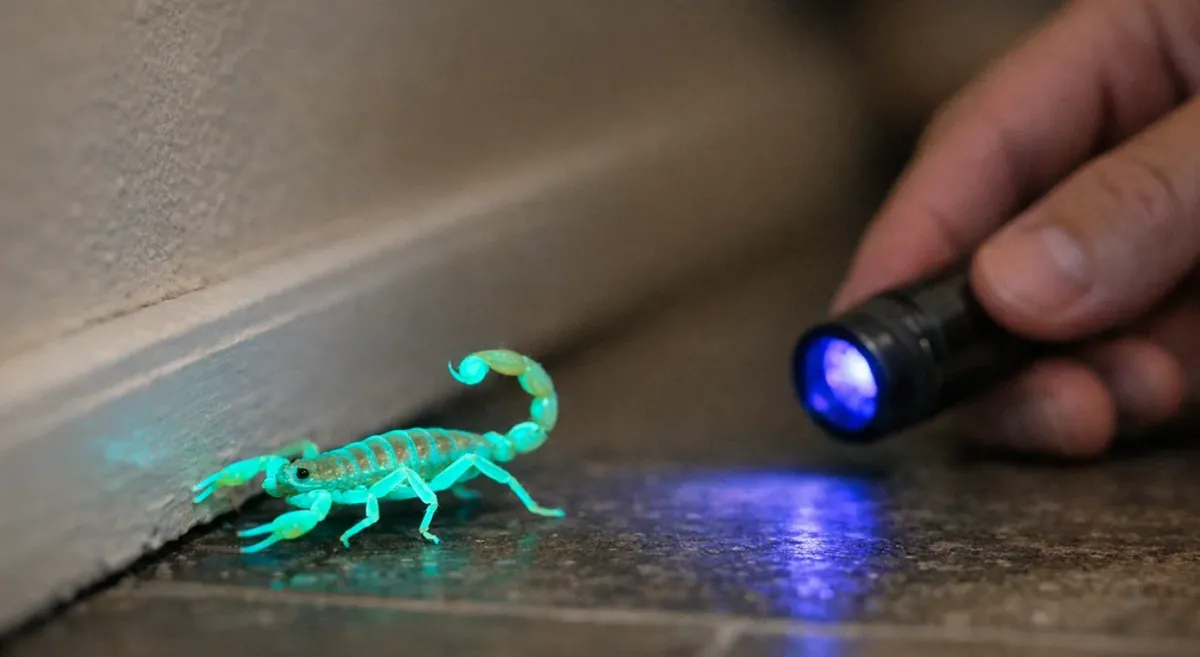
The goal of monitoring is to catch nighttime activity along the room edges where scorpions travel — especially through the summer peak — without you having to patrol with a flashlight every single night. Scorpions glow a bright greenish color under 365nm UV light, a quirk of their exoskeleton that makes them easy to spot in the dark.
That's the idea behind Scorpion Alert. Plug-in detectors sit on the room perimeter, switch on when the room goes dark, and use UV light to watch for that telltale glow — sending a photo-verified push or SMS alert to your phone within seconds. Since a past sighting is the strongest predictor of another encounter, the smart move is to place a detector in any room where a scorpion has already turned up: entry-adjacent rooms, bedrooms and nurseries, and water areas like bathrooms and laundry rooms. You can compare rental plans on the live pricing calculator.
In College Station, scorpions are most active after dark, so a quick nighttime check around entry points, garages, and patio edges can make a real difference. Because scorpions naturally glow under UV light, Scorpion Alert helps you spot them when they’re hardest to see—right when they’re out and moving; learn more at ScorpionAlert.com.