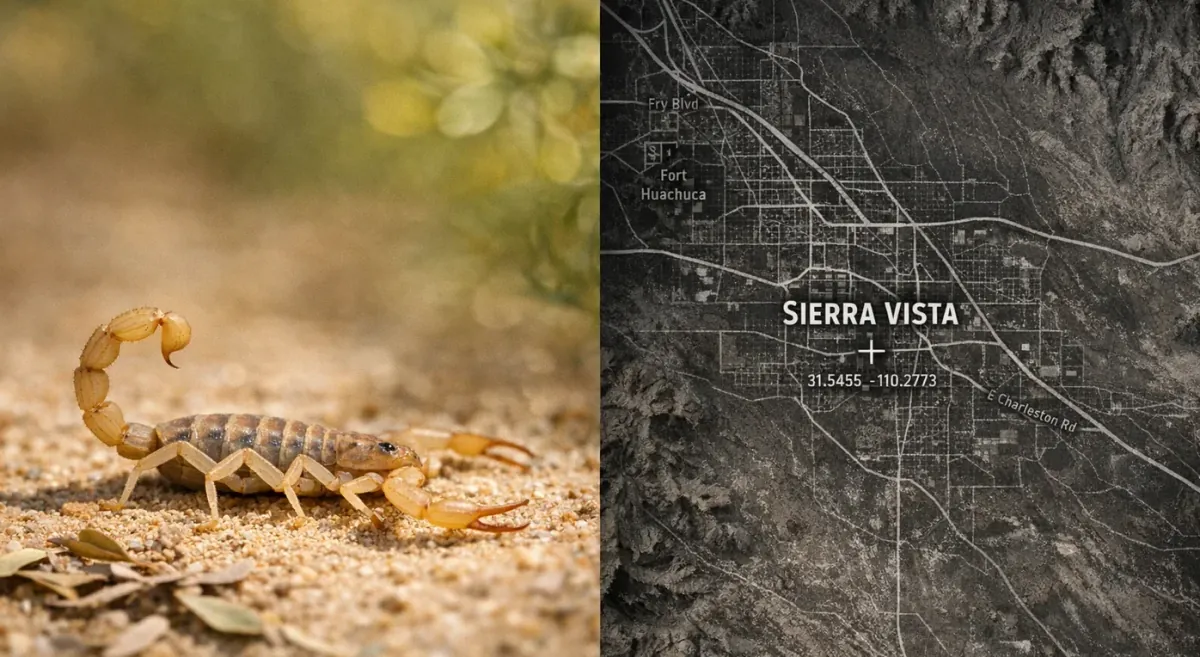
Are scorpions a problem in Sierra Vista?
Yes — scorpions in Sierra Vista, Arizona are common enough that prevention and monitoring are worth doing. This part of Cochise County sits in classic scorpion country, where desert landscaping, block walls, and warm nights give these arachnids exactly what they need. The smart move here is layered control, not a single spray-and-hope approach.
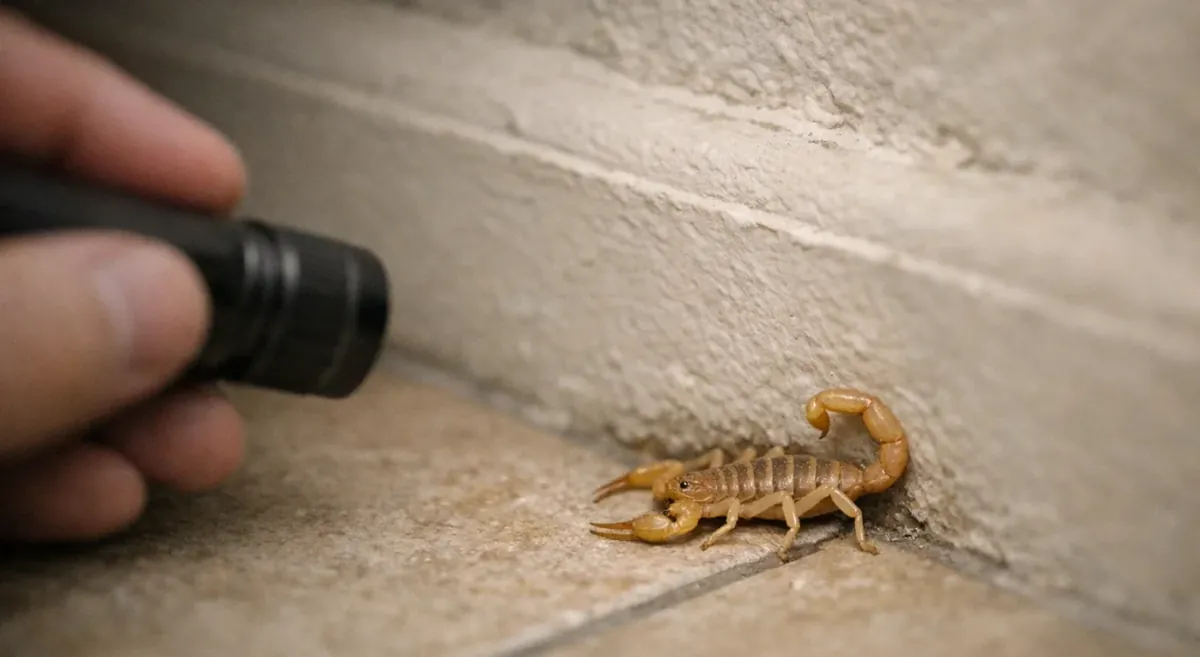
Most homeowners find them in predictable spots: garages, bedrooms, bathrooms, laundry areas, and tucked inside shoes or boots left by the door. That pattern lines up with how scorpions behave at night. They hug walls and edges as they hunt, slipping along baseboards and into dark, sheltered corners. Picture pulling on a work boot at 6 a.m. without checking it first — that's exactly the kind of encounter Sierra Vista residents want to avoid.
Why does a layered approach matter so much here? Two reasons: food and entry points. Crickets and roaches draw scorpions indoors, and where the prey goes, the predator follows. At the same time, worn door sweeps, exposed weep screeds, and slab gaps act like open doors. Treat only the symptom and the scorpions keep coming back.
Why are scorpions showing up around Sierra Vista homes?
Local habitat is the honest answer. Decorative rock features, block walls, sheds, and woodpiles all create cool, tight spaces scorpions love during the day. These microhabitats sit right against many Sierra Vista yards, so scorpions are often already at your perimeter before they ever come inside.
From there, it comes down to food and shelter. A yard with crickets and roaches is a buffet, and a yard with stacked wood, loose pavers, and cluttered block walls is a hotel. Reduce both and you remove the reasons scorpions linger near your foundation. For a deeper look at what pulls them in, see our guide on the top things that attract scorpions in your home.
Are scorpions more of an indoor or outdoor issue here?
In Sierra Vista, scorpions are mostly an outdoor presence, with occasional indoor surprises. You'll see them on patios, along walls, and in garages far more often than in your living room. Indoors, they're usually wanderers that slipped through a gap.
Here's the simple decision point: one scorpion, one time? It was probably an accidental wanderer — seal the obvious entry points and keep an eye out. Repeated indoor sightings, especially in the same room? That points to an entry point or a nearby harborage, and it's time to act more aggressively.
When should I call a pro for Sierra Vista scorpion control?
Call a professional when you've had repeated indoor sightings, anyone has been stung, or you've spotted scorpions in a child's bedroom. Those thresholds suggest the problem is established, not random.
Before you call, document each sighting — date, time, and exact location. A simple log makes any inspection or treatment far more targeted, because it shows the pro where activity actually concentrates instead of forcing them to guess.
Which scorpion species lives in Sierra Vista?
Sierra Vista doesn't have a single confirmed dominant species in citizen-science data, but the most likely candidates in Cochise County are the Arizona bark scorpion (Centruroides sculpturatus), the striped-tail or devil scorpion (Vaejovis/Hoffmannius species), and the giant desert hairy scorpion (Hadrurus arizonensis). Of those, the Arizona bark scorpion is the only one of real medical significance.
You can safely note a few things yourself: rough size, color, tail thickness, and where you found it. What you can't reliably do is confirm species at a glance — and you should never handle one to get a closer look.
Why iNaturalist may show "None" for Sierra Vista
A blank or "none" result on iNaturalist doesn't mean Sierra Vista has no scorpions. It usually reflects low or patchy reporting — fewer people uploading photos, not fewer scorpions on the ground. Absence of data is not data of absence.
For real verification, lean on local experts. The University of Arizona Cooperative Extension office for Cochise County can help with identification, and a few clear photos go a long way. Capture the whole body from above, a side view of the tail, and a close shot of the pincers.
Common Cochise County scorpions homeowners report
Treat this list as likely, not definitive. The Arizona bark scorpion is slender, light tan, and turns up higher than other species — you'll find it on walls, fences, and even indoor ceilings. The striped-tail/devil scorpion is stockier and tends to stay low, hiding under rocks and debris. The giant desert hairy scorpion is large, dark-backed, and usually lives in burrows out in the open desert rather than inside homes.
How to identify a scorpion without handling it
Don't pick it up — ever. Observe from a safe distance and let a photo do the work. Run through this quick checklist:
- Estimate body length next to a coin or ruler placed nearby
- Note tail thickness (thin and delicate vs. thick and robust)
- Look at pincer size relative to the body
- Record overall color and any stripes or markings
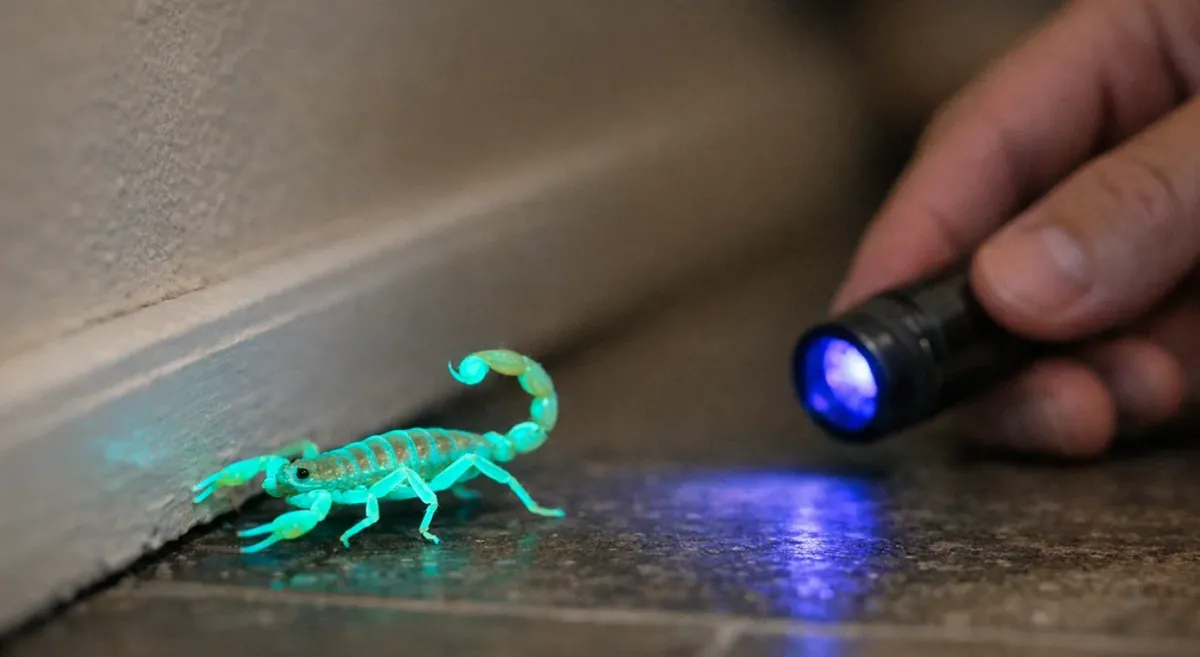
One important caveat: scorpions glow greenish under UV light, but the glow alone tells you nothing about species. It confirms you're looking at a scorpion — that's it.
When are scorpions most active in Sierra Vista?
Scorpion season in Sierra Vista runs roughly from spring through fall, with the peak in August and September, when monsoon humidity and lingering heat drive activity. Those late-summer months also line up with open patio doors, evenings outside, and kids and pets on the floor — the exact moments encounters happen.
Across Arizona, Kang & Brooks 2017 identify August and September as the peak envenomation months. Nightly, the highest-risk window is the hours just after dusk. And yes — bark scorpions readily reach walls and upper areas, a result of their thigmotactic habit of staying pressed against vertical surfaces and edges.
49% of scorpion envenomations happen between 6 PM and midnight — the scorpion is nocturnal.
— Isbister & Bawaskar, N Engl J Med 2014
Scorpion season Sierra Vista: what changes month to month
The riskiest window for indoor encounters is August and September. Use a simple monthly cadence: in spring, check and replace worn door sweeps. In early summer, seal garage thresholds and plumbing gaps. During monsoon peak, inspect entry points weekly and keep floors clear. Our month-by-month Arizona scorpion season guide breaks this rhythm down further.
Why you see them at night (and where they go during the day)
By day, scorpions hide in cool, dark, humid spots — under rocks, in woodpiles, behind baseboards, and inside garage clutter. A daytime sighting often signals a nearby harborage, so it's worth checking those areas. Scorpions have up to a dozen eyes, yet they still navigate mostly by touch and vibration, which is why they hug walls and edges.
Do rain, heat, and monsoons increase sightings in Sierra Vista?
They do. Monsoon storms from July through September push scorpions and their prey toward drier ground — often your home's perimeter. After a storm, do a quick check: thresholds, garage edges, patio furniture, and any laundry piles left on the floor are prime hideouts.
How dangerous is a scorpion sting in Sierra Vista?
Most scorpion stings in Sierra Vista are painful but not dangerous for a healthy adult. The exception is the Arizona bark scorpion, whose venom can cause systemic effects that warrant urgent care — especially in young children and seniors. Across Cochise County, the AZ Poison & Drug Information Center logged 56 scorpion exposures and 10 envenomations in 2025.
Arizona consistently reports the highest rates of sensory, neuromuscular, and respiratory effects from scorpion stings of any state, according to Kang & Brooks 2017. Keep the Poison Help line handy: 1-800-222-1222.
Typical symptoms vs. emergency warning signs
Most people feel immediate burning pain at the site, followed by tingling and numbness that can last several hours. Pain at the sting site shows up in 88.9% of stings and local numbness in 62.2%, per the Klotz et al. 2021 Arizona cohort.
Treat it as an emergency if you see trouble breathing or swallowing, uncontrolled muscle jerking, roving or darting eye movements, or intense full-body symptoms — particularly in a child. Those are red flags that need immediate care.
Are scorpion stings worse for kids and pets in Sierra Vista?
Yes. Smaller bodies absorb a relatively larger venom dose, so children under 10 have the highest rates of systemic effects, hospitalization, and ICU admission. Effective treatment exists, which is the reassuring part. According to Dr. Leslie Boyer, Director of the VIPER Institute at the University of Arizona College of Medicine, "This study told us that the dangerous effects of bark scorpion venom can be reversed quickly with the right antivenom. One hundred percent of the children who received it got better very quickly, meaning that using this antivenom in the emergency room will make intensive care treatment unnecessary for most patients."
Pets, especially small dogs and cats, can react strongly too. Focus prevention on the rooms where kids and pets spend floor time — bedrooms, family rooms, and play areas.
What homeowners mean by "poisonous" vs. "venomous"
Quick clarification: poisonous means harmful when eaten or touched, while venomous means it injects a toxin through a sting or bite. Scorpions are venomous. The label matters less than the response plan — know the symptoms and what to do next.
What to do if you're stung in Sierra Vista
Stay calm, wash the area with soap and water, apply a cool compress, and call Poison Control at 1-800-222-1222 for guidance. Most stings can be managed at home, but documenting symptoms helps the experts decide what you need next.
First 5 minutes: what to do right away
Move through these steps in order:
- Wash the sting site gently with soap and water
- Apply a cool compress or wrapped ice pack for 10 minutes on, 10 off
- Take an over-the-counter pain reliever if needed
- Stay calm and keep the limb still and slightly elevated
- Call Poison Control to talk through symptoms
Do not cut the wound, try to suck out venom, apply a tourniquet, or reach for unproven home remedies — they can cause harm without helping. Our bark scorpion sting first-aid guide walks through the first 30 minutes in detail.
When to call Poison Control vs. go to urgent care/ER
Call Poison Control first for any sting — they can advise and, if needed, escalate. Go straight to urgent care or the ER if you see red flags: difficulty breathing or swallowing, uncontrolled muscle movements, roving eyes, or severe systemic symptoms in a child. When you call or go in, bring this info: the person's age and weight, the time of the sting, how symptoms have changed, and a photo of the scorpion if you safely captured one.
What if you can't find the scorpion?
If the scorpion got away, reduce immediate risk fast. Shake out bedding and clothing, check inside any nearby footwear, and clear the floor around the area. Then set up short-term monitoring so the next one doesn't catch you off guard. Automated nighttime detection can take the guesswork out of this — Scorpion Alert Detectors switch on when a room goes dark and send photo-verified alerts to your phone, so you know the moment a scorpion crosses the floor.
How to keep scorpions out of your Sierra Vista home
The reliable approach is layered: seal entry points, reduce yard habitat, control the prey that draws scorpions in, and monitor high-risk rooms at night. No single step does the whole job — together, they reduce both the population and your odds of an encounter.
What actually kills scorpions? Honestly, less than people hope. Their hard exoskeleton shrugs off many sprays, and barrier treatments wear down over time. Exclusion and habitat reduction do more heavy lifting than any chemical alone. For the full picture on how they sneak in, read our breakdown of the top ways scorpions get into your home.
Exclusion: seal the entry points scorpions use
Prioritize the gaps scorpions exploit most: door sweeps and weatherstripping, garage thresholds, plumbing penetrations under sinks, exposed weep screeds, and loose window tracks. Bark scorpions can squeeze through a gap as thin as a credit card.
For a weekend project, work through this checklist:
- Replace worn door sweeps on every exterior door, including the garage
- Re-caulk around pipes, cables, and outdoor faucets
- Add weatherstripping where you can see daylight under doors
- Screen weep holes and check window tracks for gaps
Yard fixes that reduce scorpion habitat (without removing all landscaping)
You don't have to rip out your desert landscaping — just make it less hospitable. Move woodpiles and stacked pavers away from the house, clear leaf litter and debris, trim ground cover back from the foundation, and declutter the base of block walls. Those rock piles, woodpiles, and wall crevices are exactly the cool, tight microhabitats Cochise County scorpions hide in by day, so distance from your walls matters.
Indoor strategy: reduce prey + monitor high-risk rooms at night
Fewer bugs means fewer scorpions. Keep crickets and roaches in check by sealing food, fixing moisture leaks, and reducing indoor clutter — cut the food supply and scorpions have little reason to linger. Pull beds away from walls, skip the bed skirt, and shake out shoes before slipping them on.
For monitoring, place detection near entry points and in bedrooms where stings most often happen. Since past sightings are the strongest predictor of a future encounter, any room where you've already seen a scorpion deserves coverage. Scorpion Alert's plug-in Detectors handle this automatically across the whole property — multiple detectors, family sharing, and instant push or SMS alerts with photo verification, without you doing blacklight walks every night. It's a quiet upgrade in peace of mind for any Sierra Vista home in scorpion country.
If you’re in Sierra Vista, knowing where bark scorpions tend to hide is half the battle—especially when kids or pets are in the house. For extra peace of mind, Scorpion Alert uses scorpion-specific AI detection to help you spot them faster and respond sooner; learn how it works at Scorpion Alert.