Is the scorpion in my glue trap dead—and can it still sting?
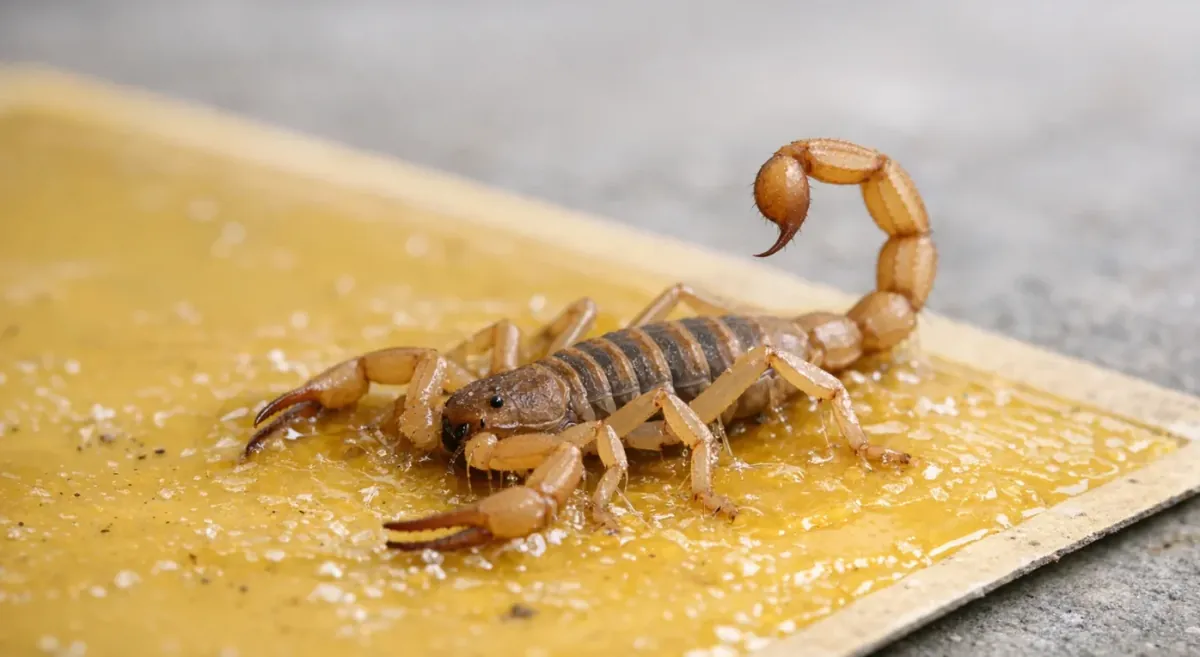
Assume the scorpion is alive until you've sealed the trap in a bag and thrown it out. A scorpion stuck in glue can sit perfectly still for hours, then twitch a leg or flex its tail. Even a confirmed dead scorpion can puncture skin if you brush against the stinger. Treat the trap as hazardous either way.
That uncertainty is exactly why people freeze when they find one. You walk into the laundry room, spot a dark shape glued to the board by the baseboard, and have no idea whether it's been there ten minutes or ten days. Take a breath. You don't need to touch it to handle this safely.
What are the quickest signs it's still alive?
Look for any movement at all. A live scorpion may slowly wave its pedipalps (the front claws), curl or twitch its tail, or flex a leg as it tries to free itself. Movement can be tiny and infrequent, so watch for ten or fifteen seconds before deciding.
But here's the thing: scorpions can stay motionless for a remarkably long time, especially when stressed or partly stuck. A still scorpion isn't proof it's dead. Default to "alive" when in doubt, and keep your distance. You lose nothing by being cautious, and you risk a defensive sting by getting close.
Can a dead scorpion still sting you?
Yes—sort of. A dead scorpion can't actively strike, but the stinger stays sharp, and the venom gland can still hold venom for a while after death. If you press a finger against the tip, it can break the skin and deliver a dose. That's enough to cause real pain.
That's why a curious child or a sniffing dog is the real danger here, not the homeowner with tongs. Keep the trap well out of reach of kids and pets from the moment you find it. If anyone does get stung, here's bark scorpion sting first aid for the first 30 minutes.
What's the safest way to check without getting close?
Keep your face and hands back, and let a tool do the work.
- Stand back and don't lean over the trap—a startled scorpion can arch upward.
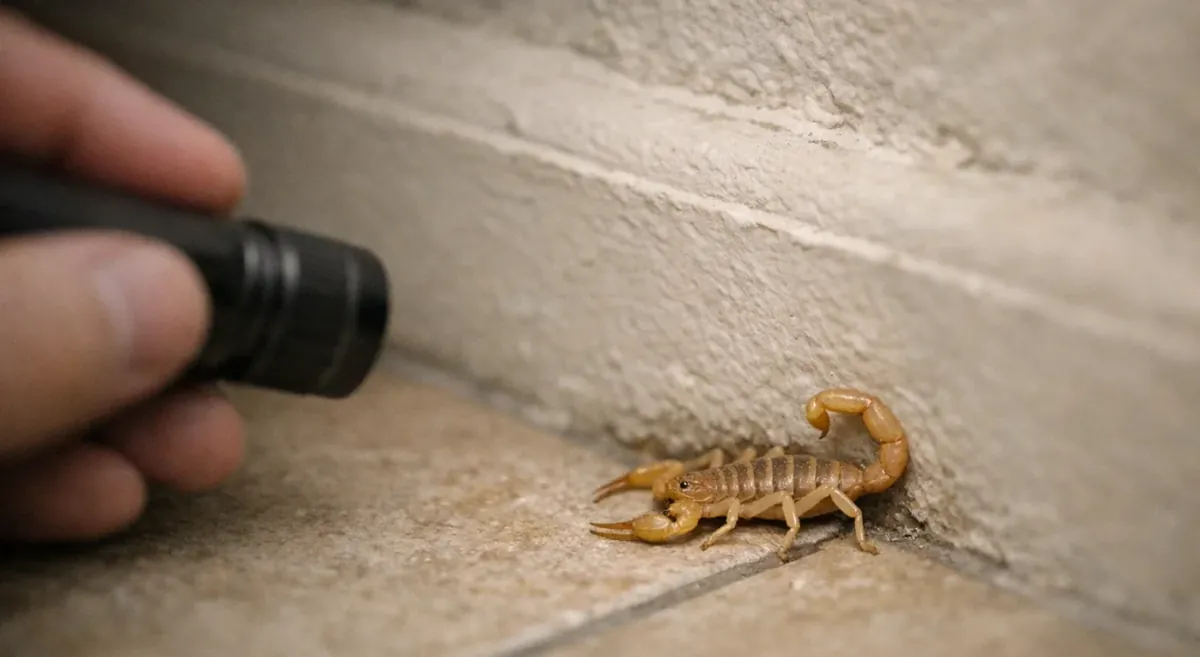
- Use 12-inch (or longer) tongs or forceps, never bare fingers.
- Tap the edge of the trap, not the scorpion, and watch for any reaction.
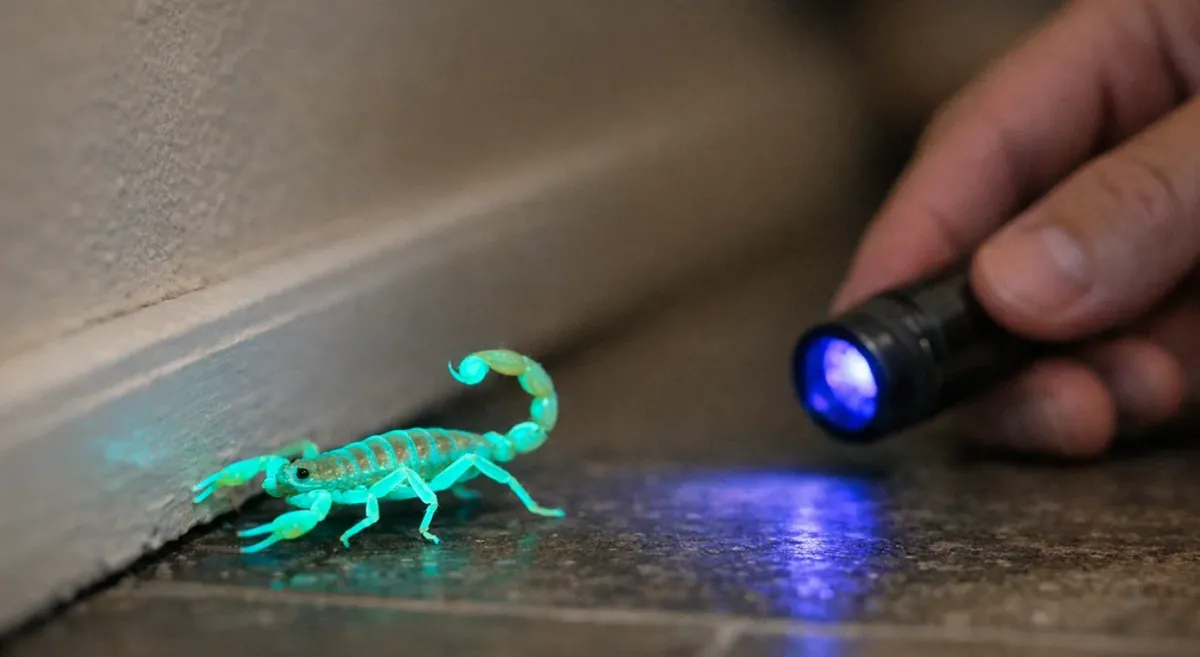
- Shine a UV flashlight on it—scorpions glow a bright greenish color, which makes the body and stinger easy to see in a cluttered trap.
If nothing moves after a few taps, it's probably dead—but handle it as if it's alive. Now for the question that brought you here: how long has the thing actually been stuck?
How can I estimate how long the scorpion has been stuck in the trap?
Honestly, you can only get a range, not a timestamp. Combine three clues—the scorpion's body condition, the room's environment, and the trap's own condition—to land on "caught recently" (hours to a day or two) versus "older" (several days to weeks). No single clue is precise, so weigh them together.
Think of it as detective work. A plump scorpion on a clean, sticky trap in a humid bathroom tells a very different story than a shriveled one on a dust-caked board in a hot garage. That's the core challenge with a scorpion in a glue trap: how long has it been there is rarely something you can answer with certainty—but the clues below get you close.
What does the scorpion's posture and body condition tell me?
The body dries out as time passes, so use this quick checklist:
- Recent: plump, rounded abdomen; flexible legs; minimal curl.
- Older: shriveled or sunken abdomen; brittle, stiff legs; tightly curled tail and limbs.
Smaller juveniles dry out faster than thick-bodied adults, so a tiny, shriveled scorpion may have been caught more recently than its appearance suggests. Body condition is your single most reliable clue—but the room around it changes the math.
Do heat, AC, and humidity change the timeline?
A lot. Dry, air-conditioned indoor air and hot garages can "mummify" a scorpion quickly, so it can look ancient after only a day or two. A humid room slows drying and keeps the body plumper longer, making the catch look fresher than it actually is.
Factor in where the trap sat. A board near an AC vent or in a dry hallway dries a scorpion fast. A trap in a steamy bathroom or near a swamp cooler stays moist, so adjust your estimate older than the body alone suggests.
Can dust, hair, or other insects on the glue help date it?
The trap's surface is a calendar of sorts. A fresh board is glossy and clean; an older one collects a gray film of dust, stray hairs, and lint. Heavy debris means the trap has been out a while—and so, likely, has the scorpion.
Secondary insects are another tell. Ants, gnats, or tiny beetles stuck around the scorpion suggest it's been there long enough to attract scavengers. Going forward, write the date on each trap with a marker so you never have to guess again.
Does the glue itself change as it sits out?
It does. As adhesive collects dust and dries, it loses grip, which is why old traps create "mystery catches"—a scorpion gets lightly stuck, struggles, and sometimes pulls free or dies half-attached. A tired, dusty board also lets some scorpions walk right across it, so you miss them entirely. That's the hidden weakness of relying on glue alone.
Do scorpions change color or stop glowing under UV after they die?
Color and UV glow are the clues homeowners reach for next, and both are unreliable. A dead scorpion may look slightly duller, but lighting can fool you. Its greenish UV fluorescence can persist for a long time after death. Brittleness is a far better aging clue than either color or glow.
Will a dead scorpion look darker, lighter, or brittle over time?
A live scorpion often looks faintly waxy and shiny. A long-dead one tends to go matte and dull as it dries. But that shift is subtle, and a single overhead bulb or your flashlight angle can flip your impression in a second. Lean on brittleness instead—stiff, fragile legs that look ready to snap are a more honest sign of age than any color change.
Will a dead scorpion smell in a glue trap?
Usually not much. Indoors, a dried-out scorpion gives off little to no odor. If you do notice a musty or moldy smell, the culprit is usually moisture, not the scorpion—damp glue and a humid corner can grow mold. Treat a smell as a nudge to check that room for a moisture problem, since moisture is one of the top things that attract scorpions in the first place.
Does UV glow mean it's alive?
No. The glow comes from compounds in the exoskeleton, not from anything living, so a dead scorpion can keep fluorescing for a long time. Brightness varies with dust on the body, the angle of your light, and how thick the cuticle is. Never use UV glow as a timer or an "alive" test—it tells you "this is a scorpion," nothing more.
What should I do with the glue trap now (and what does this catch mean)?
Bag and bin the trap safely first, then think about the next day or two. Don't crush it, don't pick at it, and don't leave it sitting on the counter "to look at later." A few more mistakes to avoid after spotting a scorpion are worth a quick read here.
How do I safely bag and throw away a trap with a scorpion on it?
- Skip bare hands—use tongs to lift the trap by its edge.
- Drop the entire trap, scorpion still attached, into a thick plastic bag.
- Seal the bag tightly, squeezing out the air.
- Double-bag it or place it in a rigid container with a lid.
- Carry it straight to an outdoor trash bin—not the kitchen can.
- Keep it away from kids and pets the entire way out.
Should I move, replace, or add more glue traps after one catch?
Replace any board that's dusty or older—its grip is already fading. Place fresh traps flush against baseboards and wall edges, because scorpions are thigmotactic and travel hugging surfaces rather than crossing open floor. Check them on a set schedule, and label each one with the date and location so you're never guessing about timing again.
Does finding one scorpion mean there are more in the house?
Sometimes it's a lone wanderer; sometimes it's the first sign of a pattern. One catch isn't proof of an infestation, but repeat hits in the same room are a red flag. Write down the date, room, and size of each one and watch for clusters. It also helps to know how scorpions climb walls, beds, and ceilings and what to expect across scorpion season month by month in Arizona.
How can I stop guessing 'when' next time and find out sooner?
There are two paths forward. Either run a disciplined manual glue-trap routine, or use real-time monitoring that timestamps activity the moment it happens. The difference comes down to whether you want to keep playing detective after the fact—or get a record of exactly when a scorpion showed up.
68.2% of all US scorpion exposures reported to Poison Control Centers from 2005 to 2015 occurred in Arizona.
— Kang & Brooks, J Med Toxicol 2017
If I keep using glue traps, what routine actually works?
Keep it simple and consistent. Check traps on a fixed cadence, date every board when you set it out, and swap traps before they collect dust and lose grip. That discipline cuts down the guesswork. The tradeoff is real, though: unless you happen to check right after a catch, you still won't know the exact moment a scorpion arrived.
What does real-time scorpion monitoring look like in a home?
Real-time monitoring watches the room perimeter at night—when scorpions are most active—and alerts you the instant one shows up. Instead of finding a mystery body days later, you get a photo-verified alert with a timestamped image. The "how long has it been there?" question disappears, because the system already logged the exact date, time, and location.
How Scorpion Alert fits (without changing your whole life)
Scorpion Alert works as a hands-off alternative to glue-trap guessing. Each Detector plugs into a standard outlet—no hub required—and runs autonomously at night, shining 365nm UV light to catch the greenish fluorescence scorpions give off. When it spots one, it sends a push notification and SMS within seconds. You grab a UV flashlight and a glass, walk to the room that triggered, and handle one glowing scorpion you actually know about—instead of wondering how long the last one sat in a trap.
If you’ve found a scorpion in a glue trap and you’re trying to estimate how long it’s been there, the bigger takeaway is that timing clues are imperfect—so consistent monitoring matters. Scorpion Alert helps you spot scorpion activity sooner with AI-enhanced detection designed to reduce false positives, so you can respond quickly instead of guessing. Learn more at Scorpion Alert.