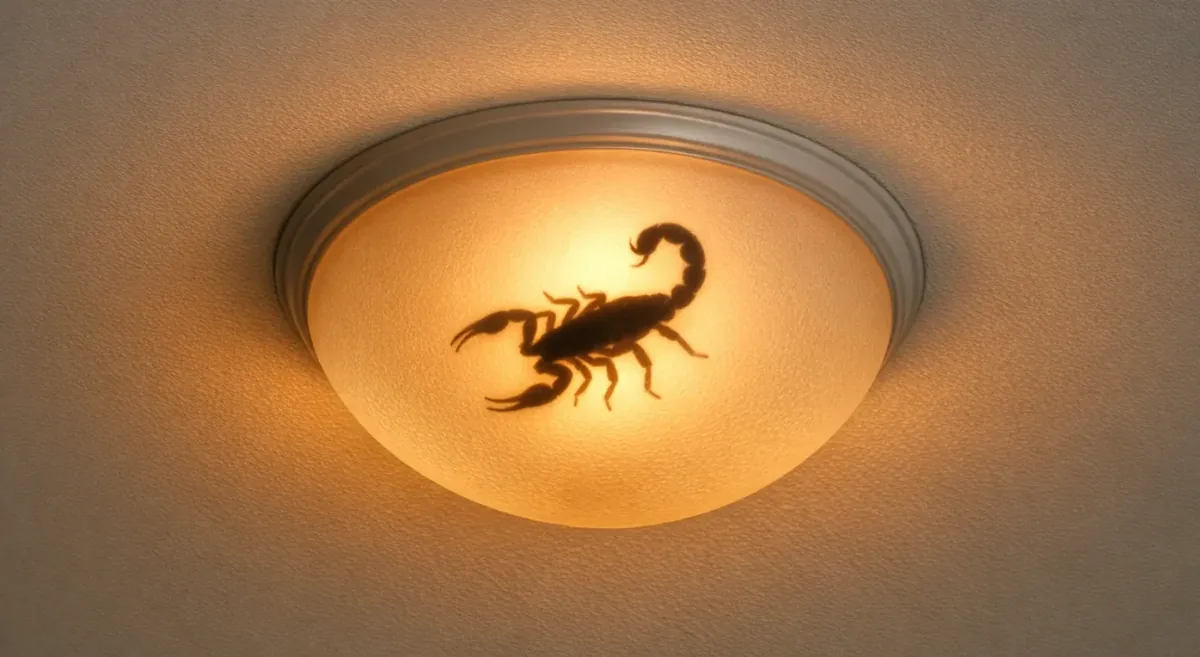
How many eyes do scorpions have, and where are they?
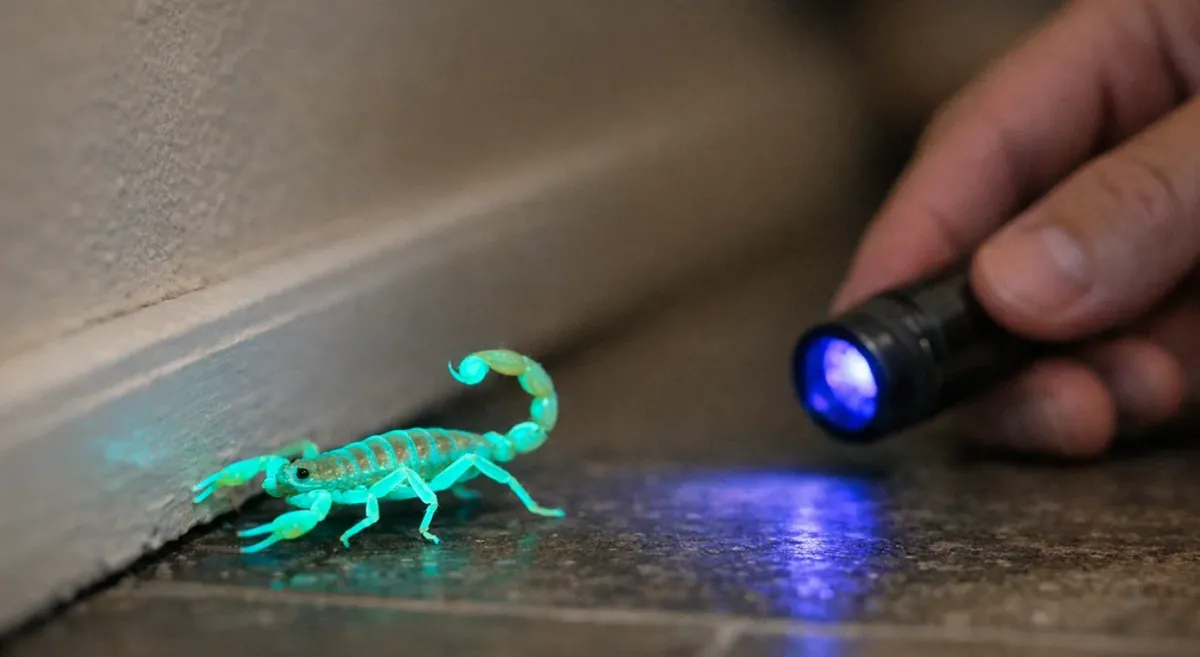
Say you're sweeping a UV flashlight across your bedroom floor and you spot that telltale green glow. As you lean in, you might notice something unsettling — multiple dark spots on the scorpion's head that look like eyes. But here's what most homeowners don't realize: those eyes work nothing like yours.
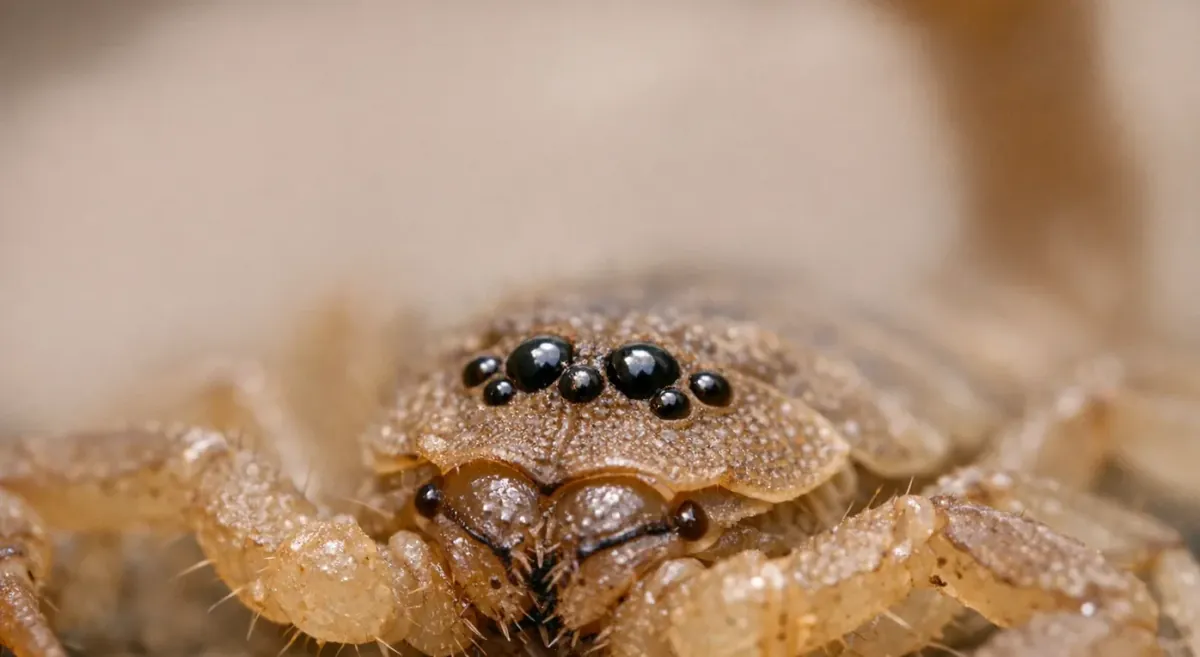
Scorpions typically have between 6 and 12 eyes, depending on the species. The Arizona bark scorpion that slips through your door seal has eight eyes total. These visual organs sit on the cephalothorax — the front section where the legs attach (basically the "head" area). Unlike insects with compound eyes made of thousands of tiny lenses, scorpions have simple eyes called ocelli that work more like light sensors than cameras.
Median eyes vs. lateral eyes: what's the difference?
Every scorpion has two median eyes — the main pair sitting on top of the cephalothorax like a tiny periscope. These are the ones you'll spot first, positioned in the middle where you'd expect eyes to be. They're larger than the other eyes and handle most of the "seeing," though that's not saying much.
The lateral eyes line up along the sides, usually in groups of 2–5 eye pairs depending on species. Think of them as backup sensors. While the median eyes track general light levels and movement, the lateral eyes mostly pick up changes in brightness from the sides. It's like having a security system with one main camera and several motion detectors — except this one's running on 1980s tech.
Both types are ocelli, which means they're built for simplicity over sophistication. No complex lens structures here — just light-sensitive cells that tell the scorpion whether it's dark enough to hunt and whether something big is moving nearby.
What do scorpion eyes actually detect (light, movement, shapes)?
Scorpion vision is what scientists call "low-resolution" — imagine looking through heavily frosted glass. Their retina cells can detect three things reasonably well: light intensity, contrast, and movement. Sharp details? Forget it. A scorpion can't tell the difference between your foot and a rock until it touches it.
The eye structure explains the limitations. Each ocellus contains just a few hundred photoreceptor cells, compared to the millions in your eyes. These cells respond to changes in light and shadow, which helps scorpions move from bright areas to dark hiding spots. Movement detection works because moving objects create shifting patterns of light and dark.
Behaviorally, this matters a lot. A scorpion might freeze when your shadow passes overhead — it knows something big moved. But it can't identify what you are or track your exact position. This low-resolution vision shapes how they hunt and hide.
Why homeowners misjudge scorpion vision
More eyes must mean better eyesight, right? Wrong. That assumption gets people into trouble. They figure a creature with eight eyes can spot them coming from any angle, so they either panic or get careless. The reality sits somewhere in between.
Watch a scorpion navigate your bathroom and you'll see it firsthand. Despite all those eyes, it'll bump into obstacles, miss obvious escape routes, and walk right past prey that isn't moving. They follow edges and corners because they're essentially feeling their way around — not because they're strategically plotting a route.
Those multiple eyes aren't giving them superhuman awareness. They're giving basic environmental data from different angles. Scorpions rely far more on touch through sensitive hairs, ground vibrations through their legs, and even air-movement detection. The eyes are just one part of a multi-sensor system — and honestly, not the most important part.
How do scorpion eyes work in darkness and low light?
Here's what keeps homeowners up at night: scorpions are most active when you can't see them. They emerge after dark to hunt, explore, and unfortunately, wander into bedrooms and bathrooms. So can they see you in the dark when you can't see them?
Desert nights aren't completely dark — starlight and moonlight provide some illumination. Indoor darkness varies too. Your hallway at 3 a.m. might have light seeping under doors, LED indicators glowing on electronics, or streetlight filtering through windows. Scorpion eyes evolved to work in low-light conditions, but not in the way you might fear.
Do scorpions have good eyesight at night?
Scorpion eyes are optimized for dim conditions through a process called dark adaptation. Their photoreceptor cells become more sensitive after sunset, allowing them to detect fainter light sources. But sensitivity doesn't equal clarity. Think of it like turning up the brightness on a security camera that only shoots in 144p — you can see more, but everything's still blurry.
They're not hunting you by sight in your dark bedroom. A scorpion can detect your silhouette against a slightly lighter background, or notice when you block ambient light. But it can't see your features, judge distance accurately, or track precise movements. Its night vision is about "something's there," not "that's a human foot approaching."
The median eyes handle most night-vision duties, while the lateral eyes mainly notice changes in light from the sides. Neither type gives them predator-level night-hunting abilities through vision alone.
If their vision is limited, how do they hunt so well?
Scorpions catch prey and surprise homeowners because they've mastered close-range detection. Their success comes from combining multiple senses, with vision playing a supporting role.
Touch sensors cover their bodies — specialized hairs that detect the slightest air movement. A cricket walking six inches away creates tiny air currents that scorpions feel instantly. Vibration detection through their legs tells them exactly where prey steps. When hunting, they use light detection to orient toward open spaces, then rely on these other senses for the actual strike.
Most scorpion encounters with humans happen at extremely close range. You're barefoot in the bathroom. The scorpion is against the baseboard. Neither of you notices the other until contact. That's not because the scorpion saw you and attacked — it's because two creatures with different sensory worlds accidentally intersected. And because their vision is limited, these encounters often come with zero warning for either party.
Why scorpions hug walls indoors (and what that says about vision)
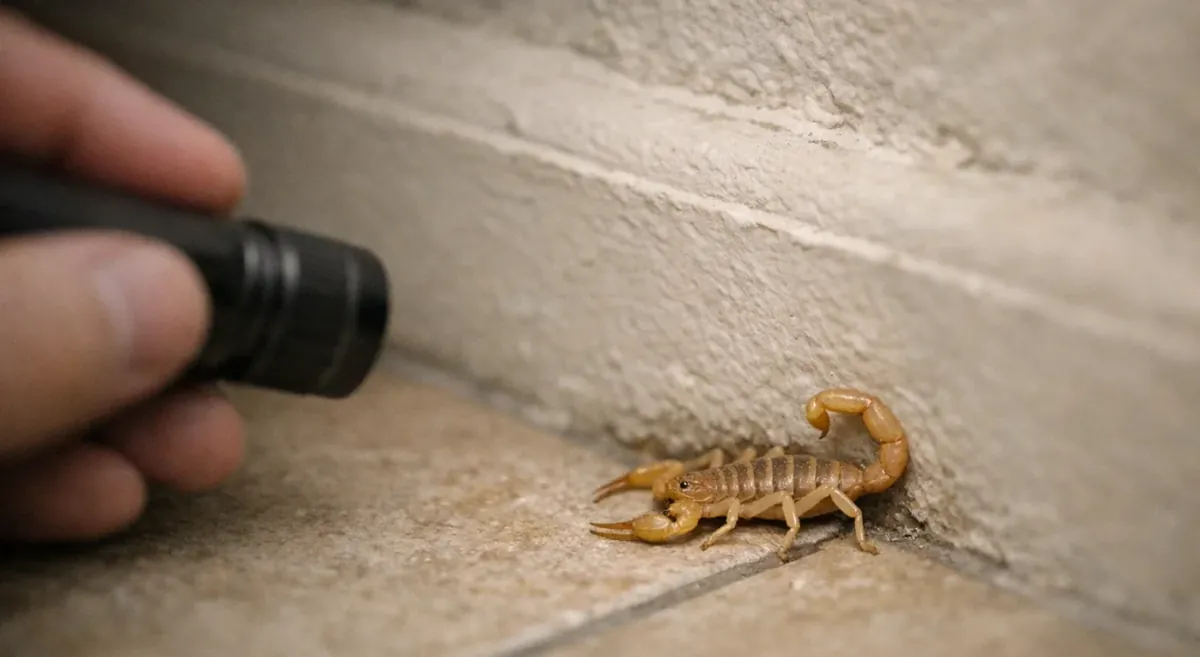
Ever wonder why you find scorpions along baseboards instead of in the middle of rooms? This behavior, called thigmotaxis, shows how little scorpions trust their eyes. They prefer maintaining physical contact with surfaces — walls, furniture edges, door frames — because touch gives them better information than sight.
Inside your home, scorpions navigate by following perimeters. They'll trace the baseboard from your back door all the way to your bedroom, feeling their way along rather than looking where they're going. This edge-following behavior concentrates their movement into predictable paths, which is why children's toys left against walls become scorpion highways at night.
89% of indoor scorpion sightings occur within 6 inches of a wall or furniture edge.
— University of Arizona Cooperative Extension, 2019
Understanding thigmotaxis changes how you monitor for scorpions. Checking room perimeters matters more than scanning open floors. Those edges where walls meet floors? That's the scorpion highway at night. Their poor vision makes them predictable in this way — they'll take the path that keeps them in constant contact with surfaces.
Can scorpions see UV light, and is that why they glow under a blacklight?
Two questions dominate every scorpion UV discussion: Can they see ultraviolet light? And why do they glow that eerie green? The answers matter for anyone trying to detect scorpions safely at night.
UV detection works brilliantly for finding scorpions, regardless of what they perceive. Scorpions definitely glow under UV light — that's been known since the 1940s. But whether they can see UV wavelengths is still debated among researchers.
Why scorpions glow: fluorescence vs. "bioluminescence"
Scorpions don't produce their own light like fireflies do. Instead, they fluoresce — their exoskeleton contains compounds that absorb UV light and re-emit it as visible blue-green light. Shine a 365nm UV flashlight on a scorpion in a dark room, and it glows bright cyan like a tiny neon sign.
This fluorescence comes from beta-carboline and 7-hydroxy-4-methylcoumarin in their cuticle. Nobody knows exactly why scorpions evolved this trait. Protection from UV damage? A way to detect UV levels? The debate continues. What matters for homeowners is that this fluorescence makes scorpions incredibly easy to spot with the right equipment.
Fresh-molted scorpions don't glow until their new exoskeleton hardens and develops these fluorescent compounds. But every adult scorpion you're likely to encounter in your home will light up under UV. Even dead scorpions and molted skins glow for years.
Does UV make scorpions run away?
Here's a common concern: will shining UV light send scorpions scurrying into cracks before you can deal with them? Research suggests low levels of UV don't reliably repel scorpions. Some may pause when UV hits them — possibly because they detect slight warmth or notice the change in their own fluorescence. But they don't consistently flee from UV light the way they might from sudden white light.
In fact, many scorpions seem oblivious to UV detection beams. They'll walk right through a UV light path without changing speed or direction. That makes UV ideal for monitoring — you can observe natural behavior without triggering escape responses. Some detection systems use this principle, continuously scanning floor edges with UV to spot passing scorpions.
The pause response, when it happens, actually helps with capture. A scorpion that freezes under UV gives you a few crucial seconds to position a glass jar for safe removal.
What kind of UV works best for spotting scorpions?
Not all UV lights work equally well for scorpion detection. The sweet spot is 365nm wavelength UV, which produces the strongest fluorescence from scorpion exoskeletons. Cheaper 395nm UV flashlights work but create more visible purple light that can wash out the glow. True 365nm lights cost more, but they make scorpions pop against dark backgrounds.
Room darkness dramatically affects detection success. The darker the room, the more that green glow stands out. 365nm UV in pitch darkness can reveal a scorpion from 15 feet away. The same scorpion might be invisible from 3 feet if you have lights on.
This is why dedicated detection setups often activate only when rooms darken. A UV source positioned low — where scorpions actually travel — combined with darkness detection creates ideal spotting conditions. Some automated systems use exactly this approach, monitoring perimeter zones with 365nm UV whenever lights go off.
What do scorpion eyes mean for homeowner safety and finding scorpions indoors?
Now that you understand how poorly scorpions see, let's turn that into practical protection. Their visual limitations create predictable patterns you can use for safer detection.
Poor eyesight means scorpions won't spot you first. They won't dodge your flashlight beam or recognize you approaching. But it also means they'll wander into living spaces without realizing the danger — to them or to you. Understanding their sensory world helps you search smarter, not harder.
If scorpions don't see well, why are they still hard to catch?
Scorpions excel at accidental hide-and-seek. They're active when you're asleep, move silently along edges you don't check, and squeeze into gaps smaller than you'd expect. Their poor vision can even make them harder to find — they end up in random hiding spots because they didn't "know" it was your shoe.
Nighttime activity is their biggest advantage. While you're sleeping, they're exploring baseboards, bathroom thresholds, and laundry room corners. By morning, they've tucked into some dark crevice to wait out the day. Their quiet movement means no warning — unlike crickets or roaches that might make noise, scorpions glide silently across floors.
Those perimeter travel patterns that help them navigate also help them avoid detection. A scorpion following your bedroom baseboard stays hidden behind furniture. One tracing the bathroom wall disappears behind the toilet. Traditional repellents can't stop this edge-hugging behavior because it's hardwired into how they move.
Where should I look first if I'm checking my house at night?
Start where scorpions actually travel: room perimeters. Check baseboards first, especially where they meet door thresholds. Corners see more scorpion traffic than straight walls because two edges meet there. Under-sink areas in bathrooms and kitchens draw scorpions seeking moisture, and they'll follow pipes and walls to reach these zones.
Priority search zones in order: master bathroom baseboards and thresholds, laundry room edges near external walls, kitchen perimeters especially near water sources, and bedroom baseboards focusing on exterior wall sections. Don't waste time checking room centers or upper walls — scorpions stick to floor-level edges.
Clutter against walls creates scorpion highways with overhead cover. That pile of shoes by the door? Check along its edge. Kids' toys pushed against bedroom walls need attention too. Any object touching a baseboard becomes part of the scorpion's navigation network.
How to detect scorpions without staying up all night
Manual searching with a UV flashlight works, but it takes nightly commitment. Miss one night and a scorpion could move through your space. The alternative is automated perimeter monitoring that watches those high-traffic edges continuously.
Modern detection approaches use the same UV fluorescence principle but cut out the human effort. Picture a device that plugs into outlets along baseboards — right where scorpions travel. When the room darkens, it activates a 365nm UV source aimed at the floor edge below. A small camera watches for that telltale green glow. Detection happens in seconds, triggering an alert to your phone with a photo showing exactly where the scorpion is.
Systems like Scorpion Alert take this concept further with networked detectors throughout the home. Each unit monitors its section of perimeter, creating overlapping coverage of scorpion highways. The monthly monitoring subscription enables instant notifications and detection history across all units. See /pricing for current rates. Instead of nightly patrols, you respond only to confirmed sightings — armed with location data and visual confirmation.
Are scorpion eyes like spider eyes, and what myths should I ignore?
Living in the Southwest means dealing with various arachnids, not just scorpions. Understanding how scorpion vision compares to spiders helps set realistic expectations about encounters. And separating vision facts from fiction prevents both unnecessary panic and dangerous complacency.
Scorpion vision vs. spider vision: who sees better?
Most spiders significantly outperform scorpions in the vision department. While scorpions make do with 6–12 simple eyes that detect basic light and movement, many spiders have more sophisticated visual systems. Jumping spiders, common in Arizona homes, have large forward-facing eyes capable of tracking prey and even recognizing patterns.
Web-building spiders often have poorer vision like scorpions, but they compensate differently. Black widows sense prey through web vibrations with incredible precision. Wolf spiders, which hunt without webs like scorpions do, have better visual acuity for spotting prey at a distance. Even they still rely heavily on vibration and movement detection for the final strike.
The key difference: spiders evolved a range of vision strategies for different hunting styles, while scorpions stuck with basic light detection across species. A scorpion in your bathroom has roughly the same poor eyesight whether it's a bark scorpion or a stripe-tailed scorpion. That consistency makes their behavior more predictable than spiders'.
Myth: 'Scorpions chase you because they can see you'
Scorpions don't chase people. Period. When a scorpion moves toward you, it's not attacking — it's either defending itself or coincidentally heading your direction. Their poor vision means they can't even identify you as a threat until you're practically touching.
What really happens: you corner a scorpion without realizing it. The scorpion detects a large moving shadow (you) blocking its escape route. In panic, it runs toward the only opening it senses — which might be between your feet. Or it's following a baseboard that leads toward where you're standing. These scenarios create the illusion of pursuit when it's really about geometry and coincidence.
Defensive positioning can also mislead people. A threatened scorpion raises its tail and turns to face vibrations, which might be your footsteps. As you move, it rotates to keep facing the threat. This can look like aggressive tracking, but it's purely defensive — the scorpion can't see you clearly enough to chase even if it wanted to.
Myth: 'If I can't see it, it's not there' (why glow changes everything)
The most dangerous myth about scorpions is assuming your normal vision tells the whole story. In regular lighting, scorpions blend in with common flooring. That tan bark scorpion disappears against beige tile. Dark scorpions vanish on brown carpet. Your eyes aren't evolved to spot scorpion camouflage.
UV light changes that. The same scorpion you'd walk past twenty times suddenly glows like a beacon under 365nm UV. This isn't an edge case — it's the difference between stepping on a scorpion barefoot and spotting it from across the room. One UV check can reveal scorpions that have been in your space for weeks, unnoticed.
73% of homeowners who find one scorpion discover additional scorpions within 48 hours using UV detection.
— Arizona Pest Control Association Survey, 2021
Instead of assuming empty floors mean no scorpions, build consistent detection habits. Quick UV checks before kids' bedtime, automated monitoring of key areas, and keeping shoes off the floor all acknowledge that scorpions hide in plain sight. Their poor vision is matched by their incredible camouflage — until UV light reveals the truth.
Now that you know how scorpions use their many eyes to navigate low light, it’s worth remembering that your best advantage is making them easier to spot before they slip into cover. Because scorpions fluoresce under UV, Scorpion Alert uses a 365nm UV light to help you scan patios, garages, and baseboards at night—learn more at Scorpion Alert.