Does finding one scorpion in my house mean there are more?
Finding one scorpion doesn’t automatically mean your home is crawling with them. But it also doesn’t guarantee you’ve found the only one. The real answer depends on several factors — from the time of year to what’s happening in your walls.
Most homeowners search this exact question within minutes of their first scorpion encounter. You’re standing there with a shoe in one hand and your phone in the other, wondering if this is just the scout for an army hiding in your baseboards. The good news? Scorpions aren’t like termites or ants. They don’t build colonies in your walls.
When people say “more,” they usually mean finding another scorpion days or weeks later — not discovering a writhing mass behind the water heater. Knowing the difference between a lone wanderer and signs of ongoing activity helps you respond appropriately without losing sleep over imagined invasions.
Are scorpions social or solitary?
Scorpions are fundamentally solitary creatures. Unlike ants that march in lines or roaches that scatter when you flip on the light, scorpions don’t form social groups or build communal nests in your home. Each scorpion operates independently, hunting alone at night.
However — and this is important — scorpions will cluster when conditions line up. Picture a pile of lumber in your garage that stays cool and damp. Several scorpions might independently discover this ideal shelter. They’re not socializing; they’re just drawn to the same resources: moisture, darkness, and the crickets that hide there too.
This clustering behavior helps explain why some homes see multiple scorpions while neighbors see none. It’s not about friendship. It’s about shared resources.
What makes the odds higher that there are more?
Several factors can dramatically increase your chances of finding scorpion number two. Recent weather extremes top the list — heavy rains flood scorpions out of outdoor hiding spots, while heat waves drive them inside looking for water. If Phoenix just hit 115°F or Austin got three inches of rain overnight, your odds went up.
Next, check your prey insect situation. Lots of crickets hopping around? Roaches scurrying under appliances? You’re running a scorpion buffet. These predators follow their food, and a home with abundant prey can attract multiple hunters.
Physical conditions matter too. That gap under your garage door wide enough to slide a pencil through? Multiple scorpions can use the same entry point. A cluttered garage with cardboard boxes stacked against walls can create a scorpion highway system. Prior sightings in your neighborhood also raise the stakes — scorpions in the area mean scorpions looking for territory.
Even so, higher odds don’t guarantee anything. Your next step is verification, not panic.
What should I do immediately after I spot a scorpion indoors?
First, take a breath. You’ve got about 30 seconds to make smart decisions that’ll help you figure out whether this visitor has friends. Your immediate actions set up everything that follows — from identifying the species to preventing the next encounter.
Don’t make the common mistakes homeowners make after spotting a scorpion. Focus instead on the steps that actually matter for determining whether more scorpions are nearby.
Should I kill it, capture it, or let it go outside?
If you can safely contain or eliminate the scorpion, do it now. Use tongs, a jar, or even a shoe — just never your bare hands. Arizona bark scorpions pack a medically significant sting, and even less dangerous species can hurt like stepping on hot glass.
Here’s a simple decision tree: Can you trap it under a clear container without putting yourself at risk? Great — slide cardboard underneath and you’ve got a specimen. Too risky, or it’s heading for cover? A quick shoe strike works, but try to keep the body intact. Lost it behind the refrigerator? Mark the spot and plan a careful search later.
Why does having the specimen matter? A clear photo or the actual scorpion helps identify the species, which directly affects your risk level. Striped bark scorpions in Texas behave differently than Arizona bark scorpions. Even a crushed specimen tells the story better than “it was yellowish and about this big.”
What information should I note before I forget?
Grab your phone and record these details immediately — they’re clues to whether more scorpions share your address. Location matters most: was it on the bathroom floor or up on the bedroom wall? Ground floor or upstairs? Near the sliding glass door or by interior plumbing?
Note the time and conditions. A scorpion at 2 a.m. after monsoon rains tells a different story than one at noon on a dry Tuesday. Was it near a heat register, under the kitchen sink, or next to the dog’s water bowl? These details reveal how scorpions enter homes and what might attract more.
Weather context helps too. Did it just rain? Has it been over 100°F for a week? Scorpions move predictably in response to environmental pressures, and understanding the “why” behind this sighting helps guide your next steps.
What if someone was stung during the encounter?
A sting changes everything — medical care comes first. Most scorpion stings feel like angry wasp stings, but children under 10 and elderly adults face higher risks from bark scorpion venom. Watch for symptoms beyond pain: difficulty breathing, muscle twitching, or unusual eye movements mean call 911.
For typical sting reactions, follow proven bark scorpion first aid steps immediately. Clean the site, apply ice, and monitor symptoms. Take a photo of the scorpion if possible — emergency rooms in scorpion territory know different species require different responses.
How can I tell if there are more scorpions hiding in my house?
Think of scorpion evidence like a ladder — some signs practically guarantee ongoing activity, while others just suggest the possibility. Repeated sightings sit at the top. If you see another scorpion within two weeks, especially in the same area, you’re dealing with shared conditions that attract them.
Baby scorpions rank second on the evidence ladder. Finding juveniles means an adult female gave birth nearby, and she didn’t travel far while carrying 20-30 babies on her back. Shed skins (called molts) prove scorpions lived in that spot long enough to grow. These papery husks look like ghost scorpions and often hide in the same dark corners as their former owners.
Increased prey insects provide indirect but powerful evidence. A sudden spike in crickets or roaches means your home offers the buffet that attracts scorpion hunters. They follow food, and abundant prey can support multiple predators.
If I find a small scorpion, does that mean babies?
Size alone doesn’t tell the whole story. That inch-long scorpion might be a full-grown lesser stripetail scorpion, not a baby bark scorpion. True juveniles look distinctly different — paler, more delicate, with thin legs and underdeveloped pincers.
Finding an actual juvenile changes the game. Baby scorpions can’t travel far from where they were born. Their presence means mama scorpion found suitable conditions in or very near your home within the past few months. One baby suggests 20-30 siblings dispersed nearby, dramatically increasing your odds of future encounters.
Species identification matters here. Adult Arizona bark scorpions measure 2-3 inches, so a one-inch specimen could be juvenile. But many scorpion species max out at one inch fully grown. When in doubt, photograph it next to a coin for scale.
What are the most common 'signs' besides seeing one?
Molted skins top the list of physical evidence. These papery shells maintain the scorpion’s exact shape — pincers, segments, and tail intact but translucent white. Find one tucked against a baseboard or in a garage corner? A scorpion lived there long enough to outgrow its exoskeleton.
Sticky trap catches provide ongoing intelligence. A scorpion stuck in a glue board placed two weeks ago tells you about past activity. Multiple catches in the same area? You’ve identified a travel route. Empty traps after a month of monitoring suggest your visitor really was alone.
Watch your cricket and roach populations. These prey insects often spike before scorpion sightings increase. It’s ecosystem dynamics in your living room — more food supports more predators. If you’re suddenly seeing crickets in the bathroom or roaches in the kitchen, scorpions may follow.
Can scorpions climb walls and reach beds or counters?
Yes — scorpions aren’t limited to the floor, so they can turn up on beds, counters, and other surfaces above ground level. One thing that does stop them is a truly smooth surface: they can’t get a grip on smooth glass or polished metal, which is why glass barriers work. Rougher, textured surfaces give them the traction that smoother ones don’t.
This is why some encounters are so unnerving. You flip on the bathroom light and there’s a scorpion up off the floor, or one turns up on the ceiling above your bed. A scorpion overhead usually hasn’t come up the inside of the wall — it has traveled the attic or wall voids above the room and slipped through the gap around a ceiling fixture or the edge of the drywall, dropping in from above.
Don’t assume “floor level only” when searching. Check walls near beds, examine ceiling corners in bathrooms, and look above door frames. Scorpions that turn up above the floor are often hunting — spiders and other prey hide up there too.
Where should I look tonight to confirm whether more are inside?
Tonight’s search can make the next two weeks a lot less stressful. A systematic check of high-probability zones beats random flashlight waving. Wait until full darkness — scorpions that hide all day usually emerge to hunt around 9 or 10 p.m.
You’re not dismantling your home. You’re checking specific spots where scorpions naturally travel and hide. Think edges, corners, and anywhere moisture collects. The goal is simple: confirm whether that first sighting was a lone explorer or evidence of established activity.
What rooms and micro-spots are most worth checking first?
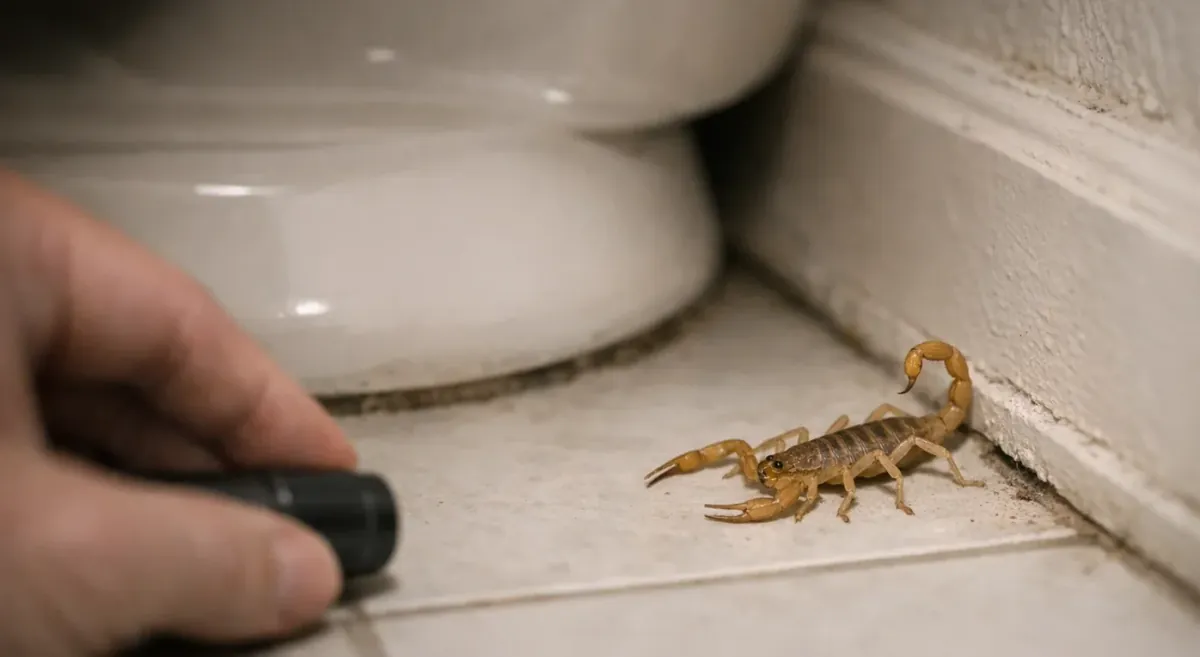
Start with bathrooms — they’re scorpion magnets. Check behind every toilet, under sink cabinets, and along the tub edge. That gap where the toilet meets the wall? Prime scorpion real estate. Laundry rooms rank second, especially around washing machines and water heaters where humidity rises.
Move to the garage next. Scorpions love garages because they bridge indoor comfort with outdoor access. Focus on storage along walls, gaps around the garage door, and any cardboard boxes touching the floor. Ground-floor bedrooms deserve attention too — check under beds, behind nightstands, and inside closets along baseboards.
Within each room, think “cool, dark, tight.” The space between a dresser and wall. Under bathroom cabinets where pipes create gaps. Behind water heaters where warmth meets moisture. These micro-habitats draw scorpions like magnets.
How do I use UV light/blacklight safely and effectively?
Scorpions glow greenish-white under ultraviolet light — it’s like they’re wearing highlighter ink. Turn off room lights for best visibility. Hold your UV flashlight at a low angle and sweep slowly along baseboards, corners, and wall edges where scorpions naturally travel.
Don’t rush. Move the light in overlapping arcs, checking both horizontal and vertical surfaces. Pay special attention to bathroom thresholds, closet edges, and anywhere walls meet floors. Check behind furniture you can safely move — scorpions often rest against walls during their travels.
A thorough UV sweep takes 10-15 minutes per room. Do this for several nights after your first sighting. Finding nothing after a week of checks? That’s a good sign. Spotting that telltale glow? Now you know where to focus your efforts. For ongoing monitoring without nightly patrols, automated detection systems like Scorpion Alert can watch these areas continuously.
Do sticky traps actually tell me if I have more scorpions?
Sticky traps work like security cameras that record evidence. Place them strategically — not randomly. Set traps flush against walls where scorpions travel, especially behind toilets, under sinks, and along garage walls. Slide them under beds and dressers, keeping them against the baseboard.
Use enough traps to cover key areas — one per bathroom, two in the garage, one under each bed. Mark the date on each trap with a Sharpie. Check them every few days, looking for scorpions, prey insects, or those telltale molted skins.
Results tell stories. Empty traps after two weeks suggest your scorpion was passing through. A trapped scorpion confirms ongoing activity. Multiple catches in one area? You’ve found a travel route that needs attention. Remember — traps monitor and catch, but they’re not a complete solution. They’re intel gathering for your broader response plan.
What kills scorpions—and how do I stop the next one from showing up?
Killing the scorpion you see solves today’s problem. Preventing the next one means understanding why this one showed up in the first place. Most homeowners want both — immediate elimination and long-term prevention. Here’s how to approach it without turning your home into a chemical mess.
What works fastest indoors (and what's just wishful thinking)?
Direct physical removal works instantly — shoe, fly swatter, or vacuum with a long attachment. For chemical options, scorpions resist most general insect sprays. Their waxy exoskeleton and low body position protect them from casual pesticide contact. Concentrated sprays designed for scorpions work better, but they require direct application.
Wishful thinking includes ultrasonic repellers, essential oil barriers, and most over-the-counter “scorpion killer” granules. These might feel proactive, but they rarely affect actual scorpion behavior. The myths about scorpion repellents persist because people want simple solutions.
Long-term control means addressing what attracts scorpions to your home. Reduce prey insects, eliminate moisture sources, and seal entry points. A home without crickets and roaches won’t support scorpion hunters.
Why scorpion mating/season changes repeat sightings
Scorpion encounters spike during mating season (typically late spring through early fall in the Southwest). Males wander far from their normal territory seeking females, which sharply increases your chances of indoor encounters. One male might travel through multiple yards and homes in a single night.
Seasonal movement patterns compound the issue. Summer monsoons in Arizona drive scorpions indoors. First freezes in Texas send them seeking warm shelter. Understanding these patterns explains why you might see nothing for months, then three scorpions in a week.
One more factor: scorpions live 3-8 years depending on species. That scorpion you eliminated might have called your garage home for years. If conditions remain favorable, another will eventually discover the same setup. This longevity makes one-time treatments less effective than ongoing monitoring and prevention.
When should I call a professional—and what should I ask them?
Call a professional when patterns emerge: multiple sightings within a week, scorpions in bedrooms or beds, finding babies, frequent stings, or consistent sticky trap catches. A single scorpion in the garage might be DIY territory. Scorpions falling from bedroom ceilings? Time for expert help.
Ask smart questions when they arrive. What’s their inspection protocol — do they check attics, wall voids, and exterior harborages? Will they identify and seal entry points or just spray? What’s their monitoring plan between treatments? How often will they return, and what triggers additional service?
Modern scorpion control combines exclusion, prey reduction, and monitoring. Ask about integrated approaches that might include automated detection systems like Scorpion Alert alongside traditional methods. The best professionals focus on long-term prevention, not just today’s kill count. They should leave you with a clear plan for confirming whether their treatment worked — because with scorpions, verification beats assumption.
Finding one scorpion indoors often means it wandered in for water, shelter, or prey—so it’s smart to keep checking quiet, dark spots and tighten up entry points like gaps around doors, windows, and plumbing. If you want an easier way to stay on top of where scorpions are showing up and what to do next, Scorpion Alert can help you track sightings and focus your prevention.