Why does UV blacklight scorpion hunting work at night?
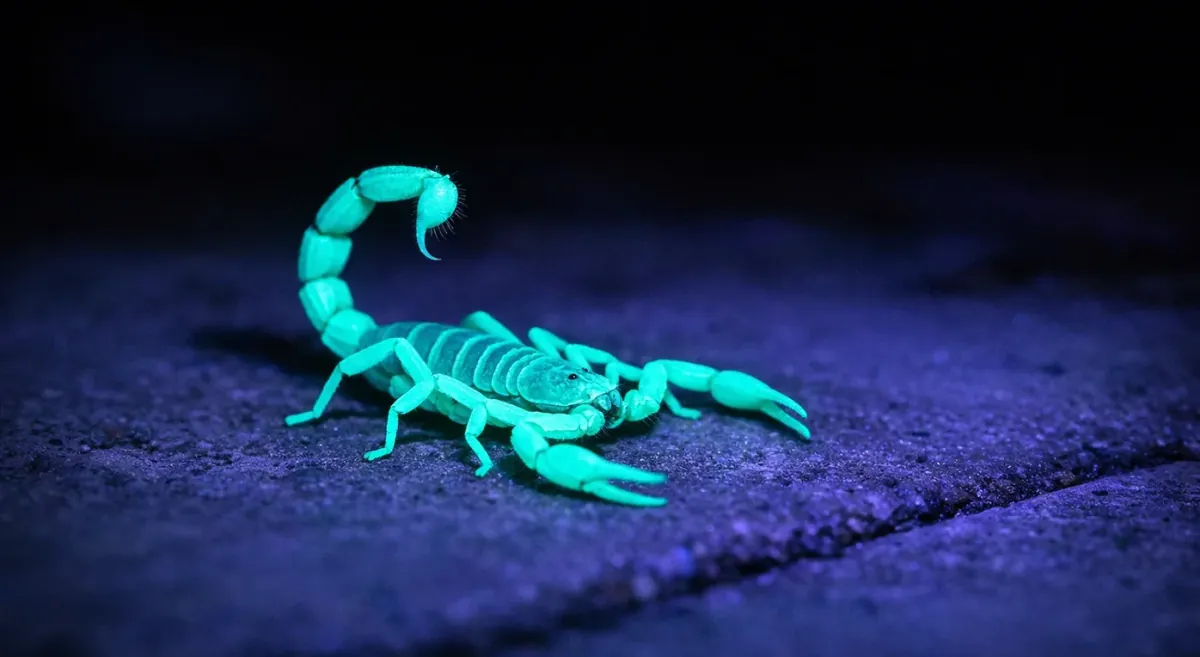
UV blacklight scorpion hunting works at night because scorpions' exoskeletons contain fluorescent proteins that glow bright blue-green under 365nm UV light in darkness. This fluorescence is visible from 10-15 feet away at night but barely detectable in daylight. Scorpions are most active 1-2 hours after sunset when temperatures drop below 85°F, making nighttime patrols with a UV flashlight the most effective detection method.
You're standing in your backyard at 10 p.m. with a UV flashlight, and suddenly a scorpion on your block wall lights up like a neon sign. That eerie green-blue glow isn't magic — it's fluorescence, and it's how you spot scorpions before they find their way inside.
Fluorescence happens because mature scorpions have special proteins in their exoskeleton that absorb UV light and re-emit it as visible light. In pitch darkness, this glow can be visible from 10–15 feet away. During daylight, you'd need to be inches away to see even a hint of it. That's why serious scorpion hunters wait until well after sunset.
Here's what to know before your first patrol: UV hunting makes scorpions easier to spot, but you're still doing the legwork. You'll need the right gear, you'll need to know where to look, and you'll need to handle any scorpions you find safely. Think of it as a nightly security sweep — except your intruders glow in the dark.
What's actually glowing—and what isn't?
The glow comes from compounds in the scorpion's hardened exoskeleton, specifically beta-carboline and 7-hydroxy-4-methylcoumarin. Only scorpions with fully developed exoskeletons fluoresce under UV light. A freshly molted Arizona bark scorpion won't glow much until its new shell hardens over several days.
Here's a critical mistake beginners make: baby scorpions don't glow under UV light. Their exoskeletons haven't developed those fluorescent compounds yet. These tiny scorpions — often riding on their mother's back — are nearly invisible under blacklight. And here's the problem: baby bark scorpions pack the same potent venom as adults. If you rely only on UV detection, you could walk right past a cluster of the most dangerous scorpions in your yard.
Adult scorpions fluoresce brightest at their thickest parts — the body segments and tail. The legs and pincers glow too, but more faintly. Different species glow with slightly different intensities. Arizona bark scorpions tend to have a bright cyan-green glow, while desert hairy scorpions often appear more yellow-green under the same UV light.
Why do scorpions hug walls during patrols?
Scorpions are thigmotactic creatures — they navigate by maintaining contact with surfaces. Watch one move across your patio and you'll see it follow the edge where the concrete meets the house, trace along the base of planters, or stick to the grout lines between pavers. They rarely venture into open spaces unless they're chasing prey or escaping danger.
This wall-hugging behavior makes your patrol strategy simple: focus on edges. Inside your home, scorpions travel along baseboards, door frames, and where furniture meets walls. Outside, they follow block wall bases, foundation lines, and the edges of walkways. You don't need to scan your entire yard — just trace the perimeter paths where scorpions naturally travel.
Understanding thigmotaxis also explains why certain monitoring strategies work better than others. Sticky traps placed along walls catch more scorpions than those in open floor space. Detection systems positioned at room perimeters take advantage of these predictable travel routes. Once you start thinking like a scorpion — always touching a wall — you'll find them much more efficiently.
What UV wavelength and gear should I buy for beginner night patrols?
Don't overthink your first UV flashlight purchase. The scorpion hunting community has largely settled on 365nm as the sweet spot for making scorpions glow. You can find a decent 365nm flashlight for $20–40 that'll serve you well for years of patrols.
Some enthusiasts experiment with deeper UV wavelengths like 254nm, claiming scorpions might not perceive these wavelengths the same way and could be less likely to flee. But for beginners, stick with 365nm. It's readily available, produces the strongest fluorescence, and won't break the bank. It's also the wavelength automated detection systems like Scorpion Alert use — there's good science behind this choice.
Is 365nm really the best UV for spotting scorpions?
Yes. 365nm hits the sweet spot between scorpion visibility and practical availability. At this wavelength, the proteins in a scorpion's exoskeleton fluoresce most efficiently, creating that unmistakable blue-green glow. Tests comparing different wavelengths consistently show 365nm producing the brightest, most visible fluorescence from typical hunting distances.
You might see discussions about 254nm or 280nm wavelengths in scorpion forums. These deeper UV wavelengths do make scorpions glow, and some hunters swear scorpions react less to them. But here's the reality: deep UV flashlights cost significantly more, require special safety gear, and can damage your eyes with brief exposure. For safe, effective backyard patrols, 365nm remains the gold standard.
Beginner kit checklist (and why each item matters)
Your basic scorpion hunting kit runs about $50–80 total. Here's what you actually need:
- UV flashlight (365nm, $15-40): Get one with at least 1000mW power and a focused beam. You want to spot scorpions from 6–10 feet away, not just when you're standing over them.
- Long-handled tongs or forceps ($10-15): Never grab a scorpion with your hands. 12-inch tongs give you a safe working distance.
- Closed-toe boots: Scorpions sometimes drop from walls or scurry toward your feet when startled. Flip-flops are asking for trouble.
- Long pants: Brush and low branches harbor scorpions. Protect your legs while checking these areas.
- Work gloves: Essential when moving rocks, checking irrigation boxes, or reaching into dark spaces.
- Amber safety glasses ($10-20): Optional but helpful — they filter out background UV reflection from light-colored surfaces, making the scorpion glow pop more.
Skip the expensive "scorpion hunting kits" on Amazon that bundle cheap components for premium prices. Buy each item separately and you'll get better quality for less money.
What about the popular Amazon UV flashlights everyone links?
The LEDwholesalers 51-LED UV flashlight shows up in nearly every scorpion forum as the budget go-to. At around $15–20, it works fine for beginners. The wide beam pattern helps you scan larger areas quickly, though you'll sacrifice some intensity compared to focused-beam models.
When shopping for any UV flashlight, check these specs: true 365nm wavelength (not 395nm marketed as "UV"), at least 1000mW output power, and aluminum construction that can handle drops. Battery life matters too — AA or 18650 rechargeable batteries beat built-in USB charging for all-night patrols. For detailed comparisons of specific models and honest reviews from desert homeowners, check out the complete Amazon scorpion product breakdown.
When is the best time and weather to hunt scorpions with a blacklight?
Timing your patrol can mean the difference between spotting five scorpions or seeing none. Scorpions follow predictable activity patterns based on temperature, darkness, and prey availability. Stack these factors in your favor, and you'll maximize your chances of clearing scorpions from your property before they make it inside.
Consistency beats intensity when it comes to scorpion control. A 15-minute patrol every few nights during peak scorpion season will reduce your scorpion encounters more effectively than one marathon hunting session per month.
What time should I start my patrol?
The prime hunting window opens 1–2 hours after sunset. In Phoenix during summer, that means starting your patrol around 9:30–10:30 p.m., when temperatures drop below 85°F. Scorpions emerge from daytime hiding spots to hunt, and they're actively moving along walls and surfaces — right where your UV beam will catch them.
Early risers have another option: the pre-dawn patrol. Head out 30–45 minutes before sunrise, when scorpions are making their last hunting passes before seeking shelter. You might catch stragglers that avoided your evening sweeps, especially near moisture sources that attract prey.
Temperature matters more than clock time. Scorpions are most active between 75–85°F. On extra-hot nights when it's still 95°F at 10 p.m., you might need to patrol later or focus on cooler microenvironments like irrigated planters and pool equipment areas.
Do moonlight and clouds really make a difference?
Darker conditions absolutely improve your hunting success. During a new moon or heavy cloud cover, scorpion fluorescence stands out like a beacon against the black background. Full-moon nights wash out the contrast — you'll still see glowing scorpions, but you might miss smaller ones or those partially hidden in cracks.
Here's a practical trick: kill all artificial lights during your sweep. Turn off porch lights, pool lights, and landscape lighting. Your eyes will adjust to the darkness within minutes, and suddenly even faint scorpion glows become obvious. Keep a regular flashlight in your pocket for walking between search areas safely.
Wind can actually help your hunt. Scorpions hunker down in extreme wind, but a light breeze gets prey insects moving — and hungry scorpions follow. Focus on the lee side of walls and structures where both insects and scorpions gather.
Should I patrol after rain?
Post-rain patrols often yield the highest scorpion counts of the year. Desert storms flood scorpion burrows and hiding spots, forcing them into the open. Within 2–6 hours after rain stops, scorpions emerge to find new shelter and hunt the surge of active insects.
Check these areas first after rain:
- First, check block wall caps where water pools
- Next, inspect irrigation control boxes that might flood
- Then examine the base of stucco walls where water sheets down
- Finally, survey pool equipment pads
These spots become scorpion highways as they search for dry ground.
Safety tip: wet surfaces make scorpions harder to catch — they can skitter away faster on slick concrete. Approach from the side rather than above, and have your capture container ready before you get close. This is especially important around pool decks and play areas where kids and pets will be active the next morning.
Where should I look during a blacklight patrol around my house?
Experienced hunters don't randomly wave UV lights around their yard. They follow a systematic route that hits proven hotspots where scorpions predictably appear. After a few patrols, you'll develop your own efficient circuit based on your property's unique features.
What are the highest-yield exterior spots?
Start with block walls — specifically the expansion joints, caps, and any cracks in the blocks themselves. Scorpions wedge into these gaps during the day and emerge at night. Sweep your UV light slowly along the entire wall base, then check vertical seams and the underside of caps.
Move to vegetation next. Scorpions hunt in the lower branches of bushes and small trees, especially oleanders and Texas sage. They're not up there for fun — they're after the insects attracted to flowers and new growth. Check irrigation drip lines and valve boxes while you're in planted areas. The combination of moisture, prey, and shelter makes these scorpion magnets.
Don't skip these often-missed spots: the gap where stucco meets the foundation, door and window frames (especially the bottom corners), pool equipment pads, and outdoor storage areas. Stack of pavers by the wall? Scorpion hotel. Coiled garden hose? Check underneath. AC unit pad? Walk around it slowly — scorpions love the condensation moisture.
Technique matters: sweep your light in slow arcs about 6–8 feet ahead. When you spot a glow, approach from the side to avoid driving the scorpion into a crack. Have your tongs and container ready before you get within striking distance.
What are the highest-yield interior spots?
Inside, scorpions stick to their wall-hugging habits. Start with baseboards in rooms with exterior walls — these are primary entry routes. Pay extra attention to corners where two walls meet, gaps where plumbing enters walls, and the space behind furniture pushed against walls. 86.5% of Arizona residential scorpion exposures occur indoors. Of those, 42.5% happen in a bedroom — the most-stung room in the house Skolnik & Ewald 2018.
Bathrooms and laundry rooms draw scorpions seeking moisture and the insects that moisture attracts. Check behind toilets, under vanities, and around washing machines. Don't forget to scan up — scorpions can turn up above ground level and perch on door frames or crown molding.
Make kid and pet areas your priority zones. A quick baseboard check in bedrooms and playrooms before bedtime provides peace of mind. Focus on beds pushed against walls, toy boxes on the floor, and closet floors where shoes and sports equipment create hiding spots. Remember that detection here only shows you what's visible right now — scorpions could enter these spaces later in the night.
How long should a beginner patrol last to make progress?
The scorpion hunting community swears by the "15-minute rule" — daily 15-minute patrols during peak season can noticeably reduce scorpion sightings within 2–3 weeks. It's not about marathon sessions; it's about consistent pressure that disrupts scorpion patterns and removes individuals before they establish territory.
Track your finds like a scientist. Note the date, time, location, and size of each scorpion. After a week, you'll see patterns — maybe they're always by the pool equipment on humid nights, or clustering near your citrus trees after irrigation. This "heat map" approach makes each subsequent patrol more efficient.
During Arizona's July–August peak, consider twice-weekly 20-minute patrols. In cooler months, weekly checks might suffice. The goal isn't perfection — it's reducing encounters to a manageable level while understanding that scorpions are part of desert life.
How can I get the benefits of blacklight hunting without staying up every night?
Manual UV hunting works, but it has an obvious limitation: you only catch scorpions during the few minutes you're actively searching. Scorpions are active for hours each night, entering homes through gaps you might not even know exist. What if you could extend that UV detection to work automatically all night long, exactly where scorpions travel?
What does "automated UV hunting" look like in a home?
Automated UV detection systems like Scorpion Alert apply the same fluorescence principle you use with a handheld blacklight, but they watch continuously while you sleep. These plug-in detectors mount in standard outlets along room perimeters — right in the natural path scorpions follow thanks to their wall-hugging behavior.
Each detector shines 365nm UV light (the same wavelength your flashlight uses) onto the floor below when the room is dark. Instead of your eyes watching for that telltale glow, a camera system monitors for the characteristic blue-green fluorescence. When a scorpion passes through the detection zone, you get an alert on your phone within seconds — complete with a photo showing exactly what triggered the system.
The beauty of this approach is that outlets are naturally positioned on room perimeters where scorpions travel. You're essentially creating a UV security system along the exact routes scorpions use to explore your home.
How does Scorpion Alert detect and confirm a scorpion?
The system captures frames every 500 milliseconds — that's twice per second — watching for the specific color signature of scorpion fluorescence. But it gets smarter than simple motion: instead of alerting you every time it sees something greenish, it uses a two-stage AI pipeline to minimize false alarms.
First, an on-device algorithm quickly screens each frame for potential scorpion glows. When it spots something promising, it sends that frame to cloud-based AI for deeper analysis. This second stage has been trained on thousands of scorpion images to distinguish real scorpions from other UV-reactive materials like certain plastics or lint. You get an alert only when the system is confident it's found an actual scorpion, complete with a confidence percentage.
The photo verification is crucial. You can see exactly what triggered the alert, where it is in relation to the outlet, and which direction it's facing. No more guessing whether that 3 a.m. alert is worth getting out of bed — the image tells you what you need to know.
How should I combine a nightly ritual with 24/7 monitoring?
Think of it as defense in depth. Keep your evening patrol routine for outdoor areas — checking block walls, sweeping vegetation, and clearing scorpions before they reach your house. This active hunting reduces the overall population pressure on your property. Then let automated detectors handle the overnight indoor watch, especially in bedrooms and high-traffic areas where a scorpion encounter could mean a trip to the ER.
This hybrid approach maximizes your coverage while minimizing effort. You might patrol the yard twice a week during peak season, focusing on exterior hotspots and entry points. Meanwhile, detectors watch interior perimeters every single night, catching any scorpions that slip past your outdoor defenses.
Remember the limitation we discussed earlier: baby scorpions don't fluoresce under UV, whether it's your flashlight or an automated detector. That's why combining UV detection with physical exclusion (sealing cracks, door sweeps, screens) creates the most comprehensive protection. No single method is perfect, but layered defenses dramatically reduce your risk of surprise scorpion encounters.
Now that you know how to run a safer, more effective UV night patrol—where to scan, what that glow looks like, and how to stay consistent—the next step is making detection less of a guessing game. Scorpion Alert pairs a 365nm UV light with two-stage AI confirmation to help you spot fluorescence and document findings as you hunt. If you want a tool that supports your routine, explore Scorpion Alert here.