Do scorpions communicate with each other?
Yes, scorpions communicate—just not the way we picture animals "talking." They send signals using chemical scents (pheromones), vibrations felt through the ground, and direct touch. These cues change another scorpion's behavior, steering it toward a mate, away from a rival, or into a defensive stance. They don't form colonies or friendships.
Think of it as practical signaling rather than conversation. A scorpion isn't chatting with its neighbors. It's broadcasting information that helps it survive and reproduce—and reading the information other scorpions leave behind.
What does "communication" mean for a scorpion?
For a scorpion, communication is any chemical, vibration, or touch cue that changes what another scorpion does. A pheromone might trigger courtship. A vibration pattern might trigger a strike or a retreat. A pincer touch might mean "back off" or "let's dance."
This is very different from truly social insects like ants or bees, which coordinate as a group toward shared goals. Scorpions are mostly loners. If you're curious about how solitary they really are, we cover that in detail in our guide on whether scorpions are social or solitary. The short version: they interact for mating, territory, and threats—then go their separate ways.
Chemical messages (pheromones): can they really track each other?
Scorpions release pheromones that act like invisible breadcrumbs on the surfaces they cross. A male can pick up the scent trail of a nearby female and follow it. These chemical markers can linger for hours on hard floors, baseboards, and outdoor rock.
How long a trail lasts depends on conditions. Humidity, airflow, and heat all affect how quickly a scent fades and how far it travels. A still, humid night keeps trails intact longer, which makes finding a mate easier—and increases the odds of scorpions moving through your home.
Vibration messages: how they 'feel' movement through floors and walls
Scorpions "hear" with their legs. Tiny slit-shaped sensors called slit sensillae detect vibrations traveling through the surface beneath them. Different patterns carry different meanings—the frantic buzz of struggling prey reads differently than the deliberate steps of another scorpion.
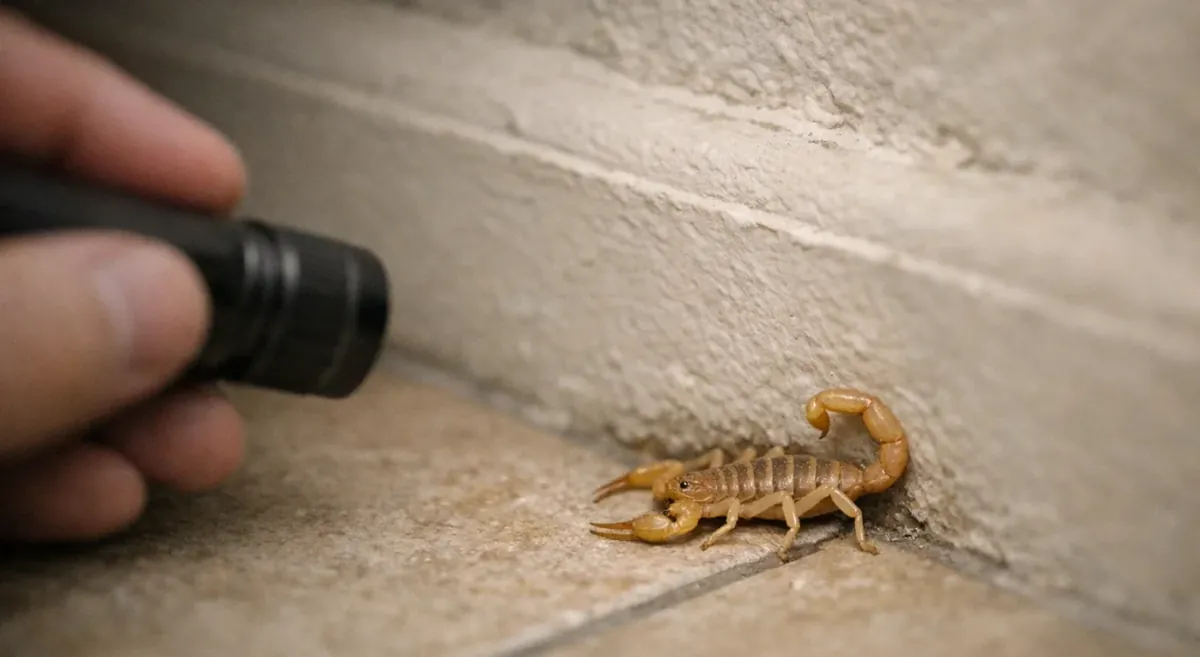
This sensitivity is one reason you tend to spot them hugging walls at night. Edges and hard surfaces transmit vibration well, giving a scorpion a clearer read on what's moving nearby. It's part of why nighttime indoor sightings so often happen along baseboards.
Touch and body posture: what happens at close range?
Up close, scorpions rely on their pedipalps—the front pincers—as sensory "hands." They probe, grip, and gauge the size and intent of whatever they meet. Body posture speaks volumes: a raised, arched tail with spread pincers signals defense, while a gentler grip during courtship reads very differently.
Safety note: never get close enough to test these signals yourself. An agitated scorpion can strike fast, and trying to read its "mood" isn't worth a sting.
How do scorpions find a mate (and why does that bring them indoors)?
Scorpions find mates mostly through active searching combined with chemical trails, and this roaming behavior is exactly why sightings climb during warm months. Males do most of the moving, following pheromone cues across the landscape—including your yard, garage, and walls—which raises the chance they'll end up inside.
Do scorpions actively search, or do they just bump into each other?
It's both. Males roam actively in search of females, following scent trails, but many encounters are also opportunistic. Because scorpion populations can be spread thin, a searching male may travel surprisingly far before crossing paths with a mate.
That long-distance wandering matters to you. The more ground a scorpion covers at night, the more likely its route intersects your baseboards and door thresholds.
Why they hug baseboards and edges when they roam
Scorpions are thigmotactic, which means they follow edges. They stay pressed against walls, furniture, and thresholds as they travel because contact with surfaces helps them navigate and sense danger.
This makes their movement predictable. A roaming scorpion rarely strolls across the middle of a room—it works the perimeter. That's precisely why sightings cluster along baseboards, and why perimeter placement is the smart spot for any monitoring.
When mate-seeking behavior peaks in the Southwest
Mate-seeking activity climbs on warm nights, with peaks that vary by region and species across the Southwest. In much of Arizona, that means late spring through summer, overlapping with monsoon warmth and humidity.
For exact windows where you live, see our month-by-month Arizona scorpion season timeline. It breaks down when activity typically spikes so you know what to expect.
What does the scorpion mating dance look like (step by step)?
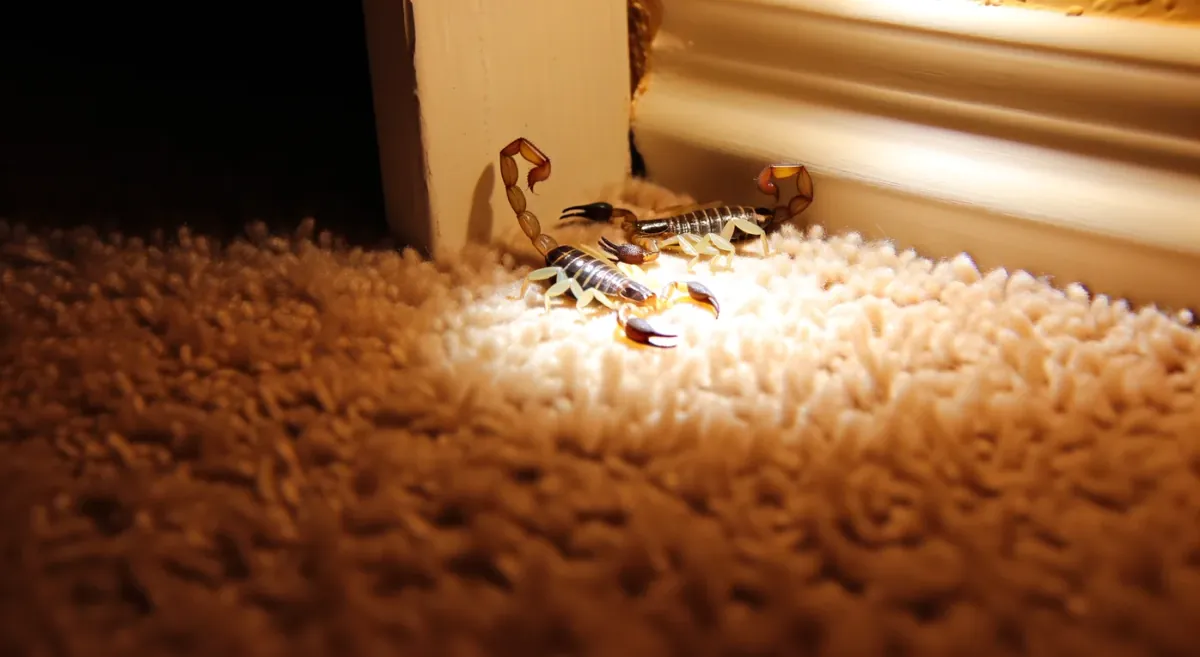
The scorpion mating ritual—the behavior at the heart of understanding do scorpions communicate, mating dance explained—is called the promenade à deux, French for "walk for two." The male grips the female's pincers, walks her back and forth to find a suitable surface, deposits a sperm packet, then guides her over it. It can last minutes or hours, and to most homeowners it often looks like a fight.
Step 1: The 'handshake' (pedipalp grasp)
Courtship usually begins with the male grasping the female's pedipalps—pincer to pincer. It can look tense, even aggressive, but this "handshake" is often the opening move of a dance, not a battle. Tails typically stay lowered or slightly arched early on rather than locked in strike position.
Step 2: The promenade à deux (the guided walk)
Once locked together, the pair walks. The male leads, steering the female while he searches for the right patch of ground. Picture two scorpions shuffling in tandem from a tile floor to a grout line, along a carpet edge, or across cool concrete. This guided walk can stretch from a few minutes to well over an hour.
Step 3: Spermatophore placement and pickup (the purpose of the dance)
The whole dance exists for this moment. The male deposits a spermatophore—a small sperm packet—onto a surface with the right texture and angle to anchor it. Then he maneuvers the female directly over it so she can take it up. Surface matters here, which is why the male spends so long searching for the perfect spot.
Step 4: Separation—can the female eat the male?
After transfer, the pair separates. Sexual cannibalism does happen in some species and situations, though many males escape unharmed. Either way, both scorpions are often agitated afterward. Don't intervene with bare hands or feet.
If I see two scorpions together, does that mean my house is infested?
Not necessarily. A single pair doesn't automatically mean an infestation, but it does tell you your home offers suitable habitat—food, moisture, and shelter scorpions like. It also means mating may be underway, which can eventually lead to live young. Two scorpions is a signal to increase vigilance, not to panic.
Mating vs. fighting: what are the fastest visual cues?
The quickest tell is coordination. Watch from a safe distance and compare what you're seeing.
| Behavior | Movement | Likely meaning |
|---|
| Pincers locked, walking together | Smooth, coordinated | Courtship (mating dance) |
| Rapid striking, grabbing, disengaging | Chaotic, jerky | Conflict or predation |
| One dragging or steering the other | Deliberate, guided | Courtship |
Locked-and-walking usually means courtship. Chaotic striking and breaking apart leans toward conflict.
Does mating mean babies are coming soon?
Not right away. Scorpions give live birth, and litters commonly range from around a dozen to several dozen young depending on species. Gestation varies widely—from a few months to over a year—based on species and conditions. Some females can even store sperm, so timing isn't immediate or predictable.
What a 'pair sighting' tells you about risk in your home
A pair sighting is a useful warning. In Arizona survey data, 81.8% of households where someone was stung had already seen scorpions on the property, making a sighting the single strongest predictor of a future sting (Skolnik & Ewald 2018). Focus attention on the rooms where you saw them, especially along edges and in spaces adjacent to entry points.
81.8% of homes where a scorpion sting occurred had already spotted scorpions on the property beforehand.
— Skolnik & Ewald, J Med Toxicol 2018 (FEARS survey)
What should I do right now if I find two scorpions indoors?
Stay calm, protect people and pets, then contain the scorpions safely before improving your detection. Keep your distance, put on closed-toe shoes, and add light so you can track their movement. Real-time alerts and photo verification afterward can dramatically cut down on surprise nighttime encounters.
Immediate safety checklist (kids, pets, bare feet, and visibility)
The moment you spot a pair, work through these steps:
- Keep several feet of distance—don't lean in for a closer look.
- Put on closed-toe shoes right away; bare feet are the most commonly stung body part.
- Move children and pets out of the room. Kids face higher risk from stings, as we explain in our guide on why children are more at risk from scorpion stings.
- Turn on every light so you can see both scorpions and track them if they move.
How to contain or remove them without getting stung
The safest capture method needs no direct contact:
- Grab a wide-mouth container or drinking glass and a piece of stiff cardboard.
- Place the container over one scorpion at a time.
- Slide the cardboard underneath to seal it in.
- Carry it outside and release it well away from the house.
If the pair separates and vanishes before you can act, don't chase blindly. Pause, re-scan edges and baseboards carefully, and call a professional if you can't relocate them. Avoid the common blunders in our roundup of what not to do after spotting a scorpion.
How to reduce the chances of a repeat 'midnight surprise'
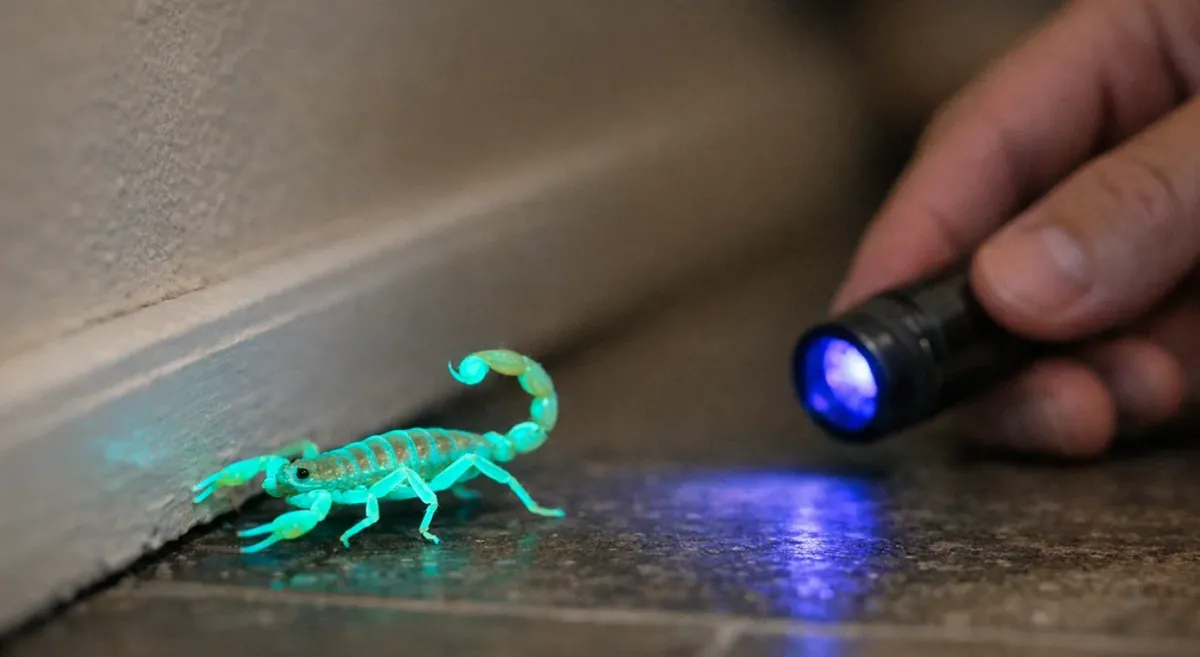
Monitor where scorpions actually travel—along room perimeters. Scorpions fluoresce a bright greenish glow under 365nm UV light, and their edge-hugging behavior makes their routes predictable, which is what makes perimeter detection so effective. Sticky traps are messy and unreliable, and no one wants to patrol the house with a flashlight every night.
Scorpion Alert Detectors plug into standard perimeter outlets, scan automatically once a room goes dark, and send a photo-verified alert with an AI confidence score straight to your phone within seconds. You get to see the scorpion before you ever walk into the room. Addressing the conditions that draw them in helps too—see the top things that attract scorpions in your home.
Where to place monitors after a sighting (rooms that matter most)
After you've seen scorpions in a specific spot, prioritize monitoring there first, then expand to the highest-traffic zones. Focus on outlets in these areas:
- The exact room where you saw the pair.
- Outlets near exterior doors and garage-adjacent walls.
- Bathrooms and laundry rooms, where moisture draws scorpions.
- Bedrooms and nurseries, since that's where sleeping people are most vulnerable.
Placing Detectors along the perimeter of these rooms turns unpredictable midnight encounters into early, well-lit warnings—so the next time a scorpion travels your baseboards, your phone knows before your bare foot does.
Understanding how scorpions communicate—from subtle vibrations to the famous mating dance—can make it easier to anticipate when they’re most active and likely to wander into homes. If you’d like a practical way to turn that awareness into peace of mind, Scorpion Alert can help you detect their presence early so you can respond quickly and safely.