Why can a scorpion antivenom vial cost $29,000 in Arizona?
Imagine this: Your 4-year-old gets stung by a bark scorpion in Phoenix. After a terrifying ambulance ride and three vials of antivenom, you're handed a hospital bill showing $87,000 just for the medication. That’s not a typo — it’s the reality many Arizona families face during scorpion season.
The “$29,000 per vial” headlines tell only part of the story. There are actually three different prices for the same antivenom: what it costs in Mexico (around $100), what U.S. distributors pay (roughly $3,500), and what hospitals charge on their bills (often $20,000–$40,000). Understanding those price layers helps explain how a scorpion sting can become a financial emergency right alongside the medical one.
What does "$29,000 per vial" actually mean on a hospital bill?
That shocking number usually comes from something called the hospital chargemaster — essentially a master price list that few patients ever pay in full. Think of it like a car’s sticker price before negotiations. The hospital might have paid $3,500 for the vial, but it’ll bill $29,000 to leave room for insurance negotiations.
Here’s how it typically breaks down: Your insurance company has a pre-negotiated rate, maybe $8,000 per vial. It’ll pay 80% after your deductible, leaving you with the rest. But if you’re uninsured or your claim gets denied, you’re staring at the full chargemaster price unless you negotiate aggressively.
The cruel irony is that the people least able to pay — the uninsured — often see the highest bills. Meanwhile, Medicare might reimburse the same vial at just $4,200, showing how wildly the “price” changes depending on who’s paying.
How many vials are typically used—and how fast can costs add up?
Most bark scorpion stings require 2–3 vials of antivenom, though severe cases can need more. Children under 5 often need multiple vials because the venom concentration in their smaller bodies is proportionally higher. A 30-pound toddler stung by the same scorpion as a 180-pound adult faces six times the venom concentration per pound of body weight.
Do the math: Three vials at $29,000 each equals $87,000 just for the medication. Add the ER visit, physician fees, and monitoring, and you can easily end up with a six-figure bill. One Phoenix family reported a total bill of $143,000 for their daughter’s bark scorpion sting treatment in 2023.
83% of severe scorpion envenomations requiring antivenom occur in children under age 10.
— Arizona Poison and Drug Information Center, 2023
Why is the same antivenom far cheaper in Mexico?
Cross the border to Hermosillo, and the same antivenom costs around $100 per vial. Same manufacturer, same medication — wildly different price. The difference comes down to distribution networks, regulatory costs, and fundamentally different healthcare billing systems.
In Mexico, antivenom moves through a simpler supply chain with fewer middlemen taking cuts. The U.S. system adds layers: FDA approval processes, specialized distributors, hospital pharmacy markups, and the whole insurance negotiation apparatus. Each layer adds cost, turning a $100 medication into a $29,000 line item.
Some desperate families have driven to Mexican pharmacies after stings, but doctors strongly advise against this. Delaying proper emergency care to save money can turn a treatable sting into a tragedy, especially for young children whose symptoms can escalate quickly.
How did ASU create scorpion antivenom—and why was it once free?
Long before scorpion antivenom became a profit center, it was a public service. Arizona State University ran the only antivenom production facility in North America for decades, distributing vials to local hospitals at cost or even free. Knowing that history makes today’s prices even harder to swallow for longtime Arizona residents who remember when the cure was accessible to everyone.
Who was Herbert Stahnke, and why were Arizona kids at the center of this story?
Dr. Herbert Stahnke arrived at ASU in 1955 with a mission: stop Arizona children from dying of scorpion stings. Before his antivenom program, parents dreaded summer nights. A bark scorpion sting could send a child into uncontrollable muscle spasms, breathing difficulties, and potentially fatal complications. Hospitals could only offer supportive care — sedatives for the twitching, breathing tubes if needed, and prayers that the child would survive the night.
Stahnke had seen too many small caskets. He knew that children face dramatically higher risk from scorpion stings due to their size and developing nervous systems. His lab became a lifeline for Arizona families, producing antivenom specifically for the bark scorpions terrorizing the Southwest.
How do you make antivenom (and why is it inherently expensive to produce)?
Creating antivenom starts with the dangerous work of “milking” scorpions — using electrical stimulation to extract venom from live specimens. A single bark scorpion produces only about 0.5 milligrams of venom per milking. You need hundreds of scorpions and months of collection to gather enough raw material.
Next comes the immunization process. Goats receive carefully controlled venom injections over several months, building antibodies. Their blood is then collected, and the antibodies are extracted and purified through complex laboratory processes. Each batch requires extensive testing for purity, potency, and safety.
The whole cycle takes about six months and requires specialized facilities, trained staff, and rigorous quality control. Even at ASU’s non-profit operation, producing antivenom was expensive — they just chose not to mark it up 800% the way today’s system does.
What changed in ER care when hospitals had free access?
When Phoenix emergency rooms had ready access to affordable antivenom, medical decisions were straightforward. Child comes in with bark scorpion sting symptoms? Administer antivenom immediately. The medication typically reversed symptoms within 30 minutes, turning potential tragedies into routine treatments.
Doctors didn’t hesitate or wait to see if symptoms would worsen. Parents didn’t face the horrible choice between their child’s health and financial ruin. The antivenom was just another tool in the ER toolkit, like bandages or antibiotics — available when needed without a second thought about cost.
What happened when the ASU lab closed—and how did Arizona run out of antivenom?
The ASU antivenom program limped along for years after Stahnke’s retirement, but by the late 1990s, the writing was on the wall. Increased FDA regulations, liability concerns, and a lack of institutional support slowly strangled the operation. When the lab finally closed in 2000, Arizona lost more than a building — it lost accessible scorpion sting treatment.
Why did a university program disappear instead of scaling up?
After Stahnke retired, ASU struggled to find anyone willing to take over the antivenom program. Running a pharmaceutical production facility didn’t fit the university’s academic mission. The liability scared administrators — one contaminated batch could bankrupt the school. Meanwhile, new FDA requirements demanded expensive facility upgrades and extensive documentation that a small university lab couldn’t afford.
Big pharmaceutical companies weren’t interested either. Why invest in a product needed only in a few southwestern states when the same resources could develop blockbuster drugs for nationwide markets? The 2,000–3,000 severe scorpion stings per year in Arizona seemed insignificant to companies chasing billion-dollar drugs.
What did doctors do when the antivenom wasn't available?
The early 2000s were dark times in Arizona emergency rooms. Without antivenom, doctors returned to 1950s-style supportive care. They sedated writhing children with powerful benzodiazepines, sometimes inducing medical comas to control the neurological storms. Breathing tubes stood ready for when throat muscles began spasming.
Parents endured watching their children suffer for hours or days instead of the 30-minute recovery antivenom could provide. ICU stays dragged on as families waited for the venom to metabolize naturally. The medical bills often exceeded what antivenom treatment costs today — but with far more trauma for everyone involved.
How did scorpion antivenom come back as a 'rare drug'—and who benefits?
Scorpion antivenom returned to Arizona in 2011, but not as the accessible public health tool it once was. A Mexican pharmaceutical company navigated the FDA approval process, gaining orphan drug status — a designation meant for medications treating rare diseases affecting fewer than 200,000 Americans annually. This classification, designed to incentivize drug development for neglected conditions, helped transform antivenom into a luxury product.
How does orphan drug status affect competition and price?
Orphan drug designation grants seven years of market exclusivity — no generic competition allowed. For investors, it’s a golden ticket: monopoly pricing power for a medication with guaranteed demand every scorpion season in Arizona. The designation makes sense nationally (most Americans will never need scorpion antivenom), but it doesn’t reflect the reality in Phoenix or Tucson, where bark scorpion stings flood ERs every summer.
This exclusivity means the manufacturer can charge what the market will bear. With insurance companies and government programs as the primary payers, that ceiling keeps rising. The company doesn’t need to compete on price — they’re the only legal supplier in a market where desperate parents will pay anything to save their child.
Why do hospitals mark up specialty drugs so aggressively?
Hospitals don’t just pass along the wholesale drug cost — they add layers of fees that can multiply the price by 5–10 times. There’s the pharmacy handling fee, storage costs for temperature-sensitive biologics, administrative overhead for tracking controlled substances, and the ever-present “facility fee” for receiving treatment in a hospital setting.
But the biggest factor is strategic pricing. Hospitals know insurance companies will negotiate down from the chargemaster price, so they start absurdly high. A $3,500 wholesale vial becomes $29,000 on the bill, creating room for insurers to claim they “saved” 70% while still paying double the wholesale cost. The hospital wins, the insurance company looks good, and the patient — especially the uninsured patient — gets crushed.
If someone is stung today, what should you do—and what should you ask about the bill?
When a bark scorpion sting happens, medical care comes first and financial concerns second. Still, knowing what to do in both areas can mean the difference between a scary night and a financial hit that follows your family for years.
When is a bark scorpion sting an emergency (especially for kids)?
Not every scorpion sting requires antivenom, but you need to recognize when it does. Watch for progressive neurological symptoms: uncontrolled muscle twitching that spreads from the sting site, roving eye movements, difficulty swallowing, excessive drooling, or breathing changes. In young children, these symptoms can escalate from mild to severe in under an hour.
Don’t wait to see if symptoms improve. If you see any neurological signs — especially in children under 10 — head to the ER immediately. Time matters more than money when a child’s nervous system is under attack. Call ahead so the ER can prepare the antivenom if needed.
94% of children under 5 with bark scorpion stings develop symptoms requiring medical evaluation.
— Banner Poison Control Center, 2024
What should you do right away at home before you leave?
First, stay calm — panic won’t help anyone. Wash the sting site with soap and water, but avoid the dangerous myths about scorpion sting treatment. No tourniquets, no cutting, no ice directly on the wound. These outdated methods can do more harm than the sting itself.
If possible, safely photograph the scorpion for identification — use a glass to trap it first; don’t try to handle it. Arizona bark scorpions have a slender build and a distinctive curved tail, but don’t delay medical care for a perfect photo. Time the onset of symptoms and write them down; that information helps ER doctors judge treatment urgency.
What are the 5 billing questions that can save you thousands?
Once the medical crisis passes, the financial battle begins. Here’s your checklist:
- Request an itemized bill immediately. Generic bills hide inflated charges. Itemized statements reveal each vial’s cost, letting you verify the count and catch errors.
- Confirm the exact number of vials used. Medical records should match the bill. Billing errors happen — one family was charged for five vials when records showed three were administered.
- Ask your insurance company about emergency claim protocols. Some require notification within 24–48 hours for out-of-network ER visits. Missing this window can mean a denial of coverage.
- Request the hospital's financial assistance policy. Most hospitals must offer charity care or payment plans by law. At $29,000 per vial, even middle-class families may qualify for relief.
- Document everything for potential appeals. Keep photos, symptom timelines, and physician notes. Insurance companies often deny initial claims for antivenom as “not medically necessary” — your documentation helps prove otherwise.
How can you reduce the odds you'll ever need antivenom in the first place?
The best antivenom is the one you never need. While you can’t eliminate scorpion risk in the Southwest, you can dramatically reduce the chances of a dangerous encounter in your home — where 97.8% of stings occur.
What are the most practical, homeowner-proof prevention moves?
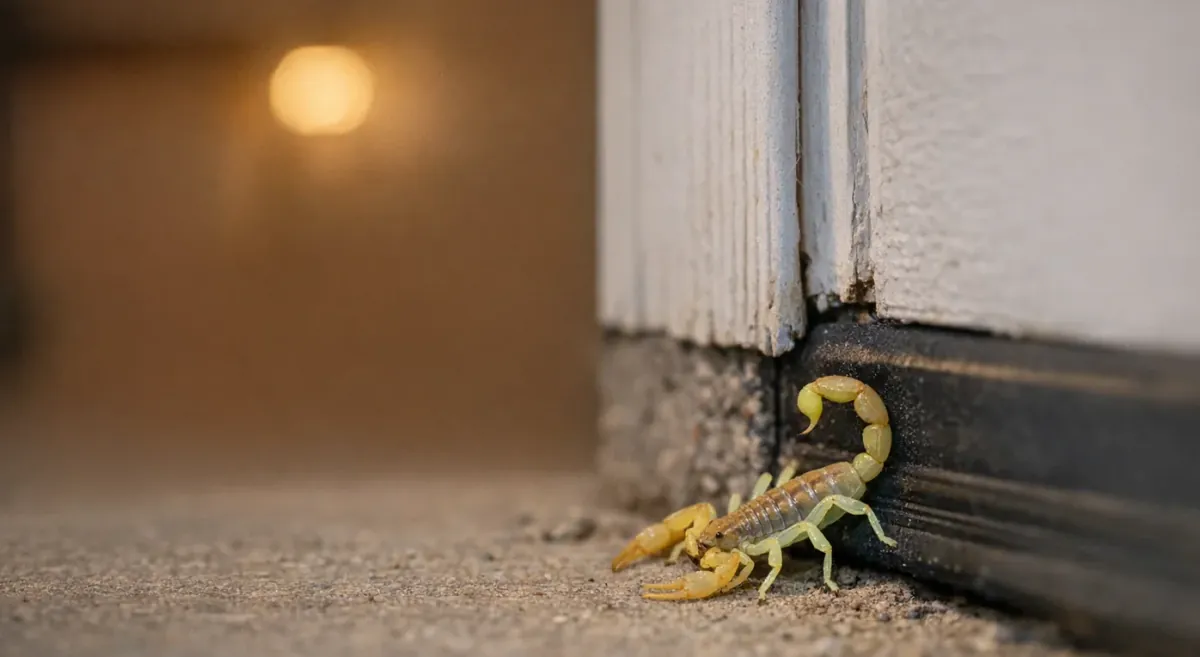
Start with the basics that actually work. Reduce clutter along walls where scorpions travel — they navigate by touch, following baseboards and furniture edges. Manage the cricket and roach populations that scorpions hunt. Seal the common entry points scorpions exploit, focusing on door sweeps and utility penetrations.
Prioritize protection for bedrooms and nurseries. A scorpion in the garage is annoying; a scorpion in a toddler’s room is an emergency. Move beds away from walls, use scorpion-proof crib barriers, and eliminate the moisture sources and hiding spots that attract scorpions indoors.
Why early detection at night matters more than most people think
Scorpions emerge at night to hunt, traveling along baseboards and walls in search of prey. By the time you spot one during the day, it’s already found a hiding spot in your home. The key is catching them during their active hours — between 10 p.m. and 3 a.m. — when they’re on the move.
This is when scorpions’ natural behavior works against them. They fluoresce under UV light and stick to edges as they navigate. But who wants to patrol their home with a blacklight every night for months? That’s where automated detection becomes valuable.
Where does Scorpion Alert fit into a prevention plan?
Think of Scorpion Alert as your automated night watch. The plug-in detectors use UV light to monitor floor edges where scorpions naturally travel, activating only when rooms darken. When the system spots that telltale fluorescent glow, it captures an image and sends an alert to your phone within seconds — complete with an AI confidence score to minimize false alarms.
Strategic placement maximizes protection: near exterior doors, along bedroom baseboards, and close to water sources like bathroom fixtures. Multiple detectors create overlapping coverage zones throughout your home. The subscription costs a fraction of a single ER copay — and you can cancel anytime once scorpion season passes. See /pricing for current rates.
The real value isn’t just detection — it’s peace of mind. Instead of wondering whether that movement in your peripheral vision was a scorpion or a shadow, you’ve got 24/7 monitoring handling the vigilance. When you do get an alert, you know exactly where to look with your UV flashlight and capture jar, turning a potential sting into a simple catch-and-release.
ASU’s $29,000 antivenom vial is a powerful reminder that treatment is critical—but avoiding a sting in the first place is even better. If you want a practical way to spot scorpions sooner using UV visibility and AI-backed detection to cut down on false alarms, Scorpion Alert can help you stay a step ahead.