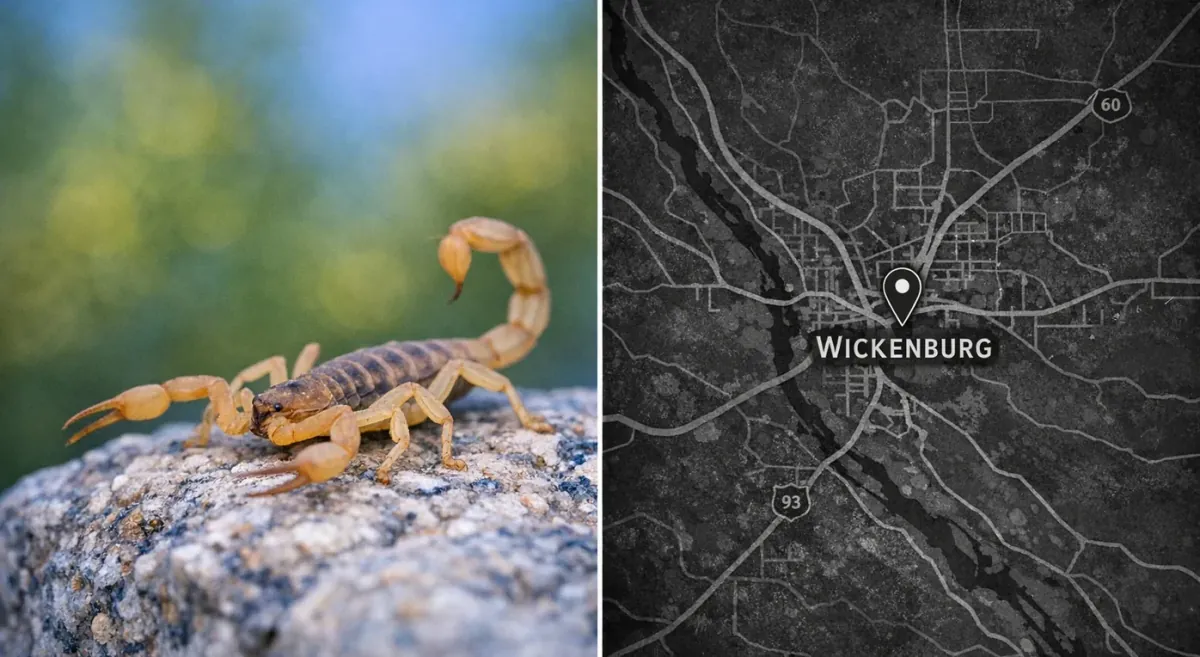
Are scorpions a problem in Wickenburg?
Yes — Wickenburg is a high-concern area for scorpions. Sitting on the desert edge of northwestern Maricopa County, the town has the warm, dry, rocky terrain Arizona's scorpions thrive in. That means more sightings, more indoor encounters, and more sting anxiety than you'd find in a cooler or higher-elevation town.
Maricopa County is ground zero for scorpion activity in the United States. Across the county, the Banner Poison & Drug Information Center logged 518 scorpion exposures and 794 envenomations in just the first few months of 2026 — and those are only the calls that came in. Statewide, Arizona accounts for 68.2% of all US scorpion exposures reported to poison centers, far more than any other state (Kang & Brooks 2017).
Scorpion pressure isn't uniform, though. Homes backing up to a wash, a desert lot, or new construction near undisturbed ground tend to see more activity than older, in-town lots. This guide walks through the species you might find, the scorpion season in Wickenburg, your sting risk, and a practical, homeowner-first control plan — in that order.
Why homeowners report scorpions more in desert-edge towns
Desert landscaping is beautiful, but it's also perfect scorpion cover. Rock piles, block walls, decorative gravel, woodpiles, and dense shrubs all give scorpions shade, moisture, and a steady supply of the crickets, roaches, and spiders they hunt. Where there's cover and prey, there are scorpions.
So why do they come inside? Heat, water, prey, and shelter. During a scorching summer day, a cool tile floor or a damp bathroom is inviting — and the bugs that wander indoors can bring hungry scorpions right behind them. The prevention section below covers how to cut that off.
One more thing worth knowing: scorpions are mostly nocturnal. That's why so many indoor sightings happen late at night or in the gray light of early morning, when the house is quiet and you're least expecting one.
Is Wickenburg worse than other parts of Maricopa County?
Scorpion pressure varies block by block more than city by city. A home pressed against a desert wash in Wickenburg can see far more activity than a home in the middle of a built-out Phoenix subdivision — and vice versa. Local terrain matters more than the town line.
If you haven't spotted one yet, don't take that as proof you're in the clear. Scorpions hide extremely well in cracks and voids during the day. "No sightings yet" usually just means you haven't caught one out in the open. The smart move is to focus on reducing entry points and setting up monitoring, rather than waiting for a sighting to confirm the problem.
Which scorpion species lives in Wickenburg?
Public sighting databases didn't return a confirmed primary species for the Wickenburg city dataset, so the honest answer is: we can't name one species from the data alone. The practical takeaway is to plan around the most common and most medically significant Arizona possibility — the Arizona bark scorpion — until you've confirmed what you're dealing with.
When you spot a scorpion, resist the urge to get close for a better look. Snap a photo from a safe distance instead, ideally from above and the side so the pincers, tail, and body shape are visible. Correct identification matters because it shapes how seriously to take a sting. Across Maricopa County, more than one species shares the surrounding desert — and they don't all carry the same risk.
What the Arizona bark scorpion looks like (and why it matters)
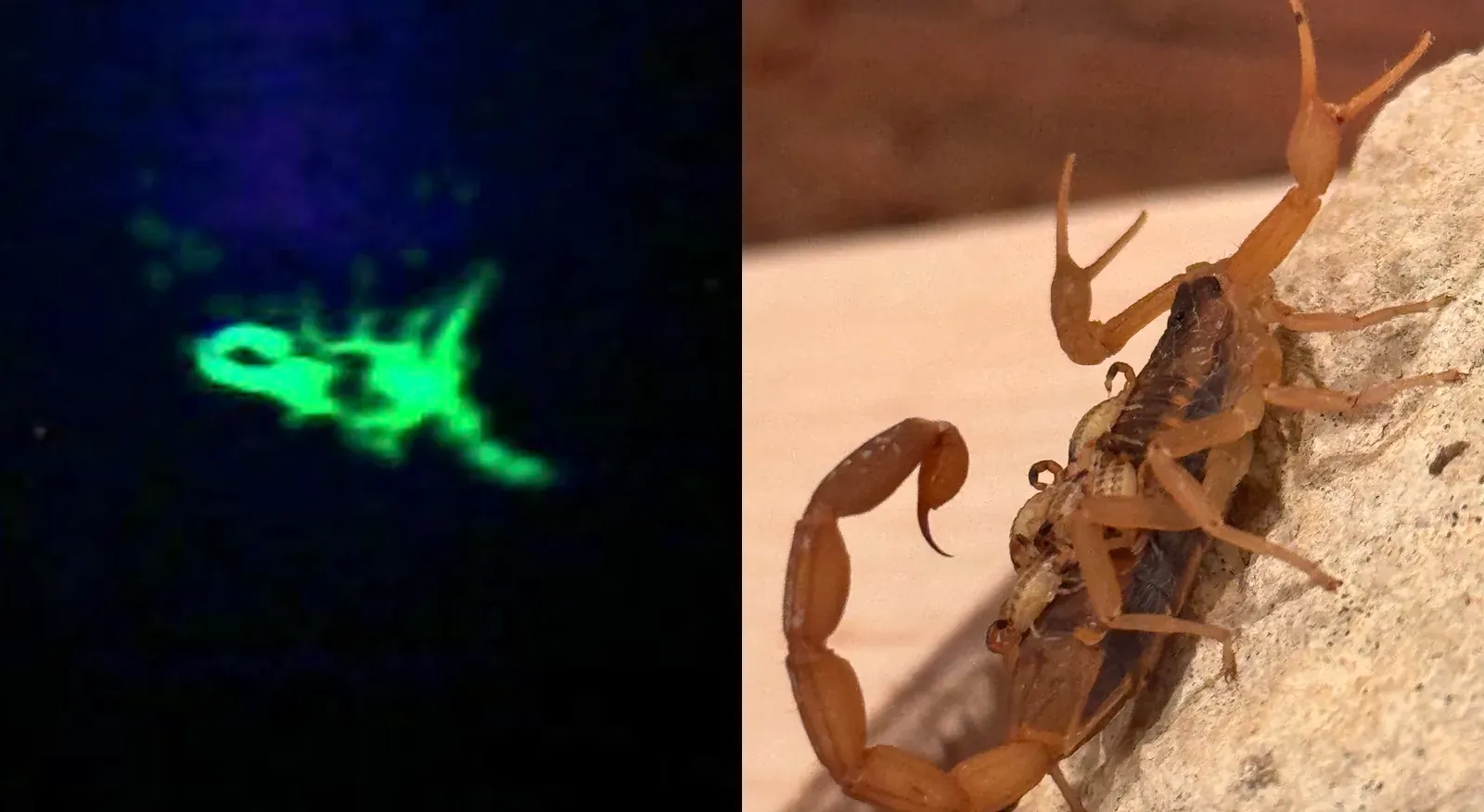
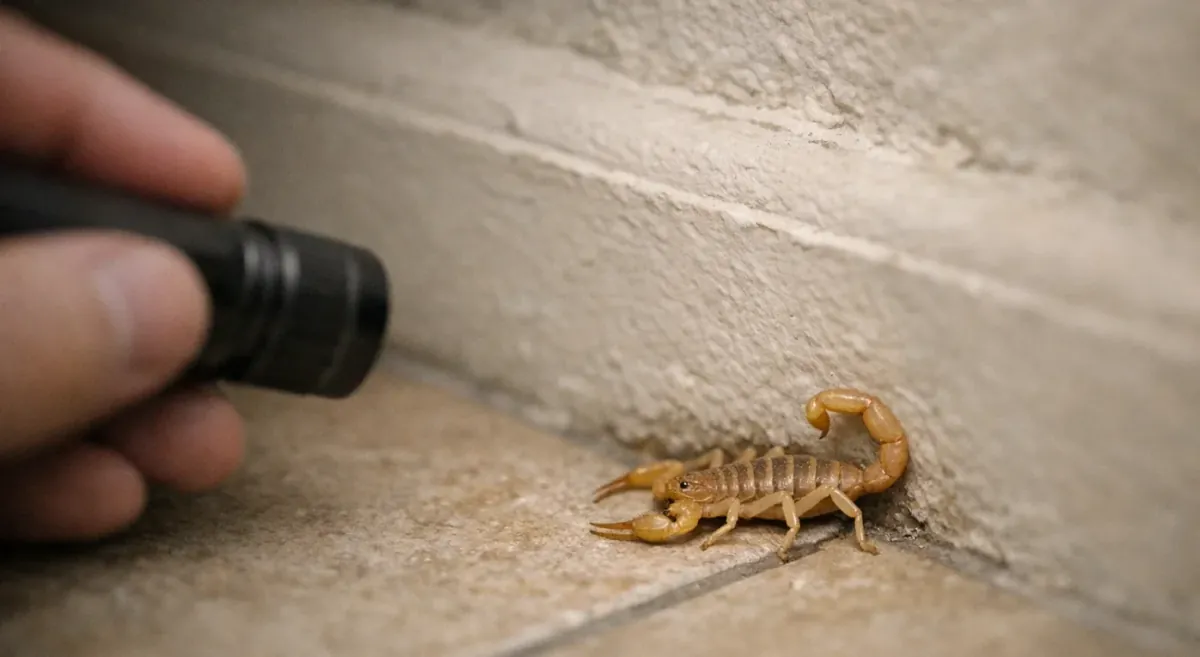
The Arizona bark scorpion (Centruroides sculpturatus) is slender and light tan to yellowish, usually about two to three inches long, with thin pincers and a thin tail. It's the one scorpion in Arizona capable of a medically significant sting, which is exactly why it matters for your household.
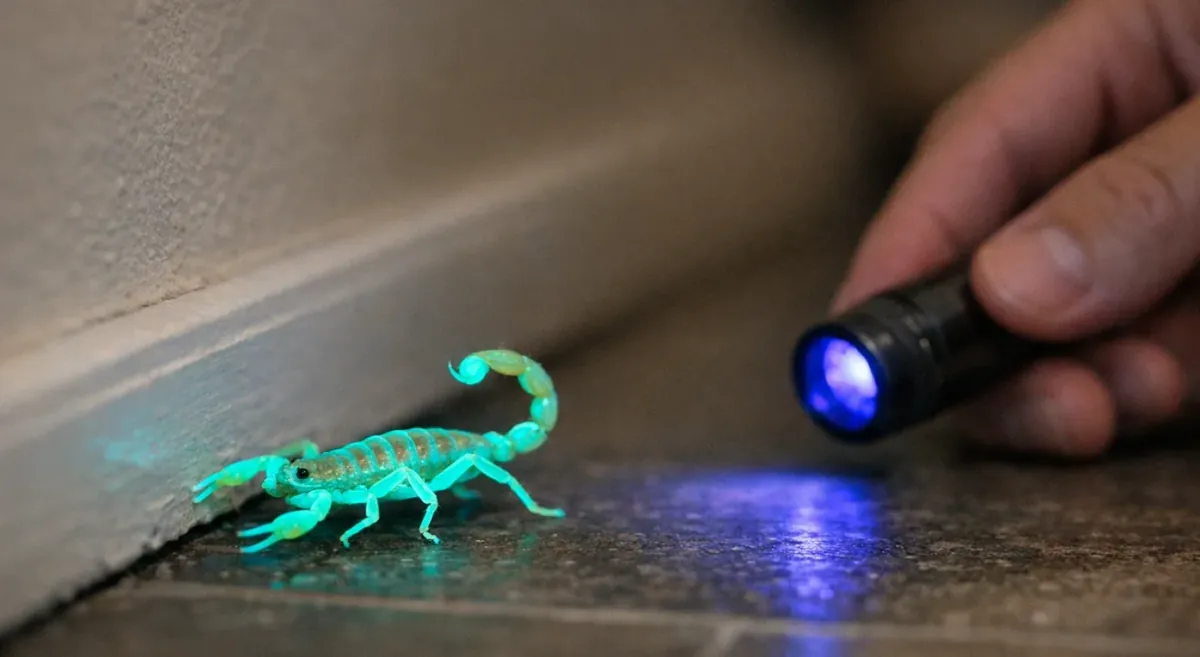
If you suspect bark scorpions, tighten up your nighttime habits — shoes, bedding, and bare feet all become points of caution (more on that below). Bark scorpions glow a bright greenish-blue under 365nm UV light, so a UV flashlight used outdoors at night can help you confirm their presence along walls and landscaping.
Other scorpions you may see around Wickenburg
Not every scorpion you find is a bark scorpion. The surrounding Sonoran Desert is home to bulkier species like the giant hairy scorpion and the stripe-tailed (devil) scorpion, which tend to be larger, darker, and thicker-tailed. Their stings hurt, but they're generally far less severe than a bark scorpion's.
The problem is that telling species apart by sight is tricky, especially in low light. When you're unsure, treat the scorpion as if it could be a bark scorpion — keep your distance, keep kids and pets well away, and don't handle it.
How to safely confirm you have a scorpion problem indoors
Scorpions are genuinely hard to catch in the act. They're active at night, they travel along baseboards and wall edges (a behavior called thigmotaxis), and they vanish into cracks before dawn. Random daytime checks almost always miss them.
Rather than walking your house with a blacklight every night, an automated monitor does the watching for you. Scorpion Alert Detectors plug into standard outlets around a room's perimeter, switch on when the room goes dark, and continuously scan the floor with UV light for that telltale greenish glow. When one appears, you get a push or SMS alert within seconds — complete with a photo and confidence score, so you're not jumping at every false alarm.
When are scorpions most active in Wickenburg?
Scorpions are active in Wickenburg nearly year-round, but activity peaks in the hot months — roughly late spring through early fall — with August and September being the busiest stretch statewide. Warm nights, summer humidity, and abundant prey all push activity to its highest point (Kang & Brooks 2017).
The daily rhythm matters just as much as the season. Scorpions hunt after dark, which is why so many indoor encounters happen while people sleep. Before the active season ramps up, it's worth getting ahead of it: install door sweeps, refresh weatherstripping, cut back clutter, and tidy the yard perimeter so you aren't scrambling in July.
What time of day are scorpions most active?
Evening and overnight are the danger window. Research puts the peak sting hours between 6 PM and midnight, accounting for nearly half of envenomations, with a second bump from 6 AM to noon (Klotz et al. 2021). Scorpions navigate by staying close to surfaces and edges — they tend to travel along walls, baseboards, and furniture edges rather than crossing open floor.
That perimeter behavior tells you where to look. A quick nighttime glance along the floor edges of kids' rooms, bathrooms, and the laundry area catches far more than scanning the middle of a room.
Does monsoon season change indoor sightings?
Yes. Monsoon humidity drives up insect activity and shifts where scorpions seek shelter, which tends to increase indoor sightings in mid-to-late summer. As the ground gets wet and bugs move, scorpions follow their food — and that food often leads them toward your home.
During these stretches, pay extra attention to door thresholds, garage gaps, and plumbing penetrations under sinks and behind appliances. Homes near washes or undeveloped desert lots in and around Wickenburg should be especially diligent during monsoon weeks.
How to monitor activity without nightly blacklight patrols
A blacklight walk now and then can turn up a scorpion, but nobody keeps that up every single night — and scorpions move when you're asleep. That's the gap you need to close.
Scorpion Alert closes it by running autonomously. The Detectors scan every dark room on their own and send an alert within seconds of spotting a scorpion, so you don't have to remember to patrol. Place them where scorpions travel — near doors and the garage, and in bedrooms and bathrooms — and let them handle the overnight watch.
How dangerous is a scorpion sting in Wickenburg?
Most scorpion stings in Arizona cause intense local pain but resolve without serious complications. The exception is the Arizona bark scorpion, whose venom can trigger medically significant symptoms — and the risk is highest in young children. Arizona reports the highest rates of neuromuscular and respiratory effects and the highest hospitalization rates of any state (Kang & Brooks 2017).
The good news is that bark scorpion stings are almost always treatable, and most patients never need the ER. But because symptoms can progress quickly in small kids, it pays to know the warning signs and keep the Poison Help line handy: 1-800-222-1222.
Who is at higher risk from stings?
Infants and young children, older adults, people with known allergies, and pets all face higher risk. Children under 10 have the highest rates of systemic effects, hospitalization, and ICU admission (Kang & Brooks 2017).
The reason comes down to body mass — the same dose of venom hits a small child much harder, and symptoms can escalate faster. That's why nurseries, kids' bedrooms, and the spots where pets sleep deserve the most vigilance. We cover why children are more at risk from scorpion stings in more detail here.
Common symptoms vs. emergency symptoms
Knowing the difference between an expected reaction and an emergency keeps panic in check. Pain at the sting site shows up in about 88.9% of stings, and local numbness in 62.2% (Klotz et al. 2021).
- Expected, localized symptoms: immediate burning or stinging pain, tingling or numbness around the site, mild swelling, sensitivity to touch.
- Emergency symptoms — seek urgent care now: difficulty breathing, uncontrolled muscle twitching or jerking of the arms and legs, roving or jerky eye movements, trouble swallowing, excessive drooling, or intense full-body symptoms in a child.
If you aren't sure what stung you and symptoms are getting worse, treat it seriously and call for guidance rather than waiting it out.
What to do if you're stung in Wickenburg
Stay calm, clean the area, control the pain, and watch for symptoms. Most stings are managed right at home, but you want a clear escalation plan ready — especially for small children, who should be monitored more closely and escalated faster.
Immediate steps (first 10 minutes)
- Move away from where you were stung so you don't get a second sting.
- Wash the sting site with soap and water.
- Apply a cool compress or ice pack to reduce pain and swelling.
- Remove rings, watches, or anything tight near the sting in case of swelling.
- If you can do it safely, photograph the scorpion — never risk a second sting to capture it.
- For a young child or a pet, start watching for symptoms immediately and be ready to escalate quickly.
When to call Poison Control or seek urgent care
Call the Arizona Poison Help line at 1-800-222-1222 — it's free, staffed around the clock, and the specialists can tell you whether home care is enough or whether you need to be seen. Have these details ready: the patient's age and rough weight, the time of the sting, current symptoms, and the suspected species.
Call right away if the patient is a young child, is elderly, has trouble breathing, shows muscle twitching or abnormal eye movements, or if symptoms are worsening. When in doubt, err on the side of calling — it costs nothing and may save a trip to the ER. If serious symptoms do develop, bark scorpion envenomation is treatable with Anascorp antivenom, and an Arizona follow-up of 252 ED patients found zero hypersensitivity reactions (Klotz et al. 2023).
How to reduce the chance of a second sting that night
Where there's one scorpion, there may be another nearby. Shake out bedding, blankets, and any shoes before putting them on, and check floor edges and baseboards with a UV flashlight. Keep kids and pets off the floor temporarily until you've looked things over.
Because scorpions move silently in the dark, timing is everything. A photo-verified alert from a Scorpion Alert Detector lets you know the moment one is active indoors, so you can respond quickly and confidently instead of lying awake wondering. This is also a good time to review what not to do after spotting a scorpion in your home — folk remedies included.
How to keep scorpions out of your Wickenburg home
The most effective scorpion control plan for a home in Wickenburg, Arizona works in layers: seal entry points first, reduce the hiding spots and prey that draw scorpions in, add nighttime monitoring, and bring in a pro if the pressure is heavy. Here's a plan you can start this weekend.
97.8% of US scorpion envenomations happen in the home — not out in the desert.
— Kang & Brooks, J Med Toxicol 2017
That single number is why exclusion is your highest-leverage move: if stings happen indoors, keeping scorpions out is a big step toward keeping your family safe.
Seal the most common entry points first
Scorpions are flat and can squeeze through gaps thinner than you'd believe. Start with the spots they use most:
- Garage and exterior door thresholds — add or replace door sweeps.
- Sliding glass door tracks and weatherstripping.
- Plumbing penetrations under sinks and behind the washer, dishwasher, and water heater.
- Gaps around baseboards, outlets, and attic access panels.
A simple test: run a flashlight along each door at night from the inside — if light leaks through, a scorpion can get through. The credit-card test works too; if a card slides under the door, seal or adjust it. For a full rundown, see the top ways scorpions get into your home.
Reduce hiding spots and the bugs that feed scorpions
Cut down the cover around your foundation. Move woodpiles away from the house, clear leaf litter and debris, keep gravel and ground cover from piling against walls, and trim shrubs and tree limbs so they don't touch the structure. A clean perimeter gives scorpions far fewer places to shelter.
Starve them, too. Fewer crickets, roaches, and spiders means less food, which makes your home less attractive overall — that's one of the top things that attract scorpions to your home. Consider swapping bright exterior lights near doors for warmer, bug-resistant bulbs, since those lights pull in the insects scorpions hunt.
Add monitoring in the rooms that matter most
Sealing and cleanup cut the odds, but you still want to know the instant a scorpion makes it inside. Place Scorpion Alert Detectors along room edges near entry points and in your highest-priority rooms — bedrooms, nurseries, and bathrooms, where scorpions tend to turn up.
For anxious households, the differences that matter are simple: the Detectors run on their own every night, send photo-verified alerts so you're not guessing, and scale across multiple rooms for whole-home coverage. One practical note before you set up — the Detectors need 2.4GHz Wi-Fi to send alerts. You can check current rental pricing on the live calculator at scorpionalert.com/pricing, and the rate drops with every Detector you add.
In Wickenburg, bark scorpions are most active at night and often move along walls and edges, so consistent checks around foundations, garages, and patios can make a real difference. If you want a simple way to spot them sooner, Scorpion Alert’s UV detection tools help you scan those high-traffic paths and identify glowing scorpions before they become a surprise indoors.