Are scorpions a problem in New Braunfels?
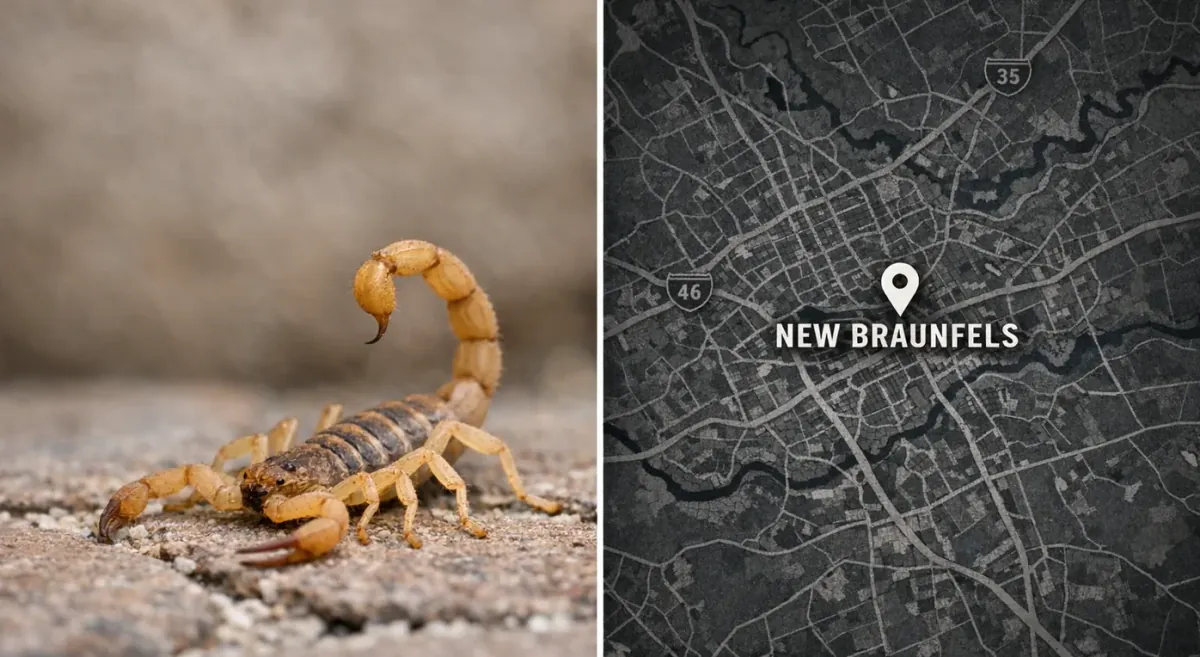
Yes — scorpions are a common fact of life in New Braunfels and the surrounding Comal County. The Hill Country's rocky soil, greenbelts, and warm nights create ideal conditions for the Striped Bark Scorpion, the species behind nearly every local sighting. Most encounters are a single scorpion, not a swarm, but repeat indoor sightings are worth taking seriously.
Within 30km of New Braunfels, citizen-science observers have logged 673 research-grade scorpion sightings on iNaturalist between 2010 and 2026. Statewide, Texas reports roughly 1,743 scorpion exposures to poison centers each year — about 10.3% of the US total, according to Kang & Brooks 2017.
What does "a problem" actually look like? For most homeowners, it's an occasional scorpion in the garage or along a baseboard. The thing to watch for is the pattern: the same room, the same time of night, more than once. Scorpions are largely solitary, so you won't see an ant-style colony — but repeat sightings usually mean there's good harborage and a steady insect food supply nearby.
What makes Comal County homes scorpion-prone?
Comal County's landscape does scorpions plenty of favors. Rock and wood landscaping, limestone outcrops, creek corridors, and greenbelts all offer cool, tight crevices to hide in by day. New construction and land clearing push scorpions out of disturbed ground and toward the nearest shelter — which is often your foundation.
Think of it as a pipeline: outdoor harborage plus nighttime hunting plus small gaps around doors and weep holes equals the occasional indoor wanderer. Because scorpions are thigmotactic — they navigate by hugging edges — they tend to travel along baseboards and walls once inside, which is exactly where homeowners spot them.
Are scorpions usually alone—or do they travel in pairs?
Almost always alone. Scorpions are solitary hunters, so the overwhelming majority of sightings are a single animal. Seeing two in a short window doesn't mean they "travel together" — it usually means conditions outside are good, and multiple individuals are drifting toward the same shelter or food.
You may notice a short uptick during late spring and summer mating activity, or when prey insects are abundant after rain. The smartest move is simple: jot down the date, time, and location of each sighting. A few entries will quickly tell you whether you're dealing with flukes or a genuine pattern.
How to tell if you have an indoor pattern (not a fluke)
A real indoor pattern shows up as repeat sightings in the same high-risk rooms — bathrooms, laundry rooms, bedrooms, and garages — often at the same hours of the night. One scorpion in the garage in August is normal. Three in your bathroom over two weeks is a pattern.
Run a two-week tracking window. Each time you see one, note where, what time, and the recent weather, since activity tends to climb during the warmest months and after rain. If that list keeps growing, photo-verified monitoring is worth considering. Systems like Scorpion Alert run on their own at night and send alerts when a scorpion is detected — which takes the guesswork out of "is this a problem?"
Which scorpion species lives in New Braunfels?
The scorpion you'll almost certainly encounter in New Braunfels is the Striped Bark Scorpion (Centruroides vittatus). It accounts for 616 of the 673 research-grade sightings logged within 30km of the city on iNaturalist. It's also the most widely distributed scorpion in North America, dominant across Texas, per Yamashita & Rhoads 2017.
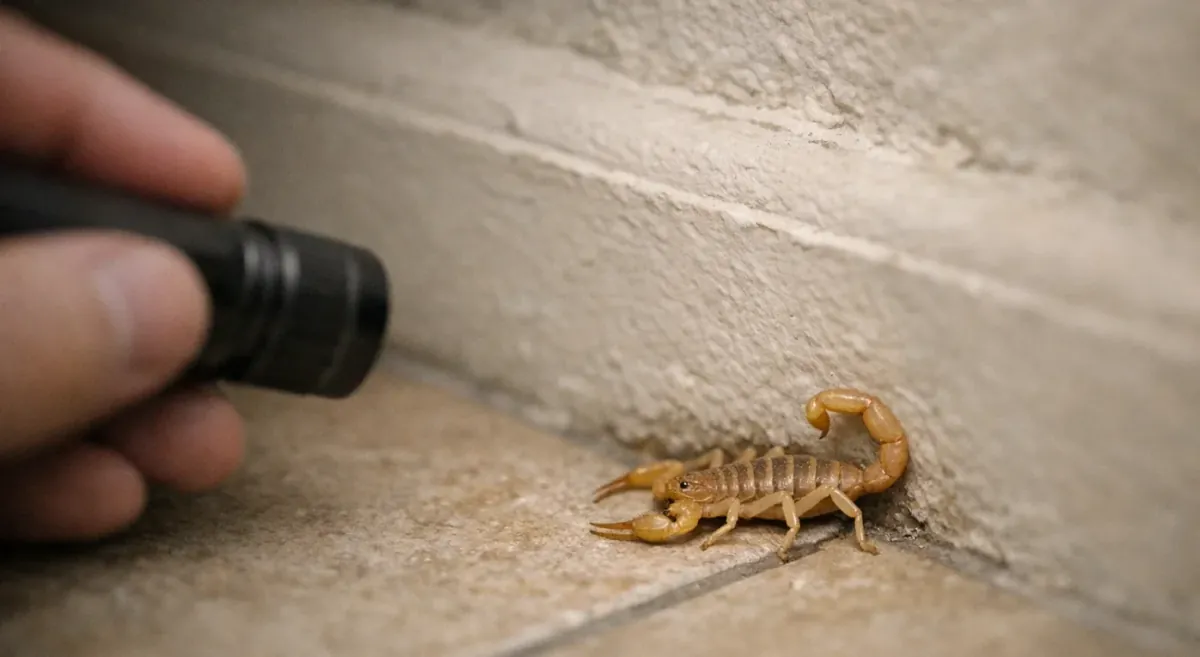
It's a slender, tan-to-yellowish scorpion, usually around two to two-and-a-half inches, with two darker stripes running down its back. You'll find it on and around homes rather than deep in burrows. Don't try to pin down a species from a blurry phone photo alone — if you need certainty, lean on local sightings data or a pest professional.
Striped Bark Scorpion (primary local species)
Outdoors, the Striped Bark Scorpion favors tree bark, rock and wood piles, fence lines, patio edges, and cluttered garages. True to the "bark" name, it's a capable climber — far more than people expect. This species can scale walls, fences, and other vertical surfaces, which is why it sometimes turns up off the ground rather than strictly at floor level.
It's active after dark, hunting insects and hugging edges as it moves. That nighttime, edge-following behavior is exactly why indoor inspections should focus on baseboards, thresholds, and corners rather than open floor space.
Are there other scorpions in the New Braunfels area?
Mostly it's the Striped Bark Scorpion, but it isn't the only one. Local data also shows a smaller number of the Texas cave scorpion (Pseudouroctonus reddelli), with 57 sightings near New Braunfels. It tends to stick to rocky, cave-like microhabitats and is rarely a household concern.
Correct ID matters because it shapes your expectations around sting risk and where you're likely to find them. If you come across a scorpion you can't identify, snap a photo from a safe distance, never handle it with bare hands, and keep kids and pets clear until it's gone.
Do scorpions glow under blacklight in Texas?
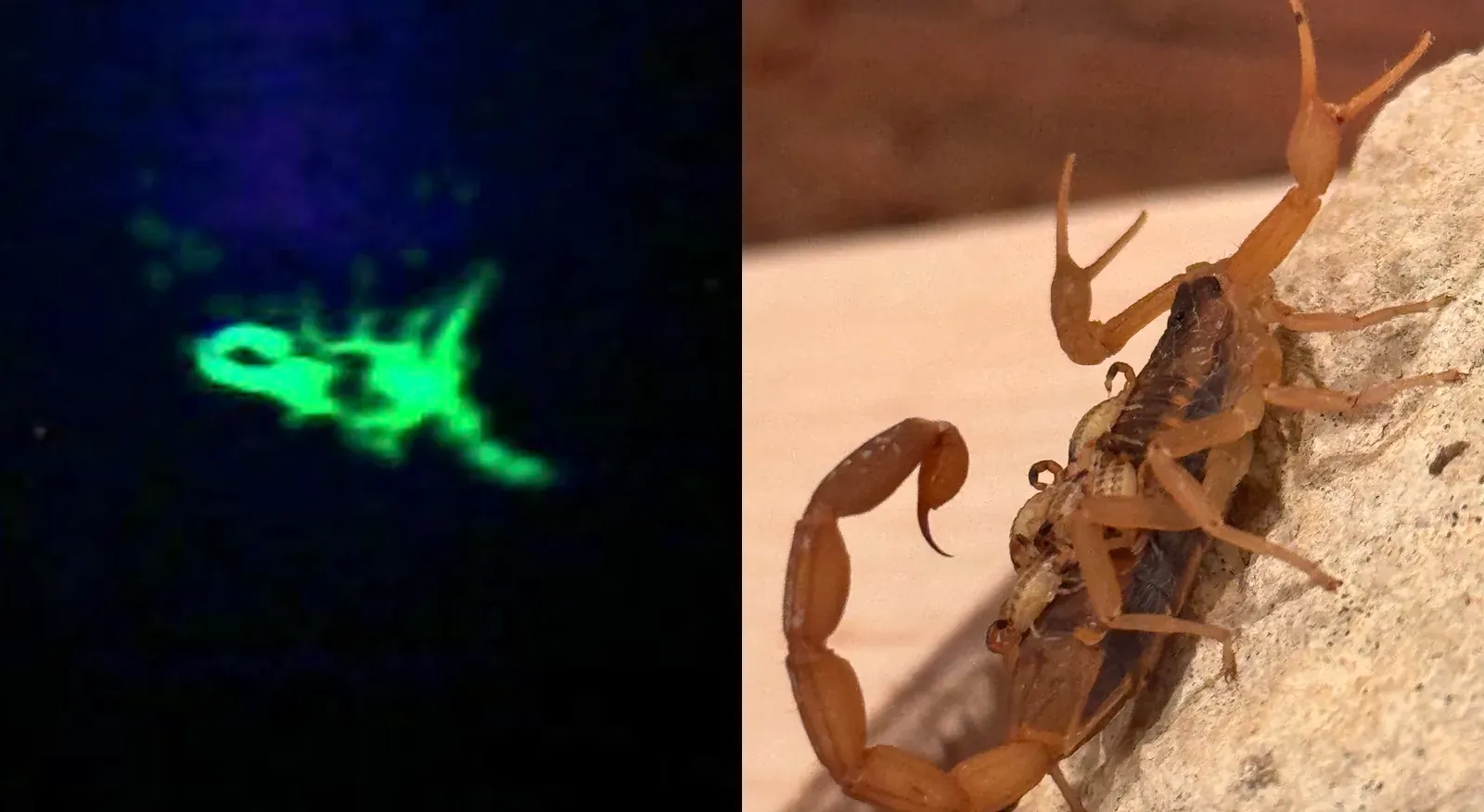
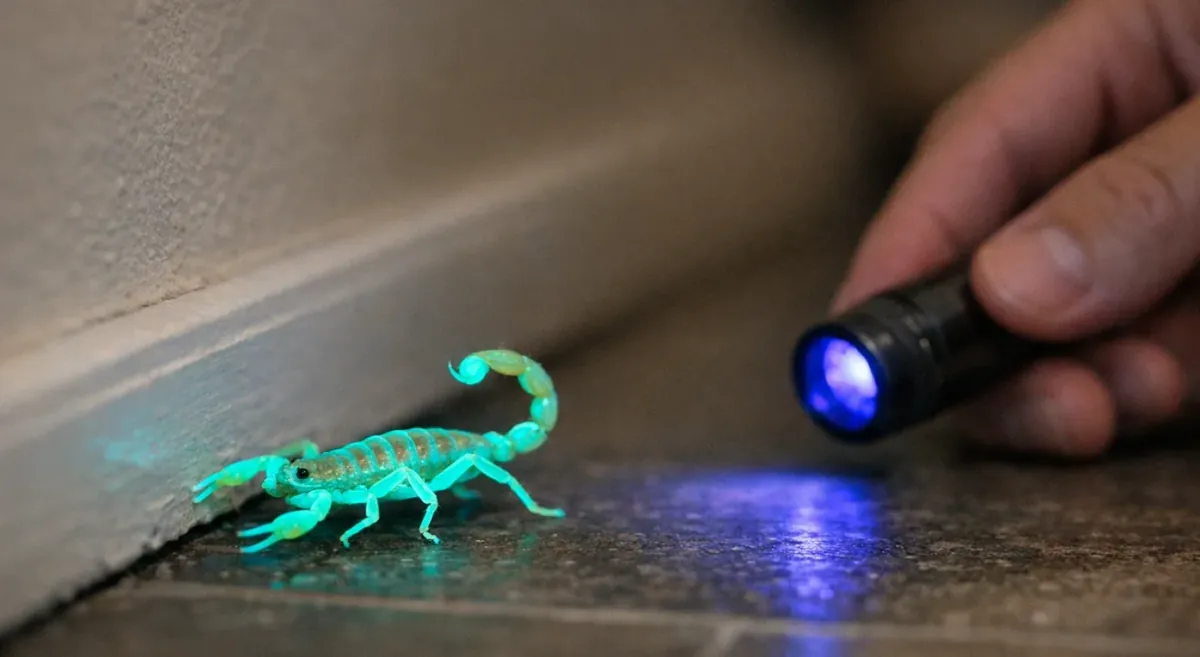
They do. Texas scorpions, including the Striped Bark Scorpion, fluoresce a vivid greenish color under ultraviolet light because of compounds in their exoskeleton. That glow makes them dramatically easier to spot at night, which is why a UV flashlight is a genuinely useful tool.
For the strongest glow, a 365nm UV light works best. One realistic caveat: UV helps you find scorpions — it does nothing to repel them. It's a detection tool, not a deterrent.
When are scorpions most active in New Braunfels?
Scorpions are active in New Braunfels for much of the year, but they spike sharply in the warm months, roughly late spring through early fall, with the peak in summer. Nationwide data shows summer evening hours dominate scorpion encounters, per Kang & Brooks 2017. Heat, humidity, and abundant prey insects all push activity up.
Within a given night, the action is concentrated after dark through the early morning hours. Most stings happen between 6 PM and midnight, with a secondary bump in the early morning, according to clinical data on sting timing. Scorpions move along room perimeters and exterior walls during these windows.
Why does this matter? It tells you when to be careful. Time yard work and garage trips with a light, tighten up exclusion before the hottest months, and focus monitoring on the hours scorpions are actually moving.
What does "scorpion season" mean locally?
"Scorpion season" doesn't mean scorpions suddenly arrive — they're here year-round. It means sightings spike as warm weather and insect prey peak. In New Braunfels, that window runs through the hot stretch of summer and into early fall.
Weather drives it: heat gets scorpions moving, and humidity and rain bring out the insects they hunt. Striped Bark Scorpions are also long-lived for arthropod predators — several years is typical — so a resident population can persist season after season if the habitat stays favorable.
Why you see them at night (and near walls)
Scorpions are thigmotactic, meaning they prefer to travel with a surface pressed against their body. Indoors, that translates to baseboards, wall edges, and the backs of furniture — which is exactly why sightings cluster along walls instead of out in the open.
Put that to work during inspections: check along baseboards behind furniture, around door thresholds, and in garage corners. Automated night monitoring fits this behavior neatly because it matches when scorpions move — Scorpion Alert Detectors activate when a room goes dark and scan continuously through the night.
Do activity spikes happen after rain or irrigation?
Often, yes. Rain and heavy irrigation drive prey insects out of hiding and onto surfaces, and scorpions follow the food. A wet night can mean more movement right around your foundation and entry points.
Translate that into action: do a quick entry-point check after storms, reduce standing water, and be cautious bringing in items that have been stored outside. Logging the date, weather, and location of each sighting will help you confirm these patterns around your own property.
How dangerous is a scorpion sting in New Braunfels?
For most healthy adults, a Striped Bark Scorpion sting is painful but not dangerous. According to Yamashita & Rhoads 2017, this species produces sharp local pain averaging 15–20 minutes, and life-threatening envenomation has not been documented. Risk rises for certain people, so prompt assessment matters in those cases.
Who's higher risk? Young children, older adults, and anyone with a known sting allergy or significant underlying health conditions. Pets can also react more strongly relative to their size. The local species' venom targets pain-signaling sodium channels, which explains the intense sting without the systemic neuromotor syndrome caused by Arizona's bark scorpion, per the same research.
What a typical sting feels like (and how long symptoms last)
A typical sting brings immediate sharp or burning pain at the site, often followed by tingling, numbness, and some localized swelling or redness. For most people, the worst of the pain eases within 15–20 minutes, though tenderness can linger for hours.
Don't read too much into the scorpion's size. A smaller scorpion can deliver a sting that hurts just as much, so size isn't a reliable safety signal. If you're stung, note the time and track how your symptoms change — that information is genuinely helpful if you need to call for guidance.
When a New Braunfels scorpion sting is an emergency
Call Poison Control or 911 right away if you see red-flag symptoms: trouble breathing or swallowing, severe muscle twitching or jerking, spreading numbness, repeated vomiting, altered behavior, or facial and eye symptoms such as roving eye movements. These are uncommon with the local species, but they demand immediate care.
Children can deteriorate faster than adults, so err on the side of caution with a young child who was stung. Our deeper guide on why children are more at risk from scorpion stings covers this in detail. If red flags appear, don't wait it out.
Are Texas scorpions "poisonous"?
Technically, scorpions are venomous, not poisonous. The distinction matters: venom is injected through the sting, while poison is something that harms you if eaten or touched. A scorpion delivers venom, so "venomous" is the accurate word.
Texas is home to several scorpion species, and perceived danger varies more than actual risk. For the full breakdown, see our explainer on whether brown scorpions in Texas are poisonous.
What to do if you're stung in New Braunfels
Stay calm — most Striped Bark Scorpion stings can be managed at home. Wash the site with soap and water, apply a cool compress, take an over-the-counter pain reliever per the label, and watch your symptoms. Call the Poison Help line at 1-800-222-1222 if you have questions or if anything escalates.
Just as important is what not to do. Don't cut the wound or try to suck out venom, and skip risky home remedies — our guide on what not to do after spotting a scorpion covers the common mistakes. If the sting is on a finger or hand, remove rings and tight jewelry early in case of swelling.
Immediate first aid checklist
Here's the step-by-step plan for a sting:
- Wash the sting site thoroughly with soap and water.
- Apply a cool compress or ice pack (wrapped in cloth) for 10 minutes at a time to reduce pain and swelling.
- Elevate the limb if that's comfortable, and take an OTC pain reliever per the label.
- Keep the person calm and still, and monitor symptoms closely for any escalation.
- If it's safe, photograph the scorpion for identification — but never risk a second sting trying to catch it.
Who to call in New Braunfels (and what to say)
Call Poison Control at 1-800-222-1222 first for guidance; they can tell you whether home care is enough or whether you need urgent care or the ER. For red-flag symptoms, call 911 right away.
Have a quick script ready: the person's age and weight, the time of the sting, current symptoms, any known allergies, and the suspected scorpion type. If you need in-person care, the nearest hospital is CHRISTUS Santa Rosa Hospital – New Braunfels at 600 N Union Ave, about 0.86 miles from the city center. PAM Health Specialty and Rehabilitation Hospital at 1445 Hanz Dr is another nearby option.
How to avoid a second sting that night
Where there's one scorpion, there can be another — so take a few precautions before bed. Shake out shoes, slippers, and clothing before putting them on, check the edges of bedding, and keep kids and pets off the floor temporarily.
If you have a UV flashlight, use it for a careful sweep along baseboards and corners, since scorpions glow and are far easier to find that way. For households where scorpions in New Braunfels, Texas are a recurring worry, photo-verified night alerts cut down on the guessing and help you respond fast instead of lying awake wondering.
How to keep scorpions out of your New Braunfels home
The most effective approach is "outside-in": reduce outdoor hiding spots, cut off the insect food supply, seal the gaps that let scorpions in, and add monitoring so you know whether it's working. Because scorpions travel along edges, perimeter-focused strategies pay off the most, especially in high-risk rooms like bathrooms, laundry rooms, bedrooms, and garages.
No single step solves it. Stacking these layers is what keeps the occasional outdoor scorpion from becoming an indoor regular.
Step 1: Reduce harborage in the yard and against the foundation
Start by taking away the hiding places scorpions love. Clear rock piles, stacked lumber and firewood, thick groundcover, and cluttered patios — especially anything touching the house.
Pay special attention to the zone right against your exterior walls, where cool, tight crevices sit just inches from your foundation. Move woodpiles well away from the foundation, trim back vegetation, and tidy the garage. Ideally, tackle this cleanup before the summer peak, so you're ahead of the season instead of chasing it.
Step 2: Seal the gaps that matter most
Scorpions exploit small gaps, so prioritize the high-yield ones: install tight door sweeps, seal the garage threshold, screen or cover weep holes and utility penetrations, and repair torn window screens. Our rundown of the top 5 ways scorpions get into your home goes deeper on each entry point.
A quick night audit helps you find the leaks. With the interior lights on, step outside after dark and look for light escaping around doors and thresholds — wherever light gets out, a scorpion can get in.
Step 3: Control the food supply (insects) and moisture
Scorpions follow their prey, so fewer insects means fewer scorpions hunting near your home. Swap bright white exterior bulbs for warmer, bug-reducing lighting, keep vegetation trimmed, and fix leaks that draw bugs in. Our list of the top 5 things that attract scorpions is a useful checklist here.
Moisture is a big driver, which is why bathrooms and laundry rooms show up as hotspots. After rain or heavy irrigation, insect activity climbs and scorpions follow. Addressing standing water and leaks as part of an integrated pest-management approach quietly removes the reason scorpions come close in the first place.
Step 4: Add monitoring so you're not guessing
Even a well-sealed home benefits from knowing what's actually happening at night. Place monitoring along the perimeter and near entry points, since that's where scorpions travel. This is where Scorpion Alert fits in: plug-in Detectors sit on the room perimeter, shine 365nm UV light onto the floor, scan continuously once the room goes dark, and send a photo-verified alert to your phone within seconds of spotting a scorpion.
A practical layout for a typical New Braunfels home: one Detector near the front door, one near the back door, one at the garage entry, and one in each bedroom or bathroom where you've seen activity before. When an alert comes in, you grab a UV flashlight and a glass, head to the Detector that triggered, trap the glowing scorpion, and release it outside. Hardware is included in the monthly monitoring subscription — the per-Detector rate drops as you add more, so check the live calculator at scorpionalert.com/pricing for current pricing, and cancel any time by emailing support and returning the Detectors.
In New Braunfels, scorpions tend to show up when you least expect them—especially after warm evenings—so the goal is spotting them before a painful surprise. Scorpion Alert helps by using 365nm UV light and a two-stage AI check to detect scorpions on your floors and send an alert, so you can respond quickly and confidently. If you want an extra layer of peace of mind at home, learn more at Scorpion Alert.