Are scorpions a problem in Moapa Valley?
Yes — scorpions are a common, real concern in Moapa Valley, Nevada. The area sits in Clark County, where scorpion activity ranks high, and desert homes here regularly see both outdoor and indoor scorpion sightings. Even one scorpion inside your living space is enough to justify a simple monitoring and exclusion plan.
For most homeowners, "a problem" starts small. You might spot a scorpion on the patio or in the garage first. Occasional yard sightings are normal in the desert. Indoor sightings are the ones that change your plans — because that means a scorpion found a way in, and where one goes, others can follow.
Clark County sits in the same southern Nevada corridor that researchers have flagged for rising scorpion exposure. A 2010–2015 follow-up analysis confirmed growing exposure counts in southern Nevada, per Kang & Brooks 2017. Nevada as a whole accounts for roughly 4.2% of US scorpion exposures — about 707 a year, per Kang & Brooks 2017.
What kinds of Moapa Valley properties tend to see scorpions?
Desert-edge homes see the most activity. If your Moapa Valley property backs up to open desert, a wash, or rocky landscaping, you're next to prime scorpion habitat. Properties with block walls, decorative rock, wood piles, and outbuildings or detached garages give scorpions the cool, dark harborage they love.
Sightings tend to cluster for three simple reasons: food, shelter, and water. Scorpions follow their prey — crickets, roaches, and other insects. They settle where there are gaps and crevices to hide. And in a dry climate, irrigated yards and leaky fixtures draw them closer to the house.
If I only saw one scorpion, does that mean there are more?
Not necessarily — but don't assume it was a one-off. A single scorpion can be a lone wanderer that slipped in through a door gap. Repeated sightings, though, point to nearby harborage or an open entry route that keeps letting them in.
Start with tracking. Jot down the date, time, and exact location of each sighting. Scorpions are mostly nocturnal, so most indoor encounters happen after dark. That log is step one of real scorpion control for Moapa Valley, Nevada homes — it helps you tell the difference between a wanderer and a pattern.
Can scorpions climb walls in Moapa Valley homes?
Yes. Many scorpions can scale textured surfaces like stucco, block, and wood, squeezing into small gaps along the way. That's why wall-and-floor junctions, baseboards, and the edges of door frames matter so much during an inspection — scorpions travel along edges, not out in the open.
Understanding that edge-hugging behavior is key to prevention. Focus on the perimeter of each room and the seams of your home's exterior, and you're looking exactly where scorpions actually go.
Which scorpion species lives in Moapa Valley?
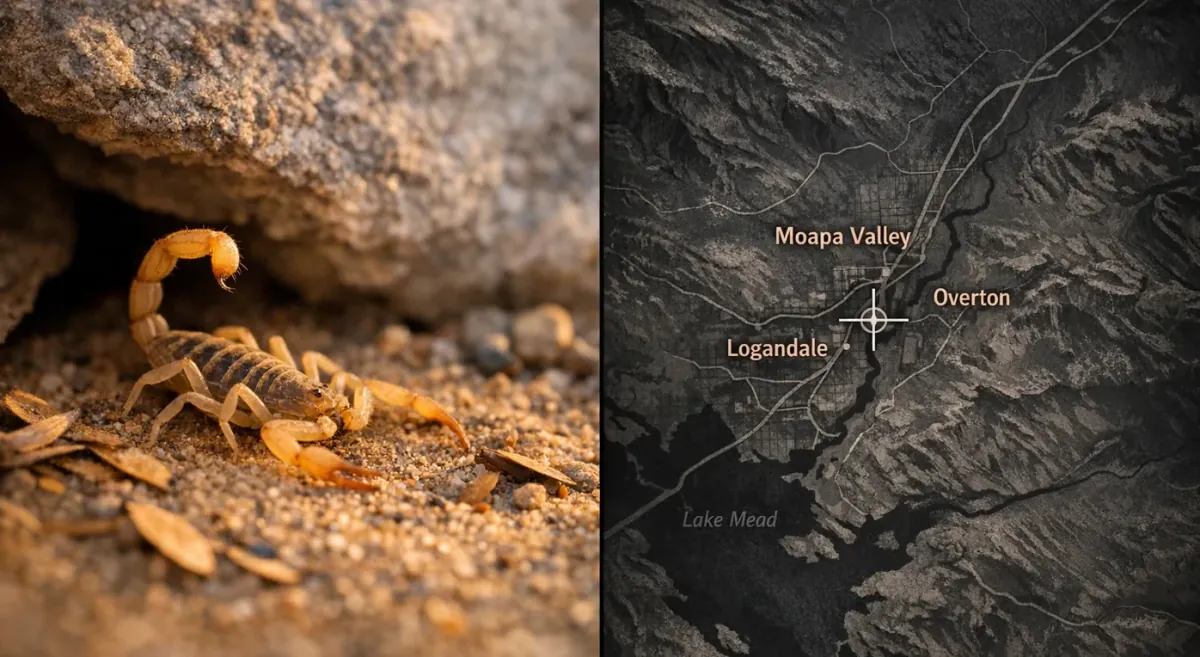
The most commonly observed scorpion in and around Moapa Valley is the Desert Hairy Scorpion (Hadrurus arizonensis). Of the 63 research-grade scorpion observations within 30km of Moapa Valley on iNaturalist, 25 were Desert Hairy Scorpions — the single most-recorded species in the area.
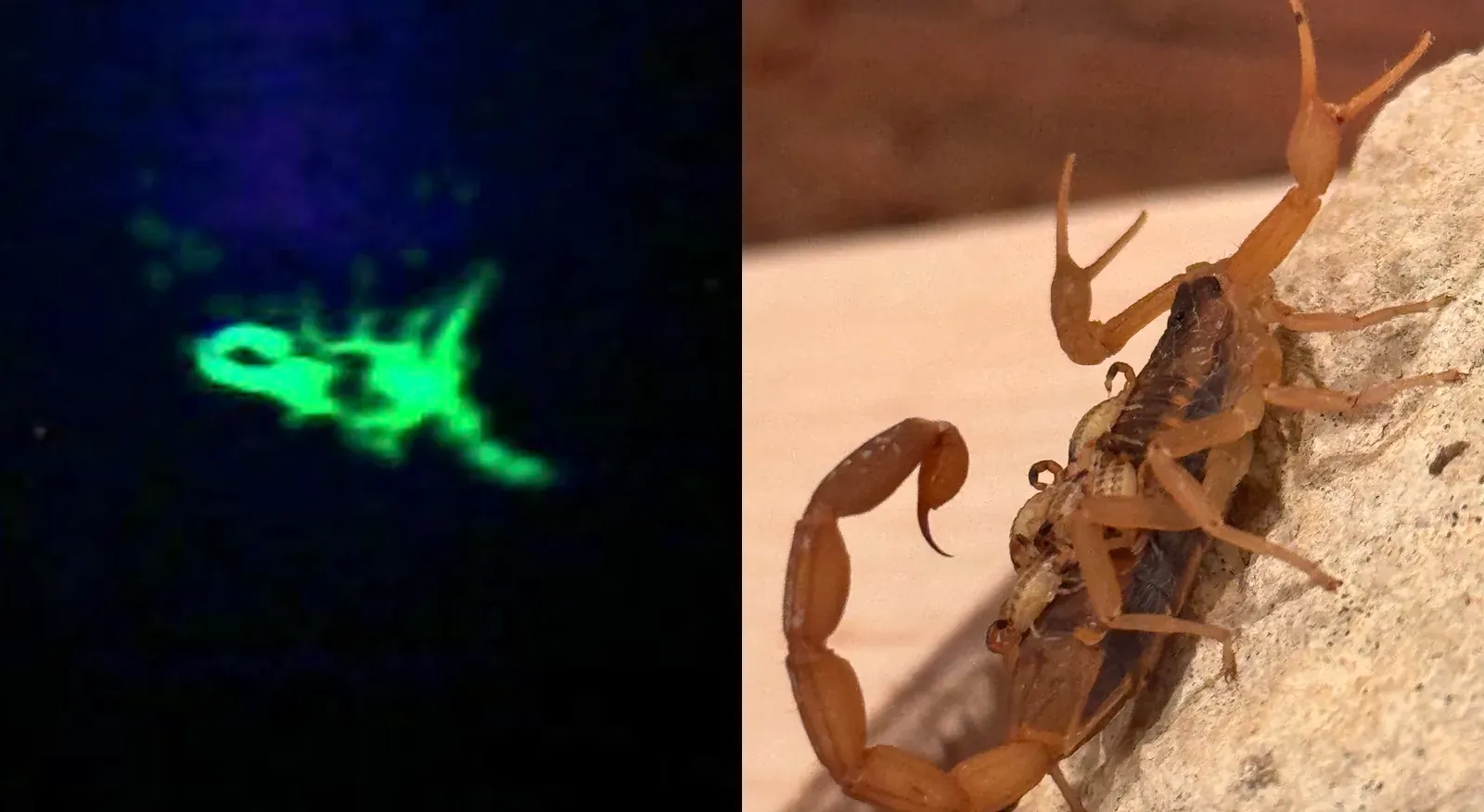
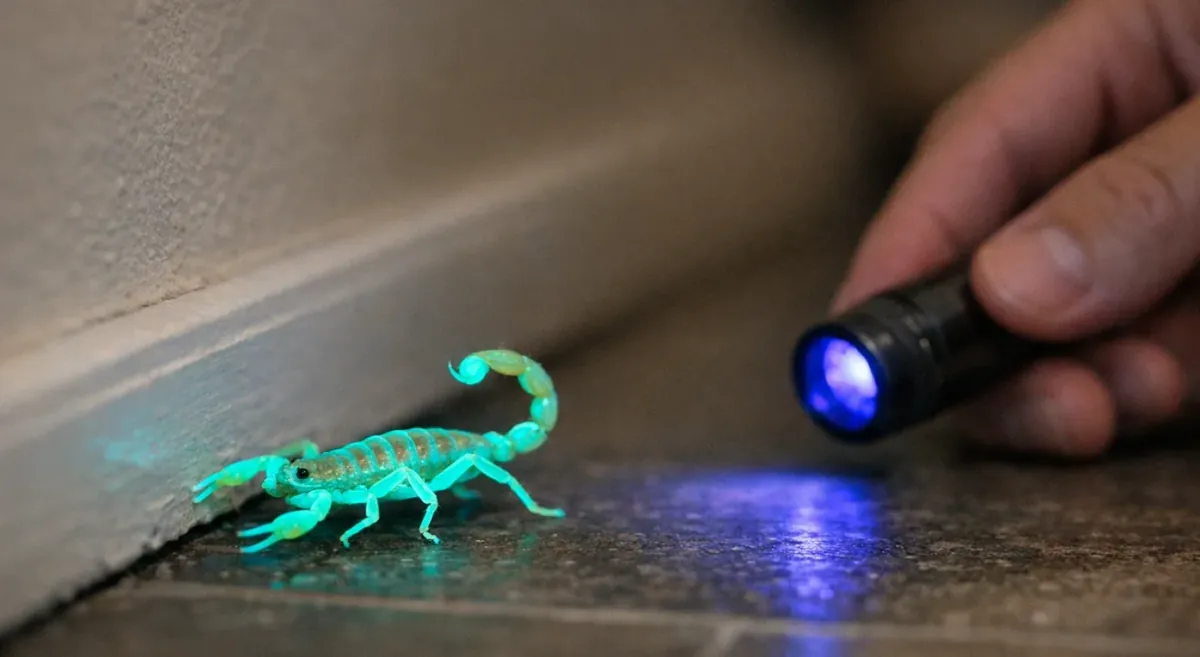
For safe identification, never handle a scorpion. Use your phone's zoom, a flashlight, or a UV light at night — scorpions glow a pale green under UV — to confirm what you're looking at from a safe distance.
Desert Hairy Scorpion: what it looks like and where it hides
The Desert Hairy Scorpion is the largest scorpion in North America, often running three to six inches long. It's robustly built, with a yellowish-tan body, a darker back, and fine sensory hairs on its legs and tail that give it its name. You'll find it tucked into rock piles, wood stacks, block walls, and the dark gaps under landscaping items and outdoor gear.
Because it's a burrower and an ambush hider, control comes down to removing cover. Don't try to grab it — a phone zoom or a UV flashlight at night is the safer way to confirm an ID.
Are Clark County scorpions always the same species?
No. Clark County scorpions vary by microhabitat, so your neighbor across the valley may see a different species than you do. The same iNaturalist dataset for the Moapa Valley area also logged Smeringurus vachoni, Paravaejovis confusus, and the medically significant Arizona bark scorpion (Centruroides sculpturatus).
The practical takeaway: treat any unknown scorpion as capable of stinging, and focus on prevention regardless of exact species. You don't need a perfect species ID to take sensible precautions.
How many eyes do scorpions have—and why it matters for hiding
Scorpions usually have six to twelve eyes — a pair in the middle and several smaller ones along the front edges — yet their eyesight is poor. They rely far more on sensing vibration and air movement through the hairs on their legs and tail.
That's why they crave tight, dark cover and react to the faintest disturbance. For homeowners, it's a clear rationale for decluttering edges and reducing hiding spots — fewer snug gaps means fewer places a scorpion wants to be.
When are scorpions most active in Moapa Valley?
Scorpions are active in Moapa Valley from roughly spring through fall, with peak activity during the hot summer months of June through September. They're mostly nocturnal, so "scorpion season" really means more nighttime movement — especially on warm nights after sundown.
Summer accounts for the overwhelming majority of scorpion encounters nationwide, with warm-month evening hours dominating the calls, per Kang & Brooks 2017. Heat waves, sudden storms, and yard irrigation all nudge scorpions to move — and sometimes to move indoors toward cooler, more humid spots.
What months are 'scorpion season' in Moapa Valley?
Plan for a season that runs spring through fall, peaking in the summer stretch from June to September. During those weeks, expect more porch, patio, and garage sightings after dark. You flip on the garage light at 10 p.m. in July and catch one near the wall — that's the season at work.
Keep in mind that indoor sightings can happen any month of the year. The risk simply feels higher during peak season, when more scorpions are out hunting at night.
Why do scorpions show up at night (and what they do then)?
Scorpions are nocturnal hunters. After dark they leave their hiding spots to pursue insects, traveling by hugging surfaces — baseboards, walls, thresholds, and the edges of furniture. Peak sting hours run from 6 PM to midnight, which accounts for roughly 49% of envenomations, per Klotz et al. 2021 and related toxicology work.
That edge-travel habit is predictable, and it happens while your household sleeps — which is exactly why passive nighttime monitoring along room perimeters is so useful.
Do scorpions travel in pairs or mate during the season?
No — scorpions are solitary animals and don't travel in pairs. During mating season you may briefly see two interacting, but a single sighting never confirms a "pair." Repeated sightings instead suggest your property offers favorable conditions.
Extra activity is most noticeable during the summer peak, June through September, when more scorpions are moving and hunting at night.
How dangerous is a scorpion sting in Moapa Valley?
Most scorpion stings in Moapa Valley cause painful but manageable local reactions rather than medical emergencies. The common Desert Hairy Scorpion delivers a sting often compared to a bad bee sting. The bigger concern in Clark County is the Arizona bark scorpion, which also turns up in local sightings and can cause more serious systemic effects — especially in young children.
Pain at the sting site shows up in 88.9% of stings and local numbness in 62.2%, according to the Arizona cohort in Klotz et al. 2021. Higher-risk groups include young kids, older adults, people with known allergies, and pets.
97.8% of US scorpion envenomations happen in the home — and about 90% are managed on-site without an ER transfer.
— Kang & Brooks, J Med Toxicol 2017
What a Desert Hairy Scorpion sting typically feels like
A Desert Hairy Scorpion sting usually brings immediate, sharp pain, followed by localized swelling, redness, and a tingling or numb feeling around the site. Reactions vary from person to person and depend partly on where you're stung.
Don't judge severity by the scorpion's size. A big scorpion isn't automatically a worse sting. Treat every sting seriously and watch how your symptoms change over the next few hours.
When is a scorpion sting an emergency in Moapa Valley?
Call for help immediately — or head to the nearest emergency room — if you notice trouble breathing, swelling of the face or throat, uncontrolled muscle twitching or jerking, severe vomiting, spreading numbness, roving eye movements, or any change in alertness. These red flags matter most in children, older adults, immunocompromised people, and anyone with a known allergy.
Children under 10 have the highest rates of systemic effects, hospitalization, and ICU admission in both Arizona and Nevada cohorts, per Kang & Brooks 2017. When in doubt, call Poison Help at 1-800-222-1222 before deciding where to go.
Are small scorpions more dangerous than big ones?
Not reliably. Size alone doesn't tell you how a sting will go — venom potency varies by species, not by how big the animal looks. The practical rule is to focus on symptoms and seek care when red flags appear, not on measuring the scorpion. For a deeper look, see our guide on whether smaller scorpions are more dangerous and what size really tells you about a sting.
What to do if you're stung in Moapa Valley
Stay calm — most Moapa Valley stings can be handled at home with simple first aid and close monitoring. Wash the area, apply something cool, watch your symptoms, and call Poison Help at 1-800-222-1222 for guidance tailored to the person who was stung, especially a child. Escalate to emergency care if red-flag symptoms appear.
First aid steps to take right away
- Wash the sting site gently with soap and water.
- Remove rings, watches, or anything tight near the sting before swelling starts.
- Apply a cool pack or cloth-wrapped ice for 10 minutes at a time to ease pain and swelling.
- Keep the affected limb comfortable and at rest; avoid overexertion.
- Call Poison Help at 1-800-222-1222 — guidance can differ for children and older adults.
- Write down when the sting happened and note symptoms as they change.
Skip the risky home remedies. Don't cut the wound, don't try to suck out venom, and don't take alcohol or random medications hoping to "beat" the sting. Those can do more harm than good.
What symptoms to track for the next few hours
Keep a simple running list. Watch whether the pain is easing or worsening, whether swelling is spreading, and whether numbness or tingling grows. Note any muscle twitching, nausea or vomiting, roving eye movements, or changes in breathing.
Symptom progression — not the scorpion's identity — drives the medical decision. If symptoms climb instead of settling, that's your signal to get care quickly.
If a scorpion is still nearby: how to handle it safely
Never use your bare hands. The safe move is to cover the scorpion with a wide-mouth container, slide a stiff piece of paper or cardboard underneath, and release it well away from the house — or call a pest professional if you'd rather not. For more on avoiding common mistakes, read what not to do after spotting a scorpion in your home.
At night, a UV flashlight makes this far easier — scorpions fluoresce a vivid green, so one that would vanish into a shadow lights up instantly. That same fluorescence is the basis for monitoring your home while you sleep, which is where real prevention begins.
How to keep scorpions out of your Moapa Valley home
Keeping scorpions out comes down to three layers working together: exclusion (seal entry points), habitat reduction (remove cover and clutter), and monitoring (know when one gets inside). Given the high scorpion relevance across Clark County, treat this as an ongoing plan, not a one-time fix.
A 1-week 'scorpion reset' checklist (fast wins)
Spend the first week on the high-leverage basics:
- Pull mulch, rock piles, and firewood away from the foundation and entryways.
- Clear ground clutter that touches the house — hoses, bins, lumber, and stored gear.
- Declutter indoor edges, especially along baseboards, closets, and under furniture.
- Install or replace door sweeps and weatherstripping on exterior and garage doors.
- Shake out shoes, slippers, and folded laundry before use.
These steps pay off fastest during the summer season, and they shrink the number of places scorpions want to settle. It also helps to understand the top things that attract scorpions to your home so you can address the root causes.
Seal and screen: the Moapa Valley entry-point audit
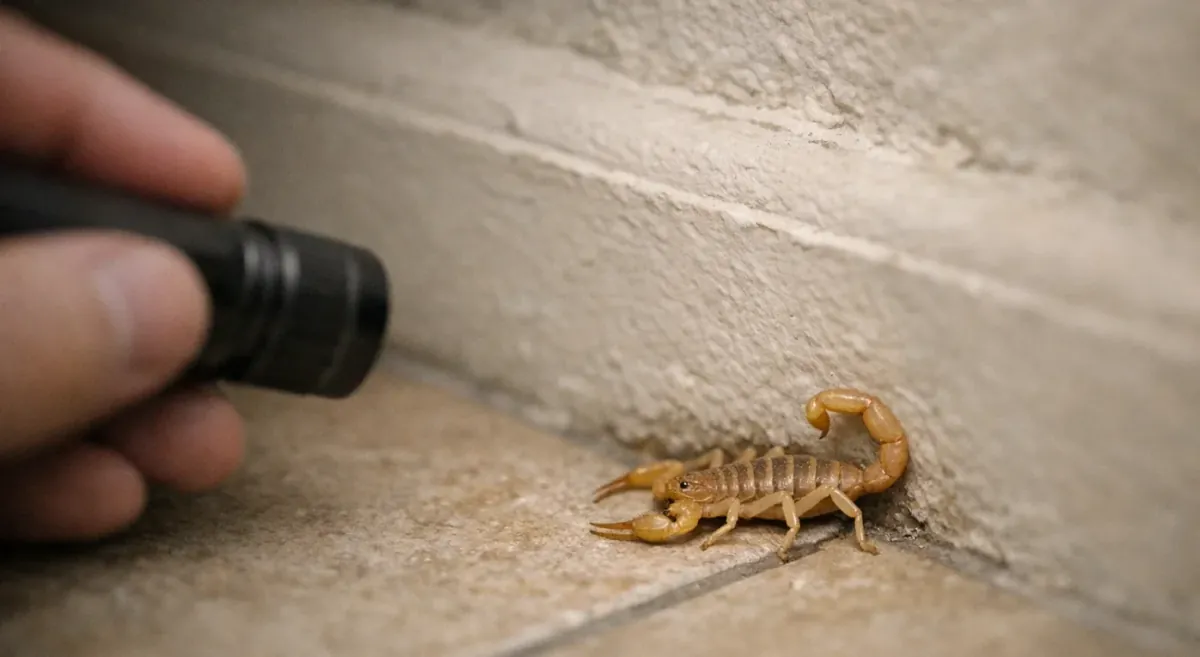
Do a two-part audit. At night, walk the interior with a flashlight and look for light leaks around doors and baseboards. In daylight, inspect and caulk the usual gaps: door thresholds, weep holes, utility and pipe penetrations, window screens, and the seam where the garage meets the house.
Scorpions squeeze through surprisingly small openings, so consistency matters more than any single fix. For larger structural gaps, bring in a pro. A deeper walkthrough of the ways scorpions get into your home will help you prioritize the gaps most relevant to Clark County properties.
Monitoring at night: how to catch scorpions before they hide
Monitoring is the layer most homeowners skip, and it's the one that catches problems early. The manual approach — periodic UV flashlight checks — is effective, but you'd have to do it night after night, and scorpions are most active while you're asleep.
The automated approach is continuous monitoring. Detection systems like Scorpion Alert plug into standard outlets on the room perimeter — right where scorpions naturally travel — and shine 365nm UV light on the floor to watch for that telltale greenish glow. When one is detected in the dark, you get a photo-verified alert on your phone within seconds, so you can grab a glass and a UV flashlight and deal with it before it disappears into a wall.
How long do scorpions live—and why long-term prevention matters
Scorpions are long-lived for their size — many species survive several years, and the Desert Hairy Scorpion can live well beyond that. That longevity is exactly why a quick spray isn't a strategy; the population outside your home persists across seasons.
Sustained exclusion, habitat management, and ongoing monitoring are what actually keep a Moapa Valley home protected through each spring-to-fall season. Children face the highest risk, so families should pay extra attention — see why children are more at risk from scorpion stings.
Scorpion Alert offers its UV Detectors as part of a monthly monitoring subscription — the hardware is included, the per-Detector rate drops as you add more rooms, and there's a one-time shipping fee at checkout. You can cancel any time by emailing support@scorpionalert.com and returning the Detectors. Check current rates with the live calculator at scorpionalert.com/pricing.
Living in Moapa Valley means taking scorpions seriously—especially because they’re most active at night and often follow edges and tight spaces when they move. If you want a clearer picture of when and where they’re turning up around your home, Scorpion Alert can help you spot activity sooner and respond with more confidence.