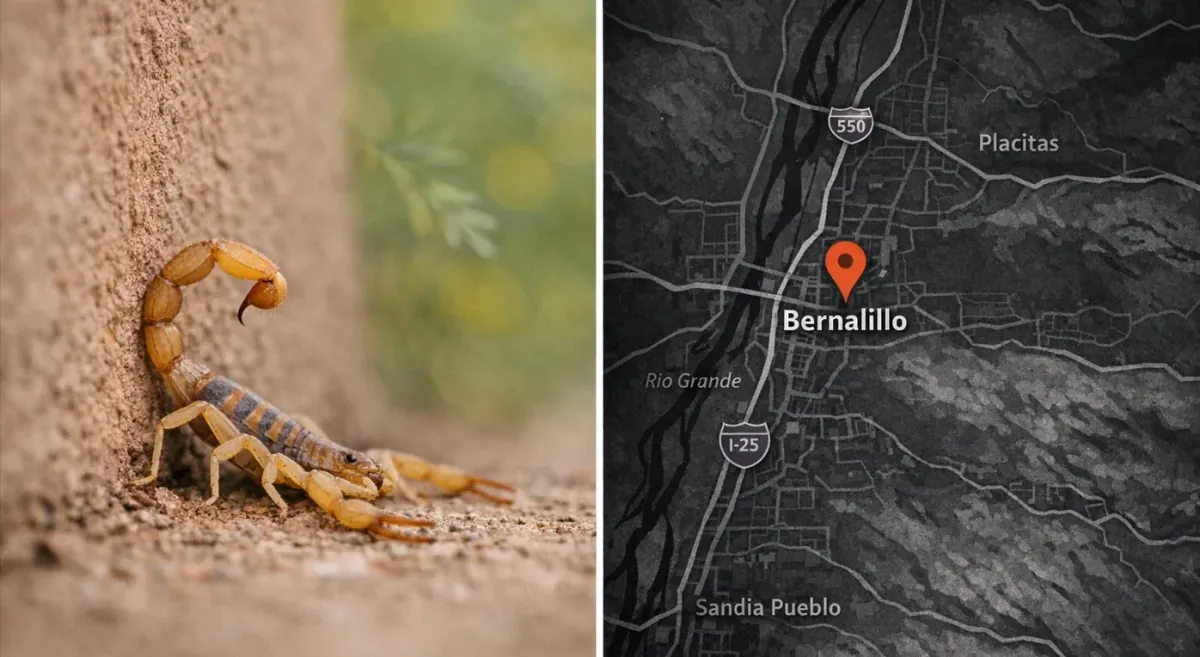
Are scorpions a problem in Bernalillo?
Yes — Bernalillo sits in scorpion country, and residents do find them in yards, along block walls, and inside homes at night. This is a high-relevance area, so the occasional sighting isn't unusual. The good news: most encounters are with relatively mild local species, and smart prevention keeps indoor run-ins rare.
Scorpions in Bernalillo, New Mexico follow the same desert-edge patterns you'd expect from Sandoval County's mix of open scrub, rock outcroppings, and residential development. Homeowners most often report activity outdoors first — under rocks and landscape borders, along the base of block walls, in garages, and around woodpiles — then occasionally inside after dark when scorpions wander in while hunting insects.
Effective scorpion control is a layered plan rather than a single fix. Reduce the hiding spots, food, and moisture that draw them close to the foundation, seal the gaps they slip through, and add indoor monitoring to catch the nighttime activity you'd otherwise never see. Each layer covers for the others.
If I saw one scorpion, does that mean there are more?
One scorpion can mean either a lone wanderer or a sign that harborage is nearby — and the surroundings usually tell you which. A single scorpion deep indoors in winter is often a random straggler. A scorpion near a cluttered garage, a rock border, or a block wall is more likely a sign of a population living right outside.
In Bernalillo, the usual culprits are yard debris, stacked landscape rock, firewood against the house, and dark garage storage. Clear those and you remove both the hiding places and the insect prey that lure scorpions toward your walls.
Why would scorpions come inside Bernalillo homes?
Scorpions come indoors chasing three things: prey, moisture, and stable temperature. On hot Bernalillo evenings, they hunt insects that gather around lights and doorways, and they drift toward cool, humid spots when the weather swings. That's why the most common indoor sightings happen in bathrooms, laundry rooms, garages, and bedrooms.
Research backs this up — the most common indoor harborage sites are bathrooms, laundry rooms, garages, and bedrooms, driven by a preference for cool, dark, humid micro-habitats (Kang & Brooks 2017). For more on what pulls them in, see our guide to the top things that attract scorpions in your home.
Which scorpion species lives in Bernalillo?
The most-recorded scorpion within 30km of Bernalillo is the Lesser Stripetail Scorpion (Chihuahuanus coahuilae), with 62 of 114 research-grade observations on iNaturalist. Striped bark scorpions (Centruroides vittatus) and a few desert species also show up, but the Lesser Stripetail dominates local records.
That matters for your risk picture. Unlike Arizona's notorious bark scorpion, the species common around Bernalillo deliver stings that hurt but rarely turn serious for a healthy adult. Still, never try to ID a scorpion by color alone, and ignore the myth that "small means more dangerous" — size isn't a reliable danger signal.
Don't guess from a blurry phone photo. Several harmless arthropods — like vinegaroons, solifuges (wind scorpions), and large spiders — get mistaken for scorpions. If you're unsure, keep your distance and let a photo or a safely contained specimen do the talking.
What does the Lesser Stripetail Scorpion look like?
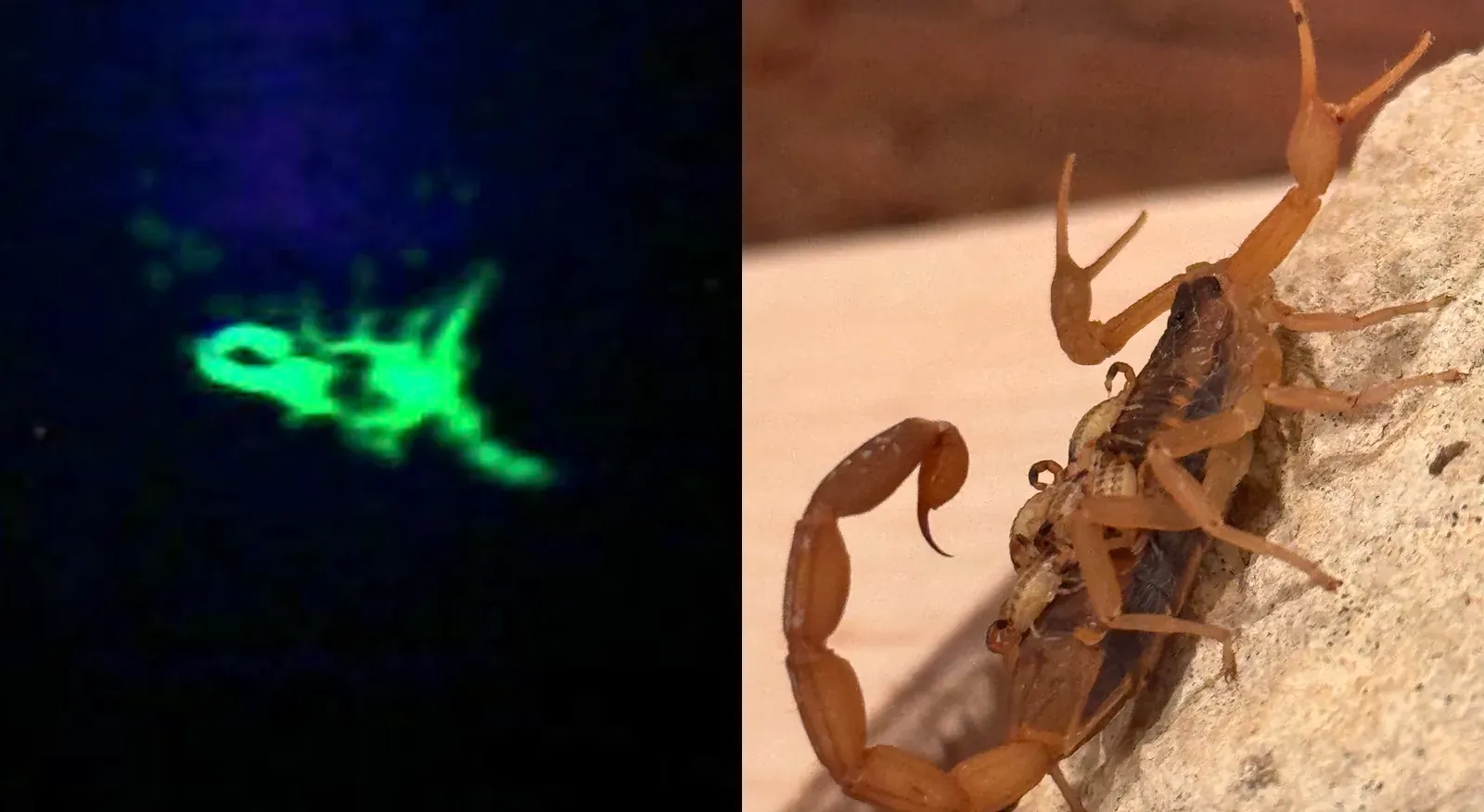
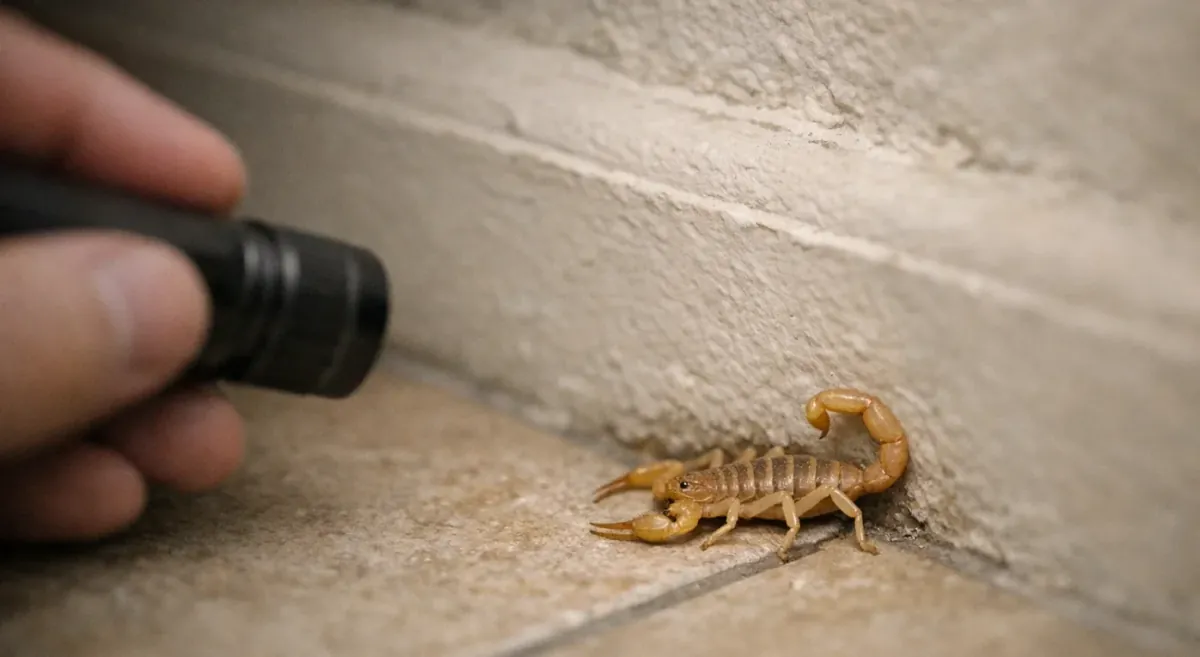
The Lesser Stripetail is a small, pale-to-tan scorpion, usually under two inches, with slender pincers and the faint tail striping that gives it its name. People often describe it as sandy or yellowish, which blends right into Bernalillo soil and stucco. Because coloring varies with lighting and life stage, treat it as a clue, not a verdict.
Do scorpions in Bernalillo glow under UV light?
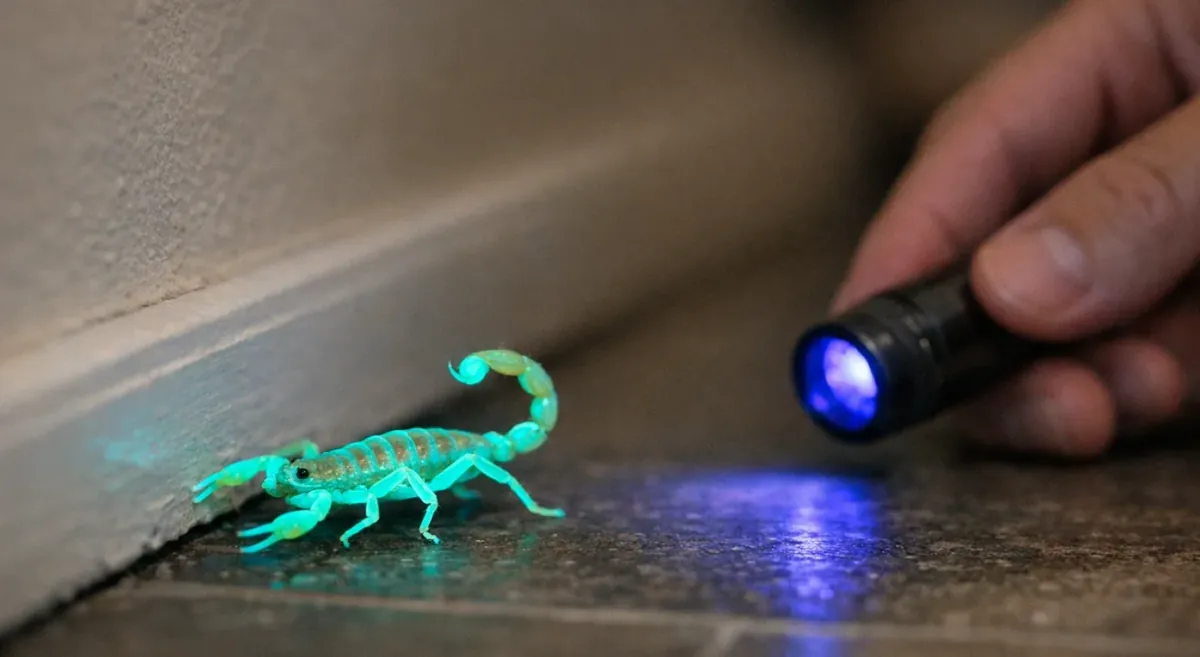
Yes — scorpions fluoresce a bright greenish-blue under 365nm UV light, and Bernalillo's species are no exception. A compound in their exoskeleton lights up, which is why a scorpion that's nearly invisible on a tile floor practically glows in the dark. This trick works best at night, when scorpions are out and the room is dark.
If you go searching with a UV flashlight, wear closed-toe shoes, move slowly, and never reach toward a glowing scorpion with bare hands. The light is for spotting — not for getting close.
When are scorpions most active in Bernalillo?
Scorpion season in Bernalillo runs through the warm months, peaking in the heat of summer — roughly June through September — and tapering as nights cool in fall. You'll see the most activity on warm evenings after the sun drops. Summer accounts for the overwhelming majority of scorpion encounters nationwide (Kang & Brooks 2017).
Activity spikes with heat, warm nights, and moisture. After a rain or an evening of yard irrigation, insects get busy and scorpions follow their prey — which is when homeowners notice more of them on patios, in garages, and along the foundation. Prey abundance is the engine; warm, humid nights are the fuel.
A little planning before peak season pays off. Clear yard debris and move rock piles and firewood away from the house in late spring, seal the obvious gaps, and set up indoor monitoring before the summer surge rather than during it.
Are scorpions more active at night in Bernalillo?
Yes — scorpions are strongly nocturnal, so you'll rarely spot one in the open at midday. The highest-risk window is evening into night, with peak sting hours between 6 PM and midnight (Klotz et al. 2021 notes the pattern; Isbister & Bawaskar 2014 put ~49% of stings in that window). Indoors, they travel the edges — hugging baseboards, wall corners, and furniture borders as they hunt.
Does weather change scorpion activity week to week?
It does. Warm evenings, nights right after rain, and irrigation nights all tend to bring a bump in sightings. On those nights, take extra care on patio walks, when carrying out the trash in the dark, and when checking areas where kids and pets play. A quick scan with a UV flashlight before anyone goes barefoot outside is worth the thirty seconds.
How dangerous is a scorpion sting in Bernalillo?
Most scorpion stings in Bernalillo are painful but not dangerous for a healthy adult — expect burning pain, swelling, and tingling that fade over hours. The species common here are far milder than Arizona's bark scorpion. Severity still varies by person, so certain groups should take any sting more seriously.
Who should be more cautious? Young children, older adults, people with known sting allergies, those who are immunocompromised, and pets. Children under 10 have the highest rates of systemic effects, hospitalization, and ICU admission in studied cohorts (Kang & Brooks 2017). Our guide on why children are more at risk from scorpion stings explains the biology behind that.
Keep the Poison Help line handy — 1-800-222-1222 — for any sting you're unsure about. Red-flag symptoms that warrant urgent care include trouble breathing or swallowing, severe muscle twitching or jerking, roving or abnormal eye movements, and intense whole-body symptoms, especially in a child.
What does a scorpion sting feel like (and what's normal)?
A typical sting feels like a sharp, hot jab followed by throbbing pain, mild swelling, redness, and tingling or numbness around the site. Pain at the sting site shows up in 88.9% of stings and local numbness in 62.2% (Klotz et al. 2021). Those local symptoms are normal. Emergency symptoms are different — difficulty breathing, drooling or trouble swallowing, uncontrollable muscle movements, or symptoms spreading well beyond the sting.
When should Bernalillo homeowners seek medical care?
Seek care promptly for a young child, an older adult, anyone with a known allergy, or any sting that produces breathing or swallowing trouble, spreading numbness, roving eye movements, or pain you can't control. The nearest hospital is UNM Sandoval Regional Medical Center at 3001 Broadmoor Blvd NE in Rio Rancho (about 7.3 miles away, 505-994-7000). When in doubt, call Poison Control first — they'll tell you whether home care is enough.
What to do if you're stung in Bernalillo
Stay calm — most stings are managed at home. Wash the area, cool it, watch for warning signs, and call Poison Control if anything escalates. Here's the step-by-step so you can follow it even at 2 a.m.
Immediate first aid steps to do at home
- Wash the sting with soap and water.
- Apply a cold compress or ice pack (wrapped in cloth) for 10 minutes at a time to ease pain and swelling.
- Remove rings, watches, or anything tight near the sting in case of swelling.
- Take an over-the-counter pain reliever if appropriate and keep the limb still and comfortable.
- Watch closely for the first few hours, especially with children.
Don't cut the wound, don't try to suck out venom, and skip risky home remedies — they do more harm than good. Our rundown of what not to do after spotting a scorpion covers the common mistakes.
Who to call in Bernalillo if symptoms get worse
Call the Poison Help line at 1-800-222-1222 — it's free, staffed around the clock, and routes to the New Mexico Poison & Drug Information Center. If breathing, swallowing, or whole-body symptoms develop, go to UNM Sandoval Regional Medical Center in Rio Rancho or call 911. Have this information ready: the child's age and weight, the time of the sting, and a clear list of symptoms.
If you can, how to identify or contain the scorpion safely
Only if it's safe, trap the scorpion under a glass or firm container, then slide a stiff card underneath to seal it. Never use bare hands. A contained specimen or a clear photo helps a clinician or pest pro confirm the species — but your safety comes first. Containment is about information, not revenge.
How to keep scorpions out of your Bernalillo home
Keeping scorpions out comes down to three layers: cut outdoor hiding spots, seal entry points, and add indoor nighttime monitoring. Reducing harborage near the foundation makes your home less attractive; sealing keeps wanderers out; monitoring catches whatever slips through when you're asleep.
Prioritize the gaps scorpions actually use. Garage door bottom seals, worn door sweeps, stucco and weep-screed gaps, plumbing penetrations under sinks, and vent screens top the list — and they're common weak points in local builds. Our breakdown of the top ways scorpions get into your home is a good sealing checklist.
Fast wins this weekend (inside + outside)
- Declutter floor edges and closet corners indoors — fewer dark hiding spots.
- Move firewood, rock piles, and debris away from the foundation.
- Fix dripping spigots and reduce standing moisture near the house.
- Replace worn door sweeps and weatherstripping on exterior and garage doors.
- Trim plants touching the house so they don't form a bridge to the wall.
Can scorpions climb walls—and does that matter for prevention?
Yes, scorpions can climb many rough vertical surfaces like stucco and block walls. For prevention, though, what matters most is that indoors they overwhelmingly travel along floor edges and baseboards. So focus your effort low: seal ground-level gaps, tighten door sweeps, and monitor perimeter paths where scorpions actually move — that's where you'll intercept them.
Where to place monitoring (and why perimeter outlets matter)
Put monitoring where scorpions enter and travel: near entry doors, in the garage, in the laundry room and bathrooms close to water, and in kids' bedrooms. Because scorpions hug baseboards and wall edges as they hunt at night, a perimeter outlet is the ideal vantage point. An automated UV detector like Scorpion Alert sits in those outlets, scans the dark floor, and sends a photo-verified alert to your phone within seconds — so you can respond fast instead of finding one the hard way. It's a quieter, more reliable layer than sticky traps, and it pairs well with debunking the common myths about scorpion repellents.
Scorpion Alert rents Detectors as part of a simple monthly monitoring subscription — the hardware is included, the per-Detector rate drops as you add more rooms, and there's a one-time shipping fee at checkout. There's no long-term contract; cancel any time by emailing support@scorpionalert.com and returning the Detectors. Check the live rates for your home on the pricing calculator.
In Bernalillo, scorpions tend to be most active after dark, so pairing basic prevention (sealing entry points and reducing harborage) with smart nighttime checks can make a real difference. If you want an extra layer of confidence, Scorpion Alert uses 365nm UV and AI-based detection to help spot that telltale glow and keep tabs on activity around your home—learn more at Scorpion Alert.