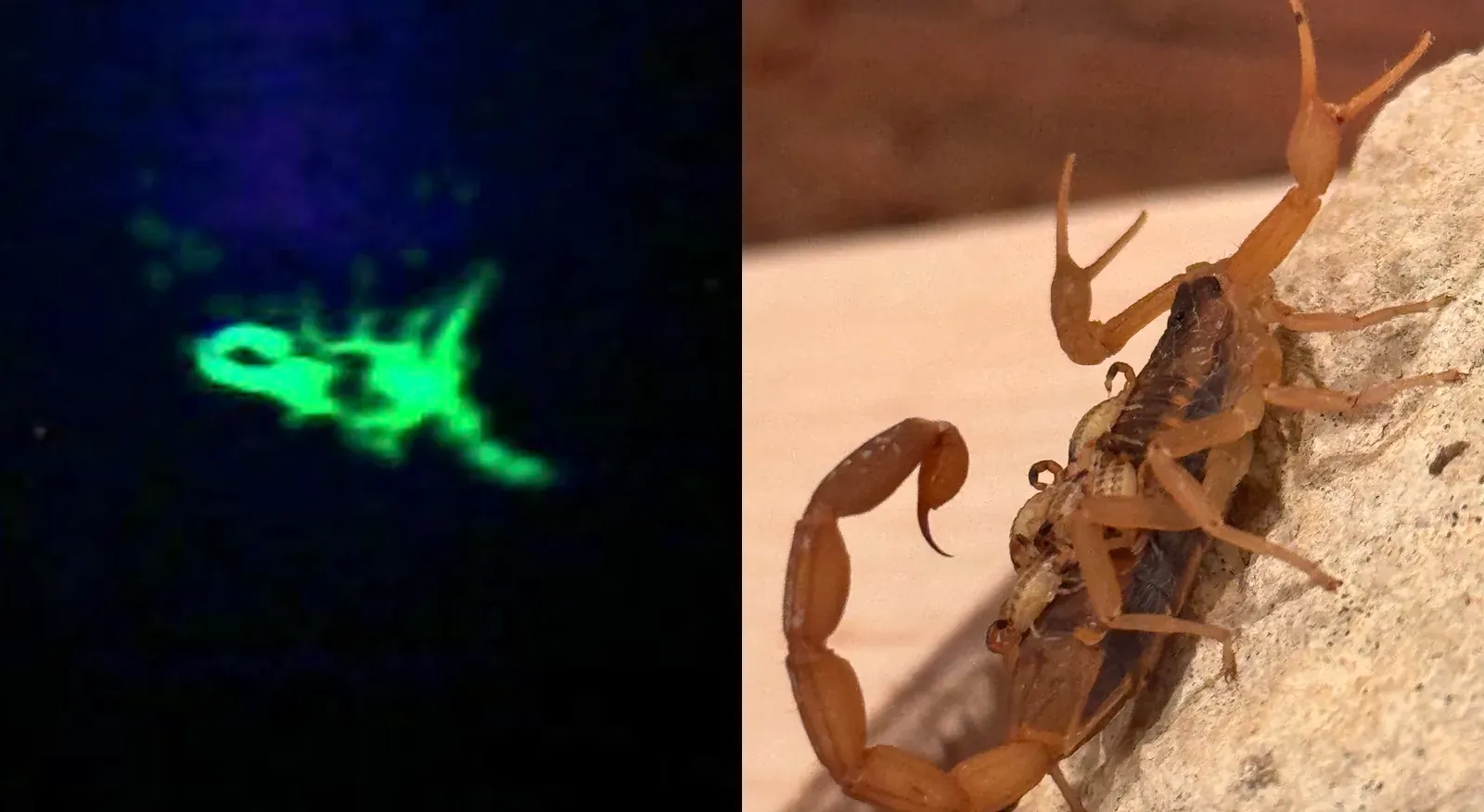
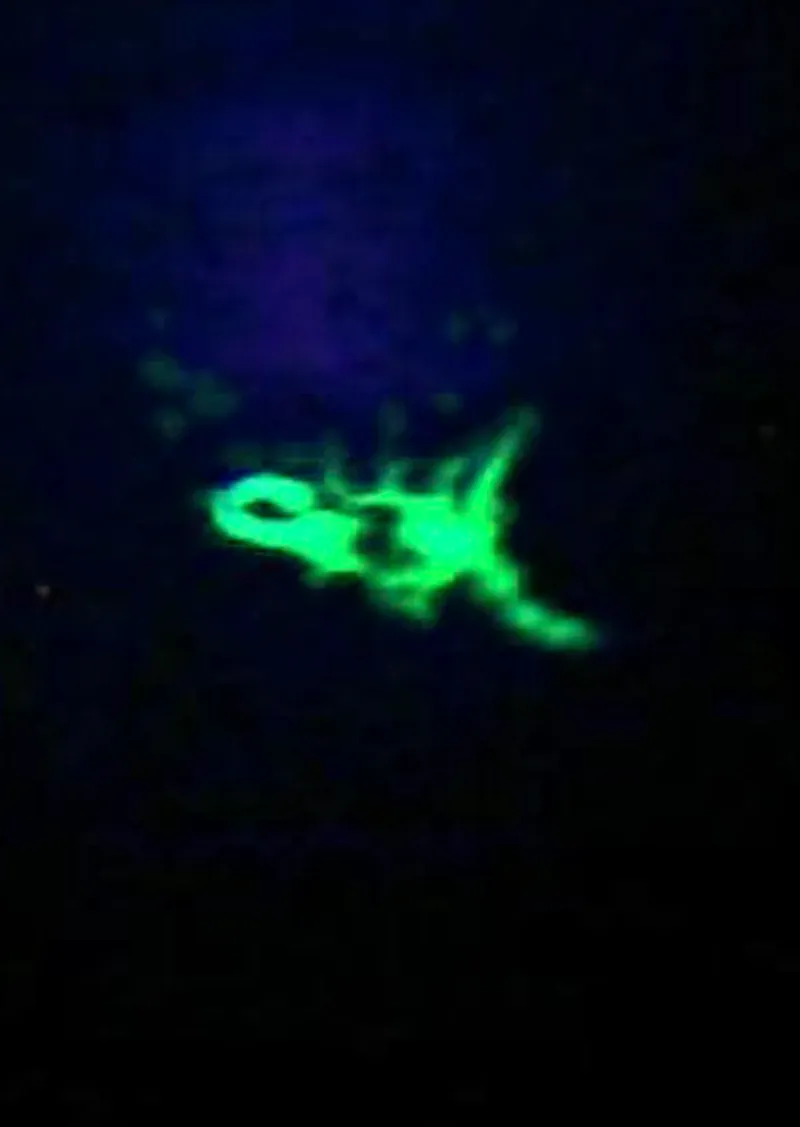
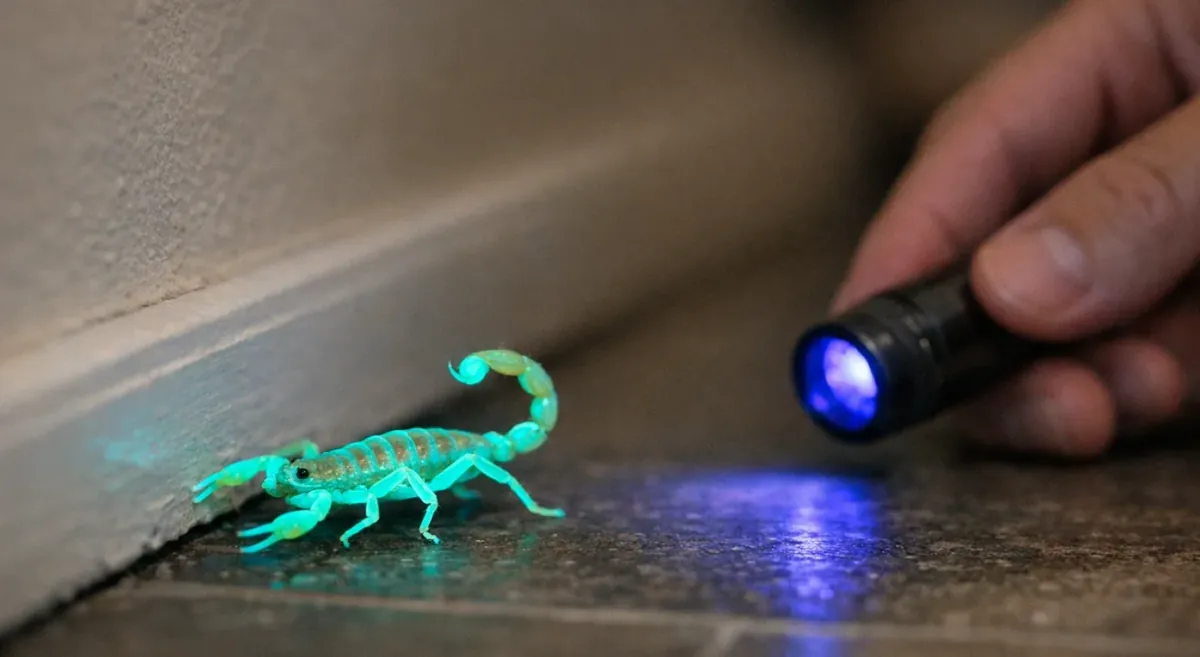
Three weeks ago we pulled a striped bark scorpion (Centruroides vittatus) out of a home in Austin, Texas and moved her into a terrarium in the Scorpion Alert lab, with a Detector watching the tank the same way it would watch a garage or a bedroom. Last night the Detector did its job: an alert at 92% confidence. But the frame looked wrong. She was glowing the way scorpions do under UV, except for a dark patch across her back, as if someone had taken a bite out of the glow.
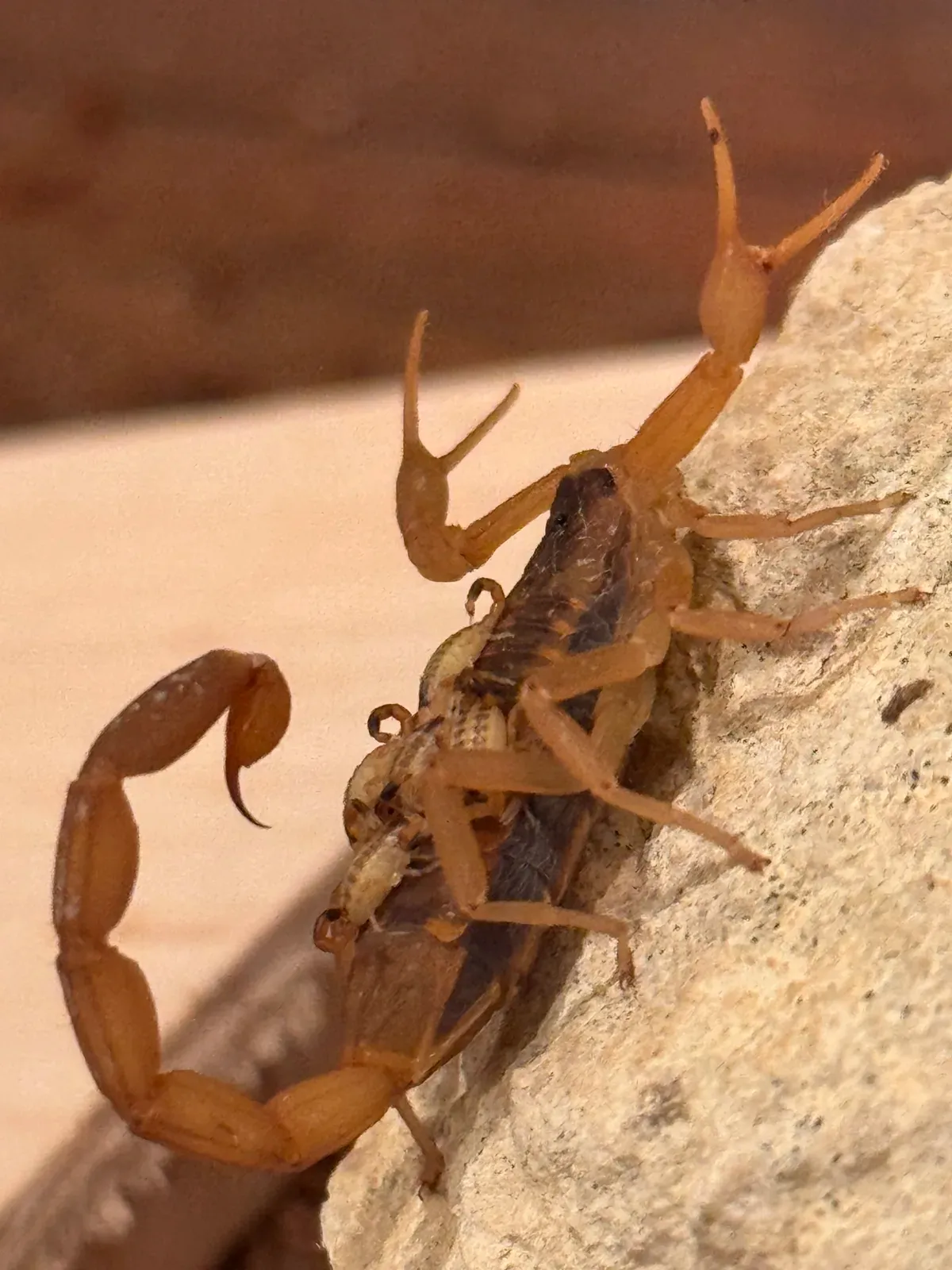
Under normal light, the "bite" turned out to be eight newborn scorpions riding on her back. She had given birth, and the Detector had caught it.
Why the babies showed up as a shadow
Scorpions glow under ultraviolet light because of compounds built into the outer layer of their exoskeleton. Two have been identified so far: beta-carboline and 4-methyl-7-hydroxycoumarin. Those compounds aren’t there on day one. They accumulate as the cuticle hardens, a process called sclerotization, which is why a freshly molted scorpion of any age barely glows for a day or two until its new shell cures.
Newborns are the extreme case. A first-instar scorpling has a soft, pale, almost translucent cuticle that has never hardened at all. Shine a blacklight on a mother carrying a brood and you get exactly what our Detector saw: a glowing adult outline with a dark hole in the middle, where eight small bodies block her fluorescence without adding any of their own. The glow arrives after their first molt, usually within a week, once that new cuticle sets.
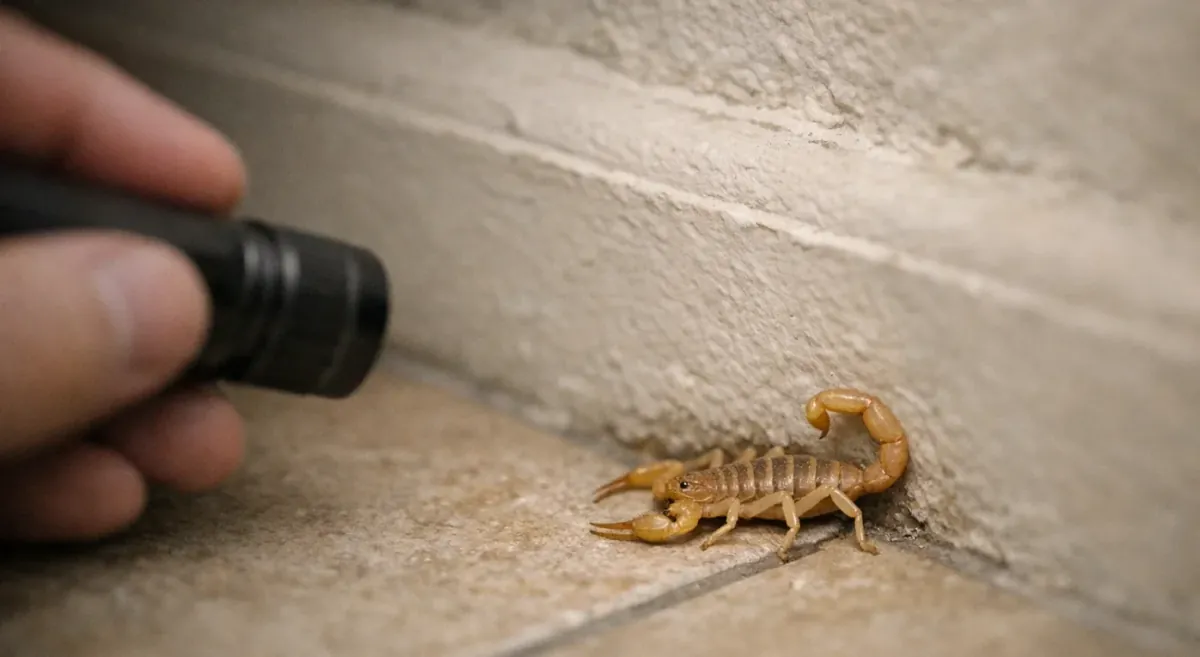
That has a practical consequence for anyone hunting scorpions with a UV flashlight: newborns are invisible to the technique. If you find a glowing adult with an odd dark patch on its back, or a dark lump that doesn’t match the body outline, assume it’s a mother with young. The Detector still flagged her at 92% because the adult’s glow and shape were all there; the shadow just rode along with her. Our beginner’s guide to UV night patrols covers what else a blacklight will and won’t show you.
Why this is birthing season
October feels late for babies, but for bark scorpions it’s the tail end of a season that runs from late spring into fall. To see why, you have to back up almost a year.
Mating: the dance and the sperm packet
Scorpions don’t mate the way insects do. The male grips the female by her pincers and leads her in a back-and-forth walk, the promenade à deux, that typically lasts ten to fifteen minutes and can run much longer. He is searching for a patch of firm, flat ground. When he finds it, he deposits a spermatophore, a sealed sperm packet on a stalk, and steers her over it so she can take it up. Striped bark scorpions mate in the fall, spring, and early summer, which is why sightings of pairs climb after warm nights. We walk through the whole ritual in how scorpions mate.
One detail matters more than the rest for homeowners: a female can store sperm and produce more than one brood from a single mating. The scorpion that walks into your home in September doesn’t need a mate to give birth there. She may already be carrying everything she needs.
Pregnancy: live birth after months of gestation
Scorpions are among the few arachnids that bear live young instead of laying eggs. The embryos develop inside the female and are nourished through a placenta-like connection. For the striped bark scorpion, gestation runs around eight months. Across scorpion species it ranges from a few months to more than a year, and it stretches when temperatures are cool and food is scarce. Fall and spring matings therefore line up with births from late spring through early fall, when nights are warm and prey is everywhere. That timing is the same reason mating season is when sightings spike.
A warm September in Central Texas, or a heated house, pushes that window later. Our female was already carrying this brood when we caught her in mid-September, and in a terrarium at indoor temperatures she finished the job three weeks later.
Birth: eight at a time, or fifty
The young are born one at a time over several hours, and each one crawls straight onto its mother’s back. Striped bark scorpion broods average around 30 and can top 50, so eight is a small litter; brood size swings with the female’s age, condition, and how good the summer was for hunting. The scorplings ride on her back for roughly a week while she stays put, fasts, and gets defensive. Then they molt for the first time, start to glow, and scatter. From that point each one is a small but fully equipped scorpion with a working stinger. It takes about six molts and a year and a half to two years to reach adult size.
Pregnant scorpions still fit through the gaps in your house
This is the part we most wanted to get across. This female was heavily gravid when she came indoors. A bark scorpion is flattened top to bottom, and a pregnant one gets wider but not much thicker: the abdominal segments spread apart (that’s the dark banding you can see on her back in the photo) while the body stays flat. She still fits through a gap about the thickness of a credit card. Worn weather stripping, the corner of a garage door, the cut-out around a pipe, an unscreened weep hole. She came in through one of them.
So the “one scorpion” you spot indoors in September can be a pregnant female weeks from giving birth, and after she does, you have a mother plus a brood that won’t show up in a flashlight sweep. Our post on mother scorpions bringing babies into your home covers what to do when you find a brood, and the top five ways scorpions get in covers where to seal first.
What this means for your home this fall
- Treat any indoor scorpion in late summer or fall as possibly pregnant. Catch and remove it rather than waiting to see if it leaves. If you squash a gravid female, do a careful check of the area anyway.
- Don’t trust a UV sweep to find newborns. Look near where the adult was found for pale, rice-grain shapes along baseboards and grout lines, and sweep again after a week, when the brood will have molted and started to glow.
- Seal before the births, not after. One sealed gap in September keeps out a female and the dozens of scorplings she would have had indoors.
- Watch the rooms, not just the flashlight. A Detector catches the adult’s glow around the clock, brood or no brood, and sends the alert while there is still only one scorpion to deal with. Here’s what happens after you get a scorpion alert.
What happens to the eight scorplings
They’re still on her back in the terrarium, and the Detector is still watching the tank. We’ll post a follow-up when they molt and begin to fluoresce, because that transition, from invisible under UV to glowing, is exactly the window we want to see through the camera.